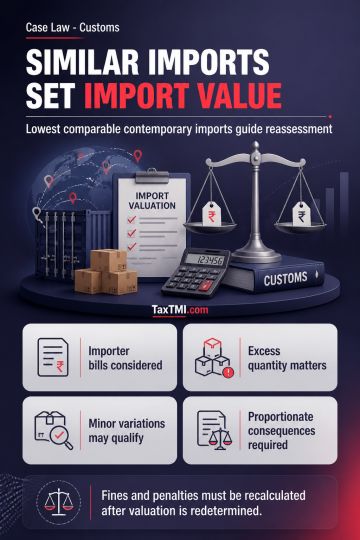
Customs valuation must use comparable contemporary imports, while confiscation fines and penalties require proportionate recalculation on reassessed v...
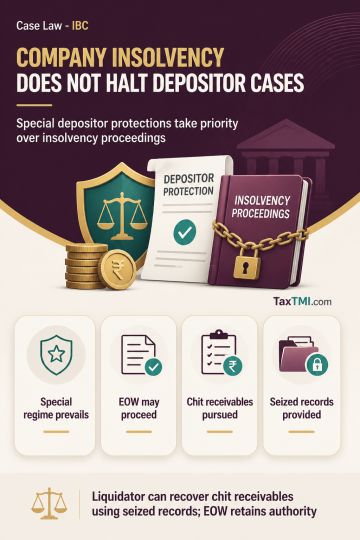
Depositor-protection proceedings prevail over corporate insolvency, while liquidators may recover chit receivables using copies of seized company reco...
Intermediary service classification fails where overseas admission facilitation is supplied independently, preserving export treatment and small-provi...
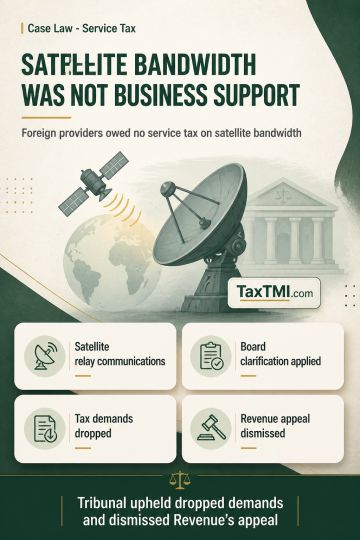
Satellite transponder bandwidth is telecommunication, not Business Support Service; foreign non-telegraph providers triggered no service tax liability...
Commitment proceedings gain extended timelines, structured defect refiling, and automatic resumption of inquiry after the adjusted completion period e...
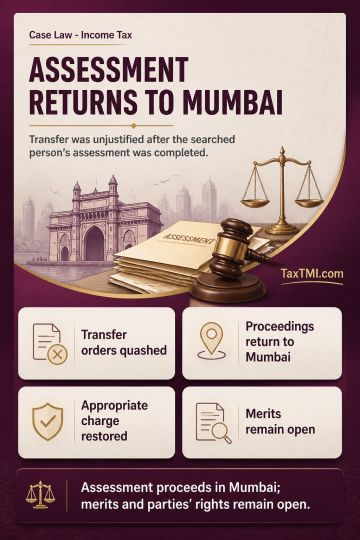
Centralised assessment transfer becomes unwarranted once the searched person's assessment is complete, requiring restoration to the appropriate charge...
Page of 4817
Press 'Enter' after typing page number.
321 to 340 of 96333 Results
❮
❯
❯❯
0 / 200
Expand Note
Add to Folder
No Folders have been created
+
Are you sure you want to delete "My most important" ?
Recovered foreign-origin gold bars concealed in specially created vehicle cavities, coupled with no lawful-possession documents and fabricated supporting papers, gave customs officers reasonable ground to treat the goods as smuggled. The statutory reverse burden then shifted to the appellants, but they failed to prove lawful origin or rebut the electronic and documentary material linking them to the supplier and recipient. Applying the preponderance of probability standard, the Tribunal sustained confiscation of the gold and vehicle and affirmed the penalties. It also rejected the Section 138B objection because the statements were corroborated by independent evidence, and found no natural justice violation from denial of cross-examination, as no prejudice was shown.
Recovered foreign-origin gold bars concealed in specially created vehicle cavities, coupled with no lawful-possession documents and fabricated supporting papers, gave customs officers reasonable ground to treat the goods as smuggled. The statutory reverse burden then shifted to the appellants, but they failed to prove lawful origin or rebut the electronic and documentary material linking them to the supplier and recipient. Applying the preponderance of probability standard, the Tribunal sustained confiscation of the gold and vehicle and affirmed the penalties. It also rejected the Section 138B objection because the statements were corroborated by independent evidence, and found no natural justice violation from denial of cross-examination, as no prejudice was shown.
Note: It is a system-generated summary and is for quick reference only.
 TaxTMI
  TaxTMI
 of 4817
















 Join Channel