Specified regulatory authority income receives conditional tax exemption, subject to non-commercial activity, unchanged income character, and return f...
Tax exemption for regulatory authority income applies retrospectively, subject to non-commercial activity, unchanged income sources, and return-filing...
Input tax credit conditions remain constitutionally valid, with eligible recipient claims considered under GST circulars and retrospective filing dead...
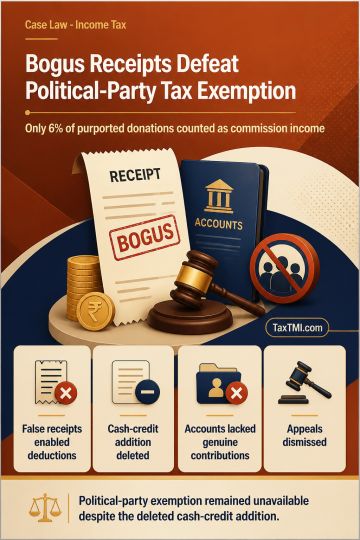
Bogus donation receipts justified commission income assessment and defeated political-party tax exemption for inaccurate accounts and reporting failur...
Pure reimbursement without income element escapes tax withholding, while delayed withholding and unsupported provisions face deferred or renewed scrut...
Public benefit requirement defeats charitable registration where residents' association services are reciprocal, member-only facilities governed by mu...
A general board resolution authorising an officer to sign and file documents was sufficient to file the section 7 applications; no fresh post-Code authorisation was required, so the objection to locus failed. The underlying transaction constituted financial debt because the agreement separately treated the construction advance as an interest-bearing unsecured loan with repayment and penal-interest terms, and it was reflected as unsecured borrowing in the balance sheet; the contrary finding was set aside. The alleged related-party and section 65 fraud findings were unsustainable for want of specific statutory pleading and proof, and penalty under section 65 could not be imposed on the corporate debtors. As debt and default stood established, the section 7 applications were directed to be admitted.
A general board resolution authorising an officer to sign and file documents was sufficient to file the section 7 applications; no fresh post-Code authorisation was required, so the objection to locus failed. The underlying transaction constituted financial debt because the agreement separately treated the construction advance as an interest-bearing unsecured loan with repayment and penal-interest terms, and it was reflected as unsecured borrowing in the balance sheet; the contrary finding was set aside. The alleged related-party and section 65 fraud findings were unsustainable for want of specific statutory pleading and proof, and penalty under section 65 could not be imposed on the corporate debtors. As debt and default stood established, the section 7 applications were directed to be admitted.
Note: It is a system-generated summary and is for quick reference only.
 TaxTMI
  TaxTMI
 of 4807


















 Join Channel