Business expenditure deduction requires proof of genuine commission payments and commercial allowability; turnover growth alone cannot validate the cl...
Article 8 treaty coverage excluded third-party airline support services, while documented demonetisation cash receipts remained accepted business inco...
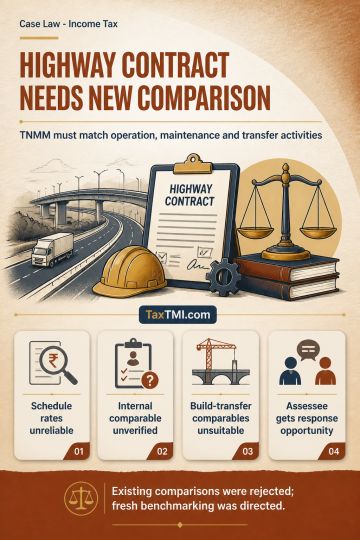
Functional comparability under TNMM requires highway contract benchmarks to reflect operation, maintenance and transfer activities, requiring fresh be...
A High Court held that money-laundering under Section 3 of the PMLA is an independent offence, but prosecution still requires prima facie material showing proceeds of crime derived from a scheduled offence and the accused's involvement in a connected process or activity. Where the predicate investigation had already found that the petitioner was not a beneficiary and no independent material showed tainted funds, the PMLA case could not rest on assumption. The Court also held that a co-accused's Section 50 statement could not, by itself, found the prosecution, and that the warehouse-receipt transactions were not shown to be sham. Continuation of proceedings against the petitioner was quashed as abuse of process.
A High Court held that money-laundering under Section 3 of the PMLA is an independent offence, but prosecution still requires prima facie material showing proceeds of crime derived from a scheduled offence and the accused's involvement in a connected process or activity. Where the predicate investigation had already found that the petitioner was not a beneficiary and no independent material showed tainted funds, the PMLA case could not rest on assumption. The Court also held that a co-accused's Section 50 statement could not, by itself, found the prosecution, and that the warehouse-receipt transactions were not shown to be sham. Continuation of proceedings against the petitioner was quashed as abuse of process.
Note: It is a system-generated summary and is for quick reference only.
 TaxTMI
  TaxTMI
 of 4809













 Join Channel


