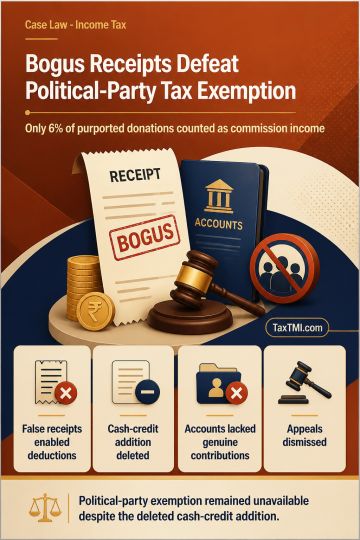
Bogus donation receipts justified commission income assessment and defeated political-party tax exemption for inaccurate accounts and reporting failur...
Pure reimbursement without income element escapes tax withholding, while delayed withholding and unsupported provisions face deferred or renewed scrut...
Public benefit requirement defeats charitable registration where residents' association services are reciprocal, member-only facilities governed by mu...
Exempt-income expenditure disallowance is confined to investments that actually generated exempt income, while supported business expenses remain dedu...
Convertible debentures were held to be entirely equity in nature, since the contractual terms and accounting treatment showed no unilateral obligation to deliver cash and the stray note describing a compound financial instrument could not override substance. Accordingly, no transition amount arose under section 115JB(2C), and the deletion of the MAT adjustment was upheld. The Tribunal also held that the year of convergence governed the character of the instrument for later years, so the earlier coordinate bench ruling in the assessee's own case had to be followed on judicial discipline. For section 14A, the Assessing Officer failed to record the required dissatisfaction with the assessee's suo motu disallowance, making Rule 8D invocation unsustainable; the deletion was upheld.
Convertible debentures were held to be entirely equity in nature, since the contractual terms and accounting treatment showed no unilateral obligation to deliver cash and the stray note describing a compound financial instrument could not override substance. Accordingly, no transition amount arose under section 115JB(2C), and the deletion of the MAT adjustment was upheld. The Tribunal also held that the year of convergence governed the character of the instrument for later years, so the earlier coordinate bench ruling in the assessee's own case had to be followed on judicial discipline. For section 14A, the Assessing Officer failed to record the required dissatisfaction with the assessee's suo motu disallowance, making Rule 8D invocation unsustainable; the deletion was upheld.
Note: It is a system-generated summary and is for quick reference only.
 TaxTMI
  TaxTMI
 of 4809














 Join Channel


