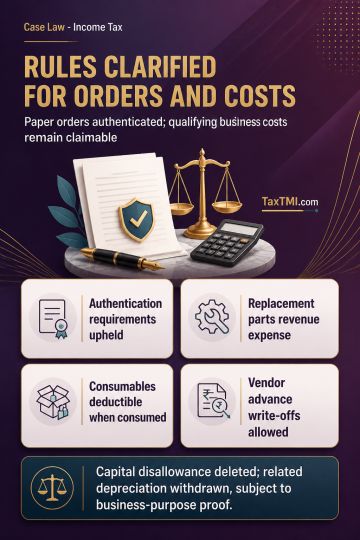
Authentication of paper assessment orders upheld, while qualifying repairs, consumables and vendor advance write-offs remain deductible business claim...
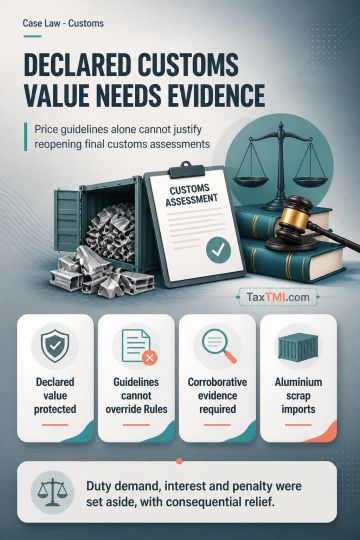
Transaction value cannot be rejected solely on non-statutory valuation guidelines without corroborative evidence supporting reassessment of final cust...
Cross-examination rights and corroborated evidence limit customs penalties for misdeclaration in genuine import transactions involving documented clea...
Page of 4807
Press 'Enter' after typing page number.
801 to 820 of 96136 Results
❮
❯
❯❯
0 / 200
Expand Note
Add to Folder
No Folders have been created
+
Are you sure you want to delete "My most important" ?
A constituent of joint ventures and consortiums formed to bid for government infrastructure contracts was treated as eligible for deduction under section 80IA(4) because the arrangements were pass-through vehicles, with execution, risk, and profit sharing resting on the members in their agreed proportions. The absence of a direct contract in the assessee's own name did not defeat eligibility where its participation was substantively through the consortium contract. The Tribunal also held that the Explanation to section 80IA(13) excludes only pure works contracts; the assessee, having undertaken design, procurement, construction, commissioning, and operation and maintenance obligations while bearing entrepreneurial and investment risk, was a developer and not a works contractor. Deduction was therefore allowed for both assessment years.
A constituent of joint ventures and consortiums formed to bid for government infrastructure contracts was treated as eligible for deduction under section 80IA(4) because the arrangements were pass-through vehicles, with execution, risk, and profit sharing resting on the members in their agreed proportions. The absence of a direct contract in the assessee's own name did not defeat eligibility where its participation was substantively through the consortium contract. The Tribunal also held that the Explanation to section 80IA(13) excludes only pure works contracts; the assessee, having undertaken design, procurement, construction, commissioning, and operation and maintenance obligations while bearing entrepreneurial and investment risk, was a developer and not a works contractor. Deduction was therefore allowed for both assessment years.
Note: It is a system-generated summary and is for quick reference only.
 TaxTMI
 of 4807





 Join Channel


 TaxTMI

