Donor-directed corpus contributions retain capital character despite exemption claims under section 10(23C)(vi), preventing their treatment as taxable...
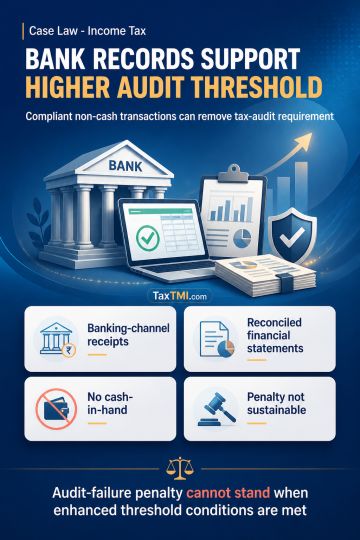
Enhanced tax-audit threshold applies where banking records establish compliant non-cash receipts and payments, eliminating penalty exposure for audit ...
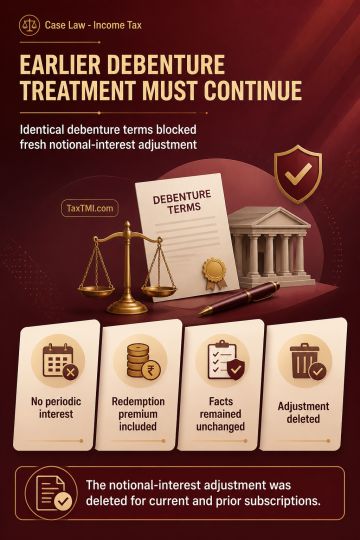
Transfer pricing consistency protects identical non-interest-bearing debenture terms from a later notional-interest adjustment without valid statutory...
Rectification of debatable deduction claims cannot reverse scrutiny-approved co-operative society interest income deductions as apparent record errors...
Cash-method accounting bars presumptive interest taxation, while unsupported securities and share-trading additions require reliable material and veri...
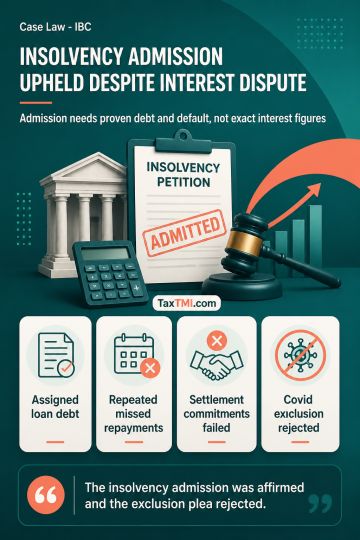
Section 7 admission requires established financial debt and default, not precise interest quantification, while post-suspension defaults remain action...
Page of 4811
Press 'Enter' after typing page number.
141 to 160 of 96208 Results
❮
❯
❯❯
0 / 200
Expand Note
Add to Folder
No Folders have been created
+
Are you sure you want to delete "My most important" ?
Timely resolution under the IBC was held to outweigh an indefinitely delayed plan approval process where the post-remand refiling timeline was missed, no extension or condonation was sought, and defects in the approval application remained unresolved for months. The Appellate Tribunal held that extension beyond the outer limit is reserved for exceptional cases where delay stems from legal proceedings or factors not attributable to the parties, which was not shown here because the delay was caused by the resolution professional and the committee of creditors. Liquidation was therefore upheld, and the challenge to the rejection of the plan failed. Adverse remarks against the resolution professional were also sustained as fact-based and supported by the record.
Timely resolution under the IBC was held to outweigh an indefinitely delayed plan approval process where the post-remand refiling timeline was missed, no extension or condonation was sought, and defects in the approval application remained unresolved for months. The Appellate Tribunal held that extension beyond the outer limit is reserved for exceptional cases where delay stems from legal proceedings or factors not attributable to the parties, which was not shown here because the delay was caused by the resolution professional and the committee of creditors. Liquidation was therefore upheld, and the challenge to the rejection of the plan failed. Adverse remarks against the resolution professional were also sustained as fact-based and supported by the record.
Note: It is a system-generated summary and is for quick reference only.
 TaxTMI
  TaxTMI
 of 4811
















 Join Channel