
Just a moment...

Top
Help
×

By creating an account you can:

Logo TaxTMI
>
Call Us / Help / Feedback

Contact Us At :

E-mail: [email protected]

Call / WhatsApp at: +91 99117 96707

For more information, Check Contact Us

FAQs :

To know Frequently Asked Questions, Check FAQs

Most Asked Video Tutorials :

For more tutorials, Check Video Tutorials

Submit Feedback/Suggestion :

Email :
Please provide your email address so we can follow up on your feedback.
Category :
Description :
Min 15 characters0/2000
Add to...
You have not created any category. Kindly create one to bookmark this item!
Create New Category
Hide
Title :
Description :
❮❮ Hide
Default View
Expand ❯❯
Close ✕
🔎 News - Adv. Search
TEXT SEARCH:

Press 'Enter' to add multiple search terms. Rules for Better Search

Search In:
Main Text + AI Text
  • Main Text
  • Main Text + AI Text
  • AI Text
Category: ?
Categorized by AI
---- All Categories ----
  • ---- All Categories ----
  • Income Tax
  • GST
  • Customs, DGFT & SEZ
  • FEMA & RBI
  • Corp. Laws, SEBI & IBC
  • PMLA, Black Money & ED
  • Budget
  • News and Press Release
  • PTI News
Month:
---- All Months ----
  • ---- All Months ----
  • January
  • February
  • March
  • April
  • May
  • June
  • July
  • August
  • September
  • October
  • November
  • December
Year:
---- All Years ----
  • ---- All Years ----
  • 2026
  • 2025
  • 2024
  • 2023
  • 2022
  • 2021
  • 2020
  • 2019
  • 2018
  • 2017
  • 2016
  • 2015
  • 2014
  • 2013
  • 2012
  • 2011
Sort By: ?
In Sort By 'Default', exact matches for text search are shown at the top, followed by the remaining results in their regular order.
RelevanceDefaultDate
    India placed in lower 10 pc US tariff bracket; reaffirms commitment to BTA
    Ratnaveer Precision Engineering Reports 20% Revenue Growth and 21% PAT Growth in Q1 FY27
    India placed in lower tariff tier at 10 pc under US Section 301 measures on forced labour: Govt
    ED report says CMRL ex-MD cited Veena’s ties to then Kerala CM for payments
    Union Minister for Finance & Corporate Affairs Smt. Nirmala Sitharaman outlines 5Rs of responsive tax governance; Calls for greater tax certainty and ...
    Trump says US will investigate EU trade practices, claiming bloc unfairly fined tech giants
    World shares are mixed and oil prices fall, markets in Asia skid in sell-off of AI-related shares
    Sitharaman ask I-T officials to go after tax evaders, ensure convenience for honest taxpayers
    HIGHLIGHTS
    Rupee recovers 20 paise to settle at 96.53 against US dollar
    Sri Lanka welcomes US tariff reduction
    DPIIT's One District One Product Initiative Promotes 1,244 Unique Products Across 773 Districts
    India's Services Exports Rise to USD 421.3 Billion in FY 2025-26, Led by Telecommunications, Computer and Information Services and Business Services
    India and Israel Conclude Second Round of Negotiations for Proposed Free Trade Agreement
    Glomo Secures Visa's Principal Membership, Becomes India's First Non-Bank Acquirer to Join the Network
    India's forex reserves jump USD 1.08 billion to USD 676.237 billion
    Boult Earbuds in India 2026: Five Reasons They are the Smartest Budget Pick
    Stock markets extend losses for 5th straight day on US trade tariffs, West Asia tensions
    China slaps export controls on 14 EU entities in retaliation for Russia-related sanctions
    Rupee recovers 18 paise to settle at 96.55 against US dollar
❯❯
MaximizeMaximizeMaximize
0 / 200
Expand Note
Add to Folder

No Folders have been created

    +

    Are you sure you want to delete "My most important" ?

    NOTE:

    News
    Showing Results for :
    Reset Filters
    Results Found:
    Show All SummariesHide All Summaries
    July 25, 2026
    Show AI Summary
    Forced-labour import tariffs place Indian goods under an additional duty while exemptions preserve access for specified exports.
    A 10 per cent Section 301 additional import duty applies to specified Indian goods over and above ordinary most-favoured-nation duty, following a forced-labour-related investigation. Generic pharmaceuticals, smartphones, other specified products, and goods already subject to Section 232 sectoral duties remain outside the additional levy. The textile-specific mechanism has not yet been operationalised for India, while tariff-rate quota concessions using US-origin cotton and fibre were announced for certain other economies. India continues engagement on a bilateral trade agreement and tariff access for garments using American inputs.
    July 25, 2026
    Show AI Summary
    Copper Clad Laminate expansion advances through policy and rights-issue approvals, supporting domestic electronics manufacturing and strategic growth initiatives.
    The company reported progress on a proposed Copper Clad Laminate manufacturing project, including in-principle approval under the Gujarat Electronics Policy and substantial project completion. The facility is intended to support domestic electronics manufacturing and reduce import dependence. It also reported upgraded credit ratings, enhanced rated bank facilities, and stock-exchange in-principle approvals for a proposed rights issue supporting expansion and strategic growth initiatives.
    July 25, 2026
    Show AI Summary
    US forced-labour tariffs place India in a lower tier while preserving exclusions for specified imports and Section 232 products.
    US Section 301 forced-labour measures impose an additional 10 per cent tariff on imports from India, with India placed in a lower tariff tier than initially proposed. Generic pharmaceuticals, smartphones and certain specified products outside additional duties remain excluded, as do products already covered by Section 232 measures, including steel, aluminium and auto parts. The textile-specific mechanism has not yet been established or operationalised, and engagement continues in connection with bilateral trade agreement negotiations.
    July 25, 2026
    Show AI Summary
    Money-laundering investigation examines alleged fictitious expenses, circular vendor payments, and consultancy payments without services or deliverables.
    A money-laundering investigation alleges misappropriation through fictitious expense entries, unsupported vouchers, and inflated vendor invoices used to withdraw funds in cash. The Enforcement Directorate further alleges that payments described as software or IT consultancy expenses were made to Exalogic Solutions Pvt Ltd and Veena T without services or deliverables. The report cites statements concerning the alleged sham payments, Exalogic's dependence on company funds, and subsequent transfers from its account. The PMLA case is based on a prosecution complaint concerning suspected financial irregularities.
    July 25, 2026
    Show AI Summary
    Tax certainty and taxpayer-centric administration drive simplified compliance, reduced litigation, digital service delivery, and stronger voluntary tax compliance.
    Tax administration reform under the Income-tax Act, 2025, rules and forms is directed toward a simpler, transparent and taxpayer-centric system. Key priorities include reducing compliance costs and litigation through tax certainty, faster return processing, refunds, grievance redressal, voluntary compliance and timely appeal disposal. Digital initiatives, including PAN 2.0, ITBA 2.0, IEC 3.0, Kar Saathi and SAKSHAM NUDGE, are intended to simplify compliance and improve taxpayer experience. Capacity building in technology, international taxation, transfer pricing, digital assets and cybersecurity supports this reform agenda.
    July 24, 2026
    Show AI Summary
    Trade Practice Investigation: Tech-company antitrust fines prompt proposed tariffs and trade sanctions under federal trade law mechanisms.
    A formal investigation into alleged unfair trade practices has been announced in response to European regulatory fines imposed on major United States technology companies. The stated concern is that digital antitrust penalties are unfairly directed at United States businesses, with possible tariffs on European Union imports indicated. The proposed response is linked to Section 301 of the Trade Act of 1974, permitting import taxes and other sanctions against unjustifiable, unreasonable or discriminatory trade practices.
    July 24, 2026
    Show AI Summary
    Import tariffs and energy costs heighten inflation risks, pressuring consumers, corporate profits and monetary-policy expectations amid market volatility.
    Fresh tariffs on imports, rising energy prices and Middle East conflict are identified as concurrent pressures on global financial markets. The tariff measures apply to nearly all imports into the United States and are paid by importing companies, which typically pass the additional costs to consumers. Higher energy costs and tariffs may increase inflationary pressure, reduce household discretionary spending and affect corporate profitability, while influencing monetary-policy expectations. Investors also questioned whether substantial artificial-intelligence investment can support technology-sector valuations.
    July 24, 2026
    Show AI Summary
    Responsive tax governance promotes taxpayer convenience, correction of bona fide errors, tax certainty, prompt refunds and prevention of avoidable litigation.
    Responsive tax governance requires convenience for honest taxpayers, correction of bona fide errors and firm consequences for deliberate tax evasion. The Income Tax Act, 2025 is intended to simplify the legal framework, reduce uncertainty and lower compliance costs, supported by stronger electronic filing infrastructure and prompt refund processing. Tax certainty should promote voluntary compliance and shift the focus from litigation management to litigation prevention through consistent guidance, simplified procedures, technology, standardised processes, effective grievance resolution and reduction of recurring taxpayer difficulties.
    July 24, 2026
    Show AI Summary
    Examination integrity safeguards prompt monitoring, enforcement action and proposed stricter penalties for paper leaks and institutional failures.
    Examination integrity measures include reported termination of agency officials, contemplated legal and criminal action, proposed stricter punishment for paper leaks, and Supreme Court monitoring of preventive steps. The Supreme Court also prohibited unauthorised posting or uploading of audio-video court proceedings on social media and digital platforms without prior administrative permission. The updates further address taxpayer facilitation alongside firm action against evasion, trade measures connected with forced-labour concerns, and potential legal action concerning university communications to students.
    July 24, 2026
    Show AI Summary
    Foreign exchange market stabilisation supported rupee recovery as investor outflows, geopolitical tensions and elevated crude prices maintained currency pressure.
    Foreign exchange market conditions saw the rupee recover against the US dollar amid reports of Reserve Bank of India intervention and dollar sales by public-sector banks to limit further depreciation. Foreign institutional investor outflows, weak domestic equity sentiment, geopolitical tensions, and elevated crude oil prices continued to pressure the currency. A decline in crude prices, diplomatic engagement, and central-bank intervention were identified as potential stabilising factors.
    July 24, 2026
    Show AI Summary
    Forced-labour import prohibition enabled lower tariff treatment for Sri Lankan goods, supporting export competitiveness and responsible trade practices.
    Tariff treatment for Sri Lankan goods entering the United States was reduced after Sri Lanka prohibited imports of goods produced using forced labour. The prohibition placed Sri Lanka within the lower tariff category under the stated US framework. The reduction is described as supporting exporter competitiveness while reflecting commitments to fair trade, responsible business practices, internationally accepted labour standards, and sustainable economic reforms.
    July 24, 2026
    Show AI Summary
    One District One Product strengthens district product branding, market access, food-processing support and export-oriented value chains.
    The One District One Product initiative supports district-identified products through branding, market access, exhibitions, capacity building and Government e-Marketplace onboarding. States and Union Territories select products and may leverage Central and State schemes, as no district-specific allocation is made. PM Ekta Malls and the PMFME Scheme support sales, food-processing projects, common infrastructure, branding, packaging, quality standardisation and food-safety compliance. Districts as Export Hubs promotes export-potential products through export committees, action plans and value-chain coordination.
    July 24, 2026
    Show AI Summary
    Services export promotion expands market access, professional mobility, qualification recognition and trade outreach for Indian service suppliers.
    Services export promotion combines targeted market and sector strategies, removal of domestic impediments, trade agreements and export-promotion activity. Free Trade Agreements secure market access and national treatment for Indian service suppliers, support transparent and time-bound authorisation processes, and facilitate temporary mobility of skilled professionals. Mutual Recognition Agreement provisions seek recognition of qualifications and licensing requirements. The framework also addresses social-security coordination, student mobility, traditional medicine and double-taxation commitments for IT services. The Services Export Promotion Council supports market development, trade facilitation, capacity building and international outreach.
    July 24, 2026
    Show AI Summary
    Free trade agreement negotiations advance as India and Israel address market access, origin rules, customs facilitation and economic cooperation.
    India and Israel completed the second round of negotiations for a proposed Free Trade Agreement under the Terms of Reference signed in November 2025. Technical discussions covered trade in goods and services, rules of origin, sanitary and phytosanitary measures, technical barriers to trade, intellectual property rights, customs procedures, trade facilitation and economic cooperation. Both sides sought to narrow gaps, identify areas of convergence and work towards early conclusion of a balanced, comprehensive and mutually beneficial agreement.
    July 24, 2026
    Show AI Summary
    Direct card acquiring enables cross-border merchants to manage payment processing, settlement, risk monitoring and disputes without intermediary acquirers.
    Visa Principal Membership enables Glomo to operate as a direct non-bank acquirer for Visa-powered merchant card payments through GIFT IFSC. It allows direct management of merchant acquisition, processing, settlement, transaction approval optimisation, fraud and risk monitoring, and dispute and chargeback handling without intermediary acquirers. The arrangement is intended to accelerate onboarding and processing, enhance control over risk policies and merchant experience, and support cross-border acceptance and settlement, including management of multiple currencies, banking systems and regulatory requirements.
    July 24, 2026
    Show AI Summary
    Foreign exchange reserves rose as foreign currency assets increased, while gold reserves fell and IMF reserve position declined.
    Foreign exchange reserves increased during the reported week, principally because foreign currency assets rose, including valuation effects from movements in non-US currencies held in reserve. Gold reserves declined, Special Drawing Rights increased, and the reserve position with the International Monetary Fund decreased. Earlier reserve declines were associated with rupee pressure and foreign-exchange market intervention through dollar sales.
    July 24, 2026
    Show AI Summary
    Consumer electronics financing enables instalment purchases of affordable earbuds through in-store loan and reusable credit facilities, subject to approval.
    Affordable Boult earbuds are described as offering extended battery life, fast charging, dynamic drivers, low-latency gaming modes, Environmental Noise Cancellation, Bluetooth connectivity, and selected active noise-cancellation features. Models are compared by audio, calling, gaming, and charging specifications. Purchases through partner stores may be financed through an Easy EMI Loan or Insta EMI Card, subject to in-store application and approval, with instalment tenures and possible zero-down-payment offers on selected models.
    July 24, 2026
    Show AI Summary
    Trade-tariff concerns and oil-price volatility deepen risk aversion, extending equity market losses amid geopolitical tensions and foreign outflows.
    Indian equity markets extended their losing streak amid caution over United States trade-tariff concerns, West Asia tensions, oil-price volatility, foreign equity outflows and selling in selected blue-chip shares. Higher oil prices were identified as a potential pressure on macroeconomic indicators and growth prospects. New import tariffs were described as a constraint for export-oriented economies, particularly technology-heavy markets, while investors may diversify exposure across emerging-market opportunities.
    July 24, 2026
    Show AI Summary
    Dual-use export controls restrict supplies to European entities amid reciprocal Russia-related sanctions and non-proliferation concerns.
    China imposed dual-use export controls on 14 European entities in response to European Union sanctions affecting Chinese and Hong Kong enterprises. Chinese companies cannot export dual-use items to the listed organisations, and foreign companies are barred from supplying them with dual-use items made in China. China stated that the restrictions protect national security and interests and support international non-proliferation obligations in the context of Russia-related sanctions.
    July 24, 2026
    Show AI Summary
    Foreign-exchange market intervention supported rupee stabilisation amid investor outflows, weak equities, geopolitical tensions and elevated crude oil prices.
    Foreign-exchange market conditions supported a rupee recovery against the US dollar following reported Reserve Bank of India intervention and dollar sales by public-sector banks. Pressure on the currency persisted due to foreign institutional investor outflows, weak domestic equity sentiment, geopolitical tensions and elevated crude oil prices. Lower crude prices, a weaker dollar index and further central bank intervention were identified as potential stabilising influences.

    News

    Back

    All News

    Showing Results for :
    Reset Filters
      No Records Found

      News

      Back

      All News

      whatsappJoin Channel
      Showing Results for : Reset Filters
      Corp. Laws, SEBI & IBC

      Fourth Edition of National Conference on Responsible Business Conduct (NCRBC) 2026 Concludes in New Delhi

      July 20, 2026

      Contents
      Summary
      Note

      Note

      -

      Bookmark

      Print

      Print

      Valedictory Session’s Keynote Address delivered by Hon'ble Justice Shri Abhay S. Oka calls for Strict Enforcement of Environmental Law on India's Path to Viksit Bharat

      The fourth edition of the National Conference on Responsible Business Conduct (NCRBC) 2026, organised by the School of Business Environment (SBE) of the Indian Institute of Corporate Affairs (IICA), an autonomous institution under the Ministry of Corporate Affairs, Government of India, concluded recently in New Delhi.

      The valedictory session featured Keynote Address by Hon'ble Justice Shri Abhay S. Oka, Former Judge, Supreme Court of India, address by Shri Gyaneshwar Kumar Singh, Director General and CEO, Indian Institute of Corporate Affairs, and a Vote of Thanks by Professor Garima Dadhich, Head, School of Business Environment, Indian Institute of Corporate Affairs.
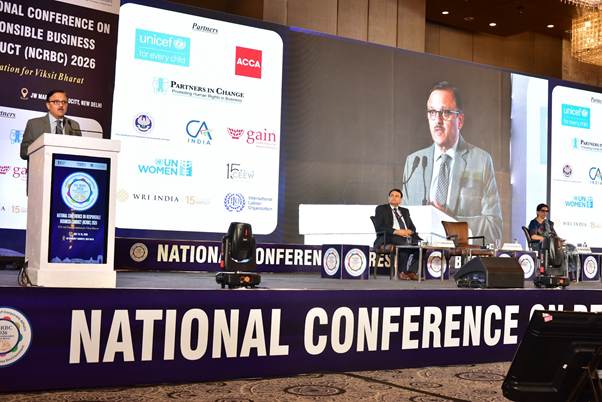
      Delivering the Keynote Address, Hon'ble Justice Shri Abhay S. Oka, Former Judge, Supreme Court of India, opened his remarks by asserting that the right to live in a pollution-free environment is an intrinsic part of the fundamental right to life guaranteed under Article 21 of the Constitution of India. Hon’ble Justice Oka emphasised that the meaning of Viksit Bharat must itself be understood through the constitutional vision of India, particularly the Fundamental Rights, the Directive Principles of State Policy and the Fundamental Duties.

      He observed, that development can be truly transformative only when it protects human dignity, advances social justice and safeguards the environment for present and future generations. Hon’ble Justice Oka traced the evolution of this jurisprudence to the enactment of the Environment (Protection) Act, 1986, which was brought into force in the aftermath of the Bhopal gas tragedy, one of the most devastating industrial disasters in the country's history. He observed that the tragedy had served as a turning point in India's environmental jurisprudence, compelling the state to institutionalise a comprehensive legal framework for environmental protection.

      Hon’ble Justice Oka remarked that a nation's true progress cannot be measured by economic indicators alone, and that environmental well-being must be treated as an equally critical marker of national development. He called upon corporates, regulators and civil society to internalise the constitutional and legal obligation towards environmental protection, social equity and justice, rather than treating it as a discretionary or peripheral concern. Hon’ble Justice congratulated IICA for hosting a Conference to deliberate on the importance of responsible conduct by businesses which is aligned with the Constitutional ethos of social equity, and environmental protection. 

      Delivering the Valedictory Address, Shri Gyaneshwar Kumar Singh, DG and CEO, Indian Institute of Corporate Affairs, reflected on the two days of deliberations at NCRBC 2026, describing the conference as a significant milestone in India's journey towards ESG-led transformation for a Viksit Bharat. He stated that Environmental, Social and Governance considerations have evolved beyond a compliance checkbox to become a foundation for business resilience, effective risk management, investment attraction and sustainable innovation. Responsible business is ultimately driven by responsible individuals and courageous leadership, rather than by regulation alone. He noted that the conference had brought together regulators, policymakers, industry leaders and civil society on a shared platform to deliberate on the future of responsible business conduct in India. Reflecting on the breadth of discussions held over the two days, spanning board-level disclosures, climate finance, sector-specific guidelines, responsible value chains, MSME competitiveness and environmental reporting metrics, he said the conference had reaffirmed the interconnectedness of India's sustainability agenda across regulators, industry and civil society.

      He emphasised that the Indian Institute of Corporate Affairs, through its School of Business Environment, remains committed to serving as a national knowledge and capacity-building hub for advancing responsible business conduct across India's corporate ecosystem. He noted that the insights and recommendations generated through the conference's High-Level Panels would inform the Institute's continuing policy research and capacity-building initiatives in the years ahead. He called upon India's businesses, regulators and civil society institutions to continue working in close partnership to strengthen the credibility, comparability and reliability of ESG disclosures.

      He reaffirmed that India's responsible business conduct framework, rooted in the country's own philosophical and legislative traditions, should continue to evolve in step with global best practice while remaining anchored in India's specific developmental priorities. He observed that the growing participation of India's Micro, Small and Medium Enterprises in the ESG ecosystem would be central to ensuring that the benefits of responsible business conduct are inclusive and widely shared. He concluded by expressing appreciation for the active participation of all delegates, speakers and partner organisations over the two days.

      Earlier in the day, the Conference featured five High-Level Panels addressing sectoral reporting, responsible value chains, MSME integration and environmental metrics. The first high-Level Panel discussion titled “Sector-Specific Guidelines for Strengthening ESG Integration,” featured Smt. Surabhi Gupta, Chief General Manager, SEBI, who noted that the BRSR framework was initially designed as a simple, sector-agnostic baseline, but must continue to evolve as materiality concerns and sector-specific data gaps emerge. She also highlighted SEBI’s ongoing efforts to strengthen the ESG ratings ecosystem through more granular data and sustained stakeholder engagement. Ms. Robin Hodess, Chief Executive Officer, Global Reporting Initiative, stressed the need to align India’s sectoral metrics with globally recognised standards to reduce the compliance burden on companies operating across jurisdictions.

      The second Panel discussion titled “Responsible Value Chains across Global and Domestic Supply Networks,” examined the global move towards mandatory due diligence and the continuing gap between corporate commitments and implementation on human rights and labour standards. The panel emphasised capacity-building for MSME suppliers, partnership-based compliance and the growing role of technology and artificial intelligence in improving supply-chain traceability.

      The third High-Level Panel of the day titled “Mainstreaming ESG in MSMEs for Competitive and Inclusive Growth,” opened with a keynote address by Shri Sivasubramanian Ramann, Chairperson, PFRDA. Shri Devendra Kumar Singh, Chairperson, Cooperative Election Authority, highlighted the potential of Udyam-linked data to support targeted policy interventions, while cautioning that policy design must reflect the predominance of micro enterprises. The representative of the Ministry of MSME underlined the need to combine compliance with a clear business case, supported by incentives for energy, water and waste management.
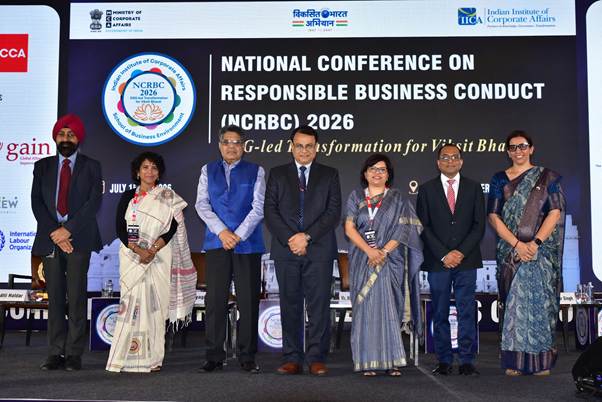
      Then the fourth High-Level Panel  titled “Beyond BRSR: Strengthening Sectoral ESG Adoption and Integration,” featured Shri Ajay Tyagi, Former Chairman, SEBI, who called for a gradual transition from a common reporting baseline to sector-specific frameworks developed through multi-stakeholder consultation. The panel also emphasised greater interoperability across global standards and a shift from backward-looking compliance reporting to forward-looking sustainability planning, supported by credible assurance. The last High-Level Panel titled, “Re-envisioning Environmental Metrics in ESG Reporting Frameworks,” brought together Dr. Ajay Mathur, Former Director General, International Solar Alliance; Dr. Virinder Sharma, Member (Technical), Commission for Air Quality Management; and Shri R.R. Rashmi, Former Special Secretary, Ministry of Environment, Forest and Climate Change. The panel examined measures to improve the rigour, reliability and comparability of environmental metrics within India’s sustainability reporting architecture.
      Following the High-Level Panels, Professor Garima Dadhich, Head, School of Business Environment, Indian Institute of Corporate Affairs, proposed the Vote of Thanks, expressing gratitude to the chief guest, DG & CEO IICA, eminent speakers, delegates, conference partner organisations and to the team of the School of Business Environment- Indian Institute of Corporate Affairs for their invaluable contributions in making NCRBC 2026 a landmark platform for advancing Responsible Business Conduct in India. She emphasised that the true success of the Conference would be reflected not merely in the deliberations held over two days, but in the collective actions and partnerships that emerge to accelerate ESG-led transformation and contribute towards the vision of a sustainable and globally competitive Viksit Bharat by 2047.

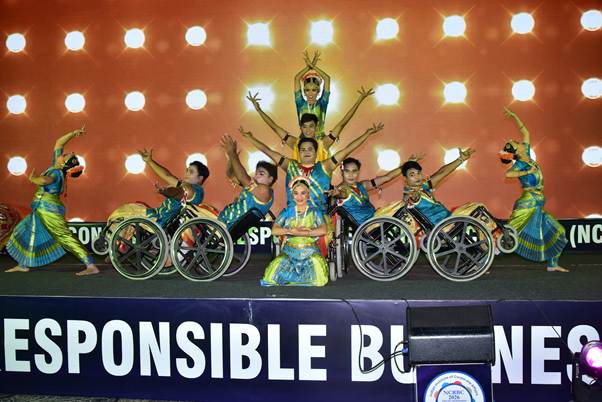
      The valedictory session concluded with a cultural performance by "We Are One," an internationally acclaimed dance group of differently-abled artists, followed by the announcement of the winners of the conference hackathon.

      With two days of substantive deliberations across the inaugural session and eight High-Level Panels, NCRBC 2026 brought together policymakers, regulators, industry leaders, professional bodies and international partners, reaffirming responsible business conduct as integral to India's journey toward becoming a developed, inclusive and ethically grounded nation by 2047.

      Topics

      ActsIncome Tax
