
Just a moment...

Top
Help
×

By creating an account you can:

Logo TaxTMI
>
Call Us / Help / Feedback

Contact Us At :

E-mail: [email protected]

Call / WhatsApp at: +91 99117 96707

For more information, Check Contact Us

FAQs :

To know Frequently Asked Questions, Check FAQs

Most Asked Video Tutorials :

For more tutorials, Check Video Tutorials

Submit Feedback/Suggestion :

Email :
Please provide your email address so we can follow up on your feedback.
Category :
Description :
Min 15 characters0/2000
Add to...
You have not created any category. Kindly create one to bookmark this item!
Create New Category
Hide
Title :
Description :
❮❮ Hide
Default View
Expand ❯❯
Close ✕
🔎 News - Adv. Search
TEXT SEARCH:

Press 'Enter' to add multiple search terms. Rules for Better Search

Search In:
Main Text + AI Text
  • Main Text
  • Main Text + AI Text
  • AI Text
Category: ?
Categorized by AI
---- All Categories ----
  • ---- All Categories ----
  • Income Tax
  • GST
  • Customs, DGFT & SEZ
  • FEMA & RBI
  • Corp. Laws, SEBI & IBC
  • PMLA, Black Money & ED
  • Budget
  • News and Press Release
  • PTI News
Month:
---- All Months ----
  • ---- All Months ----
  • January
  • February
  • March
  • April
  • May
  • June
  • July
  • August
  • September
  • October
  • November
  • December
Year:
---- All Years ----
  • ---- All Years ----
  • 2026
  • 2025
  • 2024
  • 2023
  • 2022
  • 2021
  • 2020
  • 2019
  • 2018
  • 2017
  • 2016
  • 2015
  • 2014
  • 2013
  • 2012
  • 2011
Sort By: ?
In Sort By 'Default', exact matches for text search are shown at the top, followed by the remaining results in their regular order.
RelevanceDefaultDate
    India'€™s forex kitty jumps USD 964 mn to USD 675.15 bn
    Rupee rises 14 paise to close at 96.28 against US dollar
    Office of Economic Adviser to Release Revised Index of Core Industries Series with Base Year 2022–23
    Fourth Edition of IICA’s National Conference on Responsible Business Conduct (NCRBC) 2026 held in New Delhi
    Reliance promoters raise stake by 0.5 pc through Rs 8,500-9,000 cr worth of share purchases
    US Senate bill seeks 100% tariffs on India, 4 other nations for buying Russian oil
    NRIs can bring USD 70-80 bn into India through FCNR deposits: expert
    NetAcct Solutions Launches Entries ERP Powered by the Entries AI Platform
    Union Minister of Commerce and Industry, Shri Piyush Goyal Leads High-Level Delegation to Finland to Strengthen Trade and Investment Ties
    India Achieves Major Milestone at Codex Commission with Adoption of Three Global Standards for Spices
    Centre for Trade and Investment Law launches guidebook to help Indian MSMEs expand into global markets
    Brazil calls Trump's 25 pc tariff unjustifiable, vows to impose reciprocal tariffs
    Trump administration races clock to rebuild US tariff wall knocked down by SC
    JK marks maiden export of premium cherries, plums to Singapore
    Chhattisgarh govt departments owe Rs 3,117 crore in power bills, assembly told
    Rupee weakens 17 paise to settle at 96.42 against US dollar; loses 1.5 pc in four sessions
    India-UK CETA takes effect: First zero-duty Indian coffee, jewellery consignments reach UK shores
    Govt to replace Ordinance by introducing Income-tax (Amendment) Bill in Monsoon session
    Foreign assets, income details for 2022-24 now available under AIS on income tax portal
    L-G Manoj Sinha reviews donation management systems at J-K's Vaishno Devi shrine
❯❯
MaximizeMaximizeMaximize
0 / 200
Expand Note
Add to Folder

No Folders have been created

    +

    Are you sure you want to delete "My most important" ?

    NOTE:

    News
    Showing Results for :
    Reset Filters
    Results Found:
    Show All SummariesHide All Summaries
    July 17, 2026
    Show AI Summary
    Foreign exchange reserves rose as foreign currency assets, gold, Special Drawing Rights and IMF reserve position increased.
    Foreign exchange reserves increased during the reporting week, principally because foreign currency assets rose. Reserve components include foreign currency assets, gold reserves, Special Drawing Rights and the reserve position with the International Monetary Fund. Foreign currency assets, expressed in dollar terms, reflect valuation effects arising from movements in non-US currencies held in the reserves. Gold reserves, Special Drawing Rights and the reserve position with the International Monetary Fund also increased.
    July 17, 2026
    Show AI Summary
    Rupee exchange-rate movement stabilised after possible central bank intervention, while oil prices and foreign fund flows sustained pressure.
    The rupee strengthened against the US dollar following four declining sessions, reportedly amid possible Reserve Bank of India intervention. Elevated West Asia tensions, higher crude-oil prices and cautious foreign fund flows continued to weigh on the currency, despite consolidation in the absence of major domestic triggers. Market participants were expected to monitor global developments, crude-oil movements and foreign institutional investor activity for the next directional move.
    July 17, 2026
    Show AI Summary
    Revised Index of Core Industries adopts a new base year, adds Iron Ore, and aligns production measurement methodology.
    The revised Index of Core Industries adopts 2022-23 as its base year and replaces the 2011-12 series. Its weights are derived from the 2022-23 Index of Industrial Production and redistributed pro rata to total 100. Iron Ore is added as a core industry, expanding the basket to nine industries. The Steel Index will use gross production data for consistency with the Index of Industrial Production. In the Coal sector, only Raw Coal is retained; Coal Middlings and Washed Coal are excluded to prevent double counting.
    July 17, 2026
    Show AI Summary
    Sustainability reporting discipline requires credible disclosures, board-level integration, data assurance and proportionate ESG implementation across business value chains.
    ESG-led responsible business conduct requires sustainability disclosures that are relevant, comparable, evidence-based and verifiable, supported by reliable systems, internal controls, documentation, traceability and independent examination. Sustainability should be integrated into board-level decision-making, fiduciary responsibilities, risk management and long-term enterprise value. Stronger governance, accountability and data-assurance frameworks are needed to address greenwashing, with proportionate reporting, technology and capacity-building supporting implementation across value chains and MSMEs.
    July 17, 2026
    Show AI Summary
    Promoter shareholding increase through market purchases remains within creeping acquisition limits and signals confidence in long-term growth prospects.
    Promoter and promoter-group shareholding in Reliance Industries Ltd increased by nearly 0.5 percentage points through market purchases during the June quarter. The purchases were reported to be within SEBI creeping acquisition limits, allowing gradual promoter acquisitions without triggering a mandatory open offer where prescribed thresholds are met. The increase may strengthen promoter control and marginally reduce public float, and was characterised as reflecting confidence in long-term growth, earnings trajectory and capital-allocation plans.
    July 17, 2026
    Show AI Summary
    Tariffs on Russian oil purchasers would target sanctions evasion, with reassessment mechanisms and limited energy-sector exemptions proposed.
    Proposed United States Senate legislation would impose mandatory tariffs on imports from leading purchasers of Russian oil or gas and leading facilitators of Russian oil-sanctions evasion. It provides for periodic reassessment and tariff adjustments, while exempting qualifying countries reducing Russian gas imports. Russian uranium purchases for specified nuclear and medical needs, and certain nuclear and space cooperation activities, would be excluded.
    July 17, 2026
    Show AI Summary
    Foreign currency non-resident deposits enable overseas Indians to invest foreign earnings while supporting India's foreign-exchange reserves.
    Foreign Currency Non-Resident deposits allow Non-Resident Indians and Persons of Indian Origin to maintain overseas earnings as foreign-currency fixed deposits with Indian banks without conversion into Indian rupees. Banks may offer enhanced interest rates for a limited period under an initiative intended to strengthen foreign-exchange reserves and support the rupee. The framework covers the investment process, regulatory requirements, taxation aspects and advantages for eligible overseas investors.
    July 17, 2026
    Show AI Summary
    GST compliance management integrates reconciliation, input tax credit support, invoicing and statutory monitoring within an AI-powered enterprise platform.
    The unified cloud platform combines accounting, manufacturing, inventory, procurement, human resources, payroll, compliance, reporting and document management with an embedded AI agent. Its compliance functions include GST validation, purchase-register reconciliation with GSTR-2B, input tax credit support, supplier filing-gap detection, e-invoicing, e-way bills, TDS and statutory due-date tracking. Financial and operational workflows are intended to use common real-time data, with automation for invoices, journal entries, reconciliations, reporting, workflow approvals and compliance-risk monitoring.
    July 17, 2026
    Show AI Summary
    Institutional trade cooperation expands through industry MoUs, supporting investment, innovation and technology partnerships across strategic economic sectors.
    Bilateral trade and investment cooperation was advanced through ministerial discussions and industry engagements concerning financial markets, innovation, enterprise financing and commercial relations. Two institutional Memoranda of Understanding established mechanisms for industry collaboration and greater business engagement. Sector-specific interactions covered digital and frontier technologies, space, clean energy, bioeconomy, circular economy, infrastructure and advanced manufacturing, focusing on collaboration, investment and technology partnerships.
    July 17, 2026
    Show AI Summary
    Codex spice standards harmonise quality benchmarks for cardamom, coriander and vanilla, supporting trade consistency, market access and export competitiveness.
    Codex standards for large cardamom, coriander and vanilla establish harmonised international quality benchmarks following review by relevant committees on analytical methods, food additives and food labelling. The standards are intended to promote consistent quality requirements, facilitate trade, improve market access and support export competitiveness. India was also accepted as Co-Chair of an Electronic Working Group developing policy guidance on risk analysis for new food products.
    July 17, 2026
    Show AI Summary
    Export readiness for MSMEs strengthens global market access through trade intelligence, standards compliance, preferential origin rules and trade remedy awareness.
    Export readiness for Indian MSMEs is supported through practical guidance on identifying export opportunities, market-access requirements, trade intelligence tools, international standards, sustainability requirements and buyer identification. International expansion strategies include using preferential Rules of Origin and cooperation mechanisms under Free Trade Agreements, selecting export destinations, product positioning, diversification and value addition. Trade remedy awareness and guidance on unfair trade practices and import surges, together with institutional support, partnerships and trade-exhibition participation, can strengthen global competitiveness and integration into global value chains.
    July 16, 2026
    Show AI Summary
    Reciprocal tariff measures and multilateral dispute settlement are pursued in response to contested import duties.
    Reciprocal tariff measures are proposed in response to a new tariff on specified Brazilian imports allegedly involving unfair trade practices. Brazil rejects those allegations and proposes to use its reciprocity-law mechanisms, including reciprocal tariffs and other trade-related countermeasures, while pursuing multilateral dispute settlement. It maintains that trade investigations must conform to multilateral international-trade rules and notes that the tariff may burden exports and increase commercial uncertainty.
    July 16, 2026
    Show AI Summary
    Section 301 tariff authority offers a procedurally constrained route to replace temporary global import tariffs after emergency powers failed.
    Import-tariff authority is shifting from emergency-based measures to temporary and investigatory powers under the Trade Act of 1974. Section 122 supports a global tariff measure only for a limited period, whereas Section 301 permits tariffs or trade sanctions for unjustifiable, unreasonable, or discriminatory foreign trade practices after required public-comment and hearing procedures. Current Section 301 investigations concern forced-labour imports and alleged overproduction by trading partners. A more rule-bound tariff framework may reduce, but not eliminate, commercial uncertainty, and broad use of Section 301 for near-universal tariffs may face legal challenge.
    July 16, 2026
    Show AI Summary
    International food-safety and phytosanitary compliance supports premium cherry and plum exports from Jammu and Kashmir to Singapore.
    Export of premium cherries and plums from Jammu and Kashmir to Singapore was facilitated to expand overseas market access for temperate fruits. The produce underwent scientific cultivation, optimum-maturity harvesting, grading, sorting, packing and cold-chain handling in compliance with international food-safety and phytosanitary standards. The initiative highlights quality enhancement, market development, logistics, export-oriented production and improved post-harvest management for horticultural exports.
    July 16, 2026
    Show AI Summary
    Electricity bill recovery and prepaid departmental billing are presented alongside independent tariff regulation and rooftop solar promotion.
    Electricity-payment arrears were reported against government departments and non-government consumers. Tariffs are determined independently by the State Electricity Regulatory Commission on factors including power-purchase costs, regulatory assets, the distribution company's financial position and public hearings. Recovery from non-government consumers is undertaken under the Electricity Supply Code, while a pre-paid billing system is being implemented for government departments to improve payment compliance. Rooftop solar installations are also being promoted to reduce household electricity bills.
    July 16, 2026
    Show AI Summary
    Rupee depreciation pressures intensify as elevated crude prices, foreign capital outflows and geopolitical tensions weigh on exchange markets.
    The rupee weakened for a fourth consecutive session amid elevated crude oil prices, a stronger dollar index and foreign capital outflows, with rising oil import costs adding to balance-of-payments pressures. Reserve Bank of India data showed an overall balance-of-payments deficit during the first two months of the fiscal year, although the current account recorded a surplus for April-May 2026. Geopolitical tensions and Strait of Hormuz risks were cited as supporting high crude prices, while possible Reserve Bank intervention could support the rupee.
    July 16, 2026
    Show AI Summary
    Zero-duty India-UK trade under CETA begins with jewellery and coffee consignments, supported by exporter compliance guidance.
    India-UK CETA introduced a low- or zero-tariff regime covering about 99 per cent of tariff lines for Indian exports to the United Kingdom. Initial zero-duty jewellery and coffee consignments reached the UK under the agreement. CETA is intended to improve market competitiveness, strengthen supply chains and support businesses, exporters, importers and investors. A dedicated facilitation forum and a guide to UK import standards and regulatory requirements support Indian exporters, particularly small and medium enterprises, in navigating the post-CETA trading regime.
    July 16, 2026
    Show AI Summary
    Foreign investor tax exemptions on government securities are proposed to continue, supporting sovereign debt market liquidity and capital inflows.
    Income-tax exemption for foreign investors in government securities is proposed to continue through the Income-tax (Amendment) Bill, 2026, replacing the corresponding ordinance. The ordinance exempted interest income and capital gains from the sale, exchange or transfer of government securities by foreign investors, effective from 1 April. The measure seeks to attract foreign capital, deepen the sovereign debt market and improve liquidity amid global economic volatility. The legislative agenda also includes MSME reforms concerning delayed-payment redressal, enforcement of arbitral awards and State flexibility in constituting facilitation councils.
    July 16, 2026
    Show AI Summary
    Foreign asset reporting requires complete Schedule FA and Schedule FSI disclosures despite limited information displayed in the Annual Information Statement.
    Annual Information Statement records for eligible taxpayers include foreign assets and foreign-source income information received through the Automatic Exchange of Information framework. The information is intended to facilitate accurate tax compliance and is not a scrutiny or investigation mechanism. As the displayed data is limited to information received from partner jurisdictions and is not exhaustive, taxpayers must correctly and completely disclose all foreign assets and foreign-source income in Schedule FA and Schedule FSI, whether or not such information appears in the Annual Information Statement.
    July 16, 2026
    Show AI Summary
    Donation management safeguards require transparent accounting, secure precious-metal handling, audits and adherence to prescribed banking and statutory norms.
    Donation-management governance at the Vaishno Devi shrine was reviewed with emphasis on transparency, accountability and compliance with standard operating procedures. The review covered collection, counting, accounting, custody and utilisation of offerings, supported by verification procedures, surveillance, banking safeguards and periodic audits. Security protocols also govern the handling, storage, transportation, processing and refining of precious-metal offerings. The review took place amid a pending complaint alleging irregularities in silver offerings, with complete records sought regarding action taken.

    News

    Back

    All News

    Showing Results for :
    Reset Filters
      No Records Found

      News

      Back

      All News

      whatsappJoin Channel
      Showing Results for : Reset Filters
      Corp. Laws, SEBI & IBC

      Fourth Edition of IICA’s National Conference on Responsible Business Conduct (NCRBC) 2026 held in New Delhi

      July 17, 2026

      Contents
      Summary
      Note

      Note

      -

      Bookmark

      Print

      Print

      Inaugural session of NCRBC 2026 Calls for Positioning ESG-led Responsible Business Conduct as a Driver of India's Economic Competitiveness on the Path to Viksit Bharat

      The fourth edition of the National Conference on Responsible Business Conduct (NCRBC) 2026 was inaugurated in New Delhi. The two-day conference themed "ESG-led Transformation for Viksit Bharat” has been organised by the School of Business Environment (SBE) of the Indian Institute of Corporate Affairs (IICA), an autonomous institution under the Ministry of Corporate Affairs, Government of India.
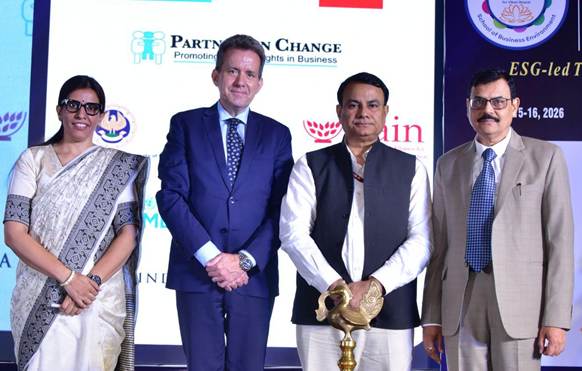
      Delivering the Special Address, Shri Nitin Gupta, Chairperson, National Financial Reporting Authority (NFRA), emphasised that Responsible Business Conduct is integral to the vision of Viksit Bharat and to fostering competitive enterprises, trusted markets, inclusive growth and environmental sustainability.

      Shri Gupta observed that India has made significant progress in strengthening sustainability disclosures and must now focus on enhancing their quality, reliability and decision usefulness. He emphasised that sustainability information should be relevant, comparable, evidence-based and verifiable, supported by robust methodologies, reliable source systems and effective internal controls.

      Highlighting the growing importance of credible sustainability reporting, NFRA’s Shri Gupta stated that sustainability information must be subjected to the same discipline and rigour that underpin financial reporting and audit. He stressed that the principles of documentation, traceability, reconciliation, control ownership, evidence retention, professional scepticism and independent examination are equally essential for ensuring the credibility of sustainability disclosures.

      Shri Gupta also underscored the need to adopt a proportionate and pragmatic approach to sustainability reporting while leveraging technology and strengthening institutional capacities, particularly across value chains and among MSMEs.

      Delivering the Welcome Address, Shri Gyaneshwar Kumar Singh, Director General and CEO, Indian Institute of Corporate Affairs (IICA), stated that India’s aspiration of becoming a USD 30 trillion economy by 2047 requires Environmental, Social and Governance (ESG) principles to move beyond regulatory compliance and become an integral part of the country’s economic development model.

      Shri Singh emphasised that Responsible Business Conduct is deeply rooted in India’s civilisational ethos and has evolved through progressive policy and regulatory reforms. Referring to the evolution of the country’s responsible business framework, he highlighted the journey from the Voluntary Guidelines on Corporate Social Responsibility issued in 2009 to the introduction of the mandatory Business Responsibility and Sustainability Reporting (BRSR) framework in 2021.

      He further noted that Section 166 (2) of the Companies Act, 2013 had incorporated the principle of stakeholder primacy into Indian corporate law well before it gained wider global recognition, reflecting India’s early commitment to integrating sustainability with corporate governance.

      Describing India’s evolving sustainability landscape as a transition from “ESG 1.0” to “ESG 2.0”, Shri Singh observed that ESG is no longer confined to regulatory compliance but is emerging as a strategic driver of long-term enterprise value, effective risk management and business resilience.

      He stressed that this transition calls for stronger legal, governance and accountability frameworks to ensure that sustainability commitments are credible, enforceable and aligned with fiduciary responsibilities. Outlining the priorities for the next phase of India’s ESG journey, Shri Singh emphasised the need to integrate sustainability considerations into board-level decision-making, strengthen legal and regulatory frameworks for sustainability data assurance to address the risks of greenwashing, and leverage emerging technologies, including Artificial Intelligence, to enhance the quality, traceability and transparency of sustainability data across value chains.

      In a special address, Mr. Jesper Moller, Deputy Representative (Programmes), UNICEF India, said child rights must be integrated into core business strategy rather than treated as a philanthropic concern, noting that India is home to over 400 million children who represent its future workforce and consumers. He illustrated how decisions such as maternity leave, workplace crèches and responsible supply chain practices directly affect children's wellbeing, citing the example of a young mother at a tea estate in Assam whose employer's family-friendly policies improved both her child's care and the company's employee retention.

      Speaking virtually, Ms. Helen Brand, Chief Executive, ACCA (Association of Chartered Certified Accountants), reaffirmed ACCA's partnership with IICA on sustainable business practices, describing India's economy as a "rocket ship bound to the moon" given its rapid growth and rising global influence. Citing ACCA's Global Talent Trends Report 2026, she noted that a growing majority of finance professionals worldwide now want careers that make a positive social impact, and that an employer's reputation on social and human rights issues is an increasingly important factor where professionals choose to work.

      Delivering the concluding address of the inaugural session, Professor Garima Dadhich, Head, School of Business Environment, Indian Institute of Corporate Affairs, described responsible business conduct as essential to Viksit Bharat and called for sustainability to be viewed as a foundation for growth rather than a compliance exercise. She outlined three guiding philosophies for the conference, generational responsibility, cultural anchoring in the Rig Vedic call for collective action, "Sangachhadhwam Samvadadhwam Sam Vo Manamsi Janatam," and alignment with India's G20 vision of "One Earth, One Family, One Future," and noted that this year's deliberations are anchored in the Union Budget 2026–27 that has placed green growth, climate transition and sustainable infrastructure at the very centre of the nation’s fiscal priorities. The Parliamentary Standing Committee on Finance has also called for stronger ESG frameworks, sharper disclosures and more rigorous impact assessments.
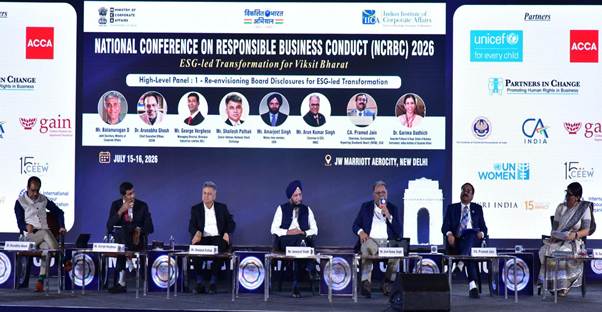
      Following the inaugural session, a High-Level Panel discussion on "ESG, Governance and Board-Level Disclosures," moderated by Professor Garima Dadhich, brought together regulators and industry leaders to examine how responsible business conduct can be embedded into corporate governance. Shri Amarjeet Singh, Whole-Time Member, Securities and Exchange Board of India (SEBI), cautioned against rushing to converge with global standards, saying India should chart its own glide path suited to its stage of development rather than align hastily with international frameworks.

      Shri Arun Kumar Singh, Chairman, Oil and Natural Gas Corporation (ONGC), said over-promising and under-delivering is "far better" than under-promising, and called on regulators to reward companies for ambition and intent rather than penalise them for falling short. Intent and trust play the key role in governance.

      Dr. Arunabha Ghosh, Chief Executive Officer, CEEW (Council on Energy, Environment and Water), said ESG is too often treated as a "headache" rather than an opportunity, pointing to an estimated USD 4 trillion investment opportunity in India's green economy.

      Shri Shailesh Pathak, Senior Advisor, National Stock Exchange (NSE), said capital "goes to where it sees opportunity, but stays where it has trust," describing the Social Stock Exchange as a transparent bridge between capital and social enterprises.

      Shri George Varghese, Managing Director, Kirloskar Industries Limited (KIL), recounted how tighter emission norms, initially seen as a cost burden, ultimately opened up international markets for his company's products.

      CA Pramod Jain, Chairman, Sustainability Reporting Standards Board (SRSB), Institute of Chartered Accountants of India (ICAI), said India has become one of the first countries to make ESG assurance mandatory rather than voluntary, lending board disclosures the same credibility as financial statements. The panel was duly moderated by Prof. Garima Dadhich, Head School of Business Environment, IICA.

      With substantive participation of more than three hundred and fifty senior corporate leaders, ESG professionals, policymakers and international delegates, and thought-provoking deliberations led by eminent speakers, the first day of NCRBC 2026 laid a strong foundation for the sessions to follow.

      The second day will feature further High-Level Panels on sector-specific guidelines for strengthening ESG integration, responsible value chains across global and domestic supply networks, mainstreaming ESG in MSMEs for competitive and inclusive growth, strengthening sectoral ESG adoption beyond BRSR, and reenvisioning environmental metrics in ESG reporting frameworks, concluding with a valedictory session. Therefore, with an elaborate two-day agenda, IICA's NCRBC 2026, held with support from the partner organisations UNICEF, Partners in Change and ACCA (Association of Chartered Certified Accountants) as Lead Partners, the Institute of Chartered Accountants of India (ICAI) and the Global Alliance for Improved Nutrition (GAIN) as Associate Partners, and UN Women, CEEW (Council on Energy, Environment and Water), WRI India and the International Labour Organisation (ILO) as Session Partners, aims to position responsible business conduct as integral to India's journey toward becoming a developed, inclusive and ethically grounded nation by 2047.

      Topics

      ActsIncome Tax
