

Loading...

Top
Help
×

By creating an account you can:

Logo TaxTMI
Call Us / Help / Feedback

Contact Us At :

E-mail: [email protected]

Call / WhatsApp at: +91 99117 96707

For more information, Check Contact Us

FAQs :

To know Frequently Asked Questions, Check FAQs

Most Asked Video Tutorials :

For more tutorials, Check Video Tutorials

Submit Feedback/Suggestion :

Email :
Please provide your email address so we can follow up on your feedback.
Category :
Description :
Min 15 characters 0/2000
Make Most of Text Search
  1. Checkout this video tutorial: How to search effectively on TaxTMI.
  2. Put words in double quotes for exact word search, eg: "income tax"
  3. Avoid noise words such as : 'and, of, the, a'
  4. Sort by Relevance to get the most relevant document.
  5. Press Enter to add multiple terms/multiple phrases, and then click on Search to Search.
  6. Text Search
  7. The system will try to fetch results that contains ALL your words.
  8. Once you add keywords, you'll see a new 'Search In' filter that makes your results even more precise.
  9. Text Search
Add to...
You have not created any category. Kindly create one to bookmark this item!
Create New Category
Hide
Title :
Description :
❮❮ Hide
Default View
Expand ❯❯
Close ✕
🔎 News - Adv. Search
TEXT SEARCH:

Press 'Enter' to add multiple search terms. Rules for Better Search

Search In:
Main Text + AI Text
  • Main Text
  • Main Text + AI Text
  • AI Text
Category: ?
Categorized by AI
---- All Categories ----
  • ---- All Categories ----
  • Income Tax
  • GST
  • Customs, DGFT & SEZ
  • FEMA & RBI
  • Corp. Laws, SEBI & IBC
  • PMLA, Black Money & ED
  • Budget
  • News and Press Release
  • PTI News
Month:
---- All Months ----
  • ---- All Months ----
  • January
  • February
  • March
  • April
  • May
  • June
  • July
  • August
  • September
  • October
  • November
  • December
Year:
---- All Years ----
  • ---- All Years ----
  • 2026
  • 2025
  • 2024
  • 2023
  • 2022
  • 2021
  • 2020
  • 2019
  • 2018
  • 2017
  • 2016
  • 2015
  • 2014
  • 2013
  • 2012
  • 2011
Sort By: ?
In Sort By 'Default', exact matches for text search are shown at the top, followed by the remaining results in their regular order.
Relevance Default Date
❯❯
Maximize Maximize Maximize
0 / 200
Expand Note
Add to Folder

No Folders have been created

+

Are you sure you want to delete "My most important" ?

NOTE:

News
Showing Results for :
Reset Filters
Results Found:
Show All Summaries Hide All Summaries
September 2, 2026
Show AI Summary
Responsible AI governance requires ethical safeguards, privacy protection, accountability and adaptive oversight to build lasting corporate stakeholder trust.
Responsible artificial intelligence governance requires continuous innovation, inclusive development, responsible deployment and trust-based governance. AI systems should be ethical, safe, transparent, fair and human-centric, with safeguards for privacy, bias, security and accountability. Proportionate and adaptive regulation should provide clear accountability, standards, monitoring, auditability and grievance redressal. Good governance, cybersecurity, personal data protection and responsible AI together strengthen organisational resilience, stakeholder trust, transparency and sustainable innovation.
September 2, 2026
Show AI Summary
E-auction of surplus public land enables transparent outright sale of RINL parcels through registered, KYC-verified bidding.
National Land Monetization Corporation will facilitate the e-auction and outright sale of 459 encumbrance-free RINL land parcels, including residential plots and parcels suited for commercial and logistics use. Competitive bidding will occur through the RailTel E-Nivida e-procurement platform. Participation requires online registration, KYC verification, and plot-wise submission of an earnest money deposit within prescribed timelines. The process supports transparent monetisation of surplus land and non-core public assets.
September 2, 2026
Show AI Summary
Competition approval for infrastructure finance restructuring covers acquisition, minority transfer, investment divestment, and merger of regulated NBFCs.
Competition Commission of India approval applies to the acquisition of Aseem Infrastructure Finance Limited by TPG Nicobar SG Pte. Ltd., a subsequent minority share acquisition by ICICI Bank Limited, and Aseem's divestment of its shareholding in NIIF Infrastructure Finance Limited to National Investment and Infrastructure Fund II. Following the acquisition, Climate Finance India Private Limited is intended to merge into Aseem as the surviving entity. The entities involved include RBI-registered non-deposit taking NBFCs operating in infrastructure finance, investment and credit, and infrastructure debt financing.
September 2, 2026
Show AI Summary
Healthcare merger approval enables KCIL to acquire fertility and specialty hospital businesses alongside related equity issuances and investment.
Competition Commission approval covers KCIL's acquisition of up to 100% equity shareholding in AFCPL and 100% equity shareholding in ASHPL. The combination includes KCIL issuing equity shares and optionally convertible debentures to AHLL, representing 9.9% fully diluted shareholding as partial consideration, together with a further KCIL equity investment by Arvon Investments Pte. Ltd. KCIL operates mother and baby care hospitals, while AFCPL provides assisted reproductive treatment and reproductive-medicine services.
September 1, 2026
Show AI Summary
Money-laundering investigation into alleged District Mineral Fund diversion examines purported liaison activity and asset acquisition through proceeds of crime.
Money-laundering proceedings under the Prevention of Money Laundering Act concern alleged diversion of District Mineral Fund resources through the Chhattisgarh Seed Corporation. The investigation alleges siphoning of public funds by contractors in collusion with government officials and political executives. A businessman was identified as an alleged liaisoner and financial coordinator between public servants, district authorities and private vendors. Allegations also include receipt of commissions, acquisition of immovable assets from purported proceeds of crime, non-production of records, and contradictory statements during questioning.
September 1, 2026
Show AI Summary
Foreign exchange market dynamics: rupee appreciation reflected portfolio inflows, domestic growth, and possible central-bank intervention amid external pressures.
The rupee appreciated against the US dollar, supported by domestic growth, controlled fiscal slippage, portfolio-related inflows and possible Reserve Bank of India intervention. Its gains were limited by weak equity markets, rising crude oil prices and a stronger dollar. External geopolitical tensions and hawkish US monetary signals remained potential pressures. Domestic indicators showed strong economic activity, while the current account deficit widened because of a higher merchandise trade deficit. Foreign portfolio inflows continued despite investors remaining net sellers during the year.
September 1, 2026
Show AI Summary
Current account deficit widened as merchandise trade deficit increased, notwithstanding stronger services receipts, remittances, and foreign direct investment inflows.
India's current account deficit widened in the first quarter of 2026-27 as the merchandise trade deficit increased. Higher net services receipts, increased personal transfer receipts and lower net primary-income outgo partly supported the external account. Financial-account movements included higher net foreign direct investment inflows, a shift in foreign portfolio investment from net inflow to net outflow, and lower net inflows through non-resident deposits and external commercial borrowings. Foreign exchange reserves declined on a balance-of-payments basis during the quarter.
September 1, 2026
Show AI Summary
Technology-enabled tax compliance and enforcement supported higher commercial tax collections, while GST rate reductions moderated sectoral net GST growth.
Technology-enabled tax administration supported commercial tax and net GST collection growth in Andhra Pradesh during August 2026 and the cumulative period through August. AI-based analytics and scrutiny, IGST reversals, UPI-based enforcement, registration verification, Aadhaar authentication, digital payment enablement, predictive analytics and data sharing strengthened compliance, scrutiny and revenue mobilisation. Petroleum VAT, professional tax, liquor VAT and IGST settlement also increased, while GST rate reductions moderated net GST performance in specified product sectors.
September 1, 2026
Show AI Summary
Windfall gains tax on petroleum exports rises for petrol and diesel while aviation turbine fuel levy is reduced.
Special additional excise duty and road and infrastructure cess on petroleum-product exports are revised with effect from 1 September 2026. The export duty on diesel is increased, the levy on aviation turbine fuel is marginally reduced, and a duty is imposed on petrol exports. Existing duty rates for petrol and diesel cleared for domestic consumption remain unchanged. The windfall-tax framework seeks to support domestic fuel availability and deter exporters from benefiting from domestic and international price differences.
September 1, 2026
Show AI Summary
Automated Free Sale and Commerce Certificate issuance reduces manual scrutiny while preserving risk-based review for eligible exporters.
DGFT has enabled automated issuance of Free Sale and Commerce Certificates through its portal for eligible exporters of items not covered by the Drugs & Cosmetics Act, 1940. Applications satisfying prevailing framework and automated processing parameters may be issued without manual scrutiny. Applications requiring verification or not meeting those parameters may be routed for manual processing, while auto-approved applications may be flagged later for risk-based review. The mechanism seeks faster, more transparent and predictable processing while retaining necessary oversight.
September 1, 2026
Show AI Summary
Five-day banking and equitable performance incentives drive planned nationwide bank union strike amid unresolved pension demands.
United Forum of Bank Unions has proposed nationwide strike action over delayed five-day banking, the performance-linked incentive framework, and unresolved pension demands. Five-day banking was agreed under the 12th Bipartite Settlement/9th Joint Note with extended Monday-to-Friday working hours, but remains pending for implementation. Unions challenge the incentive scheme for departing from a uniform, bank-performance-linked approach and for disproportionately benefiting senior officers. The dispute is under conciliation and pending before the Delhi High Court, while pension updation, a uniform dearness allowance formula, and an old pension scheme option remain unresolved.
September 1, 2026
Show AI Summary
Equity market volatility intensified as higher crude prices, geopolitical tensions and tighter monetary expectations weakened domestic investor sentiment.
Indian equity markets closed marginally lower as higher crude oil prices, US-Iran tensions, and expectations of prolonged tight United States monetary policy weakened risk appetite. The phased Closing Auction Session contributed to a late recovery in the benchmark index. Rising crude prices and global bond yields triggered broad-based selling across several domestic sectors, while foreign institutional equity sales and weakness in overseas markets added to pressure despite stronger-than-expected domestic economic growth.
September 1, 2026
Show AI Summary
GST revenue collections show higher gross and net receipts alongside increased refunds and state-level settlement data.
GST revenue collections for August 2026 recorded total gross GST revenue of Rs. 1,99,853 crore, reflecting 14.8% growth over August 2025. Total refunds were Rs. 31,795 crore, including domestic refunds and export IGST refunds processed through ICEGATE. After adjustment of refunds, total net GST revenue was Rs. 1,68,057 crore, representing 8.3% growth. SGST collections and the SGST component of IGST settlement were separately identified for States and Union Territories, with post-settlement SGST aggregating Rs. 95,531 crore.
September 1, 2026
Show AI Summary
Trade facilitation and customs preparedness feature in AILBIEA's Silver Jubilee knowledge conference on liquid bulk commerce.
AILBIEA's Silver Jubilee programme focuses on trade facilitation, customs modernisation, GST dispute preparedness and maritime-risk issues affecting liquid bulk trade. The Knowledge Conference includes sessions on the Authorised Economic Operator advantage, next-generation customs technology, GST Appellate Tribunal-era dispute preparedness, and geopolitical risks to sea-borne trade. It also marks the launch of AGS 360, integrating port information, vessel tracking, port-call estimates and maritime intelligence.
September 1, 2026
Show AI Summary
Personal guarantor insolvency: repayment plan stayed pending majority determination, with restraint on direct or indirect asset alienation.
Personal-guarantee insolvency proceedings involve a stay on implementation of a repayment plan because the earlier members' views did not produce a clear majority capable of taking effect. The personal guarantor has been restrained from directly or indirectly alienating assets pending further hearing. The dispute follows split views on approval of the plan, claim admission and voting, followed by a third-member opinion that did not resolve the absence of a determinative majority. Creditors dispute the proposed recovery, claim treatment and declared net worth relevant to the guarantees.
September 1, 2026
Show AI Summary
Rupee exchange-rate movement reflects portfolio inflows, growth data and possible central-bank support, while crude oil prices constrain gains.
Foreign-exchange market conditions strengthened the rupee by 28 paise to 94.94 against the US dollar, supported by domestic growth, controlled fiscal slippage and portfolio inflows. Possible Reserve Bank of India intervention was also identified as supportive. Higher crude oil prices, weak domestic equities and hawkish US monetary-policy signals were identified as constraints on further appreciation. Foreign investment flows, stronger-than-expected domestic growth and the fiscal-deficit position remained material factors affecting currency conditions.
September 1, 2026
Show AI Summary
Money-laundering probe into public service recruitment irregularities examines alleged question-paper leaks, selection manipulation, and laundering through purported CSR donations.
Money-laundering investigation under the Prevention of Money Laundering Act concerns alleged irregularities in Public Service Commission recruitment examinations. Allegations include question-paper leaks, manipulation of candidate selection, and illegal gratification for securing appointments of relatives and favoured candidates. Recruitment rules were allegedly amended to facilitate selection of relatives. Alleged proceeds of crime were collected in cash and routed through layered banking transactions, including through a family-controlled samiti presented as receiving corporate social responsibility donations for a non-existent college.
September 1, 2026
Show AI Summary
Personal guarantor settlement scrutiny intensifies as asset alienation is restrained pending review of a disputed creditor repayment proposal.
A five-member special bench found that no clear majority view existed under section 419(5) of the Companies Act and stayed the third member's order that had permitted the proposed recovery. Notices were directed to all parties, and the guarantor was restrained from directly or indirectly alienating property pending further consideration. The dispute concerns approval of a personal guarantor's repayment proposal, treatment of guarantee claims, creditor voting support, assessment of the personal estate, and scrutiny of declared net worth.
September 1, 2026
Show AI Summary
Personal insolvency proceedings restrict property alienation while notices issue to parties in the debtor's case.
A five-member special National Company Law Tribunal bench hearing Subhash Chandra's personal insolvency matter issued notices to all parties and restrained him from alienating property directly or indirectly. The restraint applies during the continuing insolvency proceedings and concerns dealings with the relevant property. The procedural measure requires the interested parties to participate in the matter.
September 1, 2026
Show AI Summary
Aadhaar authentication alternatives enable eligible farmers with failed fingerprint verification to access loan-waiver benefits after identity verification.
Elderly farmers whose fingerprints cannot be captured for Aadhaar authentication may approach an Aaple Sarkar Seva Kendra with their Aadhaar card and bank passbook. Loan-account details are verified on the scheme portal before authentication is initiated. If authentication fails, the concerned tehsildar verifies identity using the Aadhaar card, bank passbook and 7/12 land record extract. Eligible farmers receive loan-waiver benefits directly in their bank accounts after authentication, identity verification and satisfaction of the scheme's eligibility criteria.

News

Back

All News

Showing Results for :
Reset Filters
No Records Found

News

Showing Results for : Reset Filters
Customs, DGFT & SEZ

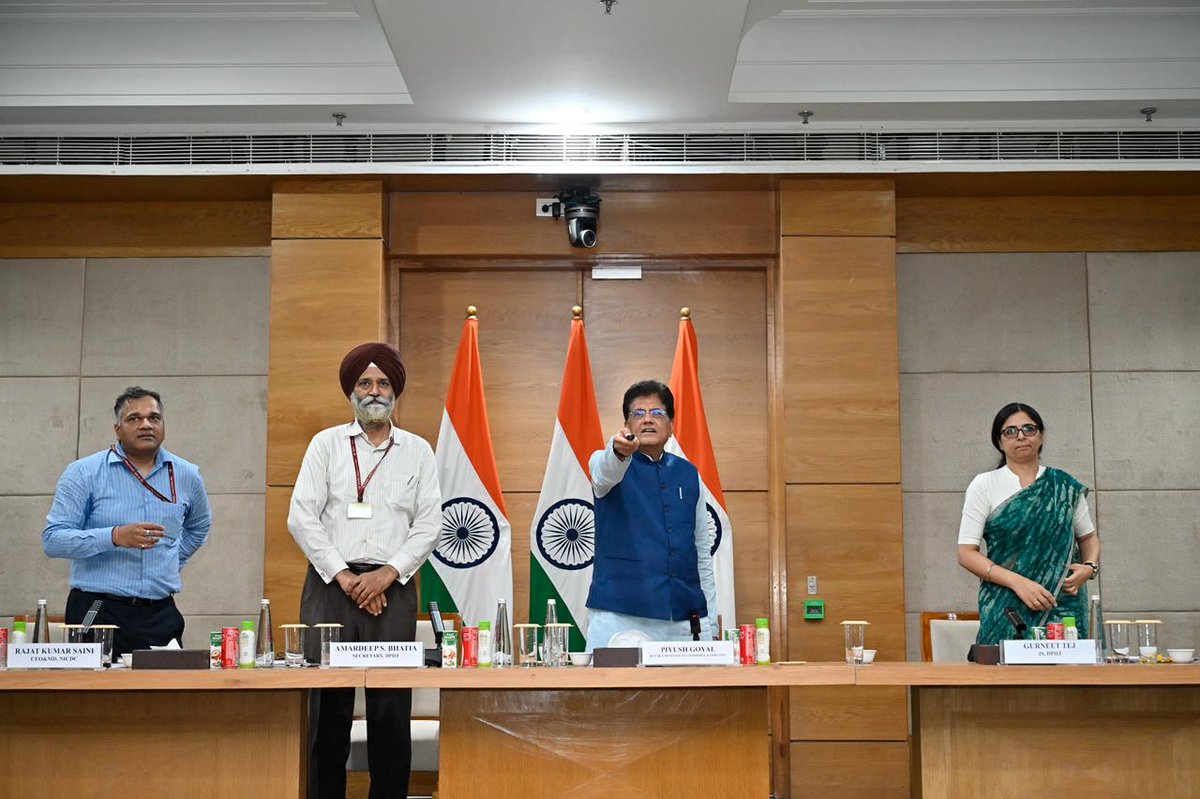
Union Minister of Commerce & Industry, Shri Piyush Goyal, Launches BHAVYA Portal

June 8, 2026

Contents
Summary
Note

Note

-

Bookmark

Print

Print

BHAVYA Scheme to Promote Competitive Development of Industrial Parks Across States: Shri Piyush Goyal

Government’s Focus on Infrastructure, Reforms and Digital Connectivity Has Created Strong Foundation for Growth: Shri Goyal

BHAVYA Parks to Include Dedicated Spaces for Startups, Deep-Tech, R&D and Innovation-Led Enterprises: Shri Piyush Goyal

Modern Testing Facilities to Be Developed in BHAVYA Parks in Partnership with BIS, EIA and FSSAI: Shri Goyal

NICDC to Lead Implementation and Monitoring of BHAVYA Through Dedicated Digital Platform

In a significant step towards the operationalisation of the Bharat Audyogik Vikas Yojana (BHAVYA), Union Minister of Commerce & Industry, Shri Piyush Goyal, launched the BHAVYA Portal today in New Delhi.

Addressing the gathering, Shri Piyush Goyal said that the BHAVYA Scheme will adopt a competitive model under which States will be encouraged to submit detailed project proposals highlighting their industrial strengths, availability of land, investor interest and sectoral potential. He said the Government will work closely with industry to identify the most suitable sectors and infrastructure requirements for each location, whether for chemicals, manufacturing, data centres or other industries. He added that investors would be able to access detailed information on industrial parks through digital platforms, including land availability, connectivity and surrounding infrastructure, enabling them to make informed investment decisions. The scheme will seek to ensure that industrial parks are designed according to the specific needs of different sectors and investors, making them more attractive destinations for domestic and global investments.

The Minister said that over the past decade, the Government has focused on creating an enabling environment for economic development and social welfare through investments in roads, highways, railways, metros, airports, ports, power infrastructure, water availability and digital connectivity. He highlighted reforms such as GST, the Insolvency and Bankruptcy Code, labour reforms, expansion of 5G connectivity, promotion of startups, support for investments, and free trade agreements with complementary economies to promote trade, investment and technology transfer.

Shri Goyal said that India is increasingly being viewed as a trusted partner and an attractive investment destination because of its scale, growing demand, young talent and youthful energy. He added that the Government remains committed to creating opportunities for businesses, industry, farmers, fishermen, startups and women entrepreneurs.

Announcing the BHAVYA Scheme, the Minister said that it aims to develop 100 industrial parks across the country to promote large-scale job creation through greater investments. He said the parks will be developed in different sizes, ranging from 25 acres in hilly regions, smaller Union Territories and Northeastern States, to between 100 and 500 acres in mid-sized States and regions, and up to 1,000 acres in locations closer to cities and towns, depending on need assessment and the commitment of States.

He informed that land for the parks will be provided by the State Governments, while the Government of India will support infrastructure creation through the National Industrial Corridor Development Corporation (NICDC), which will partner with States under a 51:49 model. He said the objective is to create plug-and-play industrial parks focused on industries best suited to specific locations.

The Minister said that the parks will provide infrastructure including assured water and power supply, road and rail connectivity, land titles, digital single-window clearances and, where feasible, air connectivity. He added that the Government will also explore earmarking areas for startups, deep-tech enterprises, technology-oriented businesses, research and development activities, and innovation-led enterprises.

Shri Goyal said that efforts will be made to establish modern testing facilities in partnership with institutions such as BIS, Export Inspection Agency and FSSAI so that investors have access to advanced testing infrastructure within the parks.

He stated that the scheme is intended to help investors commence operations more quickly by reducing the time spent on land acquisition and approvals. He added that environmental clearances and industry-specific requirements would be planned in consultation with relevant authorities and based on the suitability of each location.

The Minister said that the Government is also open to developing dedicated areas for Global Capability Centres (GCCs), worker housing and social infrastructure within the parks. He further said that the possibility of creating dedicated international enclaves in partnership with countries such as Japan, Singapore, the Republic of Korea and Switzerland could be explored to facilitate investment and provide a familiar environment for expatriate professionals working in India.

Referring to his own experience as an entrepreneur, Shri Goyal said that businesses earlier faced significant challenges in obtaining industrial land and approvals. He said the BHAVYA Scheme seeks to address these challenges through transparent systems, digital platforms and better availability of information for investors. He also emphasized the importance of mapping industrial parks through digital and satellite-based platforms so that investors can access information on land availability, connectivity and infrastructure remotely.

The Minister expressed confidence that the ₹34,000 crore earmarked by the Central Government for the development of 100 industrial parks would catalyse substantial investments, generate direct and indirect employment, strengthen Centre-State partnership and support industrial growth across the country.

Shri Piyush Goyal said that the launch of the BHAVYA Scheme comes at a time when the Government is marking 12 years under the leadership of Prime Minister Shri Narendra Modi. He said that the period has been marked by structural reforms, infrastructure development, digital connectivity, ease of doing business initiatives, and efforts to make India one of the top three economies in the world by 2047.

He informed that applications received between 1 June and 31 July would be considered for the first phase of 20 parks, while a further 30 parks would be taken up based on applications received up to 30th September. Subsequent phases would be implemented based on the experience and learnings from the initial rounds.

Shri Goyal said that the BHAVYA Scheme is intended to promote investments across India and support the vision of Viksit Bharat 2047. He expressed confidence that the initiative would contribute to a new phase of industrial development and business growth in the country.

Approved by the Union Cabinet with an outlay of ₹33,660 crore, BHAVYA is the Government's flagship programme for the development of 100 investment-ready, world-class industrial parks over a period of six years. The Scheme aims to create integrated industrial ecosystems featuring multimodal connectivity, reliable utility infrastructure, digital governance systems, worker-support facilities, and sustainable development features.

The National Industrial Corridor Development Corporation (NICDC), designated as the Project Management Agency for the Scheme, is responsible for its implementation and monitoring. Drawing upon its extensive experience in developing industrial corridors and integrated industrial infrastructure across the country, NICDC has developed the BHAVYA Portal as a comprehensive digital platform to support the entire project lifecycle under the Scheme.

The operational guidelines for BHAVYA were released by the Department for Promotion of Industry and Internal Trade (DPIIT) in May 2026, and the launch of the portal marks the next critical step in translating policy into implementation.

The portal will serve as the single digital interface for end-to-end implementation of the Scheme, facilitating the submission of Detailed Project Report (DPR) proposals, project appraisal and evaluation, and real-time monitoring of implementation progress. It will support the challenge-based competitive selection framework under BHAVYA by providing a structured and transparent mechanism for assessing proposals from States, Union Territories, and implementing agencies, while enabling efficient coordination among stakeholders throughout the project lifecycle.

The launch event was chaired by Shri Piyush Goyal, and attended by Secretary, DPIIT, Shri Amardeep Singh Bhatia, and CEO & MD, NICDC, Shri Rajat Kumar Saini, along with representatives from State and Union Territory Governments, industry associations, Export Promotion Councils, banks and financial institutions, master developers, and MSMEs.

Secretary, DPIIT, Shri Amardeep Singh Bhatia, emphasised that robust digital systems are essential for effective programme management and informed decision-making at scale. He noted that the portal, by serving as a single digital interface across all stages of project submission, evaluation, monitoring, and reporting, would significantly strengthen implementation of the Scheme and enable faster operationalisation of industrial parks across the country.

CEO & MD, NICDC, Shri Rajat Kumar Saini, highlighted that the platform had been designed to support the complete lifecycle of projects under BHAVYA. He stated that it would facilitate efficient coordination among stakeholders, provide real-time visibility into project progress, and strengthen transparency and accountability in implementation.

The launch was followed by an interaction between Shri Piyush Goyal and industry stakeholders, providing an opportunity to discuss India's next phase of industrial infrastructure development, investment facilitation, ease of doing business, logistics efficiency, and the role of integrated industrial parks in deepening domestic manufacturing capabilities and strengthening India's integration with global value chains.

The launch of the BHAVYA Portal follows closely on the Cabinet approval of the Scheme, the release of its operational guidelines, and structured consultations with States and Union Territories, reflecting the pace and commitment with which the Government is advancing one of India's most ambitious industrial infrastructure programmes.

The Scheme is expected to attract substantial domestic and foreign investment, generate large-scale industrial employment, and contribute significantly to India's emergence as a globally competitive manufacturing destination.
Topics

Acts Income Tax
