

Loading...

Top
Help
×

By creating an account you can:

Logo TaxTMI
Call Us / Help / Feedback

Contact Us At :

E-mail: [email protected]

Call / WhatsApp at: +91 99117 96707

For more information, Check Contact Us

FAQs :

To know Frequently Asked Questions, Check FAQs

Most Asked Video Tutorials :

For more tutorials, Check Video Tutorials

Submit Feedback/Suggestion :

Email :
Please provide your email address so we can follow up on your feedback.
Category :
Description :
Min 15 characters 0/2000
Make Most of Text Search
  1. Checkout this video tutorial: How to search effectively on TaxTMI.
  2. Put words in double quotes for exact word search, eg: "income tax"
  3. Avoid noise words such as : 'and, of, the, a'
  4. Sort by Relevance to get the most relevant document.
  5. Press Enter to add multiple terms/multiple phrases, and then click on Search to Search.
  6. Text Search
  7. The system will try to fetch results that contains ALL your words.
  8. Once you add keywords, you'll see a new 'Search In' filter that makes your results even more precise.
  9. Text Search
Add to...
You have not created any category. Kindly create one to bookmark this item!
Create New Category
Hide
Title :
Description :
❮❮ Hide
Default View
Expand ❯❯
Close ✕
🔎 News - Adv. Search
TEXT SEARCH:

Press 'Enter' to add multiple search terms. Rules for Better Search

Search In:
Main Text + AI Text
  • Main Text
  • Main Text + AI Text
  • AI Text
Category: ?
Categorized by AI
---- All Categories ----
  • ---- All Categories ----
  • Income Tax
  • GST
  • Customs, DGFT & SEZ
  • FEMA & RBI
  • Corp. Laws, SEBI & IBC
  • PMLA, Black Money & ED
  • Budget
  • News and Press Release
  • PTI News
Month:
---- All Months ----
  • ---- All Months ----
  • January
  • February
  • March
  • April
  • May
  • June
  • July
  • August
  • September
  • October
  • November
  • December
Year:
---- All Years ----
  • ---- All Years ----
  • 2026
  • 2025
  • 2024
  • 2023
  • 2022
  • 2021
  • 2020
  • 2019
  • 2018
  • 2017
  • 2016
  • 2015
  • 2014
  • 2013
  • 2012
  • 2011
Sort By: ?
In Sort By 'Default', exact matches for text search are shown at the top, followed by the remaining results in their regular order.
Relevance Default Date
    Trade pact with EU, US in next few months: Goyal
    India, New Zealand ink 'once-in-a-generation' trade deal
    India to import 64 LT urea, 19 LT of other fertilisers in kharif season despite high global prices
    India-New Zealand FTA to greatly benefit farmers, youth, MSMEs: PM Modi
    Bisleri Champions Hydration at TCS World 10K Bengaluru 2026
    Rupee settles 1 paisa higher to close at 94.15 against US dollar
    ED raids in case against former Punjab Police DIG Bhullar, linked entities
    India, New Zealand ink free trade agreement
    HSBC INDIA OPENS NEW BRANCH IN NAGPUR TO SUPPORT WEALTH EXPANSION
    BRFEDF Flags Systemic Issues in Shipping Line Practices; Urges Urgent Policy Intervention Following DG Shipping Meeting
    India-New Zealand free trade agreement: An explainer
    Rupee falls 11 paise to 94.27 against US dollar in early trade
    DPIIT Issues Operational Guidelines for ₹10,000 Crore Startup India Fund of Funds 2.0 to Streamline Capital Deployment
    Union Minister for Finance and Corporate Affairs delivers keynote address at 38th SEBI Foundation Day celebrations
    Union Minister for Commerce and Industry Shri Piyush Goyal and New Zealand Minister for Trade and Investment Mr. Todd McClay Lead Industry Engagement ...
    Odisha: Banking correspondent held for misappropriating customers’ money
    Russia crude oil import data 'confidential'; CIC backs denial by Petroleum Ministry's PPAC
    FTA with New Zealand to provide huge opportunities for Agra's leather exporters: Goyal
    India, New Zealand to ink free trade pact on April 27; aims to double bilateral trade
    Trader fined Rs 6.29 lakh for GST violations in J-K’s Udhampur
❯❯
Maximize Maximize Maximize
0 / 200
Expand Note
Add to Folder

No Folders have been created

+

Are you sure you want to delete "My most important" ?

NOTE:

News
Showing Results for :
Reset Filters
Results Found:
Show All Summaries Hide All Summaries
April 27, 2026
Show AI Summary
Free trade agreements move forward as India pursues pacts with the EU and US alongside New Zealand deal
India is advancing a series of free trade agreements, with the New Zealand agreement expected to enter into force by the end of the year and described as the seventh such pact concluded during the current tenure. Negotiations with the European Union have been closed, while agreements with the European Union and the United States are expected in the coming months. Talks with the United States have focused on market access, non-tariff measures, technical barriers to trade, customs and trade facilitation, investment promotion, economic security alignment and digital trade.
April 27, 2026
Show AI Summary
Free trade agreement expands duty-free access, services market entry and skilled mobility between India and New Zealand.
India and New Zealand have concluded a comprehensive free trade agreement providing duty-free access for all Indian exports to New Zealand across tariff lines, including textiles, apparel, leather, footwear, gems and jewellery, engineering goods and processed foods. The pact also contemplates New Zealand investment commitments, phased tariff liberalisation by India on a significant share of New Zealand tariff lines, and exclusions for sensitive Indian sectors such as dairy, certain agricultural goods, sugar, arms and ammunition, and specified metals-related products.
April 27, 2026
Show AI Summary
Fertiliser supply security remains stable as India plans imports, keeps urea and DAP prices unchanged.
India plans substantial imports of urea and other fertilisers for the kharif season in response to higher global prices and supply disruptions linked to the West Asia crisis, while maintaining unchanged retail prices for farmers. The government has stated that urea continues to be sold at the existing controlled price and that there is adequate supply for the season, with imports already received, additional quantities secured through global tender, and further consignments expected to arrive to support availability. Domestic urea production was affected by force majeure on gas deliveries, but higher gas availability has since improved output, and global tenders have been initiated for non-urea fertilisers to ensure peak-season supply.
April 27, 2026
Show AI Summary
Free trade agreement boosts duty-free access for Indian exports, strengthens MSMEs, and protects agriculture and dairy.
India-New Zealand free trade agreement was signed as a landmark step in bilateral partnership, aimed at deepening developmental cooperation and expanding two-way trade and investment. The arrangement provides duty-free access for Indian exports to New Zealand across all tariff lines, strengthening labour-intensive sectors, MSMEs and employment, while agriculture and dairy remain fully protected. It also supports students, skilled professionals, agriculture, manufacturing, innovation and technology.
April 27, 2026
Show AI Summary
Hydration Partnership and sustainability shape Bisleri's role at the TCS World 10K Bengaluru 2026
Bisleri International returned as the Official Hydration Partner for the TCS World 10K Bengaluru 2026, providing hydration stations and mist zones across the race categories. The partnership also highlights sustainability through Bisleri's Greener Promise initiative, including recycled plastic benches and limited edition bottles featuring marathon icons. Bisleri's broader business profile emphasizes packaged drinking water, quality testing, purification, distribution reach and sustainability-focused initiatives.
April 27, 2026
Show AI Summary
Rupee pressure amid crude oil spike and foreign selling, with market eyes on possible RBI intervention.
The rupee closed marginally stronger against the US dollar after recovering from intraday weakness, but remained under pressure from global uncertainty, West Asia tensions, elevated crude oil prices and foreign institutional investor selling. Market commentary noted a negative underlying bias, with traders watching the possibility of RBI intervention around higher levels. The report also noted a slight decline in the dollar index, higher Brent crude prices, rising domestic equities and an increase in India's foreign exchange reserves over the reporting week.
April 27, 2026
Show AI Summary
Money laundering probe under PMLA triggers searches for proceeds of crime and benami assets linked to suspended police DIG.
Enforcement Directorate searches were conducted at multiple premises in Punjab in a money laundering probe under the Prevention of Money Laundering Act against suspended police DIG Harcharan Singh Bhullar, his associates and suspected benamidars. The investigation arises from a CBI case alleging illegal gratification through a middleman and assets disproportionate to known sources of income. The searches were intended to trace proceeds of crime, identify benami assets and collect evidence relating to money laundering.
April 27, 2026
Show AI Summary
Free trade agreement expands duty-free access, tariff liberalisation, and investment facilitation between India and New Zealand.
India and New Zealand have concluded a free trade agreement providing duty-free access for Indian exports, duty-free inputs for manufacturing, and tariff liberalisation with exclusions for sensitive sectors. The agreement also includes phased tariff elimination for selected goods, limited tariff-rate quotas for certain products, a commitment to facilitate investment into India, and a rebalancing clause to address any shortfall in investment delivery.
April 27, 2026
Show AI Summary
Branch network expansion supports wealth banking, cross-border client services, and community-led CSR initiatives in Maharashtra.
HSBC India expanded its branch network by opening a new branch in Nagpur, Maharashtra, to strengthen its presence in emerging commercial and wealth centres and to build out its wealth proposition for affluent, high net worth, ultra-high net worth and non-resident clients. The expansion followed Reserve Bank of India approval to open new branches in key cities. The launch also aligned with corporate social responsibility activity in Maharashtra, including a community-led women entrepreneurship initiative in Vidarbha focused on sustainable livelihoods for tribal communities.
April 27, 2026
Show AI Summary
Shipping line charge transparency and force majeure rules face urgent calls for policy intervention amid exporter distress.
Shipping line disruptions linked to geopolitical developments have been described as a systemic issue affecting exporters across sectors, ports, and shipment categories, requiring policy-level intervention. Exporters reported stranded containers, rerouting, service suspensions, and transshipment delays, while continuing to bear detention, demurrage, war risk surcharges, and other ancillary charges despite limited or no service delivery. The discussion highlighted a regulatory gap in transparency, standardised charges, and force majeure protocols, and called for clearer norms and policy guidance.
April 27, 2026
Show AI Summary
Free trade agreement expands market access, services mobility, and investment while protecting sensitive sectors through targeted exclusions.
India and New Zealand are set to conclude a free trade agreement intended to expand bilateral commerce in goods and services and promote investment. The pact is described as a broad economic framework covering trade in goods, rules of origin, services, customs and trade facilitation, sanitary and phytosanitary measures, technical barriers to trade, trade remedies, dispute settlement and legal provisions. It provides substantial market access commitments, including duty-free or phased concessions, services access and a new Temporary Employment Entry Visa pathway for skilled Indian professionals, while sensitive sectors are protected through exclusions, tariff-rate quotas, minimum import prices and safeguard measures.
April 27, 2026
Show AI Summary
Rupee weakness deepens as dollar demand, oil prices, and geopolitical uncertainty keep pressure on currency markets.
The Indian rupee weakened in early trade against the US dollar amid persistent dollar demand, rising oil prices, geopolitical uncertainty, and foreign institutional outflows. Market participants said the currency had fallen for five straight sessions and was moving within a near-term range shaped by support and resistance levels, while India's forex reserves continued to build and cross USD 703 billion.
April 27, 2026
Show AI Summary
Startup India Fund of Funds 2.0 sets a catalytic AIF framework to mobilise private capital for startup funding access.
Operational guidelines for Startup India Fund of Funds 2.0 provide a structured framework for fund deployment, governance, and monitoring through SEBI-registered Category I and II Alternative Investment Funds investing in DPIIT-recognised startups. SIDBI is the initial Implementation Agency, with provision for an additional agency, and AIFs are segmented by focus areas such as deep tech, micro venture capital, innovative manufacturing, and sector- and stage-agnostic funds. The scheme requires minimum private capital mobilisation, includes a two-stage selection process, and allows co-investment and ecosystem capacity-building use of returns.
April 27, 2026
Show AI Summary
Cybersecurity resilience and investor awareness take centre stage as stronger anti-fraud safeguards and consultative regulation are urged.
Cybersecurity resilience, investor awareness, grievance redressal, and consultative regulation were highlighted as central priorities for the securities market, with emphasis on strengthening safeguards across regulated entities in response to AI-enabled cyber threats, fake investment content, and market manipulation risks. The address noted SEBI's Cybersecurity and Cyber Resilience Framework, data analytics and digital forensics capabilities, and the use of investor verification tools such as SEBI Check, while calling for rapid-response takedowns, expanded public awareness campaigns in regional languages, and wider visibility for anti-fraud measures.
April 27, 2026
Show AI Summary
Free trade agreement broadens market access, talent mobility and regulatory access across leather, pharma and traditional medicine sectors.
India-New Zealand Free Trade Agreement is presented as a comprehensive economic partnership extending beyond tariff reduction to include market access, agricultural productivity, investment, talent mobility, collaboration in sports and tourism, and people-to-people ties. The leather and footwear sector was highlighted as a major beneficiary because duties on Indian exports are to be eliminated on entry into force, including the reduction of tariffs on leather and footwear from 5 per cent to zero. The pharmaceutical, medical devices and health-related sectors were also central, with faster regulatory access through acceptance of GMP and GCP inspection reports and a dedicated chapter on Health and Traditional Medicine recognising AYUSH.
April 26, 2026
Show AI Summary
Customer deposit misappropriation by a banking correspondent exposed fake receipts, unauthorised withdrawals, and account irregularities.
Alleged misappropriation by a banking correspondent involved customer deposits, fake receipts, and unauthorised withdrawals from customer accounts. The conduct allegedly included obtaining signed blank forms and Aadhaar photocopies under the pretext of KYC updates, ATM card applications, and mobile number linking, and then using them to access funds without proper deposit or authorisation. The fraud came to light after a depositor noticed an account mismatch, prompting complaints to the bank and a police complaint.
April 26, 2026
Show AI Summary
RTI confidentiality over crude oil import data upheld for strategic and economic interests, with proactive disclosure directions issued.
Access to country-wise and company-wise crude oil import data relating to imports from Russia was denied as commercial and confidential information exempt from disclosure under the RTI Act. The Information Commission accepted that disclosure would prejudice the strategic and economic interests of the State and affect relations with foreign states, and also directed compliance with proactive disclosure obligations under Section 4 of the RTI Act.
April 26, 2026
Show AI Summary
Duty-free market access through India-New Zealand free trade agreement set to expand export opportunities for leather MSMEs.
India's proposed free trade agreement with New Zealand is intended to expand bilateral commerce by providing duty-free access for Indian goods in the New Zealand market and by creating wider opportunities for domestic exporters, including the leather and sports goods sectors. The benefits are particularly significant for Agra's leather and footwear cluster, which is dominated by MSMEs and relies heavily on domestic supply and exports.
April 26, 2026
Show AI Summary
Free trade agreement expands market access, services mobility, and regulatory cooperation between India and New Zealand.
India and New Zealand are set to sign a free trade agreement aimed at expanding bilateral trade, improving market access, and deepening investment and services cooperation. The pact provides duty-free or reduced-tariff access for most New Zealand exports while India excludes sensitive products such as dairy, onions, sugar, edible oils, rubber, and certain industrial goods. It also includes a temporary employment visa pathway for Indian professionals, agricultural cooperation, GI facilitation, regulatory cooperation, and faster pharma and medical devices access through acceptance of GMP and GCP inspection reports.
April 25, 2026
Show AI Summary
GST compliance enforcement targets undocumented goods movement and strengthens monitoring through intelligence-led interception and RFID tracking.
GST enforcement action resulted in a penalty being imposed on a trader for attempting to move goods without proper documentation, in contravention of GST regulations. The trader was kept under surveillance on specific intelligence inputs and intercepted with the assistance of RFID tracking, enabling monitoring of the goods movement. The operation was carried out by the state tax enforcement team under departmental supervision as a compliance measure to ensure adherence to GST norms.

News

Back

All News

Showing Results for :
Reset Filters
No Records Found

News

Showing Results for : Reset Filters
News and Press Release

UPI completes 10 glorious years, Emerges as World’s Largest Real-Time Payments Platform, Anchoring India’s Digital Economy

May 1, 2026

Contents
Summary
Note

Note

-

Bookmark

Print

Print

Transaction volume surges nearly 12,000-fold in last 10 years, Value exceeds ₹314 lakh crore in FY 2025–26, reflecting deep nationwide adoption

Over 700 banks onboarded as UPI captures nearly 49% of global real-time payments, driving high-frequency retail usage and inclusive digital growth

The Unified Payments Interface (UPI), launched on 11 April 2016 by the National Payments Corporation of India (NPCI) under the regulatory oversight of the Reserve Bank of India (RBI), has emerged as the backbone of India’s digital payments ecosystem and a critical driver of financial inclusion.

Over a decade of operations, UPI has demonstrated extraordinary scale and momentum. Annual transaction volume expanded from just 2 crore transactions in FY 2016-17 to over 24,162 crore transactions in FY 2025-26, representing an almost 12,000‑fold surge in transaction volume. Parallelly, transaction value rose sharply from ₹0.07 lakh crore in FY 2016-17 to approximately ₹314 lakh crore in FY 2025-26, translating into a more than 4,000‑fold increase in transaction value.

This simultaneous expansion in both volume and value highlights UPI’s deepening role in supporting high‑frequency retail payments. The unprecedented scale, reliability, and interoperability achieved by UPI have received global recognition, with the International Monetary Fund (IMF) acknowledging it as the world’s largest real‑time payment system by transaction volume, underscoring India’s leadership in building scalable, inclusive, and innovative digital public infrastructure.


INDIA CELEBRATES 10 YEARS OF UPI

A Decade of Transforming India's Digital Payment Landscape

From 21 Banks & 0.01 Crore Transactions in a month in the Year 2016 to 700+ Banks & 2000+ crore Transactions in a month in the Year 2025


24,162 Crore

Annual Transactions (FY2026)

₹314 Lakh Crore

Annual Value

(FY2026)

66 Crore

Daily Average Transactions

₹0.86 Lakh Crore

Daily Average Value

(FY2026)


I.  The Decade in Numbers

UPI AT A GLANCE : KEY STATISTICS (NPCI)

Annual Transaction Volume (FY2025-26)

24,161.69 Crore

Annual Transaction Value (FY2025-26)

₹314 Lakh Crore

YoY Volume Growth (2025-2026)

30.0%

YoY Value Growth (2025-2026)

20.59%

Daily Average Transactions (2025)

66 Crore

Record Monthly Volume (March 2026)

2264 Crore (peak)

Record Monthly Value (March 2026)

₹29.53 Lakh Crore

Banks Live on UPI (As on March 2026)

703 Banks

Banks at Launch (April 2016)

21 Banks

First Month Transactions (April 2016)

373

Share of UPI in India's Digital Payments

85% (FY2025-26)

Share of Global Real-Time Volume

49% of World (2025)

Countries Accepting UPI

8 Countries


Annual Transaction Volume Growth (2016-2025)
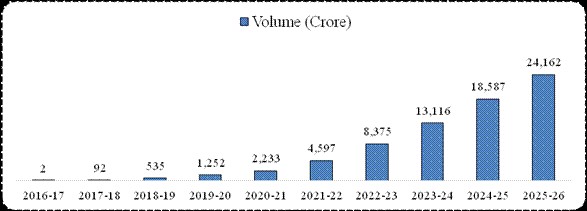
Fig 1: UPI Annual Transaction Volume in Crore| 

Annual Transaction Value Growth (2016-2025)
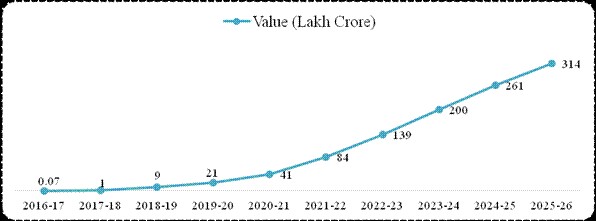
Fig 2: UPI Annual Transaction Value in ₹ Lakh Crore

II.  Monthly Performance, 2025

The Year 2025 marked a significant milestone in the growth trajectory of the Unified Payments Interface (UPI). Monthly transaction volumes crossed 2,000 crore transactions for the first time in August 2025, reaching 2,001 crore transactions, signalling a new scale of adoption. This momentum continued through the remainder of the year, with December 2025 recording 2,163 crore transactions, the highest monthly transaction volume in UPI’s decade‑long journey.

Over the course of the calendar year 2025, UPI processed approximately 22,000 crore transactions in total, translating into a daily average of about 60 crore transactions. This sustained high‑frequency usage reflects the deep penetration of digital payments across the country and the growing trust of citizens, merchants, and businesses in India’s digital payments ecosystem.
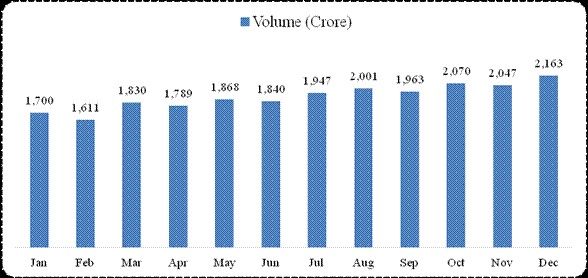
Fig 3: UPI Monthly Transaction Volume (2025)

III.  Ecosystem Strength, Banks, Apps & Geography

Banks Live on UPI, Unprecedented Participation

The Unified Payments Interface (UPI) has witnessed a steady and broad-based expansion in institutional participation since its launch. The number of banks live on UPI increased from 44 banks in FY 2016-17, the first year of operations, to 703 banks by FY 2025-26. This onboarding covers public sector banks, private banks, small finance banks, payment banks, and cooperative banks, enabling UPI's deep geographic reach. Each bank functions as a Remitter PSP (processing outgoing transactions) and/or a Beneficiary PSP (receiving funds), with NPCI monitoring performance metrics for all participants.
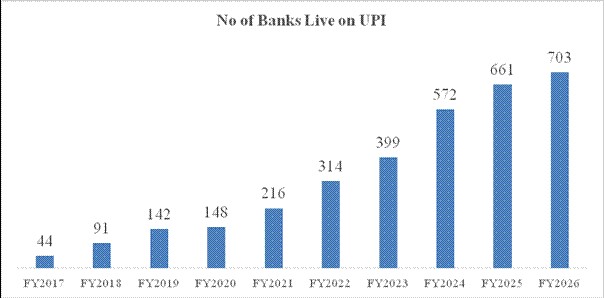
 

Fig 4: Number of Banks Live on UPI (FY2017–2026)


IV.  Transaction Segmentation, P2P & P2M Analysis

An analysis of UPI transactions highlights a clear divergence between volume and value across payment types. Person‑to‑merchant (P2M) transactions account for 63% of total transaction volume, reflecting UPI’s extensive use for high‑frequency, low‑value retail payments. In contrast, person‑to‑person (P2P) transactions dominate transaction value, contributing 71%, indicating their use for higher‑ticket transfers between individuals. This contrast underscores UPI’s dual role as a mass retail payments platform and a trusted channel for larger‑value fund transfers.
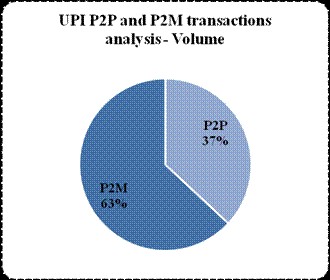
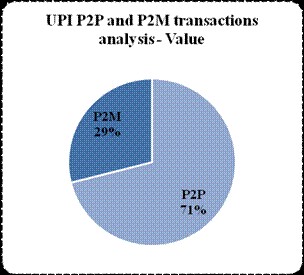
Fig 7: UPI P2P vs P2M Split — Volume & Value (H1 2025, 106.36 Billion Transactions)  |  Source: NPCI UPI Product Statistics


Transaction Distribution by Ticket Size, Micro-Payments Dominate

Fig 5: UPI P2P vs P2M Split, Volume & Value

In FY2026, UPI transactions totalling 24,162 crore reflected the platform’s deep integration into everyday digital payment usage across the country. with particularly robust momentum in the merchant segment. P2M transactions were largely driven by small-ticket payments, with 86% below ₹500, highlighting UPI’s deep integration into routine retail and day-to-day commerce, even as higher-value transactions continued to expand. P2P transactions also showed widespread usage for low-value transfers (59% below ₹500), while a significant 41% of transactions above ₹500 reflects UPI’s growing versatility in facilitating both regular personal payments and higher-value fund transfers.
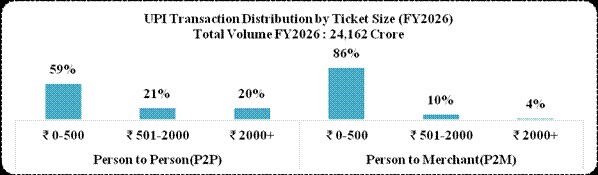


Fig 6: UPI transaction distribution by ticket size

V.  UPI on the World Stage

What began as a domestic payments innovation has today evolved into a global benchmark in digital payments.

As of 2024, India’s Unified Payments Interface (UPI) accounts for nearly 49 % percent of the world’s real-time payment transaction volume, a milestone recognized by the International Monetary Fund (IMF) in its report in June 2025.

With over 66 crores transactions processed daily, UPI has surpassed global payment network, reinforcing India’s position as the world leader in instant, secure, and inclusive digital payments.

Country / Region

Status

UAE

Operational, accepted at major merchant points; used by Indian diaspora

Singapore

Operational, linked with Singapore's PayNow for cross-border transfers

France

Operational, expanding Indian tourist payment acceptance

Bhutan

Operational, NPCI-enabled real-time cross-border payments

Nepal

Operational, accepted across the nation

Sri Lanka

Operational, Indian visitor and diaspora payments

Mauritius

Operational, integrated with local payment infrastructure

Qatar

 Operational.


VI.  The Road Ahead, UPI's Next Decade

The next decade of UPI is poised to drive even greater transformation in India’s digital payments landscape.  By bringing new users and merchants to the UPI Ecosystem, Government of India remains committed to enabling the next phase of UPI-led innovation and strengthening India’s digital payments ecosystem through continued policy support, technological advancement, and greater financial inclusion.

Topics

Acts Income Tax
