 TaxTMI
 Login
 TaxTMI
Login
Loading...
Press 'Enter' to add multiple search terms. Rules for Better Search

Press 'Enter' after typing page number.
Press 'Enter' after typing page number.


No Folders have been created
Are you sure you want to delete "My most important" ?
NOTE:
Press 'Enter' after typing page number.
Press 'Enter' after typing page number.

All News
Press 'Enter' after typing page number.
All News

Note

Bookmark

Share


The 7th Joint Group of Customs (JGC) Meeting between India and Bhutan was held on 20th–21st April 2026 in Munnar, Kerala. The meeting was co-chaired by Mr. Yogendra Garg, Special Secretary and Member (Customs), Central Board of Indirect Taxes and Customs (CBIC), Government of India, and Mr. Sonam Jamtsho, Director General, Department of Revenue and Customs, Ministry of Finance, Royal Government of Bhutan.
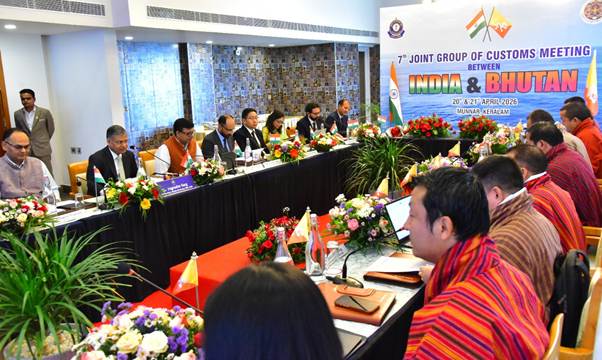
India and Bhutan share close and longstanding trade relations, with India being Bhutan’s largest trading partner, accounting for nearly 80% of Bhutan’s total trade. Bilateral trade between the two countries exceeded $1.9 billion in FY 2024–25, registering a growth of over 46% compared to the previous financial year.
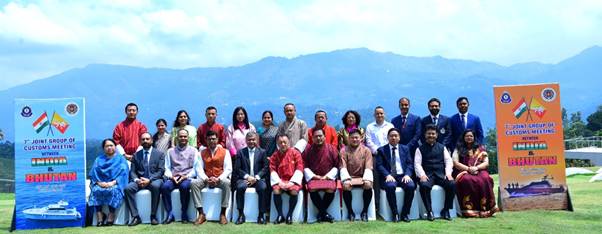
As part of the institutional framework for bilateral engagement, the JGC meetings serve as an important platform for addressing issues related to customs cooperation, trade facilitation, and border management. Given Bhutan’s landlocked geography, trade through land customs stations holds particular importance. Currently, there are 10 notified land customs stations along the India–Bhutan border, located in the states of West Bengal (6) and Assam (4).
During the meeting, both sides held detailed discussions on a range of priority areas, including Coordinated Border Management (CBM); Memorandum of Understanding (MoU) on pre-arrival exchange of customs data; strengthening of anti-smuggling mechanisms through intelligence sharing and enforcement cooperation; digitization of customs processes; and facilitation of transit cargo movement under the Electronic Cargo Tracking System (ECTS). The meeting also discussed and reviewed issues like improvement of border infrastructure, enhancing trade facilitation and harmonization & streamlining of customs procedures.
The Bhutanese delegation also visited the Kochi Port. The delegation was provided an overview of import and export procedures, including vessel berthing and container handling operations using gantry cranes. Bhutanese delegates were briefed about various aspects of maritime enforcement, such as sea patrolling, identification of suspicious vessels, rummaging operations, communication systems used during patrols, such as satellite phones and the Automatic Identification System (AIS) and methods for identification of suspicious cargo and the procedures for its examination.
The meeting concluded on a positive note, with both sides reaffirming their shared commitment to further strengthening customs cooperation, promoting seamless cross-border trade, and ensuring secure and efficient border management under the framework of the Agreement on Trade, Commerce and Transit.

