Loading...

Top
Help
×

By creating an account you can:

Logo TaxTMI
Call Us / Help / Feedback

Contact Us At :

E-mail: [email protected]

Call / WhatsApp at: +91 99117 96707

For more information, Check Contact Us

FAQs :

To know Frequently Asked Questions, Check FAQs

Most Asked Video Tutorials :

For more tutorials, Check Video Tutorials

Submit Feedback/Suggestion :

Email :
Please provide your email address so we can follow up on your feedback.
Category :
Description :
Min 15 characters 0/2000
Make Most of Text Search
  1. Checkout this video tutorial: How to search effectively on TaxTMI.
  2. Put words in double quotes for exact word search, eg: "income tax"
  3. Avoid noise words such as : 'and, of, the, a'
  4. Sort by Relevance to get the most relevant document.
  5. Press Enter to add multiple terms/multiple phrases, and then click on Search to Search.
  6. Text Search
  7. The system will try to fetch results that contains ALL your words.
  8. Once you add keywords, you'll see a new 'Search In' filter that makes your results even more precise.
  9. Text Search
Add to...
You have not created any category. Kindly create one to bookmark this item!
Create New Category
Hide
Title :
Description :
❮❮ Hide
Default View
Expand ❯❯
Close ✕
🔎 News - Adv. Search
TEXT SEARCH:

Press 'Enter' to add multiple search terms. Rules for Better Search

Search In:
Main Text + AI Text
  • Main Text
  • Main Text + AI Text
  • AI Text
Category: ?
Categorized by AI
---- All Categories ----
  • ---- All Categories ----
  • Income Tax
  • GST
  • Customs, DGFT & SEZ
  • FEMA & RBI
  • Corp. Laws, SEBI & IBC
  • PMLA, Black Money & ED
  • Budget
  • News and Press Release
  • PTI News
Month:
---- All Months ----
  • ---- All Months ----
  • January
  • February
  • March
  • April
  • May
  • June
  • July
  • August
  • September
  • October
  • November
  • December
Year:
---- All Years ----
  • ---- All Years ----
  • 2026
  • 2025
  • 2024
  • 2023
  • 2022
  • 2021
  • 2020
  • 2019
  • 2018
  • 2017
  • 2016
  • 2015
  • 2014
  • 2013
  • 2012
  • 2011
Sort By: ?
In Sort By 'Default', exact matches for text search are shown at the top, followed by the remaining results in their regular order.
Relevance Default Date
    Cabinet approves Investment Proposal for construction of 1720 MW Kamala Hydro Electric Project in Kamle, Kra Daadi & Kurung Kumey Districts of Arunach...
    Cabinet approves revision in cost and investment in equity for HPCL Rajasthan Refinery Limited (HRRL), Pachpadra, District - Balotra, Rajasthan
    Rupee likely to stabilise at 92-93 level: EAC-PM chairman
    Sensex, Nifty jump nearly 4 pc on US-Iran ceasefire, correction in crude prices
    Rupee surges 47 paise to close at 92.59/USD on US-Iran ceasefire, RBI pause on policy rates
    Across the Country, People Unite to Celebrate the First-Ever World Diamond Day
    CSB Bank Launches 'SMART SAVE ACCOUNT - SAVINGS, CURRENT & NRO', its First Retail Offering Post Core Banking Transformation
    Interest rates to remain low in medium to long term: RBI Governor
    RBI expects 6.9 pc economic growth this fiscal
    No governance or conduct-related issues found, RBI Guv on HDFC Bank
    US-Iran ceasefire, drop in crude oil prices fuel rally in stock markets; Sensex jumps 4 pc
    Monetary Policy Statement, 2026-27 Resolution of the Monetary Policy Committee April 6 to 8, 2026
    Adani wins US court hearing in push to throw out SEC fraud suit
    RBI holds rates, awaits clarity on Iran war's impact on economy
    Highlights of RBI's April monetary policy
    RBI projects FY27 retail Inflation at 4.6 pc, within government-mandated target
    Deutsche Bank and Akshaya Patra Launch Pune Kitchen to Tackle Classroom Hunger
    RBI projects India's FY27 GDP growth to moderate to 6.9 pc
    RBI keeps policy rate unchanged amid inflationary pressure
    Pradhan Mantri Mudra Yojana (PMMY) — completes 11 Years of empowering Small and Micro Entrepreneurs
❯❯
Maximize Maximize Maximize
0 / 200
Expand Note
Add to Folder

No Folders have been created

+

Are you sure you want to delete "My most important" ?

NOTE:

News
Showing Results for :
Reset Filters
Results Found:
Show All Summaries Hide All Summaries
April 8, 2026
Show AI Summary
Hydroelectric project approval strengthens power supply, grid balancing and regional infrastructure development in Arunachal Pradesh.
Cabinet approval was granted for investment in the construction of the Kamala Hydro Electric Project in Arunachal Pradesh through a joint venture between NHPC Limited and the Government of Arunachal Pradesh. The project is intended to generate energy, support power supply and peak demand management, contribute to grid balancing and provide flood moderation benefits, while also including budgetary support for flood moderation and enabling infrastructure. The State is stated to receive free power, a Local Area Development Fund share and wider infrastructure and socio-economic benefits.
April 8, 2026
Show AI Summary
Refinery cost revision and equity investment support a greenfield petrochemical complex aimed at energy security and import reduction.
Revision of the project cost for HPCL Rajasthan Refinery Limited at Pachpadra, District Balotra, Rajasthan, has been approved, along with additional equity investment by Hindustan Petroleum Corporation Limited. The project is a 9 MMTPA greenfield refinery-cum-petrochemical complex with 2.4 MMTPA petrochemical production capacity, implemented through a joint venture between HPCL and the Government of Rajasthan. The refinery is intended to support energy and industrial requirements, reduce import dependence, use locally available Mangala crude, and promote India as a refining hub.
April 8, 2026
Show AI Summary
Rupee stability and macroeconomic resilience support expectations of steady growth, manageable deficits and appropriate policy rates.
Indian rupee is expected to stabilise around the 92-93 level against the US dollar, after pressure from global uncertainties, geopolitical tensions and foreign institutional investor withdrawals. India's economic resilience, strong macroeconomic fundamentals and fiscal space were described as cushioning the economy against external shocks. The current account deficit was described as remaining manageable, the Reserve Bank of India Monetary Policy Committee's decision to keep policy rates unchanged was described as appropriate, and growth expectations were stated to remain positive.
April 8, 2026
Show AI Summary
Monetary policy caution kept the repo rate unchanged as conflict-driven energy and inflation risks weighed on the outlook.
The Reserve Bank of India kept the benchmark repurchase rate unchanged at 5.25 per cent, taking a cautious wait-and-watch stance amid uncertainty over the impact of the West Asia conflict on energy supplies, inflation and growth. The Monetary Policy Committee voted unanimously to retain the status quo, citing higher crude prices, pressure on the rupee and trade disruption.
April 8, 2026
Show AI Summary
Monetary policy neutrality and forex stability shape rupee gains as West Asia tensions ease and inflation risks persist.
The rupee strengthened against the US dollar after easing geopolitical tensions in West Asia and supportive domestic market sentiment. The Reserve Bank of India kept the key policy rate unchanged and retained a neutral stance, taking a wait-and-watch approach amid uncertainty over energy supplies, inflation, growth and trade flows. The central bank's projections pointed to higher crude oil prices and a weaker exchange rate in the next financial year.
April 8, 2026
Show AI Summary
Natural diamonds celebrated through World Diamond Day as a storytelling campaign on heritage, emotion, and craftsmanship.
The Natural Diamond Council launched World Diamond Day as a global awareness initiative to celebrate the personal, emotional, and heritage value of natural diamonds. The campaign invited artisans, manufacturers, retailers, consumers, and industry stakeholders to share authentic stories about diamonds as symbols of love, milestones, memory, legacy, and craftsmanship. A dedicated toolkit and optional creative assets were made available to participants, while the campaign message emphasised that natural diamonds are timeless heirlooms carrying meaning across generations.
April 8, 2026
Show AI Summary
Auto-sweep banking product launches with higher returns on idle balances and anytime liquidity across savings, current and NRO accounts.
CSB Bank launched its Smart Save Account as its first retail offering after upgrading its core banking platform. The product is available in Savings, Current and NRO variants and is designed to improve returns on idle balances while preserving liquidity. It includes an auto-sweep mechanism that transfers surplus funds into fixed deposits, with interest of up to 7% on 13-month sweep-in deposits and no lock-in, so funds remain accessible when needed.
April 8, 2026
Show AI Summary
Low interest rates and cautious monetary policy shape the Reserve Bank's stance amid inflation stability and market volatility.
Interest rates are expected to remain low in the medium to long term in view of benign inflationary conditions and strong macroeconomic fundamentals. The Reserve Bank has kept the benchmark repurchase rate unchanged while adopting a cautious wait-and-watch approach to assess the impact of the West Asia conflict on energy supplies, inflation, growth, the rupee and trade flows. Banks have transmitted earlier rate cuts to lending and deposit rates, and currency market steps were said to be temporary measures to curb excessive volatility.
April 8, 2026
Show AI Summary
India's GDP growth projection stays resilient despite West Asia conflict, with exports and inflation facing downside risks.
Reserve Bank projected India's GDP growth for the current financial year at 6.9 per cent, noting downside risks from elevated commodity prices, higher energy costs, and supply-chain disruptions linked to the West Asia conflict. Merchandise exports may be affected by shipping, freight and insurance costs, while domestic demand is expected to be supported by services-sector momentum, GST rationalisation, manufacturing capacity utilisation, and healthy financial and corporate balance sheets.
April 8, 2026
Show AI Summary
Governance and conduct review found no material concerns in HDFC Bank's supervisory assessment and board review.
The Reserve Bank stated that its supervisory inspection of HDFC Bank did not reveal any governance or conduct-related issues, and that review of the bank's meeting minutes also disclosed no matter of material concern. The RBI reiterated that there were no material concerns on record regarding the bank's conduct or governance, describing HDFC Bank as a Domestic Systemically Important Bank with sound financials, a professionally run board, and a competent management team.
April 8, 2026
Show AI Summary
Market rally and unchanged RBI policy follow easing geopolitical stress and a sharp fall in crude oil prices.
Equity markets rallied sharply after a US-Iran ceasefire and a fall in crude oil prices reduced concerns over energy supply disruption and inflation pressure. The Reserve Bank of India kept the benchmark repurchase rate unchanged and maintained a cautious wait-and-watch stance, citing uncertainty from the West Asia conflict, its impact on energy supplies, inflation, growth, the rupee, and trade flows.
April 8, 2026
Show AI Summary
Monetary policy stance remains neutral as the policy repo rate is held unchanged amid supply shocks and inflation risks.
The Monetary Policy Committee kept the policy repo rate unchanged at 5.25 per cent, retained the standing deposit facility rate at 5.00 per cent, the marginal standing facility rate and Bank Rate at 5.50 per cent, and continued a neutral stance. The decision was based on resilient domestic growth, contained headline inflation, and heightened uncertainty from geopolitical tensions, supply-chain disruption, energy price pressures, and weather-related risks affecting the inflation and growth outlook.
April 8, 2026
Show AI Summary
Personal jurisdiction and extraterritorial reach challenged in SEC fraud action over Indian bond offering and alleged misstatements.
Personal jurisdiction and extraterritorial reach were challenged in a US SEC fraud action arising from an Indian solar-energy bond offering. The defendants argued that the securities were sold outside the United States under Rule 144A and Regulation S, the issuer and alleged conduct were Indian, and the complaint failed to plead a domestic transaction, minimum contacts, or an actionable US nexus. They also denied credible evidence of bribery, asserted no investor losses, and contended that the relied-upon statements were non-actionable corporate puffery.
April 8, 2026
Show AI Summary
Monetary policy stance held steady as the RBI weighs energy shocks, inflation risks and growth uncertainty from geopolitical tensions.
The Reserve Bank of India retained the benchmark repurchase rate and the neutral monetary policy stance, adopting a wait-and-watch approach in view of heightened geopolitical uncertainty arising from the West Asia conflict. The central bank assessed the possible effects of disrupted energy supplies, higher crude prices, rupee weakness, supply-chain disruptions and freight-cost pressures on inflation, growth and the current account, while noting that inflation remained within the target band for the time being. It also indicated that the economy faced a supply shock and that the full impact of the conflict would become clearer over the coming months.
April 8, 2026
Show AI Summary
Monetary policy remains neutral as the repo rate stays unchanged, with growth and inflation projections set for FY27.
The Reserve Bank's first bi-monthly monetary policy for fiscal 2026-27 kept the repo rate unchanged at 5.25 per cent and retained a neutral monetary policy stance. It projected GDP growth at 6.9 per cent for FY27 and inflation at 4.6 per cent, while noting that the West Asia crisis and elevated energy and commodity prices may weigh on domestic economic activity and production. The Reserve Bank said it would remain proactive in ensuring sufficient liquidity in the banking system.
April 8, 2026
Show AI Summary
Retail inflation outlook remains within target as the repo rate stays unchanged amid supply and price pressures.
Retail inflation is projected at 4.6 per cent for the current financial year, within the government-mandated target range. Quarterly CPI-based inflation is estimated at 4 per cent in the first quarter, 4.4 per cent in the second, 5.2 per cent in the third and 4.7 per cent in the fourth, while headline inflation remains contained and below target. The Monetary Policy Committee kept the repo rate unchanged at 5.25 per cent amid geopolitical uncertainty, energy price pressures, weather-related food risks and supply chain dislocations.
April 8, 2026
Show AI Summary
School meal partnership expands nutritious mid-day meals through a centralised kitchen, improving classroom attendance and child nutrition.
Deutsche Bank, under its CSR programme in India, partnered with The Akshaya Patra Foundation to inaugurate a centralised kitchen in Pune for the PM POSHAN initiative. The facility is designed to provide hot, nutritious mid-day meals to 25,000 children in 29 government and government-aided schools, supporting classroom attendance, nutrition outcomes, and access to education. The kitchen operates as a food-safe and hygiene-compliant unit with electric meal-delivery vehicles, reflecting environmental sustainability alongside social impact.
April 8, 2026
Show AI Summary
GDP growth projection moderates as supply chain disruption, commodity prices and global volatility weigh on domestic outlook.
India's real GDP growth for 2026-27 is projected at 6.9 per cent, with quarterly estimates of 6.8 per cent in Q1, 6.7 per cent in Q2, 7.0 per cent in Q3 and 7.2 per cent in Q4. The projection reflects elevated commodity and energy prices, supply chain disruptions, and higher freight and insurance costs, while domestic demand is supported by services activity, GST rationalisation, manufacturing capacity utilisation, and healthy financial sector and corporate balance sheets.
April 8, 2026
Show AI Summary
Repo rate unchanged as inflation pressures and currency movements keep monetary policy in a cautious stance.
Monetary policy retains the repo rate unchanged at 5.25 per cent with a neutral stance amid inflationary and external market pressures. The decision follows concerns arising from disrupted energy supplies, higher crude prices, and import-linked inflation, while headline retail inflation had moved closer to the medium-term target. The inflation framework also reflects a fresh government mandate requiring the central bank to maintain retail inflation at 4 per cent within a tolerance band of 2 per cent on either side for the next five years ending March 2031.
April 8, 2026
Show AI Summary
Financial inclusion through PMMY expands collateral-free credit for small entrepreneurs across banks, NBFCs and MFIs.
Pradhan Mantri Mudra Yojana (PMMY) extends collateral-free institutional credit to small and micro entrepreneurs for non-corporate, non-farm income-generating activities, with the objective of funding the unfunded and broadening financial inclusion. The scheme operates through banks, NBFCs and MFIs, and is structured into Shishu, Kishor, Tarun and TarunPlus categories according to the borrower's credit needs. Loan support covers term finance and working capital across manufacturing, trading, service activities and allied agricultural activities, while interest rates are governed by RBI guidelines and repayment terms are flexible.

News

Back

All News

Showing Results for :
Reset Filters
No Records Found

News

Showing Results for : Reset Filters
News and Press Release

MoSPI Breaks New Ground: First-Ever Deep Dive into Unincorporated Construction Sector in Decades

April 11, 2026

Contents
Summary
Note

Note

-

Bookmark

Print

Print

Nearly 1 crore households built their own homes or undertook construction for self-use

10 Lakh+ Small Builders Power Economy: Unincorporated Construction Sector Comes into Focus

Snapshot:

  • MoSPI releases the technical report of pilot study on construction - marking NSO’s first such effort in decades to estimate key economic indicators of construction activities in the unincorporated sector and own-account household construction in a reference period of last 365 days.
  • During the reference period, an estimated 98.54 lakh households undertook own-account construction for their own use.
  • 10.27 lakh construction agencies (unincorporated establishments) were estimated to be engaged in this sector.
  • Approximately 77 per cent of these agencies engaged at least one hired worker on a fairly regular basis.
  • Estimated average value of fixed assets owned by such construction establishments was ₹5.21 lakh.
  • Nearly 23% of rural households undertaking own-account construction for own-use availed institutional funding reflecting increasing access to formal credit in rural areas.

The Ministry of Statistics and Programme Implementation (MoSPI) has released a technical report presenting the key findings from a Pilot study conducted on Construction Activities in Unincorporated Sector Establishments and Households. This study marks the first comprehensive attempt in decades by the National Statistics Office (NSO) to estimate key economic indicators for construction activities undertaken by unincorporated construction agencies (establishments engaged in construction activity), as well as own-account construction carried out by households for their own use. The study underscores MoSPI’s sustained efforts to bridge critical data gaps in sectors where reliable information has been limited. Data from the pilot study also served as an important input for the revised series of the national accounts statistics brought out by MoSPI. A brief overview of the pilot study in terms of coverage, sampling strategy, data collection mechanism, etc., is provided in the Endnote.

The construction sector plays a crucial role in Indian economy, serving both as a driver of growth and an indicator of economic progress. As a key engine of development, it contributes significantly to output, employment, and capital formation, while maintaining strong backward and forward linkages with various other sub-sectors of the economy. While the incorporated segment of the construction sector is to be covered under the recently launched Annual Survey of Incorporated Services Sector Enterprises (ASISSE), data remains limited for unincorporated construction enterprises and households undertaking own-account construction for own use in India. Recognizing the importance of generating robust and reliable estimates of key economic parameters in the construction sector, this pilot study was undertaken alongside Annual Survey of Unincorporated Sector Enterprises (ASUSE) 2025 in the same First Stage Units (FSUs) during the survey period from July to December 2025.

The pilot study, apart from capturing expenses and receipts, was designed to collect key information on employment and a broader set of economic parameters for construction establishments (both market and non-market), including fixed assets, outstanding loans, and various components of expenditure. For households, it focuses on capturing expenditure on construction activities, details of labour engagement, and sources of finance.

The findings of this pilot study served as a crucial input for the National Accounts Division (NAD) in updating and refining the rates and ratios used for estimating several economic indicators in the construction sector under the new series of national accounts.

Estimated number of construction activities undertaken:

It was estimated that 98.54 lakh households have undertaken construction during last 365 days (the reference period of the estimates)[1]. It was also estimated that 10.27 lakh unincorporated construction agencies were engaged in this sector which included both market and non-market establishment.

Average number of worker engaged in the construction sector:

On an average, an unincorporated builder establishment engaged in construction activities employed about five workers during the reference period. Further, approximately 77 per cent of such establishments reported engaging at least one hired worker on a fairly regular basis.

A household undertaking own-account construction for its own use during the reference period engaged around four labourers on an average.

Fixed Assets and Loan:

Fixed assets owned per unincorporated establishment engaged in construction activity has been estimated to be ₹5.21 lakh. The financial access, as reflected by the outstanding loan per establishment in the sector, was estimated to be little more than ₹1.40 lakh.

Value Addition and productivity:

The GVA per market establishment[2] for the unincorporated construction sector was estimated to be about Rs. 7.98 lakh and the corresponding output per establishment was Rs. 16.25 lakh.

The NVA and output per non-market establishment was observed to be Rs. 2.77 lakh and Rs. 5.59 lakh respectively.
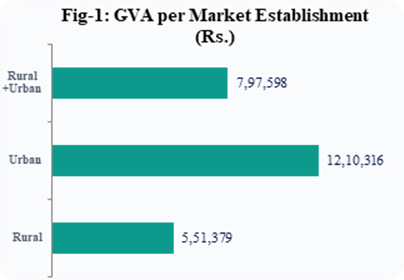
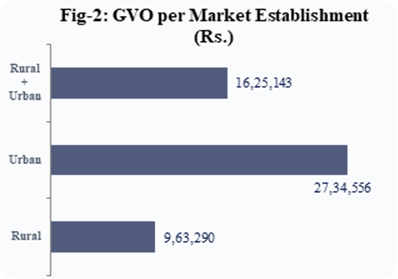
 

Title: GVA per Market Establishment (Rs.)

Financing Sources and Cost Composition of Household Construction Activities

On an average, about 97% of households reported their own income as one of the sources of fund to undertake construction activities, which accounted for approximately 77% of the total amount spent on construction.

Nearly 21% of households availed institutional (financial or non-financial) loan for financing their construction activities accounting for about 17% of the total construction expenditure. The proportion of households accessing institutional loans was higher in rural areas (23%) compared to urban areas (13%).

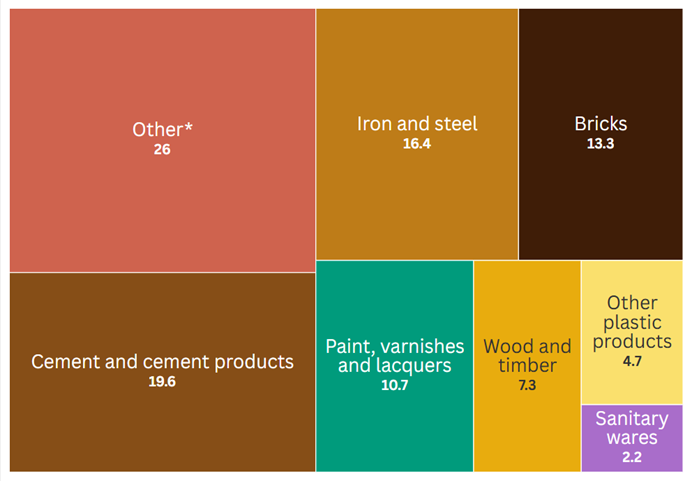
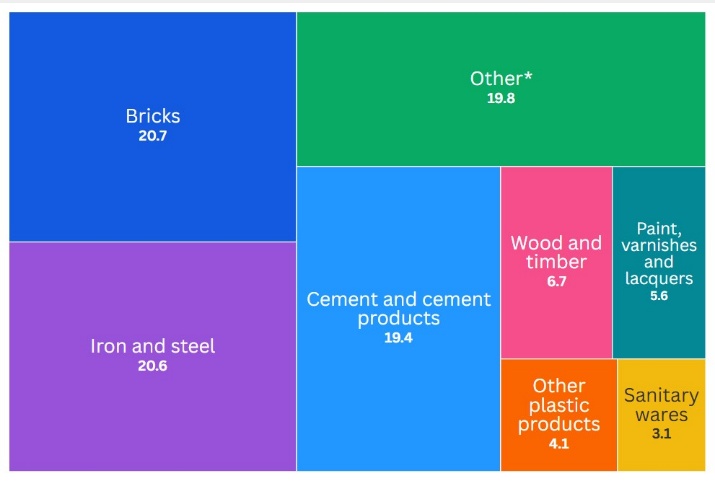
About three-fourths of household construction expenditure was on materials, with labour accounting for around 22 per cent. Within materials used for construction, bricks, cement, and iron and steel together comprised nearly 60 per cent of total expenditure.

Fig-3: Percentage Distribution of expenditure of materials: Household

*other includes petroleum, coal tar products, glass and glass products and other materials.

Fig-4: Percentage Distribution of expenditure of materials: Establishment

*other includes petroleum, coal tar products, glass and glass products and other materials.

Estimates of key indicators of the pilot study are given in Table 1 below. The detailed technical report also contains insights on major states and is available in the website of the Ministry (https://www.mospi.gov.in). Further, interactive tables and visualizations on other surveys conducted by NSO may be accessed on the Data Catalogue section of https://esankhyiki.mospi.gov.in/.

Table 1: Estimates of key indicators from Pilot Study on Construction Activities in Unincorporated Sector Establishments and Households

Indicator

Rural

Urban

Rural + Urban

(1)

(2)

(3)

(4)

Number of households undertaking own-account construction for own use

75,07,391

23,47,089

98,54,480

Number of establishments engaged in unincorporated construction activities

6,51,791

3,75,168

10,26,959

No. of Labourers engaged per household undertaking own account construction

4.2

4.4

4.3

No. of workers engaged per establishment in unincorporated construction activities

4.5

5.5

4.8

GVA per market establishment (Rs.)

5,51,379

12,10,316

7,97,598

Endnote: A brief about the coverage, sampling scheme, sample size and data collection mechanism in the Pilot Study on Construction Activities in Unincorporated Sector Establishments and Households:

A. Coverage of the pilot study:

A.1. Unincorporated Establishments: Market and non-market establishments engaged in construction activities

A.2. Households: own account construction undertaken by households for own use

A.3. Construction Activities: all activities under 2-digit NIC (2008) codes 41, 42 and 43 were considered in the definition of construction for the purpose of this pilot.

A.4.Expenditure on construction (for last 365 days or last financial year): Eligibility of establishments engaged in construction activities, as well as households undertaking own-account construction for own use, was determined based on whether their expenditure exceeded pre-specified thresholds, which varied by sector and type of sample entity. The expenditure threshold was set at ₹25,000 in rural areas and ₹50,000 in urban areas for establishments, and ₹10,000 in rural areas and ₹20,000 in urban areas for households. Any amount spent on construction below these cut-offs were not treated as construction work for this pilot study.

B. Sampling Scheme:

The survey has been conducted following a multi-stage stratified sampling scheme where first stage units (FSUs) were census villages in rural and UFS (Urban Frame Survey) blocks in urban areas.  The ultimate stage units (USU) were either establishments engaged in construction activities or households who has undertaken own account construction for own use.   

C. Sample Size:

In the pilot study, data were collected from a total of 19,154 households, 4,470 market establishments, and 717 non-market establishments pertaining to 11,981 surveyed FSUs (5,104 in rural and 6,877 in urban).

D. Data Collection Mechanism:

The pilot study has been conducted based on area frame and establishments/households have been listed in the selected FSUs of both rural and urban sector. Mostly, data were collected from the selected establishments/households through oral enquiry for the last 365 days. The data for the survey were collected in tablet using Computer Assisted Personal Interviewing (CAPI).

This pilot study has been carried out with Annual Survey of Unincorporated Sector Enterprises (ASUSE) 2025 in the same FSUs selected for the survey period July, 2025 – December, 2025. The listing schedule of ASUSE was suitably modified to accommodate the listing and selection of establishments and households undertaking construction under the coverage of the pilot study. The detailed establishment schedule was canvassed independently of ASUSE for collecting construction related information.

E. Detailed Technical Report of the Pilot Study:

For detailed understanding of the objectives, coverage, concepts, methodology and key findings from the pilot study one may refer to the Technical Report on Pilot Study on Construction Activities in Unincorporated Sector Establishments and Households published by NSO, MoSPI and available on the website of the ministry (https://www.mospi.gov.in).

Topics

Acts Income Tax