Loading...

Top
Help
×

By creating an account you can:

Logo TaxTMI
Call Us / Help / Feedback

Contact Us At :

E-mail: [email protected]

Call / WhatsApp at: +91 99117 96707

For more information, Check Contact Us

FAQs :

To know Frequently Asked Questions, Check FAQs

Most Asked Video Tutorials :

For more tutorials, Check Video Tutorials

Submit Feedback/Suggestion :

Email :
Please provide your email address so we can follow up on your feedback.
Category :
Description :
Min 15 characters 0/2000
Make Most of Text Search
  1. Checkout this video tutorial: How to search effectively on TaxTMI.
  2. Put words in double quotes for exact word search, eg: "income tax"
  3. Avoid noise words such as : 'and, of, the, a'
  4. Sort by Relevance to get the most relevant document.
  5. Press Enter to add multiple terms/multiple phrases, and then click on Search to Search.
  6. Text Search
  7. The system will try to fetch results that contains ALL your words.
  8. Once you add keywords, you'll see a new 'Search In' filter that makes your results even more precise.
  9. Text Search
Add to...
You have not created any category. Kindly create one to bookmark this item!
Create New Category
Hide
Title :
Description :
❮❮ Hide
Default View
Expand ❯❯
Close ✕
🔎 News - Adv. Search
TEXT SEARCH:

Press 'Enter' to add multiple search terms. Rules for Better Search

Search In:
Main Text + AI Text
  • Main Text
  • Main Text + AI Text
  • AI Text
Category: ?
Categorized by AI
---- All Categories ----
  • ---- All Categories ----
  • Income Tax
  • GST
  • Customs, DGFT & SEZ
  • FEMA & RBI
  • Corp. Laws, SEBI & IBC
  • PMLA, Black Money & ED
  • Budget
  • News and Press Release
  • PTI News
Month:
---- All Months ----
  • ---- All Months ----
  • January
  • February
  • March
  • April
  • May
  • June
  • July
  • August
  • September
  • October
  • November
  • December
Year:
---- All Years ----
  • ---- All Years ----
  • 2026
  • 2025
  • 2024
  • 2023
  • 2022
  • 2021
  • 2020
  • 2019
  • 2018
  • 2017
  • 2016
  • 2015
  • 2014
  • 2013
  • 2012
  • 2011
Sort By: ?
In Sort By 'Default', exact matches for text search are shown at the top, followed by the remaining results in their regular order.
Relevance Default Date
    Puri heads to Qatar amid energy supply disruptions
    PIL in SC seeks stringent guidelines for issuing Aadhaar cards to adolescents, adults
    Financial Intelligence Unit-India and Indian Cyber Crime Coordination Centre sign landmark mou to combat cyber fraud and financial crimes
    Manohar Lal arrives in Bhutan on 4-day visit; focus on energy security, sustainable development
    RBI Issues Draft Directions for ‘Trade Receivables Discounting System’
    RBI invites comments on Draft “Reserve Bank of India (Governance) Amendment Directions, 2026”
    RBI invites public comments on the draft Amendment Directions on ‘Investment Fluctuation Reserve’
    RBI invites public comments on Draft Amendment Directions on ‘Review of guidelines on inclusion of quarterly profits to Common Equity Tier 1 (CET1) ...
    NITI Aayog calls for 'Operation Golden Green' to boost J&K's horticulture sector, increase exports
    The Dow surges 1,300 in worldwide rally as oil plunges toward USD 90 following ceasefire with Iran
    Goa nightclub fire: ED attaches assets worth over Rs 17 crore
    Rupee surges 52 paise to close at 92.54/USD on US-Iran ceasefire, RBI pause on policy rates
    Investors' wealth surges by Rs 16.25 lakh cr as stock markets celebrate US-Iran ceasefire
    HDFC Bank's board minutes reviewed, no concern on ethics and governance: RBI
    Connecting the Globe, Empowering Green Energy: China International Battery Fair 2026 Shapes the Next Era of Battery Technology
    Rupee likely to stabilise at 92-93, growth of 7-8pc key for developed India: EAC-PM chief
    Sensex, Nifty soar nearly 4 pc on US-Iran ceasefire, correction in crude prices
    US-Iran ceasefire set to ease pressure on India's energy supplies
    Cabinet approves Investment Proposal for construction of 1200 MW Kalai-II Hydro Electric Project in Anjaw District of Arunachal Pradesh with an outlay...
    Cabinet approves Investment Proposal for construction of 1720 MW Kamala Hydro Electric Project in Kamle, Kra Daadi & Kurung Kumey Districts of Arunach...
❯❯
Maximize Maximize Maximize
0 / 200
Expand Note
Add to Folder

No Folders have been created

+

Are you sure you want to delete "My most important" ?

NOTE:

News
Showing Results for :
Reset Filters
Results Found:
Show All Summaries Hide All Summaries
April 9, 2026
Show AI Summary
Energy supply security drives talks on restoring LNG and LPG shipments amid Middle East disruptions.
India is seeking to secure uninterrupted energy supplies amid geopolitical disruptions that have affected liquefied natural gas and LPG flows from the Middle East. Qatar, India's largest supplier of LNG and a major supplier of cooking gas, had halted supplies after the conflict in the region and the shutdown of a key export facility led to a declaration of force majeure on gas exports. Discussions are expected to centre on resumption of shipments, review of existing arrangements and strengthening bilateral energy cooperation.
April 9, 2026
Show AI Summary
Aadhaar enrolment safeguards sought to prevent misuse of identity documents and curb improper citizenship claims.
Public interest litigation seeks directions to restrict fresh Aadhaar issuance to children up to six years of age and to frame stricter guidelines for adolescents and adults to prevent misuse by infiltrators or foreigners masquerading as Indian citizens. It also seeks display notices at common service centres stating that Aadhaar is only proof of identity and not proof of citizenship, address, or date of birth, and alleges that weak verification enables improper enrolment and acquisition of other identity documents.
April 9, 2026
Show AI Summary
Cyber fraud prevention through intelligence sharing and coordinated action now strengthened by a new inter-agency memorandum.
The Financial Intelligence Unit-India and the Indian Cyber Crime Coordination Centre entered into a Memorandum of Understanding to strengthen coordination in combating cyber fraud and financial crimes. The arrangement provides for enhanced information sharing, development of operational intelligence, and support to investigative agencies for prevention of financial crimes, protection of digital transactions, and asset recovery. It also contemplates feedback mechanisms to improve fraud detection and the dissemination of guidelines and red flag indicators for financial institutions.
April 9, 2026
Show AI Summary
Energy security and cross-border power trade shape India-Bhutan cooperation through hydropower, clean energy and technical agreements.
India-Bhutan bilateral engagement focused on strengthening cooperation in energy security, sustainable development, clean energy, hydropower and regional power trade. Discussions covered an enhanced bilateral institutional framework for regular review and coordination of initiatives, including non-hydro energy, cross-border transmission, project financing, capacity building and institutional partnerships. The parties also signed the Tariff Protocol for the Punatsangchhu-II Hydroelectric Project and a methodology for reactive energy accounting to support grid stability and cross-border electricity exchange.
April 9, 2026
Show AI Summary
Trade Receivables Discounting System directions seek to harmonise TReDS guidelines and support MSME receivables financing.
Reserve Bank of India has released draft Trade Receivables Discounting System Directions to rationalise and harmonise the existing guidelines governing TReDS platforms. The draft framework is intended to support financing of MSME trade receivables through regulated discounting mechanisms. The draft Directions have been issued for public consultation, and comments or feedback may be submitted by regulated entities and other stakeholders through the prescribed online regulatory feedback channel within the stipulated consultation period.
April 9, 2026
Show AI Summary
Bank board governance reform shifts to principle-based guidance after RBI issues draft amendment directions for public consultation.
Reserve Bank of India has issued draft governance amendment directions for commercial banks, small finance banks, payments banks and local area banks for public comments. The proposed changes follow a comprehensive review and rationalisation of existing instructions on matters to be placed before bank boards, including their periodicity, so that boards may focus more effectively on strategy and risk governance. The draft framework replaces the earlier seven broad themes with principle-based guidance on board matters and retains RBI's ability to mandate policies and items for board approval, review or information.
April 9, 2026
Show AI Summary
Investment Fluctuation Reserve rules updated through draft directions to align bank-wise prudential treatment and reporting clarity.
Reserve Bank of India has placed draft Amendment Directions for public comments to revise the framework on Investment Fluctuation Reserve across multiple categories of banks, together with related amendments on capital adequacy and financial statement disclosures. The draft seeks to modify the existing instructions governing classification, valuation and operation of investment portfolios and the treatment of IFR under the applicable prudential framework. The proposed changes aim to address operational difficulties, align instructions across bank categories, dispense with the IFR requirement for certain banks, require compliance as on balance-sheet dates, and harmonise related instructions for regulatory clarity.
April 9, 2026
Show AI Summary
Common Equity Tier 1 capital rules revised as quarterly profit recognition conditions for CRAR are proposed for removal.
Reserve Bank of India has issued draft amendment directions on the inclusion of quarterly profits in Common Equity Tier 1 capital for CRAR computation by commercial banks, small finance banks and payments banks. The draft proposes revisions to the prudential norms on capital adequacy and invites public comments. The existing rule for commercial banks permits quarterly recognition of current-year profits for CRAR calculation subject to a condition on incremental provisions for non-performing assets, and the proposed review removes that qualifying condition.
April 8, 2026
Show AI Summary
Horticulture development roadmap targets export growth, stronger production, and better market linkages for Jammu and Kashmir crops.
Operation Golden Greens proposes a phased horticulture development roadmap for Jammu and Kashmir centred on five sub-missions for dry fruits, fresh fruits, vegetables, floriculture and minor crops. The plan seeks to raise production, improve quality, strengthen market linkages and expand exports of apple, walnut, almond and saffron through branding, irrigation support, storage and cold-chain infrastructure, grading, packaging, processing, CA storage and high-density plantations.
April 8, 2026
Show AI Summary
Ceasefire-driven oil supply relief lifts global stocks as Strait of Hormuz disruption fears ease.
Global markets rallied and crude oil prices fell after a two-week ceasefire eased fears of disruption to shipping through the Strait of Hormuz and the flow of oil from the Persian Gulf. The article notes that uncertainty remained over whether maritime traffic would normalise and whether the truce would last, but the immediate effect was a sharp recovery in stocks, especially energy-sensitive sectors, and lower Treasury yields as inflation concerns eased.
April 8, 2026
Show AI Summary
Money-laundering investigation leads to provisional attachment over alleged illegal nightclub operation and forged compliance documents.
Money-laundering investigation under the Prevention of Money Laundering Act concerned a Goa nightclub allegedly operated without mandatory statutory approvals, including the requisite fire no objection certificate and a valid trade licence. The Enforcement Directorate issued a provisional attachment of immovable assets valued at Rs 17.45 crore, stating that the properties were connected with the suspected illegal operation of the establishment and were situated in Goa. The agency alleged that forged documents were used to obtain licences and that revenue from the alleged illegal operation constituted proceeds of crime.
April 8, 2026
Show AI Summary
Rupee recovery and unchanged RBI policy reflect easing geopolitical stress, softer crude, and cautious monetary outlook.
The rupee appreciated against the US dollar after easing geopolitical tensions, a softer dollar index and lower crude oil sentiment. The Reserve Bank of India kept the key policy rate unchanged and maintained a neutral stance, assessing the impact of the West Asia conflict on energy supplies, inflation, growth and trade flows. It also projected higher crude oil prices and a weaker rupee for the next financial period.
April 8, 2026
Show AI Summary
Repo rate unchanged as geopolitical uncertainty eases and equity markets rally on lower crude prices.
Equity markets rallied sharply after a two-week US-Iran ceasefire, with broad gains across stocks, sectoral indices and market capitalisation. The surge was linked to lower crude prices, reduced geopolitical uncertainty and improved risk sentiment, with comments noting support for inflation, the current account deficit, the rupee and fiscal conditions. The Reserve Bank of India kept the benchmark repo rate unchanged at 5.25 per cent and maintained a neutral stance as policymakers assessed uncertainty from the West Asia conflict, including risks to energy supplies, inflation, growth, trade flows and currency stability.
April 8, 2026
Show AI Summary
Banking supervision review confirms no governance concern and no present need for regulatory changes.
Banking sector supervision includes review of board minutes and related records as part of regular oversight. The supervisory review disclosed no governance or conduct-related material issue, and the regulator stated that no change in guidelines is presently considered necessary, though further directions may be introduced if future circumstances require them. Reported fraud incidents were characterised as criminal activity involving colluding individuals, with no present indication of systemic risk or need for a regulatory tweak.
April 8, 2026
Show AI Summary
Battery industry transition toward higher-value lithium-ion, energy storage, and low-carbon manufacturing takes center stage at a major exhibition.
China's battery sector is described as shifting from scale toward higher-value lithium-ion products, power batteries, energy storage technologies, smart manufacturing, and lower-emission production. The 18th China International Battery Fair is presented as a major international exhibition covering batteries, materials, manufacturing equipment, system solutions, and recycling applications, with forums on advanced batteries, new energy storage, battery carbon-footprint management, and battery passport themes.
April 8, 2026
Show AI Summary
Rupee stability and high-growth reforms frame India's path to developed nation status amid global uncertainty.
The Indian Rupee is expected to stabilise around the 92-93 level against the US dollar, with pressure attributed to global geopolitical headwinds and foreign institutional investor withdrawals. Strong macroeconomic fundamentals, fiscal space, and a comfortable current account deficit are described as supporting currency resilience, while the Reserve Bank of India's decision to keep policy rates unchanged is characterised as appropriate in the prevailing environment.
April 8, 2026
Show AI Summary
Crude price correction and ceasefire-led sentiment drive a broad equity rally as the central bank holds policy steady.
Equity benchmark indices rallied sharply as global risk sentiment improved following a temporary US-Iran ceasefire, which triggered a steep correction in crude oil prices and eased concerns over inflation, growth and energy supply disruptions. Broad-based buying across sectors, stronger global markets and a firmer rupee supported the advance, while Indian volatility eased and sectoral indices, mid-cap stocks and small-cap stocks also moved higher. Brent crude fell sharply and Asian and European markets recorded strong gains, reflecting the wider recovery in market sentiment.
April 8, 2026
Show AI Summary
Strait of Hormuz supply disruption eases as ceasefire improves tanker movement and steadies India's energy imports.
A conditional ceasefire between the United States and Iran eased pressure on India's energy supplies by lowering crude prices and improving prospects for transit through the Strait of Hormuz. India had earlier reduced LPG and natural gas supplies, then partially restored them as alternative sources were secured, while directing city gas distributors to prioritise piped natural gas connections for commercial users. Shipping authorities aimed to move stranded vessels before resuming trade.
April 8, 2026
Show AI Summary
Hydro electric project investment approval strengthens power supply, enables infrastructure development, and provides free power and local area benefits.
Investment approval is granted for construction of the Kalai-II Hydro Electric Project on the Lohit river in Anjaw District of Arunachal Pradesh, with an installed capacity of 1200 MW and an estimated completion period of 78 months. The project is expected to generate annual energy output and to strengthen power supply in the State, assist in peak demand management, and contribute to balancing the national grid. The arrangement provides for 12% free power to the State and an additional 1% earmarked for the Local Area Development Fund.
April 8, 2026
Show AI Summary
Hydroelectric project approval strengthens power supply, grid balancing and regional infrastructure development in Arunachal Pradesh.
Cabinet approval was granted for investment in the construction of the Kamala Hydro Electric Project in Arunachal Pradesh through a joint venture between NHPC Limited and the Government of Arunachal Pradesh. The project is intended to generate energy, support power supply and peak demand management, contribute to grid balancing and provide flood moderation benefits, while also including budgetary support for flood moderation and enabling infrastructure. The State is stated to receive free power, a Local Area Development Fund share and wider infrastructure and socio-economic benefits.

News

Back

All News

Showing Results for :
Reset Filters
No Records Found

News

Showing Results for : Reset Filters
News and Press Release

MoSPI Breaks New Ground: First-Ever Deep Dive into Unincorporated Construction Sector in Decades

April 11, 2026

Contents
Summary
Note

Note

-

Bookmark

Print

Print

Nearly 1 crore households built their own homes or undertook construction for self-use

10 Lakh+ Small Builders Power Economy: Unincorporated Construction Sector Comes into Focus

Snapshot:

  • MoSPI releases the technical report of pilot study on construction - marking NSO’s first such effort in decades to estimate key economic indicators of construction activities in the unincorporated sector and own-account household construction in a reference period of last 365 days.
  • During the reference period, an estimated 98.54 lakh households undertook own-account construction for their own use.
  • 10.27 lakh construction agencies (unincorporated establishments) were estimated to be engaged in this sector.
  • Approximately 77 per cent of these agencies engaged at least one hired worker on a fairly regular basis.
  • Estimated average value of fixed assets owned by such construction establishments was ₹5.21 lakh.
  • Nearly 23% of rural households undertaking own-account construction for own-use availed institutional funding reflecting increasing access to formal credit in rural areas.

The Ministry of Statistics and Programme Implementation (MoSPI) has released a technical report presenting the key findings from a Pilot study conducted on Construction Activities in Unincorporated Sector Establishments and Households. This study marks the first comprehensive attempt in decades by the National Statistics Office (NSO) to estimate key economic indicators for construction activities undertaken by unincorporated construction agencies (establishments engaged in construction activity), as well as own-account construction carried out by households for their own use. The study underscores MoSPI’s sustained efforts to bridge critical data gaps in sectors where reliable information has been limited. Data from the pilot study also served as an important input for the revised series of the national accounts statistics brought out by MoSPI. A brief overview of the pilot study in terms of coverage, sampling strategy, data collection mechanism, etc., is provided in the Endnote.

The construction sector plays a crucial role in Indian economy, serving both as a driver of growth and an indicator of economic progress. As a key engine of development, it contributes significantly to output, employment, and capital formation, while maintaining strong backward and forward linkages with various other sub-sectors of the economy. While the incorporated segment of the construction sector is to be covered under the recently launched Annual Survey of Incorporated Services Sector Enterprises (ASISSE), data remains limited for unincorporated construction enterprises and households undertaking own-account construction for own use in India. Recognizing the importance of generating robust and reliable estimates of key economic parameters in the construction sector, this pilot study was undertaken alongside Annual Survey of Unincorporated Sector Enterprises (ASUSE) 2025 in the same First Stage Units (FSUs) during the survey period from July to December 2025.

The pilot study, apart from capturing expenses and receipts, was designed to collect key information on employment and a broader set of economic parameters for construction establishments (both market and non-market), including fixed assets, outstanding loans, and various components of expenditure. For households, it focuses on capturing expenditure on construction activities, details of labour engagement, and sources of finance.

The findings of this pilot study served as a crucial input for the National Accounts Division (NAD) in updating and refining the rates and ratios used for estimating several economic indicators in the construction sector under the new series of national accounts.

Estimated number of construction activities undertaken:

It was estimated that 98.54 lakh households have undertaken construction during last 365 days (the reference period of the estimates)[1]. It was also estimated that 10.27 lakh unincorporated construction agencies were engaged in this sector which included both market and non-market establishment.

Average number of worker engaged in the construction sector:

On an average, an unincorporated builder establishment engaged in construction activities employed about five workers during the reference period. Further, approximately 77 per cent of such establishments reported engaging at least one hired worker on a fairly regular basis.

A household undertaking own-account construction for its own use during the reference period engaged around four labourers on an average.

Fixed Assets and Loan:

Fixed assets owned per unincorporated establishment engaged in construction activity has been estimated to be ₹5.21 lakh. The financial access, as reflected by the outstanding loan per establishment in the sector, was estimated to be little more than ₹1.40 lakh.

Value Addition and productivity:

The GVA per market establishment[2] for the unincorporated construction sector was estimated to be about Rs. 7.98 lakh and the corresponding output per establishment was Rs. 16.25 lakh.

The NVA and output per non-market establishment was observed to be Rs. 2.77 lakh and Rs. 5.59 lakh respectively.
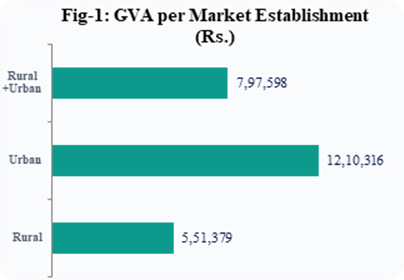
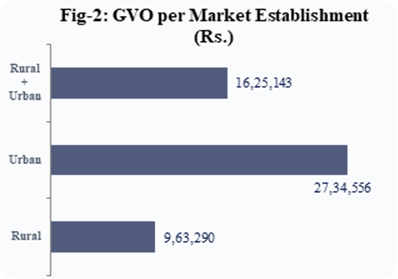
 

Title: GVA per Market Establishment (Rs.)

Financing Sources and Cost Composition of Household Construction Activities

On an average, about 97% of households reported their own income as one of the sources of fund to undertake construction activities, which accounted for approximately 77% of the total amount spent on construction.

Nearly 21% of households availed institutional (financial or non-financial) loan for financing their construction activities accounting for about 17% of the total construction expenditure. The proportion of households accessing institutional loans was higher in rural areas (23%) compared to urban areas (13%).

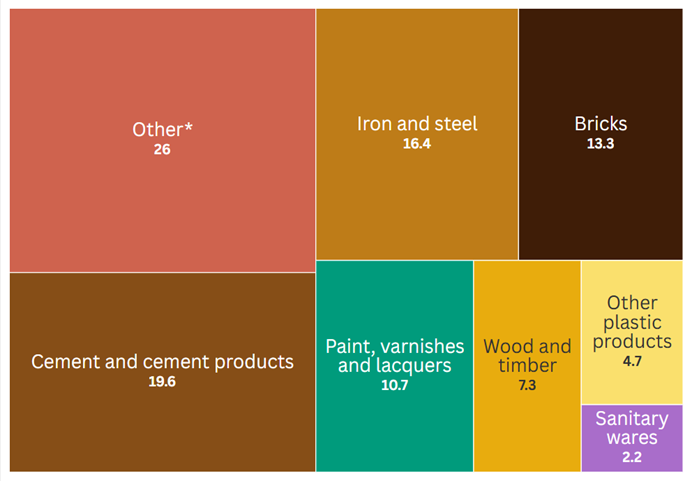
About three-fourths of household construction expenditure was on materials, with labour accounting for around 22 per cent. Within materials used for construction, bricks, cement, and iron and steel together comprised nearly 60 per cent of total expenditure.

Fig-3: Percentage Distribution of expenditure of materials: Household

*other includes petroleum, coal tar products, glass and glass products and other materials.

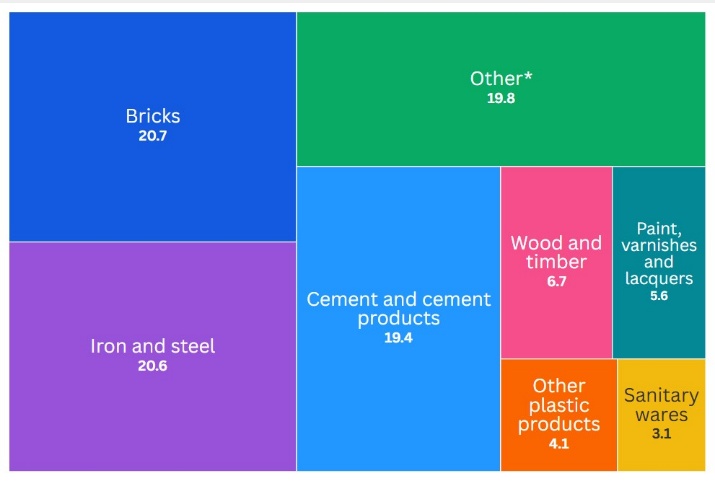
Fig-4: Percentage Distribution of expenditure of materials: Establishment

*other includes petroleum, coal tar products, glass and glass products and other materials.

Estimates of key indicators of the pilot study are given in Table 1 below. The detailed technical report also contains insights on major states and is available in the website of the Ministry (https://www.mospi.gov.in). Further, interactive tables and visualizations on other surveys conducted by NSO may be accessed on the Data Catalogue section of https://esankhyiki.mospi.gov.in/.

Table 1: Estimates of key indicators from Pilot Study on Construction Activities in Unincorporated Sector Establishments and Households

Indicator

Rural

Urban

Rural + Urban

(1)

(2)

(3)

(4)

Number of households undertaking own-account construction for own use

75,07,391

23,47,089

98,54,480

Number of establishments engaged in unincorporated construction activities

6,51,791

3,75,168

10,26,959

No. of Labourers engaged per household undertaking own account construction

4.2

4.4

4.3

No. of workers engaged per establishment in unincorporated construction activities

4.5

5.5

4.8

GVA per market establishment (Rs.)

5,51,379

12,10,316

7,97,598

Endnote: A brief about the coverage, sampling scheme, sample size and data collection mechanism in the Pilot Study on Construction Activities in Unincorporated Sector Establishments and Households:

A. Coverage of the pilot study:

A.1. Unincorporated Establishments: Market and non-market establishments engaged in construction activities

A.2. Households: own account construction undertaken by households for own use

A.3. Construction Activities: all activities under 2-digit NIC (2008) codes 41, 42 and 43 were considered in the definition of construction for the purpose of this pilot.

A.4.Expenditure on construction (for last 365 days or last financial year): Eligibility of establishments engaged in construction activities, as well as households undertaking own-account construction for own use, was determined based on whether their expenditure exceeded pre-specified thresholds, which varied by sector and type of sample entity. The expenditure threshold was set at ₹25,000 in rural areas and ₹50,000 in urban areas for establishments, and ₹10,000 in rural areas and ₹20,000 in urban areas for households. Any amount spent on construction below these cut-offs were not treated as construction work for this pilot study.

B. Sampling Scheme:

The survey has been conducted following a multi-stage stratified sampling scheme where first stage units (FSUs) were census villages in rural and UFS (Urban Frame Survey) blocks in urban areas.  The ultimate stage units (USU) were either establishments engaged in construction activities or households who has undertaken own account construction for own use.   

C. Sample Size:

In the pilot study, data were collected from a total of 19,154 households, 4,470 market establishments, and 717 non-market establishments pertaining to 11,981 surveyed FSUs (5,104 in rural and 6,877 in urban).

D. Data Collection Mechanism:

The pilot study has been conducted based on area frame and establishments/households have been listed in the selected FSUs of both rural and urban sector. Mostly, data were collected from the selected establishments/households through oral enquiry for the last 365 days. The data for the survey were collected in tablet using Computer Assisted Personal Interviewing (CAPI).

This pilot study has been carried out with Annual Survey of Unincorporated Sector Enterprises (ASUSE) 2025 in the same FSUs selected for the survey period July, 2025 – December, 2025. The listing schedule of ASUSE was suitably modified to accommodate the listing and selection of establishments and households undertaking construction under the coverage of the pilot study. The detailed establishment schedule was canvassed independently of ASUSE for collecting construction related information.

E. Detailed Technical Report of the Pilot Study:

For detailed understanding of the objectives, coverage, concepts, methodology and key findings from the pilot study one may refer to the Technical Report on Pilot Study on Construction Activities in Unincorporated Sector Establishments and Households published by NSO, MoSPI and available on the website of the ministry (https://www.mospi.gov.in).

Topics

Acts Income Tax