Loading...

Top
Help
×

By creating an account you can:

Logo TaxTMI
Call Us / Help / Feedback

Contact Us At :

E-mail: [email protected]

Call / WhatsApp at: +91 99117 96707

For more information, Check Contact Us

FAQs :

To know Frequently Asked Questions, Check FAQs

Most Asked Video Tutorials :

For more tutorials, Check Video Tutorials

Submit Feedback/Suggestion :

Email :
Please provide your email address so we can follow up on your feedback.
Category :
Description :
Min 15 characters 0/2000
Make Most of Text Search
  1. Checkout this video tutorial: How to search effectively on TaxTMI.
  2. Put words in double quotes for exact word search, eg: "income tax"
  3. Avoid noise words such as : 'and, of, the, a'
  4. Sort by Relevance to get the most relevant document.
  5. Press Enter to add multiple terms/multiple phrases, and then click on Search to Search.
  6. Text Search
  7. The system will try to fetch results that contains ALL your words.
  8. Once you add keywords, you'll see a new 'Search In' filter that makes your results even more precise.
  9. Text Search
Add to...
You have not created any category. Kindly create one to bookmark this item!
Create New Category
Hide
Title :
Description :
❮❮ Hide
Default View
Expand ❯❯
Close ✕
🔎 News - Adv. Search
TEXT SEARCH:

Press 'Enter' to add multiple search terms. Rules for Better Search

Search In:
Main Text + AI Text
  • Main Text
  • Main Text + AI Text
  • AI Text
Category: ?
Categorized by AI
---- All Categories ----
  • ---- All Categories ----
  • Income Tax
  • GST
  • Customs, DGFT & SEZ
  • FEMA & RBI
  • Corp. Laws, SEBI & IBC
  • PMLA, Black Money & ED
  • Budget
  • News and Press Release
  • PTI News
Month:
---- All Months ----
  • ---- All Months ----
  • January
  • February
  • March
  • April
  • May
  • June
  • July
  • August
  • September
  • October
  • November
  • December
Year:
---- All Years ----
  • ---- All Years ----
  • 2026
  • 2025
  • 2024
  • 2023
  • 2022
  • 2021
  • 2020
  • 2019
  • 2018
  • 2017
  • 2016
  • 2015
  • 2014
  • 2013
  • 2012
  • 2011
Sort By: ?
In Sort By 'Default', exact matches for text search are shown at the top, followed by the remaining results in their regular order.
Relevance Default Date
❯❯
Maximize Maximize Maximize
0 / 200
Expand Note
Add to Folder

No Folders have been created

+

Are you sure you want to delete "My most important" ?

NOTE:

News
Showing Results for :
Reset Filters
Results Found:
Show All Summaries Hide All Summaries
April 2, 2026
Show AI Summary
Foreign exchange counters at airports can now exchange Indian rupee notes for residents and non-residents beyond immigration controls.
Residents, as well as non-residents, may exchange Indian rupee notes at foreign exchange counters in departure halls of international airports beyond the immigration or customs desk. The earlier facility at such counters was limited to buying Indian rupees from non-residents and selling foreign currency to them. The Master Direction on Money Changing Activities is being amended to reflect the expanded exchange scope.
April 2, 2026
Show AI Summary
Tax deduction statements for non-resident payments require quarterly electronic filing, with correction statements allowed after processing.
Form No. 144 is the quarterly statement for deduction of tax at source on payments other than salary made to non-residents. It is mandatory for every deductor required to deduct tax on such payments, must be filed electronically within the prescribed quarterly due dates, and cannot be edited after submission. Corrections may be filed after processing by CPC-TDS within two years from the end of the relevant tax year. Successful filing on TRACES generates an Acknowledgment Receipt Number.
April 2, 2026
Show AI Summary
LPG supply prioritisation reshapes refinery allocations as propylene is partly redirected to ease petrochemical shortages.
The government has adjusted refinery output directions in response to LPG import disruptions and petrochemical feedstock shortages. After requiring C3 and C4 streams to be used exclusively for LPG production, the Ministry later allowed part of the propylene supply to return to the petrochemical industry. The policy is presented as a balance between domestic LPG supply security and the needs of sectors such as packaging and condom manufacturing, alongside partial restoration and enhancement of commercial LPG allocations for priority consumers.
April 2, 2026
Show AI Summary
Tax collected at source reporting through Form 143 streamlines quarterly filing, certificate issuance, and collectee credit tracking.
Quarterly reporting of tax collected at source is filed in Form No. 143 by collectors responsible for collection on specified transactions under the Income-tax Act, 2025. The form requires collector particulars, challan and deposit details, and collectee-wise annexure information on amounts, dates, rates, tax collected and deposited, with quarterly due dates and utility-based electronic filing. Processing may lead to default corrections, issuance of the collectee tax certificate, and reflection of TCS as credit in the collectee's tax record.
April 2, 2026
Show AI Summary
Tax collection at source statement filing requires quarterly electronic submission, correction limits, and acknowledgment on the portal.
Form No. 143 is the mandatory quarterly electronic statement for collection of tax at source on specified goods and transactions, to be filed by the collector, seller, operator or authorised person responsible for collection at the time of debit or receipt of payment. It follows a quarterly due-date schedule, cannot be edited after submission, and may be corrected only through a correction statement after processing by CPC-TDS, within two years from the end of the relevant tax year. Successful filing generates an Acknowledgment Receipt Number on the TRACES portal.
April 2, 2026
Show AI Summary
Virtual Digital Asset TDS reporting requires quarterly electronic filing by exchanges with transaction-wise deduction, exemption, and challan details.
Form No. 142 is the quarterly electronic statement to be furnished by a Virtual Digital Asset exchange for reporting tax deducted at source on transfer of virtual digital assets and transactions where tax was not deducted under the notified exemption framework. It must be filed with the Director General of Income-tax (Systems) and includes exchange particulars, transaction details, challan data and a declaration of correctness. The filing process uses the e-filing portal and supports smart features such as auto-population, validation, API integration and standardised fields.
April 2, 2026
Show AI Summary
Virtual digital asset tax reporting requires quarterly exchange filing, full tax deposit, and electronic submission with challan details.
Form No. 142 is a PAN-based quarterly statement to be filed electronically by a Virtual Digital Asset exchange that has agreed to deposit tax on transfers of virtual digital assets in place of deduction by the buyer or broker. It applies to VDA transactions where the exchange deposits tax, including purchase, exchange, and partly or fully in-kind settlements, and is mandatory for reporting transactions covered by the prescribed TDS mechanism. The form is filed quarterly, captures exchange, buyer or broker, transaction, and challan details, and requires full tax deposit before submission.
April 2, 2026
Show AI Summary
Combined TDS Form 141 streamlines reporting for rent, property, professional fees, and virtual digital asset transfers.
Form No. 141 is the combined PAN-based challan-cum-statement for reporting and depositing tax deducted at source on rent, transfer of immovable property, specified professional, contract, commission and brokerage payments, and transfer of virtual digital assets. It replaces the earlier separate Forms 26QB, 26QC, 26QD and 26QE, is filed electronically within 30 days from the end of the month of deduction, and uses separate schedules for each transaction category. The revised form also allows consolidated reporting for same-status parties and introduces prefilled details, smart validations, standardised fields, and correction mechanisms.
April 2, 2026
Show AI Summary
Settlement-linked quashing of proceedings keeps SEBI closure issue alive for Sterling Biotech and the Sandesara brothers.
Settlement-linked quashing of proceedings concerning Sterling Biotech Limited and the Sandesara brothers remained under consideration, with the Supreme Court indicating that SEBI must close its proceedings in view of the earlier order under which deposit of the settlement amount was to trigger quashing of all proceedings. The Court recorded that the amount had already been deposited in the registry and that the earlier order had been given effect to, while SEBI sought time after internal deliberations on the closure issue.
April 2, 2026
Show AI Summary
Trade liberalisation under India-Australia ECTA expands market access, boosts exports, and advances zero-duty access for Indian goods.
India-Australia Economic Cooperation and Trade Agreement has completed four years, marking stronger bilateral economic engagement through expanded market access, reduced trade barriers, and deeper trade and supply-chain linkages. India has granted preferential access on 70.3% of its tariff lines, while Australia has granted preferential access on 100% of its tariff lines and imports from India, with most lines duty-free immediately and all Indian exports eligible for zero-duty access from 1 January 2026. The Mutual Recognition Arrangement on Organic Products supports trade by recognising certification systems and reducing duplication, cost, and time.
April 2, 2026
Show AI Summary
Customs duty exemption on critical petrochemical inputs aims to ease supply disruptions and support downstream manufacturing.
Full customs duty exemption is granted on critical petrochemical products as a temporary and targeted relief measure in response to the ongoing conflict in West Asia and resulting supply chain disruptions. The exemption continues until 30 June 2026 and is intended to ensure continued availability of essential petrochemical inputs for domestic industry, reduce cost pressures on downstream sectors, and maintain supply stability. The notified products cover petrochemical feedstock, intermediates and related industrial inputs used across multiple manufacturing sectors.
April 2, 2026
Show AI Summary
Consolidated TDS reporting through Form 141 streamlines tax deduction filing, schedule-wise payment, and compliance for specified transactions.
Form No. 141 is a single consolidated challan-cum-statement for reporting and payment of tax deducted at source on specified transactions through separate schedules instead of multiple standalone forms. It replaces Forms 26QB, 26QC, 26QD and 26QE, and requires only the relevant schedule to be completed for the transaction reported. The form is filed using PAN, not TAN, and is available for rent, immovable property, contractor or professional payments, and transfer of virtual digital assets, with one transaction type per form.
April 2, 2026
Show AI Summary
Defence exports growth reflects India's indigenous manufacturing strength, wider global acceptance, and streamlined export regulation.
India's defence exports recorded a new high, driven by indigenous manufacturing strength, wider global acceptance of Indian defence products, and a collaborative ecosystem involving defence public sector undertakings and private industry. The exports reached more than 80 countries, while the number of exporters increased, reflecting growing participation in the sector. The ministry also noted that streamlined export regulatory processes, a revamped online portal, and simplified authorisation procedures supported this growth.
April 2, 2026
Show AI Summary
Foreign exchange market restrictions by RBI drove dollar unwinding and triggered a meaningful rupee rebound.
RBI took twin foreign exchange market restrictions by capping banks' net open rupee positions and barring non-deliverable forward offerings to corporates. The measures were directed at limiting banks' activity in onshore forward markets and were described as forcing dollar unwinding, thereby producing a meaningful rebound in the rupee.
April 2, 2026
Show AI Summary
Quarterly TDS statement for non-salary payments requires deductor details, deductee-wise reporting, and prescribed filing steps.
Form No. 140 is the quarterly TDS statement for non-salary payments to resident deductees, filed by persons responsible for deduction of tax on specified payments such as interest, commission, brokerage, professional fees, and rent. The form requires deductor particulars, tax payment details, and a deductee-wise annexure covering PAN, amount paid or credited, tax deducted and deposited, deduction rate, and related certificate details. Filing is quarterly, supported by challans and PAN details, and involves preparation, validation, and upload through the prescribed electronic or facilitation-centre process.
April 2, 2026
Show AI Summary
Foreign exchange market curbs drive rupee higher as banks adjust positions under Reserve Bank restrictions.
Reserve Bank of India measures to curb banks' activity in the onshore and derivative foreign exchange markets led to a sharp appreciation in the rupee after recent volatility and heavy pressure from capital outflows, a stronger dollar and higher crude prices. The central bank capped the net open position on the Indian rupee for banks at USD 100 million and required compliance by a specified deadline, while also restricting authorised dealers from offering non-deliverable derivative contracts involving the rupee to resident or non-resident users. Users were further barred from rebooking foreign exchange derivative contracts, whether deliverable or non-deliverable, once cancelled after the issuance of the instructions.
April 2, 2026
Show AI Summary
Tax deduction statement filing governs quarterly reporting, electronic submission, correction limits, and acknowledgment for non-salary resident payments.
Form No. 140 is the quarterly electronic statement of deduction of tax at source for non-salary payments made to resident deductees, and it is mandatory for all deductors responsible for such payments. It must be filed within the prescribed quarterly due dates, cannot be edited after submission, and corrections may be filed only after processing by CPC-TDS within the specified two-year time limit. Successful filing on the TRACES portal generates an Acknowledgment Receipt Number.
April 2, 2026
Show AI Summary
Excess TDS and TCS refund claims move through a TRACES-based electronic form with pre-filled challan details and digital signing.
Form No. 139 is the electronic refund application by which a deductor, collector, or eligible taxpayer may claim refund of excess tax paid under Chapter XIX. Filing is permitted where the corresponding TDS or TCS statement has been processed and the excess remains as an unmatched or unconsumed challan credit. The application requires challan particulars, utilisation details, refund amount, declaration, digital signature, and supporting bank and tax records.
April 2, 2026
Show AI Summary
Excess TDS/TCS refund claims under Form No. 139 must be filed online, after processing, and only when credit remains unallowed.
Form No. 139 is the prescribed online application for a deductor or collector to claim refund of excess TDS/TCS deposited under Chapter XIX-B of the Income-tax Act, 2025, where the excess is not adjusted against any other liability in the system. The form may be filed only after the relevant statement has been processed, cannot be edited after acknowledgment is generated, and is not maintainable once the deductee has been allowed credit for the same tax. Approved refunds, along with interest, are credited to the prevalidated bank account, and refund arising from appellate or rectification orders does not require filing of the form.
April 2, 2026
Show AI Summary
Quarterly TDS statement for salary and specified senior citizen income streamlines deductor reporting, annexures, and filing compliance.
Form No. 138 is the quarterly TDS statement for salary and specified senior citizen income, replacing Form 24Q and being filed under the Income-tax Act, 2025 and the Income-tax Rules, 2026. It is used by employers and specified deductors to report tax deducted and deposited, together with deductor particulars, deductee-wise details, and quarterly annexures. Annexure I applies to all quarters, while Annexure II and Annexure III are filed only in the last quarter for salary and specified senior citizen income details.

News

Back

All News

Showing Results for :
Reset Filters
No Records Found

News

Showing Results for : Reset Filters

Pradhan Mantri Mudra Yojana (PMMY) — completes 11 Years of empowering Small and Micro Entrepreneurs

April 8, 2026

Contents
Summary
Note

Note

-

Bookmark

Print

Print

PMMY instrumental in reshaping the credit landscape for MSMEs and countless individual entrepreneurs in the country: Union Finance Minister Smt. Nirmala Sitharaman

PMMY provides a platform for small entrepreneurs to access loan support from banks, NBFCs, and MFIs as it drives credit inclusion: MoS Sh. Pankaj Chaudhary

Mudra Yojana facilitates seamless access to collateral-free institutional credit up to ₹20 lakh for non-corporate and non-farm income-generating activities

PMMY has disbursed over ₹40.07 lakh crore through 57.79 crore loans, strengthening the credit ecosystem for small and micro enterprises

The Pradhan Mantri MUDRA Yojana (PMMY) launched by Prime Minister Shri Narendra Modi on April 8, 2015, is marking 11 years of success in strengthening India's grassroots entrepreneurs. This initiative has been designed to bridge the gap in financial accessibility, offering streamlined, easy collateral-free loans up to ₹20 lakh to support small-scale business ventures for non-corporate and non-farm income-generating activities.

Micro, Small, and Medium Enterprises (MSMEs) serve as the backbone of the industrial ecosystem, acting as essential partners to major corporations and driving balanced economic development. By diversifying their reach into new industries and refining their output, these enterprises are effectively addressing the needs of both local consumers and global markets.

The landscape of business financing has evolved rapidly, with digital innovations and data analytics making it easier for smaller firms to secure capital. A cornerstone of this progress is PMMY, a strategic government initiative famously characterized by its mission to "Fund the Unfunded," ensuring that credit reaches those traditionally overlooked by formal banking systems.

On the occasion of the 11th successful year of PMMY, Union Minister for Finance & Corporate Affairs Smt. Nirmala Sitharaman said, “In the last decade, India witnessed a silent transformation where crores of ordinary citizens stepped into entrepreneurship with newfound confidence and agency. At its heart lies an initiative launched on April 08, 2015, by the Prime Minister, the Pradhan Mantri MUDRA Yojana (PMMY), which, by design, focused on "funding the unfunded".

“Eleven years later, the scheme has been instrumental in reshaping the credit landscape for MSMEs and countless individual entrepreneurs in the country. These were those entrepreneurs who were hitherto excluded from the formal banking system. With this initiative, entrepreneurship has become truly democratised by removing the entry barriers to credit”, Smt. Nirmala Sitharaman added.

Highlighting PMMY’s role in Empowering Millions and Fulfilling the Vision of Inclusive Growth, Union Minister of Finance remarked, “Cumulatively, more than 57.79 crore loans have been sanctioned, amounting to ₹40.07 lakh crore of disbursement. Two-thirds of the loans have been sanctioned to women entrepreneurs. Approximately one-fifth of all the loans were extended to first-time entrepreneurs. In sheer magnitude, this translates to 12.15 crore loans with an amount of 12 lakh crores extended to new entrepreneurs.”

The Union Finance Minister also appreciated the Banks, various Financial Institutions, and stakeholders for bringing the scheme to the common man and making it a resounding success.

“PM MUDRA Yojana will continue to empower entrepreneurs to become active participants in our nation's journey to become Viksit Bharat by 2047”, Smt. Nirmala Sitharaman said.

On the occasion, Union Minister of State (MoS) for Finance, Shri Pankaj Chaudhary said, “The Pradhan Mantri MUDRA Yojana (PMMY) is one of the most significant initiatives, aimed at promoting micro-entrepreneurship. Financial inclusion is one of the top priorities of the government, as it plays a vital role in achieving inclusive growth. PMMY provides a platform for small entrepreneurs to access loan support from banks, NBFCs, and MFIs as it drives credit inclusion.”

“The MUDRA Yojana was launched by the Prime Minister Shri Narendra Modi on April 8, 2015. While launching the scheme, the Prime Minister stated that supporting India's small entrepreneurs is one of the most effective ways to help the Indian economy grow and prosper. The scheme has provided crucial financial assistance to a vast number of entrepreneurs, helping them set up and operate their businesses and instilling a sense of financial security in them.”, MoS said.

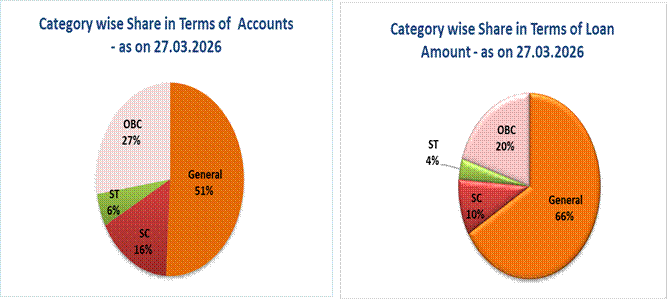
The MoS also added, “It has created self-employment opportunities across the country, especially for marginalized sections of society, including Scheduled Castes/Scheduled Tribes, Other Backward Classes (51% of loan beneficiaries), and women (67% of loan beneficiaries).”

Stressing on Mudra’s impact the MoS saidThe core objective of the MUDRA Yojana is "Funding the Unfunded." The scheme has successfully ended the exploitation of India's small entrepreneurs by informal lenders. In the past 11 years, it has extended over 40 lakh crore through 57.7 crore loans, instilling a new sense of confidence among borrowers. This clearly reflects the government's firm commitment to support their efforts and its accelerated journey toward making India a developed nation by 2047 through inclusive growth enabled by financial inclusion.”

As we commemorate eleven years of advancing financial inclusion through the core tenets of the MUDRA scheme, let us glance through some of the primary characteristics and significant milestones of the scheme:

The implementation of financial inclusion programme in the country is based on three pillars, namely,

  1. Banking the Unbanked
  2. Securing the Unsecured and
  3. Funding the Unfunded

These aforesaid three objectives are being achieved through leveraging technology and adopting multi-stakeholders’ collaborative approach, while serving the unserved and underserved as well.

One of the three pillars of FI - Funding the Unfunded, is reflected in the Financial Inclusion ecosystem through PMMY, which is being implemented with the objective to provide collateral free access to credit for small/ micro entrepreneurs.

Key Features of PMMY:

  1. MUDRA loans are being offered in four categories namely, ‘Shishu’, ‘Kishor’, ‘Tarun’ and ‘TarunPlus’ which signifies the stage of growth or development and funding needs of the borrowers: -
    • Shishu: covering loans upto Rs. 50,000/-
    • Kishor: covering loans above Rs. 50,000/- and up to Rs. 5 lakhs
    • Tarun: covering loans above Rs.5 lakh and upto Rs.10 lakhs
    • TarunPlus: covering loans above Rs.10lakh and upto Rs.20 lakhs
  2. Loans cover term financing and working capital needs across manufacturing, trading and service sectors, including activities allied to agriculture like poultry, dairy, and beekeeping, etc.
  3. The interest rate is governed by RBI guidelines, with flexible repayment terms.

Achievements under Pradhan Mantri Mudra Yojana (PMMY) as on 27.03.2026

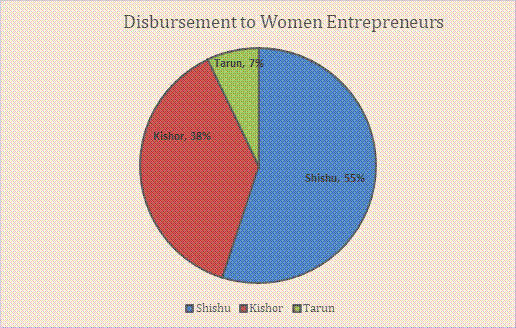
Women Borrowers: A total of ₹9.02 lakh crore was disbursed under the Shishu category, ₹ 6.22 lakh crore under Kishor, and ₹ 1.09 lakh crore under the Tarun category.  
 

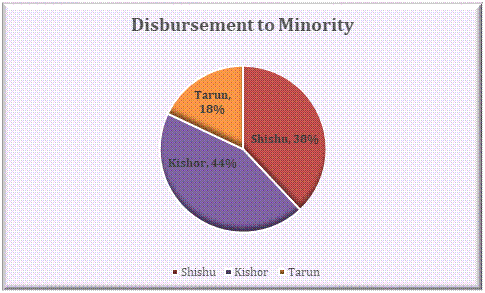
Minority Borrowers: The disbursements amounted to ₹1.33 lakh crore under Shishu, ₹1.54 lakh crore under Kishor, and ₹ 0.62 lakh crore under Tarun.
New Entrepreneurs/Accounts:

Shishu category: 8.80 crore accounts with a sanctioned amount of ₹2.47 lakh crore and disbursed amount of ₹ 2.42 lakh crore.

Kishor category: 2.79 crore accounts with ₹5.09 lakh crore sanctioned and ₹4.87 lakh crore disbursed.

Tarun category: 55 lakh accounts with a sanctioned amount of ₹4.82 lakh crore and ₹4.67 lakh crore disbursed.
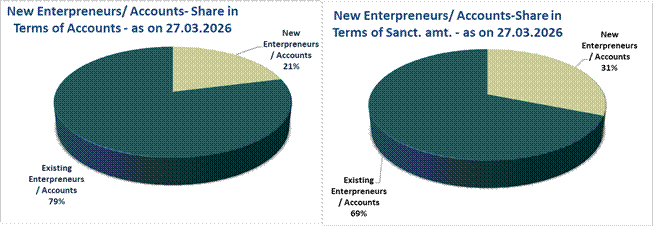
Category-wise breakup:-(Number of loans and amount sanctioned)

Category

Percentage as per No. of Loans

Percentage as per Amount Sanctioned

Shishu

74%

32%

Kishor

24%

43%

Tarun

2%

25%

TarunPlus

0.004%

0.095%

Total

100%

100%


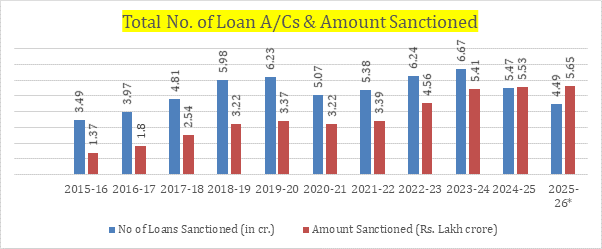
Year-wise sanction amount is as under:-

Financial Year

No. of Loans Sanctioned

(in Crore)

Amount Sanctioned

(Rs. in Lakh Crore)

2015-16

3.49

1.37

2016-17

3.97

1.80

2017-18

4.81

2.54

2018-19

5.98

3.22

2019-20

6.23

3.37

2020-21

5.07

3.22

2021-22

5.38

3.39

2022-23

6.24

4.56

2023-24

6.67

5.41

2024-25

5.47

5.53

2025-26

(as on 27.03.2026) *

4.49

5.65

Total

57.79

40.07

Marking over a decade of the PMMY, India underscores its dedicated mission to integrate the marginalized into the formal economy. By focusing on the core principles of "Banking the Unbanked," "Securing the Unsecured," and "Funding the Unfunded," the Government continues to bridge financial gaps and turn the aspirations of aspiring business owners into reality.

Topics

Acts Income Tax