Just a moment...

Top
Help
×

By creating an account you can:

Logo TaxTMI
Call Us / Help / Feedback

Contact Us At :

E-mail: [email protected]

Call / WhatsApp at: +91 99117 96707

For more information, Check Contact Us

FAQs :

To know Frequently Asked Questions, Check FAQs

Most Asked Video Tutorials :

For more tutorials, Check Video Tutorials

Submit Feedback/Suggestion :

Email :
Please provide your email address so we can follow up on your feedback.
Category :
Description :
Min 15 characters 0/2000
Make Most of Text Search
  1. Checkout this video tutorial: How to search effectively on TaxTMI.
  2. Put words in double quotes for exact word search, eg: "income tax"
  3. Avoid noise words such as : 'and, of, the, a'
  4. Sort by Relevance to get the most relevant document.
  5. Press Enter to add multiple terms/multiple phrases, and then click on Search to Search.
  6. Text Search
  7. The system will try to fetch results that contains ALL your words.
  8. Once you add keywords, you'll see a new 'Search In' filter that makes your results even more precise.
  9. Text Search
Add to...
You have not created any category. Kindly create one to bookmark this item!
Create New Category
Hide
Title :
Description :
❮❮ Hide
Default View
Expand ❯❯
Close ✕
🔎 News - Adv. Search
TEXT SEARCH:

Press 'Enter' to add multiple search terms. Rules for Better Search

Search In:
Main Text + AI Text
  • Main Text
  • Main Text + AI Text
  • AI Text
Category: ?
Categorized by AI
---- All Categories ----
  • ---- All Categories ----
  • Income Tax
  • GST
  • Customs, DGFT & SEZ
  • FEMA & RBI
  • Corp. Laws, SEBI & IBC
  • PMLA, Black Money & ED
  • Budget
  • News and Press Release
  • PTI News
Month:
---- All Months ----
  • ---- All Months ----
  • January
  • February
  • March
  • April
  • May
  • June
  • July
  • August
  • September
  • October
  • November
  • December
Year:
---- All Years ----
  • ---- All Years ----
  • 2026
  • 2025
  • 2024
  • 2023
  • 2022
  • 2021
  • 2020
  • 2019
  • 2018
  • 2017
  • 2016
  • 2015
  • 2014
  • 2013
  • 2012
  • 2011
Sort By: ?
In Sort By 'Default', exact matches for text search are shown at the top, followed by the remaining results in their regular order.
Relevance Default Date
❯❯
Maximize Maximize Maximize
0 / 200
Expand Note
Add to Folder

No Folders have been created

+

Are you sure you want to delete "My most important" ?

NOTE:

News
Showing Results for :
Reset Filters
Results Found:
Show All Summaries Hide All Summaries
March 30, 2026
Show AI Summary
Quarterly non-resident reporting in Form 92 mandates structured electronic filing, annexure declarations, and standardized identity details.
Quarterly reporting in Form 92 requires specified funds and stock brokers dealing with non-resident clients to furnish standardised information under Rule 157 through the Income-tax Department's electronic filing system. The form is submitted quarterly, may include multiple non-residents in one return, and is intended to support monitoring, compliance, verification of residency particulars, and information exchange for cross-border investments. Form 92 uses a structured Part A and Part B format, requires Annexure A-1 declarations from each non-resident, and calls for PAN details of the filer, with no other supporting documents to be uploaded.
March 30, 2026
Show AI Summary
Banking outlet coverage through GIS monitoring expands access in villages under RBI-guided infrastructure planning.
Banking outlet coverage in inhabited villages is monitored through the Jan Dhan Darshak GIS-based application, which tracks bank branches, Business Correspondents and India Post Payments Bank outlets within a five-kilometre radius. On the basis of bank-uploaded data, 99.92% of villages in the country and 100% of villages in Dadra and Nagar Haveli are covered within the prescribed radius. Expansion in uncovered areas is a continuous process under extant RBI guidelines, overseen by the State Level Bankers' Committee or Union Territory Level Bankers' Committee.
March 30, 2026
Show AI Summary
Kisan Credit Card access expands through digital issuance, concessional lending, and stronger grievance redressal for farmers.
Measures supporting the Kisan Credit Card ecosystem focus on expanding credit access, improving digital issuance, and strengthening financial inclusion for farmers, including small and marginal farmers. Priority Sector Lending guidelines and the Ground Level Agriculture Credit target operate as key policy instruments for scaling KCC coverage, with a sub-target for small and marginal farmers and incentive and disincentive frameworks intended to encourage more equitable agricultural credit distribution. The KCC scheme also covers working capital for animal husbandry, dairying and fisheries, while the Modified Interest Subvention Scheme provides concessional short-term agricultural loans through KCC with an additional prompt repayment incentive.
March 30, 2026
Show AI Summary
Priority sector lending supports rural credit flow through agriculture targets, refinance support, and self-help group programmes.
Priority sector lending and related government measures are used to maintain uninterrupted rural credit flow for agriculture, MSMEs and self-help groups. Reserve Bank of India policy requires specified banks to allocate at least 18% of adjusted net bank credit or credit equivalent of off-balance sheet exposures, whichever is higher, to agriculture, with a 10% sub-target for small and marginal farmers. Concessional refinance support and NABARD programmes further assist rural financial institutions, self-help groups and microenterprises.
March 30, 2026
Show AI Summary
Rupee volatility and RBI forex exposure cap reshape market sentiment amid geopolitical tensions and dollar strength.
Rupee volatility in foreign exchange markets intensified amid geopolitical tensions, risk-off sentiment, elevated dollar demand and firmer crude prices, with the currency touching an intra-day low before settling lower against the US dollar. The Reserve Bank of India reduced the net open position that banks may maintain overnight and capped the Net Open Position (NOP-INR) for banks at USD 100 million, with compliance required by 10 April, as part of oversight of banks' foreign exchange exposure.
March 30, 2026
Show AI Summary
Quarterly reporting of non-resident client details through Form 092 requires online filing, declarations, and timely verification.
Quarterly reporting requirements apply to specified funds and stock brokers dealing with non-resident clients under Rule 157. Form 092 is the prescribed quarterly statement for furnishing non-resident client particulars, including name, contact details, country of residence, Tax Identification Number, and, where TIN is unavailable, the unique identification number issued by the foreign jurisdiction. The form must be filed online on the e-Filing portal within 15 days from the end of each quarter, and all non-resident clients dealt with during the quarter may be reported in the same return.
March 30, 2026
Show AI Summary
Public interest refusal to furnish information under income-tax law now uses electronic Form 91 with DIN authentication.
Form 91 is the statutory electronic form used by the designated Income-tax authority to refuse furnishing information requested under section 258(2)(a) of the Income-tax Act, 2025 where disclosure is not considered to be in the public interest. It is issued only by the competent authority, records the application reference, assessee details and relevant tax year, and states the refusal on public interest grounds. The form is authenticated through a system-generated DIN and electronic issuance details, creating a formal and traceable record distinct from forms used for furnishing information or intimation of non-availability.
March 30, 2026
Show AI Summary
Money laundering probe intensifies as Nepal widens scrutiny of former prime ministers and protests continue after arrests.
Protests continued in Nepal after the arrest of former Prime Minister K P Sharma Oli and former home minister Ramesh Lekhak in connection with the alleged suppression of the Gen Z protests, while the Department of Money Laundering Investigation and police intensified scrutiny of former prime ministers Sher Bahadur Deuba, K P Sharma Oli and Pushpa Kamal Dahal. The probe expanded after preliminary enquiries and the arrest of former minister Deepak Khadka in a money laundering case, with allegations of financial benefits for facilitating licences and contracts and forensic confirmation of burnt banknote fragments.
March 30, 2026
Show AI Summary
Public interest refusal for tax information requests through Form 091 by the designated Income-tax authority.
Form 091 is the prescribed income-tax form used by the designated Income-tax authority to refuse furnishing information sought under section 258(2)(a) of the Income-tax Act, 2025, where disclosure is not considered to be in the public interest. It is issued only after an information request is received and declined, applies separately for each tax year, and is authenticated by the authority's signature, name, and designation without requiring an official seal.
March 30, 2026
Show AI Summary
Insolvency code amendments tighten timelines, add creditor-initiated resolution, and curb frivolous delays in the process.
Insolvency and Bankruptcy Code amendments introduce stricter timelines, an out-of-court creditor-initiated resolution mechanism, and an enabling framework for group and cross-border insolvency. The revised framework replaces the underutilised fast-track route with a creditor-initiated insolvency process based on debtor-in-possession and creditor-in-control principles, subject to safeguards and defined timelines. The amendments also provide deterrent measures against abuse of process, including penalties for vexatious and frivolous proceedings, and seek to protect the integrity of the resolution system by discouraging delay-causing litigation.
March 30, 2026
Show AI Summary
Non-availability of information intimation under Form 90 is issued electronically after record verification and DIN authentication.
Form 90 is the electronic intimation issued by the designated Income-tax authority under section 258(2)(a) of the Income-tax Act, 2025, where requested information is unavailable in departmental records or no assessment has been made for the relevant tax year. It is generated after verification of records, authenticated through the Department's system with DIN, and includes the application reference, assessee name, and mandatory tax year. The form is event-based, has no fixed periodicity or due date, and standardises the term tax year for clear and traceable communication.
March 30, 2026
Show AI Summary
Non-availability of information intimation under income tax law through Form 090 communicates missing records, not rejection.
Form 090 is the prescribed intimation used by the designated Income-tax authority to communicate that information sought under section 258(2)(a) of the Income-tax Act, 2025 is not available in departmental records for the specified tax year. It is issued electronically after verification of records, is event-based, and must be furnished separately for each tax year. The form requires the exact tax year, recipient details, DIN and date, application reference, assessee name, and a statement confirming non-availability of information or that no assessment has been made.
March 30, 2026
Show AI Summary
Electronic information disclosure under the Income-tax Act, 2025 uses Form 89 for structured, traceable furnishing or refusal.
Form 89 is the electronic statutory form used by the designated Income-tax authority to furnish permissible information in response to a valid application by an authorised public authority under section 258(2)(a) of the Income-tax Act, 2025, for a specified assessee and a single tax year. It is an event-based form, furnished through the Department's system with DIN and system-generated authentication, and is linked to the corresponding application in Form 88. The form contains assessee particulars in Part A and disclosure-limited information details in Part B, and it also allows recording of refusal, wholly or partly, where disclosure is not considered to be in the public interest.
March 30, 2026
Show AI Summary
Taxpayer information disclosure under authorised application governs Form 089, with electronic furnishing and limited, confidential disclosure.
Form 089 is the statutory online form used by designated income-tax authorities to furnish taxpayer-related information in response to a valid application made by an authorised public authority under section 258(2)(a) of the Income-tax Act, 2025. It is tax-year specific, furnished electronically, and may be used only for information available in departmental records and within the permissible scope of disclosure. The authority may refuse disclosure for unauthorised, invalid, incomplete, or overbroad requests, and the reasons must be recorded electronically.
March 30, 2026
Show AI Summary
Assessee information requests under the Income-tax Act now require online Form 88 filing by authorised public authorities only.
Form 88 is the prescribed application for obtaining information about an assessee under Section 258(2)(a) of the Income-tax Act, 2025. It is available only to authorised public authorities, including regulatory and law-enforcement agencies, government departments authorised under Rule 155, and other competent authorities empowered by the Central Government. A separate application is required for each assessee and each tax year; consolidated requests are not allowed. The form must be filed online through the e-Filing portal with electronic verification and supporting documents uploaded electronically.
March 30, 2026
Show AI Summary
E-commerce duty moratorium ends unresolved as WTO members defer tariff and TRIPS safeguards talks.
The World Trade Organization meeting ended without consensus on extending the moratorium on customs duties on electronic transmissions, leaving the issue of tariffs on digital downloads and streaming unresolved. The lapse of the moratorium also coincided with the expiry of the TRIPS non-violation complaint safeguard, increasing the possibility of challenges to WTO-compliant measures and reducing policy space for developing countries. Related WTO reform and e-commerce work programme discussions were also deferred for continued negotiation in Geneva.
March 30, 2026
Show AI Summary
Insolvency and bankruptcy reform drives banking health, with proposed changes aimed at faster admission of resolution applications.
The Insolvency and Bankruptcy Code is described as a central mechanism for improving banking sector health through recovery of non-performing assets under the insolvency resolution process. The proposed amendment Bill seeks further changes to the framework, including measures to reduce the time taken for admission of insolvency resolution applications, while the resolution process is said to have coincided with better company performance and improved corporate governance.
March 30, 2026
Show AI Summary
Taxpayer information requests under Form 088 require authorised filing, specific grounds, separate tax year submissions, and electronic portal authentication.
Form 088 is the online application used by authorised public authorities, regulatory bodies, law-enforcement agencies, and other competent authorities to seek specific taxpayer information under Section 258(2)(a) of the Income-tax Act, 2025. It must be filed separately for each taxpayer and each tax year through the e-Filing portal, with narrowly framed particulars, stated reasons, and supporting authorisation where necessary. Incomplete, overbroad, or unauthorised requests may be returned or rejected, and communications are issued electronically with portal-based status tracking.
March 30, 2026
Show AI Summary
Tonnage Tax Scheme audit report filing requires accountant certification, supporting annexures, and electronic submission within the specified date.
Form No. 81 is prescribed for furnishing the audit report under section 232(21) for a company that has opted for taxation under the Tonnage Tax Scheme. The report, prepared and certified by an accountant, verifies books of account, computation of shipping income, compliance with charter-in limits, and other statutory conditions. It is to be furnished on or before the specified date and may include annexures such as charter arrangement certificates, related party notes, asset notes, and loss statements.
March 30, 2026
Show AI Summary
Tonnage Tax Scheme reporting requires accountant certification, separate books, and detailed disclosure of shipping income and compliance.
Form 81 is an accountant's report for a company opting for the Tonnage Tax Scheme, certifying the correctness of books of account and income computation for qualifying ships. It requires separate books, disclosure of charter-in compliance, shipping income, statutory reserve details, ship-wise tonnage income, related party transactions, depreciation, non-exclusive assets, and losses, with mandatory annexures where applicable and reasons for any negative or qualified answers.

News

Back

All News

Showing Results for :
Reset Filters
No Records Found

News

Showing Results for : Reset Filters
News and Press Release

Release of publication “Energy Statistics India 2026”

March 30, 2026

Contents
Summary
Note

Note

-

Bookmark

Print

Print

The National Statistics Office (NSO), Ministry of Statistics and Programme Implementation has released the annual publication “Energy Statistics India 2026”. The publication is available at the website of Ministry www.mospi.gov.in.

2.  The Publication comprises integrated dataset containing diverse key information about reserve, capacity, production, Consumption and import/export of all the energy commodities (like Coal, Lignite, Petroleum, Natural Gas, Renewable Energy, etc.) of India. The publication also contains different tables (like Energy Balance), graphs (like Sankey Diagram), and Sustainable Energy Indicators as per International Standards.

Improvements in the publication:

3. The 33rd edition of the publication has enhanced its’ coverage by incorporating aspects like Credit Flow to domestic energy-sectors, world energy-statistics etc.; have effectively addressed the major data gaps like consumption of domestic Coal through e-Auction, imported non-Coking Coal, sub-sectoral consumption pattern of electricity under Industry by utilizing the data from the Annual Survey of Industries (ASI) database. Further information like the industry-wise distribution of HSD through Retail/Reseller, the International Aviation and Marine Bunker Data have also been incorporated in the domestic supply/consumption of energy for the 1st time.

4. The publication has brought harmonization among the sectoral end-use consumption Statistics of all Energy Commodities by standardizing the end-use sectors.

Key Highlights

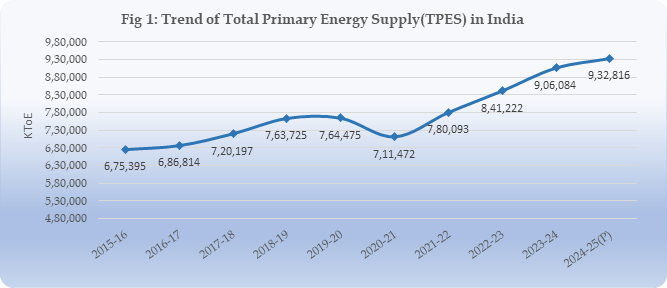
5. During the FY  2024-25, the Indian economy has depicted a healthy expansion in the Total Primary Energy Supply (TPES) registering a growth of 2.95% over the past year and stood at 9,32,816 KToE(Kilo Tonnes of oil Equivalent).
  • India has a huge potential for generation of renewable energy which stands at 47,04,043 Megawatt as on 31-Mar-25. In the total potential, the Solar Energy has witnessed a staggering growth from 748,990 Megawatt during FY: 2023-24 to 33,43,378 Megawatt during FY: 2024-25 and is having the highest share (around 71%) followed by Wind Power (11,63,856 Megawatt) and Large Hydro (1,33,410). More than 70% of the total potential for generation of renewable energy is concentrated in the following six(6) States viz. Rajasthan (23.70%), Maharashtra (14.26%), Gujarat (9.10%), Andhra Pradesh (9.1%), Karnataka (8.59%) and Madhya Pradesh(8.09%).  
  • The installed-capacity for generating electricity (including Utility and Non-Utility) from the Renewable resources has also experienced a significant growth over the past years. From 90,134 Mega Watt as on 31-Mar-2016, it has risen to 2,29,346 Mega Watt as on 31-Mar-2025, which is a CAGR of 10.93% over the years.
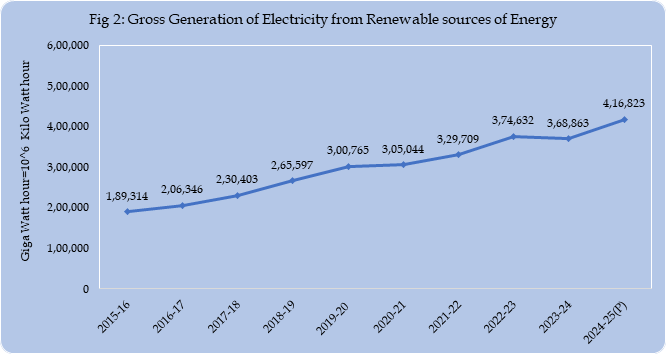
  • The gross generation of electricity from the Renewable resources (both Utility and Non-Utility together) has also increased significantly over the years. From an amount of 1,89,314 GWH of electricity generated during FY 2015-16, it has increased to 4,16,823 GWH during FY 2024-25, which is a CAGR of 9.17% over the years.

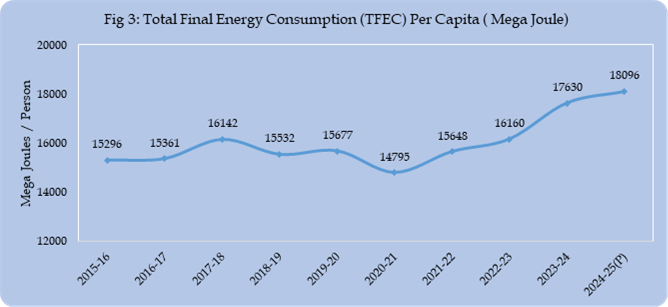
  • The per-capita consumption of energy over the years has gone up from 15,296 Mega Joule/person during FY 2015-16 to 18,096 Mega Joule/person during FY 2024-25 which is a CAGR of 1.89% over the years.

  • The utilization of the electricity has significantly improved over the years on account of reduction in the transmission and distribution losses. Percentage loss due to Transmission and Distribution which was around 22% during FY 2015-16 has gone down to around 17% during FY 2024-25.
  • Among all the major energy supply sources, coal has remained the dominant source, contributing the highest share to the total energy supply. Energy supply from coal (including lignite) has increased from 3,87,761 Ktoe in FY 2015-16 to 5,52,315 Ktoe in FY 2024-25. All other sources like Crude Oil, Natural Gas etc. have also registered a consistent growth over the periods.
  • The Total Final Consumption (TFC) of energy, into different end-use sectors, has also experienced a steady rise. TFC of energy surged by over 30.41 % from 4,69,212 Ktoe in FY 2015-16 to 608,578 Ktoe in FY 2024-25.
  • The Credit Flow to the energy sector in India has also experienced a steadfast growth over the years. From an amount of ₹ 1,688 Cr during 2021, it has gone up to ₹10,325 crore during 2025 which is a growth of over six times during this period.

Topics

Acts Income Tax