 TaxTMI
 Login
 TaxTMI
Login
Loading...
Press 'Enter' to add multiple search terms. Rules for Better Search

Press 'Enter' after typing page number.
Press 'Enter' after typing page number.


No Folders have been created
Are you sure you want to delete "My most important" ?
NOTE:
Press 'Enter' after typing page number.
Press 'Enter' after typing page number.

All News
Press 'Enter' after typing page number.
All News

Note

Bookmark

Share


BUDGET PROPOSALS FOR CUSTOMS AND CENTRAL EXCISE AIM TO FURTHER SIMPLIFY TARIFF STRUCTURE, SUPPORT DOMESTIC MANUFACTURING: UNION FINANCE MINISTER
UNION BUDGET 2026-27 PROPOSES SEVERAL BASIC CUSTOMS DUTY EXEMPTIONS TO ENSURE ENERGY TRANSITION AND SECURITY
BCD EXEMPTIONS PROPOSED FOR MANUFACTURE AND MRO REQUIREMENTS IN CIVIL AND DEFENCE AVIATION
BUDGET PROPOSES FACILITATING SALES BY ELIGIBLE MANUFACTURING UNITS IN SEZs TO DOMESTIC TARIFF AREA AT CONCESSIONAL RATES
The Budget proposals for Customs and Central Excise aim to further simplify the tariff structure, support domestic manufacturing, promote export competitiveness, and correct inversion in duty, said Union Minister for Finance and Corporate Affairs Smt. Nirmala Sitharaman while presenting the Union Budget 2026-27, in Parliament today.
Taking forward the weeding out of long continuing customs duty exemptions, the Budget proposes to remove certain exemptions on items which are being manufactured in India or where the imports are negligible. Similarly, to further simplify the process of ascertaining the rate of duty applicable on a particular item, the Budget proposes to incorporate certain effective rates in various customs notifications to the tariff schedule itself.
With an aim to promote exports, the Finance Minister Smt Nirmala Sitharaman recommended to increase the limit for duty-free imports of specified inputs used for processing seafood products for export, from the current 1 per cent to 3 per cent of the FOB value of the previous year’s export turnover. The Budget also proposes to allow duty-free imports of specified inputs, which is currently available for exports of leather or synthetic footwear, to exports of Shoe Uppers as well. Fianance Minister also proposed to extend the time period for export of final product from the existing 6 months to 1 year, for exporters of leather or textile garments, leather or synthetic footwear and other leather products.
The Budget carries several proposals to ensure energy transition and security. Firstly, the Budget proposes to extend the basic customs duty exemption given to capital goods used for manufacturing Lithium-Ion Cells for batteries, to those used for manufacturing Lithium-Ion Cells for battery energy storage systems too. With respect to solar energy, Finance Minister proposed to exempt basic customs duty on import of sodium antimonate for use in manufacture of solar glass.
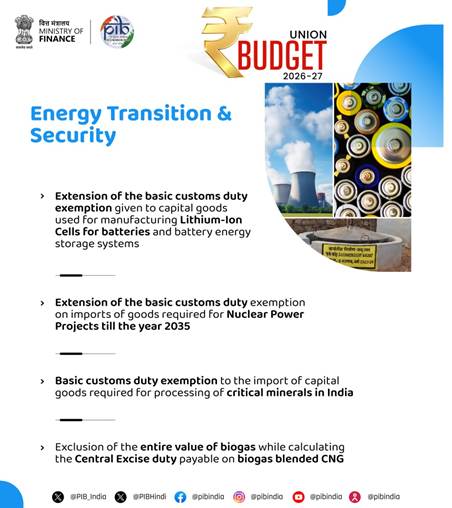
Giving a push to the Nuclear Energy sector, Smt Nirmala Sitharaman recommended extension of the existing basic customs duty exemption on imports of goods required for Nuclear Power Projects till the year 2035 and expand it for all nuclear plants irrespective of their capacity. The Budget also proposes to provide basic customs duty exemption to the import of capital goods required for processing of critical minerals in India. To promote biogas blending in CNG, the Budget proposes to exclude the entire value of biogas while calculating the Central Excise duty payable on biogas blended CNG.
Finance Minister also proposed exemption of basic customs duty on components and parts required for the manufacture of civilian, training and other aircrafts. The Budget also proposes to exempt basic customs duty on raw materials imported for manufacture of parts of aircraft to be used in maintenance, repair, or overhaul requirements by Units in the Defence sector.
To deepen value addition in the consumer electronics sector, the Budget proposes to exempt basic customs duty on specified parts used in the manufacture of microwave ovens.
The Budget addresses the concerns arising about utilization of capacities by manufacturing units in the Special Economic Zones due to global trade disruptions. For this, the Finance Minister proposed to facilitate sales by eligible manufacturing units in SEZs to the Domestic Tariff Area (DTA) at concessional rates of duty as a special one-time measure. The quantity of such sales will be limited to a prescribed proportion of their exports. Smt Nirmala Sitharaman said that necessary regulatory changes will be undertaken to operationalise these measures while ensuring level-playing field for the units working in the DTA.

