

Loading...

Top
Help
×

By creating an account you can:

Logo TaxTMI
Call Us / Help / Feedback

Contact Us At :

E-mail: [email protected]

Call / WhatsApp at: +91 99117 96707

For more information, Check Contact Us

FAQs :

To know Frequently Asked Questions, Check FAQs

Most Asked Video Tutorials :

For more tutorials, Check Video Tutorials

Submit Feedback/Suggestion :

Email :
Please provide your email address so we can follow up on your feedback.
Category :
Description :
Min 15 characters 0/2000
Make Most of Text Search
  1. Checkout this video tutorial: How to search effectively on TaxTMI.
  2. Put words in double quotes for exact word search, eg: "income tax"
  3. Avoid noise words such as : 'and, of, the, a'
  4. Sort by Relevance to get the most relevant document.
  5. Press Enter to add multiple terms/multiple phrases, and then click on Search to Search.
  6. Text Search
  7. The system will try to fetch results that contains ALL your words.
  8. Once you add keywords, you'll see a new 'Search In' filter that makes your results even more precise.
  9. Text Search
Add to...
You have not created any category. Kindly create one to bookmark this item!
Create New Category
Hide
Title :
Description :
❮❮ Hide
Default View
Expand ❯❯
Close ✕
🔎 News - Adv. Search
TEXT SEARCH:

Press 'Enter' to add multiple search terms. Rules for Better Search

Search In:
Main Text + AI Text
  • Main Text
  • Main Text + AI Text
  • AI Text
Category: ?
Categorized by AI
---- All Categories ----
  • ---- All Categories ----
  • Income Tax
  • GST
  • Customs, DGFT & SEZ
  • FEMA & RBI
  • Corp. Laws, SEBI & IBC
  • PMLA, Black Money & ED
  • Budget
  • News and Press Release
  • PTI News
Month:
---- All Months ----
  • ---- All Months ----
  • January
  • February
  • March
  • April
  • May
  • June
  • July
  • August
  • September
  • October
  • November
  • December
Year:
---- All Years ----
  • ---- All Years ----
  • 2026
  • 2025
  • 2024
  • 2023
  • 2022
  • 2021
  • 2020
  • 2019
  • 2018
  • 2017
  • 2016
  • 2015
  • 2014
  • 2013
  • 2012
  • 2011
Sort By: ?
In Sort By 'Default', exact matches for text search are shown at the top, followed by the remaining results in their regular order.
Relevance Default Date
    Business Nextgen Finance Raises Rs 215 Crore in Equity to Accelerate MSME Lending
    Drugs: ED raids in 4 states; over 2 dozen offenders, foreign links under scanner
    Razorpay Launches a Conversational AI Account Manager 'RAY' on WhatsApp For Businesses, in Partnership with IndusInd Bank
    AssetPlus Launches Portfolio Management Services to Help MFD Partners Grow and Retain High-Net-Worth Clients
    APEDA Facilitates Flag-Off of 18 MT of NPOP-Certified Ethnic Rice from Tripura for Export to Austria and the Netherlands
    VR LIVIN’s ‘THE FIRST’ Records Sale of 20 Villas Within Two Days of Launch
    IAAPI Calls for GST Rationalisation to Support Growth and Consumer Demand in India’s Amusement Industry
    ED raids multiple locations in Keralam in hybrid ganja smuggling money laundering case
    Rupee jumps 47 paise to 94.26 against US dollar in early trade
    ED raids multiple locations in Kolkata in bank loan fraud case
    Commerce & Industry Minister Shri Piyush Goyal Calls Upon Auto Component Industry To Go Global
    18th Meeting of Heads of IP Offices of BRICS Countries Held in New Delhi
    India’s Sovereign Credit Rating upgraded to 'A-' with Stable Outlook by Japan Credit Rating Agency
    Secretary, DFS Chairs Review Meeting on Financial and Business Performance of Public Sector General Insurance Companies (PSGICs)
    GIFT IFSC emerges as a strong and vibrant international banking hub, mobilises over $52.8 billion under RBI’s FCNR(B) Swap Facility, $11.62 bn in EC...
    Ex-CII executive Shuchita Sonalika appointed COO of Canada-India Business Council
    India's 7.8% growth despite global disruptions remarkable: FM Sitharaman at investors meet in US
    After 35 years, India's sovereign rating upgraded to 'A-' by JCR on solid growth, resilient financial system
    Rupee rises 22 paise to close at 94.73 against US dollar
    India draws record USD 127 bn forex deposit in special drive
❯❯
Maximize Maximize Maximize
0 / 200
Expand Note
Add to Folder

No Folders have been created

+

Are you sure you want to delete "My most important" ?

NOTE:

News
Showing Results for :
Reset Filters
Results Found:
Show All Summaries Hide All Summaries
September 3, 2026
Show AI Summary
MSME secured lending equity capital, subject to regulatory approval, supports expansion without management-control change in operations.
Business Nextgen Finance Private Limited, a non-deposit taking non-banking financial company registered with the Reserve Bank of India, has raised Rs 215 crore in equity capital to expand secured credit for micro, small and medium enterprises. The transaction received prior Reserve Bank of India approval. The capital base will support secured lending scale-up, geographic expansion, technology investment and wider access to formal credit in underserved markets. The investment does not involve a change in management or day-to-day control.
September 3, 2026
Show AI Summary
Money-laundering probes into narcotics trafficking rely on predicate police and narcotics cases and examine cross-border linkages.
Money-laundering investigation under the Prevention of Money Laundering Act involves coordinated searches in connection with multiple narcotics-trafficking matters. The investigation is founded on police and Narcotics Control Bureau FIRs and linked chargesheets concerning separate drug-trafficking allegations, including alleged trafficking in methamphetamine, marijuana and MDMA with suspected cross-border linkages.
September 3, 2026
Show AI Summary
Conversational AI account management enables businesses to access payment information, settlement support, refunds, and payment links through WhatsApp.
RAY is a conversational AI account manager on WhatsApp that enables businesses to access payment information, support, and operational actions through messages or voice notes. It can provide payment summaries, analyse payment activity, monitor settlement status, generate payment links, and issue refunds. The AI assistant is designed to proactively identify payment-health issues, flag settlement events, recommend actions, and use merchant-specific context to support payment management without dashboard navigation.
September 3, 2026
Show AI Summary
Portfolio management services distribution enables certified mutual fund distributors to digitally onboard and report for eligible high-net-worth clients through AssetPlus.
AssetPlus has launched Portfolio Management Services for certified Mutual Fund Distributor partners to digitally onboard, track, manage and report PMS investments for eligible high-net-worth clients. PMS distribution requires NISM Series-XXI-A certification and operates within the APRN distributor-registration framework. PMS comprises individually managed portfolios run by SEBI-registered Portfolio Managers and held in clients' demat accounts. The minimum investment is Rs. 50 lakh, and offerings are governed by the SEBI (Portfolio Managers) Regulations, 2020. The platform provides daily reconciliation of holdings, performance and valuations.
September 3, 2026
Show AI Summary
NPOP-certified ethnic rice exports strengthen organic producer access to international markets through certification, traceability, and organised export production.
NPOP-certified ethnic rice exports from Tripura to Austria and the Netherlands connect local farmers and Farmer Producer Companies with international markets through organised, export-oriented production. The initiative emphasises certification, traceability, food safety and quality as requirements for access to markets for certified organic products. Buyer-seller linkages support export opportunities, while coordinated organic value-chain engagement strengthens certification and quality systems and supports producers in meeting international standards.
September 3, 2026
Show AI Summary
Gated residential community launch combines smart-home villas, extensive lifestyle amenities and planned expansion into future residential developments.
VR LIVIN Ventures LLP launched 'THE FIRST', an 83-villa gated residential community in Madhavaram, North Chennai, which recorded sales of 20 villas during its first two launch days. The development includes smart-home villas and more than 50 lifestyle amenities, with access to nearby metro connectivity and social infrastructure. It forms part of the company's intended expansion of residential projects in Chennai and other South Indian locations.
September 3, 2026
Show AI Summary
GST rationalisation for amusement park admissions could lower ticket prices, stimulate consumer demand, and support investment without input tax credit.
GST rationalisation for amusement park, water park and indoor entertainment admission tickets is sought through a flat 5% GST rate without Input Tax Credit. The proposed rate is intended to reduce ticket prices, improve affordability and increase customer demand in a capital-intensive tourism and entertainment sector. Many smaller and mid-sized operators report limited ability to offset GST liability through ITC. Lower taxation is projected to support facility expansion, revenue growth, new investment, employment and reinvestment in recreational services.
September 3, 2026
Show AI Summary
Money laundering linked to hybrid ganja smuggling involves alleged illicit cross-border transfers and foreign-exchange violations.
Enforcement Directorate searches form part of a money-laundering investigation into alleged hybrid ganja smuggling from Thailand. A case under the Prevention of Money Laundering Act concerns suspected laundering of drug-trafficking proceeds and transfer of funds to Thailand through illegal channels. The inquiry also examines possible foreign-exchange violations and an alleged arrangement involving carriers, visas and funds for transporting narcotic substances.
September 3, 2026
Show AI Summary
Foreign-currency deposit mobilisation supports currency appreciation while creating surplus-liquidity sterilisation pressures through deposit swaps in domestic banking markets.
Foreign-currency deposit mobilisation strengthened foreign-exchange liquidity and supported rupee appreciation. FCNR(B) deposits, together with overseas foreign-currency borrowings and external commercial borrowings, increased aggregate foreign-currency resources. Bank swaps of such deposits with the central bank may create surplus banking-system liquidity and a sterilisation challenge, while oil prices, global yields, dollar movements and foreign equity inflows remain relevant currency-market factors.
September 3, 2026
Show AI Summary
Money laundering investigation examines alleged diversion of bank loans from a power project to group entities and personal use.
Money laundering investigation under the Prevention of Money Laundering Act concerns alleged diversion of bank loans obtained by Kohinoor Power for a power plant in Jharkhand. The loan proceeds were allegedly transferred to other group entities and used personally. Searches were conducted at eleven premises associated with the group's promoters, directors and auditors. The company entered liquidation proceedings before the National Company Law Tribunal, with limited recovery for creditors.
September 3, 2026
Show AI Summary
Globalisation of auto component manufacturing is linked to trade access, resilient supply chains, technology adoption, safety, and vehicle scrappage.
The auto component industry is encouraged to expand globally through reciprocal market access, overseas manufacturing, international investment and trade partnerships. Supply-chain resilience is to be strengthened through indigenisation of vulnerable products, access to critical minerals, and domestic capacity in auto components, speciality steel, technical textiles and semiconductors. Priority is also given to high-value integrated solutions, artificial intelligence-enabled quality control, vehicle safety and industrial parks offering manufacturing infrastructure. Vehicle scrappage requires coordinated government incentives and fair industry valuation to support replacement demand for new-age vehicles.
September 3, 2026
Show AI Summary
Updated IP cooperation guidelines strengthen cross-border innovation, patent examination coordination, traditional knowledge protection, and geographical indication commercialisation.
IP BRICS Heads adopted Updated Operational Guidelines to direct result-oriented intellectual property cooperation, promote cross-border innovation, and reinforce joint engagement in global IP standards. Priority areas include protection of traditional knowledge and traditional systems of medicine, reinforced patent examination cooperation, exchange of search results, patent analytics, and geographical indication protection and commercialisation. Coordination mechanisms and periodic progress reviews are emphasised for effective implementation and continuity of cooperation.
September 3, 2026
Show AI Summary
Sovereign credit rating upgrade reflects resilient growth, improved fiscal expenditure quality, stronger financial systems, and a robust external position.
India's long-term foreign-currency and local-currency issuer ratings were upgraded from 'BBB+' to 'A-', with a Stable Outlook, reflecting resilient economic growth, improved fiscal expenditure quality, strengthened financial-sector soundness, and a robust external position. Fiscal improvement is linked to greater capital expenditure and lower fiscal deficit. Financial resilience is supported by improved banking and non-banking sector asset quality and capital adequacy. External strength arises from a contained current account deficit, services surplus, and foreign-exchange reserves exceeding short-term external debt.
September 3, 2026
Show AI Summary
Public sector general insurance performance requires profitable underwriting, lower claim ratios, digitalisation, standardised monitoring, and quality grievance redressal.
Public Sector General Insurance Companies were advised to focus on profitable business lines, reduce the Incurred Claim Ratio, and accelerate technology use and digitalisation while optimising related expenditure. They are to improve insurance penetration, density, outreach and customer awareness, particularly in underserved segments, while reducing protection gaps. A robust, standardised KPI framework should enable comparable financial and non-financial performance assessment and be reviewed quarterly. Customer grievances require expeditious and quality redressal.
September 3, 2026
Show AI Summary
Cross-border financing through GIFT-IFSC expands foreign currency mobilisation, external commercial borrowing disbursements, and international bond market access.
GIFT-IFSC's IBUs mobilised foreign-currency liquidity under the RBI's FCNR(B) deposit swap facility, with 20 IBUs sanctioning USD 54.02 billion and disbursing approximately USD 52.82 billion as at 31 August 2026. Between April and August 2026, IBUs disbursed USD 11.62 billion in External Commercial Borrowings, while Indian banks raised USD 11.12 billion through bond listings on IFSC exchanges. These activities support cross-border financing, international capital-market access and foreign-exchange inflows.
September 3, 2026
Show AI Summary
Bilateral business council leadership appointment strengthens operational capacity to advance Canada-India economic and investment partnerships.
Operational leadership for bilateral economic engagement is strengthened through the appointment of Shuchita Sonalika as the first Chief Operating Officer of the Canada-India Business Council. The appointment is directed toward enhancing the council's capacity to support expanding investment and economic relations between Canada and India, in coordination with its board, members and partners. Sonalika brings international affairs experience in advancing India's economic partnerships across global markets.
September 3, 2026
Show AI Summary
Regulatory certainty and compliance reforms support investment facilitation, infrastructure development, MSME credit access, and reduction of bank non-performing assets.
Regulatory certainty, ease of compliance and investment facilitation are identified as central elements of India's economic reform orientation. The Insolvency and Bankruptcy Code is included among reforms supporting regulatory certainty, reduced paperwork and easier compliance. Policy priorities include infrastructure development, artificial intelligence and data centres, credit access for MSMEs, reduction of banks' non-performing assets, fiscal discipline, and investment facilitation by central and state governments.
September 2, 2026
Show AI Summary
Sovereign credit rating upgrade reflects resilient economic growth, fiscal quality, financial-system soundness, and external-sector resilience.
Japan Credit Rating Agency upgraded India's foreign-currency and local-currency long-term issuer ratings to A-, citing solid economic growth, strengthened growth-oriented policies and improved financial-system soundness. Improved banking asset quality, insolvency mechanisms, government capital infusion and stronger central-bank supervision support financial resilience. Fiscal quality has improved through greater infrastructure-focused capital expenditure and restraint in current spending, while a contained current-account deficit, services surplus and substantial foreign-exchange reserves support resilience to external shocks.
September 2, 2026
Show AI Summary
Currency-market intervention and foreign capital inflows supported rupee resilience amid higher crude prices and dollar strength.
Foreign capital inflows and modest foreign institutional equity purchases supported rupee appreciation against the US dollar despite weak domestic equities, elevated crude oil prices and a stronger dollar. RBI monitoring and apparent currency-market intervention supported the rupee amid risk aversion, higher US Treasury yields and concerns over crude supply disruptions. Forthcoming US employment data remained relevant to dollar and rupee direction.
September 2, 2026
Show AI Summary
Foreign-currency non-resident deposits bolster external liquidity through hedging support and lending flexibility during global market uncertainty.
Foreign Currency Non-Resident (Bank) [FCNR(B)] deposits are fixed-term foreign-currency deposits for non-resident Indians, with principal and interest repayable in the deposit currency and without direct rupee exchange-rate risk. A special central-bank programme mobilised substantial FCNR(B) deposits, alongside overseas foreign-currency borrowings and external commercial borrowings, to strengthen foreign-exchange liquidity. Banks received hedging-cost support and permission to lend against the deposits. The facility was closed earlier than scheduled after its mobilisation objective was met.

News

Back

All News

Showing Results for :
Reset Filters
No Records Found

News

Showing Results for : Reset Filters

INDIA SHOULD PRIORITISE DECENTRALISED, APPLICATION-DRIVEN SYSTEMS OVER CAPITAL-INTENSIVE FRONTIER MODELS TO AVOID FRAGILE DEPENDENCIES IN ARTIFICIAL INTELLIGENCE: ECONOMIC SURVEY

January 29, 2026

Contents
Summary
Note

Note

-

Bookmark

Print

Print

ECONOMIC SURVEY 2025-26 ADVOCATES AIMING FOR FRUGAL, REAL-WORLD DEPLOYMENT AT SCALE

INDIA’S APPROACH INTENDS TO ALIGN AI ADOPTION WITH STRUCTURAL REALITIES-CAPITAL, ENERGY, INSTITUTIONAL CAPACITY AND MARKET DEPTH

THE NATIONAL AI MISSION CAN SCALE DIVERSE AI-SOLUTIONS BY PROVIDING SHARED INFRASTRUCTURE, STANDARDS, GOVERNANCE FRAMEWORKS AND FUNDING WITHOUT DILUTING LOCAL CREATIVITY

LOCAL INNOVATORS, MUNICIPAL BODIES, START-UPS, AND COMMUNITY INSTITUTIONS DEPLOYING AI TO SOLVE IMMEDIATE AND CONTEXTUAL PROBLEMS

LANGUAGE AND VOICE-FIRST AI SYSTEMS EXTENDING REACH OF DIGITAL SERVICES TO POPULATIONS HISTORICALLY EXCLUDED

THE ECONOMIC SURVEY 2025-26 ENVISIONS THE WAY FORWARD FOR INDIA’S AI ECOSYSTEM

The Economic Survey 2025-26 tabled by the Union Minister of Finance and Corporate Affairs, Smt. Nirmala Sitharaman in the Parliament today, recognizes Artificial Intelligence (AI) as an economic strategy rather than a prestige technology race. The Survey examines the way AI is reshaping global economy and outlines a pragmatic strategy for India in an environment marked by rapid technological change and persistent uncertainty.

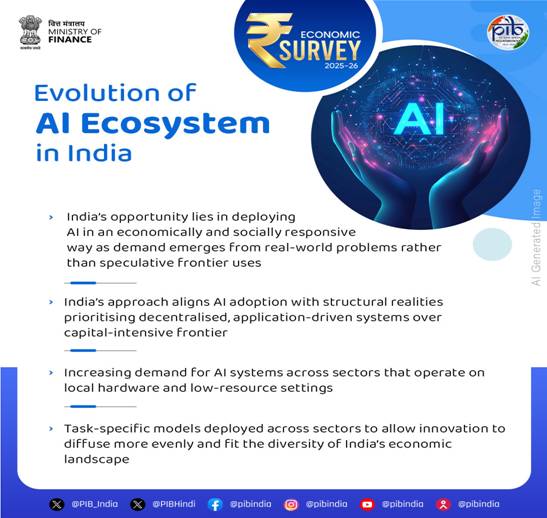
The Economic survey in its dedicated chapter highlights that AI deployment in India to be economically grounded and socially responsive. It makes a case for a bottom up, multiple sector-specific approaches grounded in open and interoperable systems to promote collaboration and shared innovation. This aligns with India’s strengths in human capital, data diversity and institutional coordination. 

India’s demand for AI is emerging from real-world problems rather than speculative frontier uses. Citing examples across healthcare, agriculture, urban management, education, disaster preparedness, and public administration, the survey highlights the growing appetite for AI systems that work on local hardware and operate in low-resource settings. From early disease screening and precision water management to farmer market access, classroom analytics, and regional language interfaces, adoption is emerging where AI lowers costs and compensates for structural shortcomings. These uses signal a large and scalable market for frugal, application-focused AI solutions tailored to India’s economic and social landscape.

The Survey focuses on aligning AI adoption with India’s structural realities, such as capital availability, energy constraints, institutional capacity, and market depth, so that technology choices reinforce long-term growth instead of creating fragile dependencies.

As the Global AI development is being shaped by structural asymmetries in access to compute, finance, data, and standards-setting power, the Survey recognizes these imbalances as essential for crafting realistic policy. In this context, the preferred pathway emphasizes decentralized and application-driven AI rather than large, centralized systems. Smaller, task-specific models deployed across sectors allow innovation to diffuse more evenly, reduce entry barriers for firms, and better fit the diversity of India’s economic landscape. The Survey calls Open and interoperable AI systems as a force multiplier.

Further elaborating upon the Education and training priorities in the AI-era, the survey underscores the need to shift away from narrow technical specialization towards essential foundational capabilities such as reasoning, reading, judgment, communication, and adaptability. This shall integrate AI into workplaces and public systems.

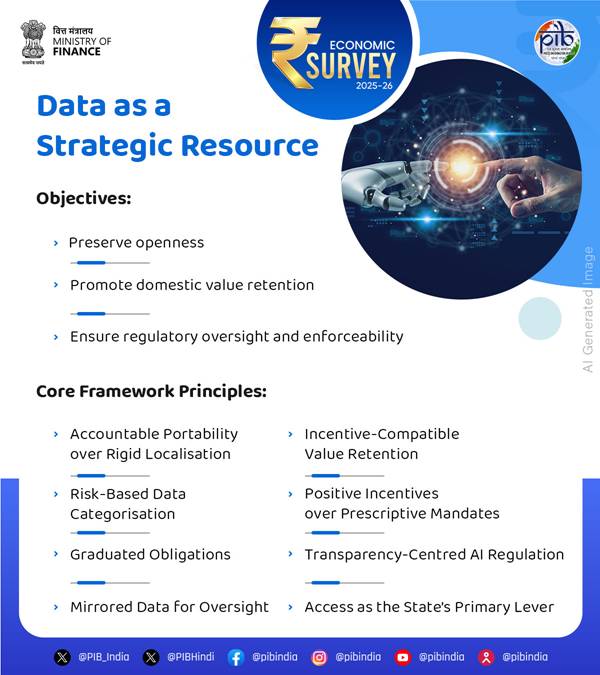
Adding on the Data governance of AI, the survey emphasizes over the need for it to be framed around accountability and value creation rather than isolation. Trusted data flows, combined with transparency and auditability, are seen as more effective than rigid localization in ensuring that economic benefits accrue domestically while maintaining global interoperability. The regulatory design favors proportionate, risk-based approaches over prescriptive control. Obligations scale with potential harm and systemic importance, allowing innovation to continue while aligning private incentives with broader economic and social objectives.

The survey reiterates that the India’s AI strategy must be sequenced carefully to avoid premature lock-in or regulatory overreach so that to build coordination first, capacity next and binding policy leverage last, allowing institutions and markets to co-evolve.

The survey in this chapter further elaborates upon Artificial Intelligence in India’s economic context, a development-oriented approach to AI, role of human capital for AI, AI-safety and risks along with the governance, institutional architecture and data as a strategic resource, followed with a phased roadmap for India’s AI Future.
ARTIFICIAL INTELIIGENCE ECOSYSTEM

The Survey deliberates upon asymmetries and trade-offs in the AI ecosystem across countries, firms, capabilities, and stages of the value chain. These asymmetries do not imply structural disadvantage but identifies the constraints within which a viable and sustainable AI strategy must be formulated to maximize economic and social returns from AI while remaining mindful of the trade-offs.

Capability Asymmetries between frontier model development and application-led development calls for India to deploy resources more effectively towards domain-specific AI systems aligned with domestic economic priorities. The capital-labour tradeoff elaborates upon the debate between scale versus inclusion which recognizes challenge - how to pace diffusion of AI to facilitate labour augmentation, choosing inclusive approach over scaling.

The cost, control, dependence of open or proprietary models ponders upon the ownership and governance of AI models. The survey underscores the need to strike a balance between openness and stewardship, leveraging shared innovation while ensuring that the economic value created from domestic data and intellectual property accrues within India rather than being captured abroad. The tradeoff between centralized scale and distributed efficiency strengthens the case for smaller, task-specific models that can run on limited hardware and decentralized compute networks. It lays emphasis on strategic autonomy and continued integration with global innovation networks to preserve openness where it enhances capability while insulating critical functions from external shocks.

LOCAL INGENUITY AND FRUGAL AI IN INDIA

India’s AI story is already evolving from the bottom-up. Local innovators, municipal bodies, start-ups, and community institutions are deploying AI to solve problems that are immediate and contextual to the communities they reside in. AI has multi-sectoral applications in health, agriculture, education, urban management, and disaster preparedness.

  • Non-invasive AI-enabled thermal imaging tools in southern India are enabling early breast cancer screening in low-resource settings.
  • Portable and low-cost AI-assisted oral cancer screening devices are bringing early detection to primary healthcare centers in eastern India.
  •  AI-enabled agricultural networks are improving market access, price discovery, and logistical efficiency for 1.8 million farmers across 12 States.
  • India’s approach to AI adoption also includes initiatives such as Bhashini under MEiTY, and AI4Bharat developed by IIT Madras. Language and voice-first AI systems are extending the reach of digital services.

Furthering interactions in native languages and functioning effectively on low-cost devices, such frugal AI pathways align scale with inclusion along with being decentralized, problem-driven, and embedded in local needs.

The National AI Mission can help scale diverse AI-solutions by providing shared infrastructure, standards, governance frameworks and funding without diluting local creativity.

A DEVELOPMENT-ORIENTED APPROACH TO AI

The Survey highlights the necessity of India’s own indigenous AI development. The AI ecosystem remaining sufficiently young creates an opening for India to shape a more value-creating and dignified employment opportunity for its workforce.

Further, the Survey highlights developments in global GPU supply chains to play a meaningful role in shaping the long-run pace of AI infrastructure expansion. The measures that enhance supply-side resilience in access to advanced compute need to complement the conventional policy levers to expand access to finance and incentivize domestic development of AI. India needs to rely on diversified and resilience access to global compute.

A government hosted, community-curated platform under IndiaAI Mission umbrella would provide secure and transparent space where developers, researchers and enterprises collaborate. Private sector participation may also to be encouraged promoting indigenous development of sector specific AI and transforming India from world’s IT sector back office to one of the AI front offices. The Bottom-up approach can be spearheaded under ‘AI-OS’ initiative. India ranks among the top global contributors to AI research output and possess a deep pool of technical talent in the field of artificial intelligence, the country also has a highly AI-literate labour force.

The heterogeneity and scale of the country suggests the possibility of curating diverse domestic datasets across various sectors, including health, agriculture, finance, education, and public administration.

GOVERNANCE, INSTITUTIONAL ARCHITECTURE AND DATA

AN AI ECONOMIC COUNCIL FOR INDIA

The AI Economic Council, separate from the Governance Council, is intended to operate, not just with a technological imperative, but with moral imperatives, but with imperatives that are sensitive to India’s socio-economic realities. They will operate as a coordinating authority that is responsible for aligning technology deployment with the evolution of India’s education and skilling infrastructure, while navigating resource constraints and development priorities. The core governance principles for such an institution would involve the following:

  1. Human Primacy and Economic Purpose
  2. Labour-Market  Sensitivity by Design
  3. Sequencing over Speed
  4. Co-evolution of  Technology and Human Capital
  5. Public Interest Safeguards and Ethical Non-Negotiable

By embedding labour realities and social stability priorities into AI policy, the institution will ensure that AI advances productivity without eroding employment and the dignity of work.

As innovations and applications are rapidly outpacing regulatory developments, the Survey calls upon a measured and swift response from policymakers. The regulatory design for AI adoption in India must seek to integrate AI within the broader socio-economic context of India, with special consideration for our labour market realities. It must ensure that AI serves humanity, rather than supplanting it.
Data-as-a-Strategic-Resource.jpg

HUMAN CAPITAL FOR AI

The Survey emphasizes experiential learning, early exposure to experience building, flexible education pathways and strengthening human-centric skills. The survey calls upon that ‘formal education and work experience’ need not be seen as mutually exclusive setup. To nurture India’s demographic dividend into a competent workforce, need for institutionalizing systems such as ‘Earn and Learn Initiative’. This pathway can be co-designed by the private sector and academic institutions. The National Education Policy 2020 aligns with the above vision.

Furthermore, a comprehensive sectoral mapping of jobs outside the white-collar workspace needs to be undertaken. For instance, nursing and geriatric care being understaffed highlights the potential for additional demand for skilled labour in the sectors.

AI SAFETY AND RISKS

The survey highlights an ‘AI Safety Institute’ as proposed under MeitY Governance Guidelines which shall analyze emerging risks, potential regulatory gaps, coordination on AI safety issues, and conducting training programmes to build awareness, among others. A Periodic, scenario-based testing and red-teaming of AI models must become institutionalized.

The survey suggests that International cooperation of institutes such as United Kingdom’s AI Security Institute and USA’s National Institute Standards and Technology shall enable joint evaluations of high risk models and shared access to completing infrastructure which will enhance global interoperability AI Safety Standards. The survey further acknowledges that no conception of safe or human-centric AI is credible without placing the protection of individual rights at its core.

ROADMAP FOR INDIA’s ‘AI’ FUTURE

The survey describes a central challenges for India - what it builds domestically, what it sources globally, what it regulates early, and what it deliberately allows to evolve. The benefit of hindsight allows India to design AI systems that are more resource-efficient and aligned with public objectives from the outset, sequencing regulation alongside deployment. It offers the country the opportunity to pursue a more resilient and inclusive AI trajectory.

India’s strengths lie in application-led innovation, the productive use of domestic data, human capital depth and the ability of public institutions to coordinate distributed efforts. A bottom-up strategy anchored in open and interoperable systems, sector-specific models, and shared physical and digital infrastructure offers a more credible pathway to value creation than a narrow pursuit of scale for its own sake.

Regulation, data governance and safety will have to evolve in parallel with deployment, not in its aftermath. Depending on the choices made, AI can be a tool for broad-based productivity and dignified work. India’s task is to ensure that AI development remains aligned with its developmental priorities and its long-term ambition to achieve economic resilience.

Topics

Acts Income Tax
