

Loading...

Top
Help
×

By creating an account you can:

Logo TaxTMI
Call Us / Help / Feedback

Contact Us At :

E-mail: [email protected]

Call / WhatsApp at: +91 99117 96707

For more information, Check Contact Us

FAQs :

To know Frequently Asked Questions, Check FAQs

Most Asked Video Tutorials :

For more tutorials, Check Video Tutorials

Submit Feedback/Suggestion :

Email :
Please provide your email address so we can follow up on your feedback.
Category :
Description :
Min 15 characters 0/2000
Make Most of Text Search
  1. Checkout this video tutorial: How to search effectively on TaxTMI.
  2. Put words in double quotes for exact word search, eg: "income tax"
  3. Avoid noise words such as : 'and, of, the, a'
  4. Sort by Relevance to get the most relevant document.
  5. Press Enter to add multiple terms/multiple phrases, and then click on Search to Search.
  6. Text Search
  7. The system will try to fetch results that contains ALL your words.
  8. Once you add keywords, you'll see a new 'Search In' filter that makes your results even more precise.
  9. Text Search
Add to...
You have not created any category. Kindly create one to bookmark this item!
Create New Category
Hide
Title :
Description :
❮❮ Hide
Default View
Expand ❯❯
Close ✕
🔎 News - Adv. Search
TEXT SEARCH:

Press 'Enter' to add multiple search terms. Rules for Better Search

Search In:
Main Text + AI Text
  • Main Text
  • Main Text + AI Text
  • AI Text
Category: ?
Categorized by AI
---- All Categories ----
  • ---- All Categories ----
  • Income Tax
  • GST
  • Customs, DGFT & SEZ
  • FEMA & RBI
  • Corp. Laws, SEBI & IBC
  • PMLA, Black Money & ED
  • Budget
  • News and Press Release
  • PTI News
Month:
---- All Months ----
  • ---- All Months ----
  • January
  • February
  • March
  • April
  • May
  • June
  • July
  • August
  • September
  • October
  • November
  • December
Year:
---- All Years ----
  • ---- All Years ----
  • 2026
  • 2025
  • 2024
  • 2023
  • 2022
  • 2021
  • 2020
  • 2019
  • 2018
  • 2017
  • 2016
  • 2015
  • 2014
  • 2013
  • 2012
  • 2011
Sort By: ?
In Sort By 'Default', exact matches for text search are shown at the top, followed by the remaining results in their regular order.
Relevance Default Date
    India–Afghanistan Joint Working Group on Trade Holds Virtual Meeting; Reviews Measures to Strengthen Bilateral Trade and Economic Cooperation
    PM Surya Ghar Yojana 2026: How to Get Rs 78,000 Solar Subsidy & Cut Your Electricity Bill
    Japan's JCR upgrades India's sovereign rating to 'A-', cites solid growth, improved financial system
    In personal insolvency case before NCLAT, Subhash Chandra opposes formation of 5-member NCLT bench
    GoCredit Launches Free Loan App Checker to Verify If a Lending App Is Real, Fake or RBI Registered
    Rupee falls 2 paise to 94.97 against US dollar in early trade
    Senior bureaucrats attend IICA’s ‘weekend wisdom’ program initiave
    NLMC to Facilitate E-Auction of 459 RINL Land Parcels in Visakhapatnam
    CCI approves acquisition of Aseem Infrastructure Finance Limited by TPG Nicobar SG Pte. Ltd. and related transactions
    CCI approves acquisition of up to 100% equity shareholding of Apollo Fertility Centre (AFCPL) and Apollo Specialty Hospitals (ASHPL) by Kids Clinic In...
    ED arrests businessman in DMF-linked money laundering case
    Rupee gains 27 paise to close at 94.95 against US dollar
    India's CAD widens to USD 4.2 bn in Q1 amid West Asia conflict: RBI data
    Andhra commercial tax collections rise by 11 per cent in August to Rs 4,983 cr
    Govt hikes windfall gains tax on petrol, diesel exports; cuts levy on ATF
    DGFT Enables Automated Issuance of Free Sale and Commerce Certificates to Promote Ease of Doing Business
    Bank unions to go on nationwide strike on Sep 11 over 5-day banking, other issues
    Stock markets close marginally lower amid higher oil prices, fresh US-Iran tensions
    Gross and Net GST revenue collections for the month of August, 2026
    A Quarter-Century of Trade. One Unbroken Connection.
❯❯
Maximize Maximize Maximize
0 / 200
Expand Note
Add to Folder

No Folders have been created

+

Are you sure you want to delete "My most important" ?

NOTE:

News
Showing Results for :
Reset Filters
Results Found:
Show All Summaries Hide All Summaries
September 2, 2026
Show AI Summary
Trade facilitation and customs cooperation drive follow-up action on connectivity, regulatory coordination, investment promotion and bilateral commercial engagement.
India-Afghanistan bilateral trade and economic cooperation is being advanced through institutional engagement on trade facilitation, customs cooperation, connectivity, investment and commercial exchange. Priority areas include customs and data-sharing cooperation, visa facilitation for traders, banking and financial cooperation, pharmaceutical and agricultural trade, energy cooperation, tariff concessions, cargo connectivity and port-related matters. Follow-up action covers regulatory cooperation, improved connectivity, investment promotion and business-to-business engagement.
September 2, 2026
Show AI Summary
Residential rooftop solar subsidy requires eligibility, prior approval, registered installation, net metering, commissioning, and verified bank details for direct transfer.
PM Surya Ghar Muft Bijli Yojana provides central financial assistance for eligible grid-connected residential rooftop solar systems, capped at Rs. 78,000 for systems of three kilowatts or more. Applicants must be Indian citizens who own a suitable house, hold a valid electricity connection, and have not received an earlier solar-panel subsidy. Applications require portal registration, distribution-company feasibility approval, installation through a registered vendor, net metering, inspection, commissioning and submission of bank details. Assistance is transferred directly after verification. State-specific net-metering procedures, approvals and additional incentives may apply.
September 2, 2026
Show AI Summary
Sovereign credit rating upgrade reflects solid growth, stronger financial systems, and improving fiscal and external resilience.
JCR upgrades India's foreign-currency and local-currency long-term issuer ratings to A- with a stable outlook, citing sustained economic growth, productivity-oriented policies and improved financial-system soundness. Fiscal constraints include elevated deficits, intergovernmental fiscal transfers, electoral-cycle sensitivity, and high combined government debt and interest burdens. Greater emphasis on infrastructure capital expenditure has improved the quality of fiscal spending. External resilience is supported by a contained current account deficit, services surplus and foreign-exchange reserves exceeding short-term external debt.
September 2, 2026
Show AI Summary
Personal insolvency bench constitution and repayment-plan eligibility remain contested where a larger tribunal bench stays a third-member order.
Personal insolvency proceedings raised a challenge to the National Company Law Tribunal's authority to constitute a five-member bench after a split verdict. The challenge contended that the mechanism for differing views permits reference to another member or members, but does not authorise a five-member bench. The larger bench stayed the third member's order, restricted asset alienation, and suspended an order permitting settlement of personal-guarantee claims. The dispute concerned the validity of that bench, the split-verdict reference procedure, repayment-plan eligibility, and pending creditor appeals.
September 2, 2026
Show AI Summary
Digital lending app verification enables borrowers to identify regulated lenders, grievance channels, and warning signs before accepting loans.
GoCredit's Loan App Checker allows borrowers to search lending apps against the public Digital Lending App directory and identify the regulated lender, grievance contact and RBI Ombudsman escalation route where a match exists. Regulatory reporting by regulated entities enables app-level verification, while borrowers should also check the lender named in app disclosures and loan agreements. A directory listing is a regulated-entity disclosure, not RBI approval or endorsement. Unmatched apps should be assessed through verification steps and reported through official channels where appropriate.
September 2, 2026
Show AI Summary
Rupee depreciation in early trade reflected oil-price pressures, risk aversion, higher Treasury yields and broad dollar strength.
Early foreign-exchange trading saw the rupee weaken against the US dollar amid renewed US-Iran tensions, risk aversion, higher Brent crude prices, and a stronger dollar. Safe-haven demand, inflation concerns linked to potential oil-supply disruption, expectations of a September Federal Reserve rate increase, and higher US Treasury yields supported the broad dollar rally. RBI monitoring of the rupee's decline was noted.
September 2, 2026
Show AI Summary
Responsible AI governance requires ethical safeguards, privacy protection, accountability and adaptive oversight to build lasting corporate stakeholder trust.
Responsible artificial intelligence governance requires continuous innovation, inclusive development, responsible deployment and trust-based governance. AI systems should be ethical, safe, transparent, fair and human-centric, with safeguards for privacy, bias, security and accountability. Proportionate and adaptive regulation should provide clear accountability, standards, monitoring, auditability and grievance redressal. Good governance, cybersecurity, personal data protection and responsible AI together strengthen organisational resilience, stakeholder trust, transparency and sustainable innovation.
September 2, 2026
Show AI Summary
E-auction of surplus public land enables transparent outright sale of RINL parcels through registered, KYC-verified bidding.
National Land Monetization Corporation will facilitate the e-auction and outright sale of 459 encumbrance-free RINL land parcels, including residential plots and parcels suited for commercial and logistics use. Competitive bidding will occur through the RailTel E-Nivida e-procurement platform. Participation requires online registration, KYC verification, and plot-wise submission of an earnest money deposit within prescribed timelines. The process supports transparent monetisation of surplus land and non-core public assets.
September 2, 2026
Show AI Summary
Competition approval for infrastructure finance restructuring covers acquisition, minority transfer, investment divestment, and merger of regulated NBFCs.
Competition Commission of India approval applies to the acquisition of Aseem Infrastructure Finance Limited by TPG Nicobar SG Pte. Ltd., a subsequent minority share acquisition by ICICI Bank Limited, and Aseem's divestment of its shareholding in NIIF Infrastructure Finance Limited to National Investment and Infrastructure Fund II. Following the acquisition, Climate Finance India Private Limited is intended to merge into Aseem as the surviving entity. The entities involved include RBI-registered non-deposit taking NBFCs operating in infrastructure finance, investment and credit, and infrastructure debt financing.
September 2, 2026
Show AI Summary
Healthcare merger approval enables KCIL to acquire fertility and specialty hospital businesses alongside related equity issuances and investment.
Competition Commission approval covers KCIL's acquisition of up to 100% equity shareholding in AFCPL and 100% equity shareholding in ASHPL. The combination includes KCIL issuing equity shares and optionally convertible debentures to AHLL, representing 9.9% fully diluted shareholding as partial consideration, together with a further KCIL equity investment by Arvon Investments Pte. Ltd. KCIL operates mother and baby care hospitals, while AFCPL provides assisted reproductive treatment and reproductive-medicine services.
September 1, 2026
Show AI Summary
Money-laundering investigation into alleged District Mineral Fund diversion examines purported liaison activity and asset acquisition through proceeds of crime.
Money-laundering proceedings under the Prevention of Money Laundering Act concern alleged diversion of District Mineral Fund resources through the Chhattisgarh Seed Corporation. The investigation alleges siphoning of public funds by contractors in collusion with government officials and political executives. A businessman was identified as an alleged liaisoner and financial coordinator between public servants, district authorities and private vendors. Allegations also include receipt of commissions, acquisition of immovable assets from purported proceeds of crime, non-production of records, and contradictory statements during questioning.
September 1, 2026
Show AI Summary
Foreign exchange market dynamics: rupee appreciation reflected portfolio inflows, domestic growth, and possible central-bank intervention amid external pressures.
The rupee appreciated against the US dollar, supported by domestic growth, controlled fiscal slippage, portfolio-related inflows and possible Reserve Bank of India intervention. Its gains were limited by weak equity markets, rising crude oil prices and a stronger dollar. External geopolitical tensions and hawkish US monetary signals remained potential pressures. Domestic indicators showed strong economic activity, while the current account deficit widened because of a higher merchandise trade deficit. Foreign portfolio inflows continued despite investors remaining net sellers during the year.
September 1, 2026
Show AI Summary
Current account deficit widened as merchandise trade deficit increased, notwithstanding stronger services receipts, remittances, and foreign direct investment inflows.
India's current account deficit widened in the first quarter of 2026-27 as the merchandise trade deficit increased. Higher net services receipts, increased personal transfer receipts and lower net primary-income outgo partly supported the external account. Financial-account movements included higher net foreign direct investment inflows, a shift in foreign portfolio investment from net inflow to net outflow, and lower net inflows through non-resident deposits and external commercial borrowings. Foreign exchange reserves declined on a balance-of-payments basis during the quarter.
September 1, 2026
Show AI Summary
Technology-enabled tax compliance and enforcement supported higher commercial tax collections, while GST rate reductions moderated sectoral net GST growth.
Technology-enabled tax administration supported commercial tax and net GST collection growth in Andhra Pradesh during August 2026 and the cumulative period through August. AI-based analytics and scrutiny, IGST reversals, UPI-based enforcement, registration verification, Aadhaar authentication, digital payment enablement, predictive analytics and data sharing strengthened compliance, scrutiny and revenue mobilisation. Petroleum VAT, professional tax, liquor VAT and IGST settlement also increased, while GST rate reductions moderated net GST performance in specified product sectors.
September 1, 2026
Show AI Summary
Windfall gains tax on petroleum exports rises for petrol and diesel while aviation turbine fuel levy is reduced.
Special additional excise duty and road and infrastructure cess on petroleum-product exports are revised with effect from 1 September 2026. The export duty on diesel is increased, the levy on aviation turbine fuel is marginally reduced, and a duty is imposed on petrol exports. Existing duty rates for petrol and diesel cleared for domestic consumption remain unchanged. The windfall-tax framework seeks to support domestic fuel availability and deter exporters from benefiting from domestic and international price differences.
September 1, 2026
Show AI Summary
Automated Free Sale and Commerce Certificate issuance reduces manual scrutiny while preserving risk-based review for eligible exporters.
DGFT has enabled automated issuance of Free Sale and Commerce Certificates through its portal for eligible exporters of items not covered by the Drugs & Cosmetics Act, 1940. Applications satisfying prevailing framework and automated processing parameters may be issued without manual scrutiny. Applications requiring verification or not meeting those parameters may be routed for manual processing, while auto-approved applications may be flagged later for risk-based review. The mechanism seeks faster, more transparent and predictable processing while retaining necessary oversight.
September 1, 2026
Show AI Summary
Five-day banking and equitable performance incentives drive planned nationwide bank union strike amid unresolved pension demands.
United Forum of Bank Unions has proposed nationwide strike action over delayed five-day banking, the performance-linked incentive framework, and unresolved pension demands. Five-day banking was agreed under the 12th Bipartite Settlement/9th Joint Note with extended Monday-to-Friday working hours, but remains pending for implementation. Unions challenge the incentive scheme for departing from a uniform, bank-performance-linked approach and for disproportionately benefiting senior officers. The dispute is under conciliation and pending before the Delhi High Court, while pension updation, a uniform dearness allowance formula, and an old pension scheme option remain unresolved.
September 1, 2026
Show AI Summary
Equity market volatility intensified as higher crude prices, geopolitical tensions and tighter monetary expectations weakened domestic investor sentiment.
Indian equity markets closed marginally lower as higher crude oil prices, US-Iran tensions, and expectations of prolonged tight United States monetary policy weakened risk appetite. The phased Closing Auction Session contributed to a late recovery in the benchmark index. Rising crude prices and global bond yields triggered broad-based selling across several domestic sectors, while foreign institutional equity sales and weakness in overseas markets added to pressure despite stronger-than-expected domestic economic growth.
September 1, 2026
Show AI Summary
GST revenue collections show higher gross and net receipts alongside increased refunds and state-level settlement data.
GST revenue collections for August 2026 recorded total gross GST revenue of Rs. 1,99,853 crore, reflecting 14.8% growth over August 2025. Total refunds were Rs. 31,795 crore, including domestic refunds and export IGST refunds processed through ICEGATE. After adjustment of refunds, total net GST revenue was Rs. 1,68,057 crore, representing 8.3% growth. SGST collections and the SGST component of IGST settlement were separately identified for States and Union Territories, with post-settlement SGST aggregating Rs. 95,531 crore.
September 1, 2026
Show AI Summary
Trade facilitation and customs preparedness feature in AILBIEA's Silver Jubilee knowledge conference on liquid bulk commerce.
AILBIEA's Silver Jubilee programme focuses on trade facilitation, customs modernisation, GST dispute preparedness and maritime-risk issues affecting liquid bulk trade. The Knowledge Conference includes sessions on the Authorised Economic Operator advantage, next-generation customs technology, GST Appellate Tribunal-era dispute preparedness, and geopolitical risks to sea-borne trade. It also marks the launch of AGS 360, integrating port information, vessel tracking, port-call estimates and maritime intelligence.

News

Back

All News

Showing Results for :
Reset Filters
No Records Found

News

Showing Results for : Reset Filters

RIGHT SKILLING, ENTREPRENEURIAL SPIRIT AND GOVERNMENT INITIATIVES CONTINUE TO BRING DOWN UNEMPLOYMENT, SAYS THE ECONOMIC SURVEY 2025-26

January 29, 2026

Contents
Summary
Note

Note

-

Bookmark

Print

Print

OVER 2.3 CRORE VACANCIES MOBILISED IN FIRST SIX MONTHS OF CURRENT FISCAL THROUGH NATIONAL CAREER SERVICE PORTAL

SOCIAL PROTECTION EXTENDED TO OVER 31 CRORE REGISTERED UNORGANISED WORKERS THROUGH E-SHRAM PORTAL

LABOUR CODES ENSURING WELFARE FOR WORKERS AND EASE OF BUSINESS FOR EMPLOYERS
AMID RISING FEMALE LABOUR FORCE, ECONOMIC SURVEY ACKNOWLEDGES NEED FOR FLEXI WORK HOURS

ENTREPRENEURIAL ACTIVITIES LEADING SELF-EMPLOYMENT REVOLUTION IN RURAL INDIA; 12.9 CRORE INDIVIDUALS (28% WOMEN) SHAPING UNINCORPORATED NON-FARM SECTOR

55% RISE IN NUMBER OF GIG WORKERS FROM FY21 TO FY25

The labour markets in India are undergoing significant structural transformations driven by digitalisation, green energy transition, and emerging forms of employment such as gig and platform work. In this backdrop, a series of significant initiatives by the Government of India continue to bring down unemployment, catalyse job creation and extend welfare cover to the workforce. This was stated by the Economic Survey 2025-26 tabled in Parliament today by Union Minister for Finance and Corporate Affairs Smt. Nirmala Sitharaman.

In the post-pandemic growth phase, the emphasis has shifted from the quantity of jobs to the quality of work, reflecting a more inclusive and sustainable vision of the labour market, the Survey notes. Recent initiatives aimed at promoting labour-intensive sectors and strengthening skill development underscore the Government’s renewed commitment to quality employment and human capital enhancement, with a view to fully harness India’s demographic dividend.

India has recorded significant employment growth in recent years, supported by structural reforms, tax rationalisation, and a sustained focus on skill development. Measures such as deregulation, GST 2.0, and labour reforms implemented by states have contributed to rising labour force participation and employment growth across industry and services, says the Survey.
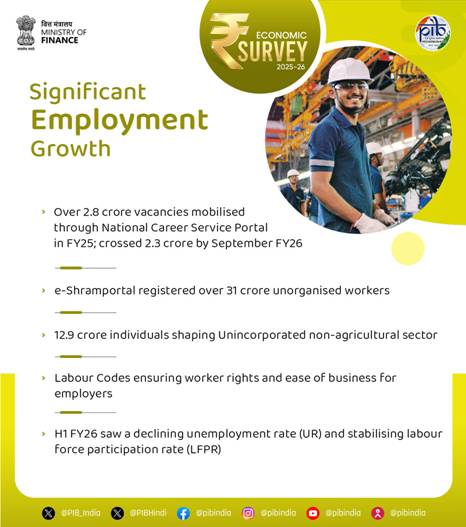

CURRENT EMPLOYMENT TRENDS:

India has witnessed a positive trend in Female Labour Force Participation Rate (FLFPR) in recent years, rising from 23.3 per cent in 2017-18 to 41.7 per cent in 2023-24, alongside a decline in Unemployment Rate (UR) from 5.6 per cent to just 3.2 per cent, reflecting a shift toward greater inclusion and economic empowerment. The Economic Survey quotes data from several pertinent surveys to give an overview of India’s employment trends.

The quarterly and monthly Periodic Labour Force Survey (PLFS) data show a steady labour market with seasonal variations. It indicates that the period from April to September 2025 (H1 FY26) saw a declining unemployment rate (UR) in the current weekly status (CWS), a stabilising labour force participation rate (LFPR), and substantial employment levels, signalling an improvement in employment conditions. A total of 56.2 crore people (aged 15 years and above) were employed in Q2 FY26, reflecting a creation of around 8.7 lakh new jobs in Q2 compared to Q1 of FY26.

Citing insights drawn from PLFS data, the Survey says, “Rural employment is dominated by agricultural workers (57.7 per cent) and self-employment (62.8 per cent), with women workers showing relatively higher participation in them. In contrast, urban employment is primarily concentrated in the services sector (62.0 per cent), with regular wage or salaried jobs making up the largest share (49.8 per cent).”

The Annual Survey of Industries (ASI), which covers the organised manufacturing sector, results for FY24 highlight the manufacturing sector’s resilience, showing a 6 per cent YoY increase in employment over the previous year. This translates to an addition of over 10 lakh jobs in FY24 compared to FY23. “The sector added more than 57 lakh jobs over the past decade, between FY15 and FY24, with a CAGR of 4 per cent,” says the Economic Survey.

According to the Quarterly Bulletin of Unincorporated Sector Enterprises (QBUSE), the unincorporated non-agricultural sector comprises a total of 7.9 crore establishments, employing 12.9 crore individuals. The share of working owners among total employed workers in the sector increased from 58.9 per cent in 2023-24 to 60 per cent in Q2 FY26, indicating a shift towards self-employment and entrepreneurial activities. The rural workforce in the sector was six crore in Q2 FY26, indicating the significant contribution of unincorporated enterprises to rural economic activities. Additionally, women represent 28.7 per cent of the workforce in the sector. The increasing trend of digitisation in the unincorporated non-agricultural sector is reflected in the rising use of the internet among business units, which increased steadily from 26 per cent in 2023-24 to 39 per cent in Q2 FY26.

EMPOWERING THE WORKFORCE:

The Economic Survey highlights the role of recent policy initiatives in identifying unorganised workers and enhancing their integration with the formal economy through the welfare and skill development systems.

e-Shram:

The Survey draws attention to the e-Shram portal as a key institutional mechanism for extending social protection to unorganised workers, and bridging the gap between informal and formal employment. The portal serves as a National Database of Unorganised Workers, which includes data on construction workers, migrant workers, gig and platform workers, street vendors, domestic workers, and agriculture workers. “As of January 2026, the portal has over 31 crore registered unorganised workers, marking a significant advancement in India’s efforts to formalise and support its informal workforce. Notably, women account for 54 per cent of total registrants, substantially strengthening the reach of gender-focused welfare schemes,” the document states.

The e-Shram platform facilitates the identification of job opportunities, apprenticeship opportunities, and skilling linkages, helping workers transition to improved employment prospects. These efforts align with the broader vision of enhancing productivity and social protection for India’s informal workforce.

National Career Service Portal:

Launched in 2015, the National Career Service (NCS) portal has emerged as a one-stop solution connecting job seekers, employers, training providers and career guidance and counselling agencies. It offers a range of services, including free registration, job application processing, interview assistance, and other employment-related services, and a multi-lingual helpline.

“Since its launch, the portal has evolved into a key employment facilitation platform, with over 5.9 crore registered job seekers and 53 lakh job providers across diverse sectors and mobilising approximately 8 crore vacancies,” states the Economic Survey. “It recorded over a 200 per cent increase in job vacancies in FY24 compared to FY23. Vacancies mobilised exceeded 2.8 crore in FY25 and have already crossed 2.3 crore by September FY26,” the document adds.

In addition, the NCS portal’s integration with the Ministry of External Affairs’ e-Migrate system enables certified recruiting agencies to post verified international job vacancies and provides job seekers with access to global opportunities under safe and monitored conditions. Further, its integration with the Skill India Digital Hub (SIDH) enables candidates to enhance their skill sets before applying for jobs. The portal is partnering with private portals to provide free online training on 'career skills' and ‘digital skills’. Currently, the portal is integrated with 30 State employment portals, including seven states/UTs, which are directly using it for job seeker registrations, the Survey elaborates.

CATALYSING JOB GROWTH THROUGH LABOUR CODES:

The Economic Survey 2025-26 highlights the potential of the Labour Codes to catalyse job growth and accelerate economic development. The four Labour Codes- Code on Wages 2019, Industrial Relations Code 2020, Code on Social Security 2020, and Occupational Safety, Health and Working Conditions Code 2020 have consolidated 29 central laws to streamline regulations and extend protections to workers. The implementation of these Codes was notified on 21 November 2025.

The Survey notes that the Codes have attempted to strike a balance between regulation and flexibility, while protecting worker rights and ensuring social security for workers. They are a result of the deliberations held in the tripartite meeting of the government, employers, industry representatives, and various trade unions from 2015 to 2019.

“Implementing the Codes marks the first step towards the labour market transformation. The transition will require coordination and investment from the private sector,” the Survey states. “Companies must enhance their systems, update policies, re-evaluate workforce models, and improve their digital readiness to remain competitive. While the Codes offer a unified framework, it is up to the private sector to integrate this framework into daily operations,” it further suggests.

THE NEW FRONTIERS OF THE GIG WORKFORCE:

The recent developments in digital platforms and policy reforms are reshaping work structures, fostering flexibility while promoting formalization, underlines the Economic Survey. The Labour Codes have formally recognised gig and platform workers, expanding social security, welfare funds, and benefit portability.

The gig economy, encompassing delivery, ridesharing, and freelancing, has witnessed structural growth, transitioning informal jobs into ecosystem-integrated roles. “From 77 lakh workers in FY21, the sector witnessed a 55 per cent increase to 120 lakh workers in FY25, driven by smartphone penetration among over 80 crore users and 15 billion UPI transactions per month. Now representing over 2 per cent of the total workforce in India, growth of gig workers outpaces overall employment, with non-agricultural gigs projected to constitute 6.7 per cent of the workforce by 2029-30, contributing ₹2.35 lakh crore to GDP,” states the Survey document.

As the gig economy expands, its impact on employment and economic growth will become increasingly evident. While it offers unprecedented opportunities for revenue generation and economic diversification, addressing its challenges is crucial to ensuring long-term, equitable growth.

NEED FOR FLEXI WORK HOURS:

Employment patterns have important gender dimensions. The proportion of women engaged in self-employment or contributing to household enterprises, especially in rural areas, is relatively high. The findings of the Time Use Survey (TUS) conducted by the Ministry of Statistics and Programme Implementation (MoSPI) enables the measurement of the time individuals spend on different activities. According to the TUS 2024, as quoted by the Economic Survey document, women are the main caregivers, with 41 per cent of females aged 15-59 years participating in caregiving for their household members; male participation in this age group was 21.4 per cent.

Evidence from the survey also highlights that the combined time spent on paid and unpaid activities by female members is higher than that of men. Female household members spend significantly more time on unpaid activities than men. While women participating in paid work contribute a considerable amount of time, their overall participation remains lower than that of men. The estimates highlight the dual burden of work on female workers in terms of caregiving activities and unpaid work, which may explain their desirability or inclination towards flexible work models.

Topics

Acts Income Tax
