

Loading...

Top
Help
×

By creating an account you can:

Logo TaxTMI
Call Us / Help / Feedback

Contact Us At :

E-mail: [email protected]

Call / WhatsApp at: +91 99117 96707

For more information, Check Contact Us

FAQs :

To know Frequently Asked Questions, Check FAQs

Most Asked Video Tutorials :

For more tutorials, Check Video Tutorials

Submit Feedback/Suggestion :

Email :
Please provide your email address so we can follow up on your feedback.
Category :
Description :
Min 15 characters 0/2000
Make Most of Text Search
  1. Checkout this video tutorial: How to search effectively on TaxTMI.
  2. Put words in double quotes for exact word search, eg: "income tax"
  3. Avoid noise words such as : 'and, of, the, a'
  4. Sort by Relevance to get the most relevant document.
  5. Press Enter to add multiple terms/multiple phrases, and then click on Search to Search.
  6. Text Search
  7. The system will try to fetch results that contains ALL your words.
  8. Once you add keywords, you'll see a new 'Search In' filter that makes your results even more precise.
  9. Text Search
Add to...
You have not created any category. Kindly create one to bookmark this item!
Create New Category
Hide
Title :
Description :
❮❮ Hide
Default View
Expand ❯❯
Close ✕
🔎 News - Adv. Search
TEXT SEARCH:

Press 'Enter' to add multiple search terms. Rules for Better Search

Search In:
Main Text + AI Text
  • Main Text
  • Main Text + AI Text
  • AI Text
Category: ?
Categorized by AI
---- All Categories ----
  • ---- All Categories ----
  • Income Tax
  • GST
  • Customs, DGFT & SEZ
  • FEMA & RBI
  • Corp. Laws, SEBI & IBC
  • PMLA, Black Money & ED
  • Budget
  • News and Press Release
  • PTI News
Month:
---- All Months ----
  • ---- All Months ----
  • January
  • February
  • March
  • April
  • May
  • June
  • July
  • August
  • September
  • October
  • November
  • December
Year:
---- All Years ----
  • ---- All Years ----
  • 2026
  • 2025
  • 2024
  • 2023
  • 2022
  • 2021
  • 2020
  • 2019
  • 2018
  • 2017
  • 2016
  • 2015
  • 2014
  • 2013
  • 2012
  • 2011
Sort By: ?
In Sort By 'Default', exact matches for text search are shown at the top, followed by the remaining results in their regular order.
Relevance Default Date
    ED raids multiple locations in Kolkata in bank loan fraud case
    Commerce & Industry Minister Shri Piyush Goyal Calls Upon Auto Component Industry To Go Global
    18th Meeting of Heads of IP Offices of BRICS Countries Held in New Delhi
    India’s Sovereign Credit Rating upgraded to 'A-' with Stable Outlook by Japan Credit Rating Agency
    Secretary, DFS Chairs Review Meeting on Financial and Business Performance of Public Sector General Insurance Companies (PSGICs)
    GIFT IFSC emerges as a strong and vibrant international banking hub, mobilises over $52.8 billion under RBI’s FCNR(B) Swap Facility, $11.62 bn in EC...
    Ex-CII executive Shuchita Sonalika appointed COO of Canada-India Business Council
    India's 7.8% growth despite global disruptions remarkable: FM Sitharaman at investors meet in US
    After 35 years, India's sovereign rating upgraded to 'A-' by JCR on solid growth, resilient financial system
    Rupee rises 22 paise to close at 94.73 against US dollar
    India draws record USD 127 bn forex deposit in special drive
    Banks mobilise USD 127.23 billion in deposits from Indian diaspora: RBI
    CBI Arrests CGST Additional Commissioner and Two others in Rs. 40 Lakh Bribery Case in Raigad, Maharashtra
    Haryana: SGST collections grow 29 pc in first 5 months of 2026-27
    Lokta Opens Its Agentic Loan Servicing Platform to NBFCs Up to Rs 100 crore, with No Platform Fee for Up to Two Years
    RTI seeks Aadhaar date-of-birth changes after pre-poll Bihar pension hike; UIDAI says no such data
    IC Electricals Secures Approx. ₹6 Crore Railway Orders and ₹1 Crore Export Order
    Additional Information related to GDP Estimates Received After Release of Q1 Estimates of FY 2026-27
    Union Minister of Commerce & Industry Shri Piyush Goyal Chairs CEO Roundtable on Ease of Doing Business for Scaling India’s Data Centre Ecosystem
❯❯
Maximize Maximize Maximize
0 / 200
Expand Note
Add to Folder

No Folders have been created

+

Are you sure you want to delete "My most important" ?

NOTE:

News
Showing Results for :
Reset Filters
Results Found:
Show All Summaries Hide All Summaries
September 3, 2026
Show AI Summary
Money laundering investigation examines alleged diversion of bank loans from a power project to group entities and personal use.
Money laundering investigation under the Prevention of Money Laundering Act concerns alleged diversion of bank loans obtained by Kohinoor Power for a power plant in Jharkhand. The loan proceeds were allegedly transferred to other group entities and used personally. Searches were conducted at eleven premises associated with the group's promoters, directors and auditors. The company entered liquidation proceedings before the National Company Law Tribunal, with limited recovery for creditors.
September 3, 2026
Show AI Summary
Globalisation of auto component manufacturing is linked to trade access, resilient supply chains, technology adoption, safety, and vehicle scrappage.
The auto component industry is encouraged to expand globally through reciprocal market access, overseas manufacturing, international investment and trade partnerships. Supply-chain resilience is to be strengthened through indigenisation of vulnerable products, access to critical minerals, and domestic capacity in auto components, speciality steel, technical textiles and semiconductors. Priority is also given to high-value integrated solutions, artificial intelligence-enabled quality control, vehicle safety and industrial parks offering manufacturing infrastructure. Vehicle scrappage requires coordinated government incentives and fair industry valuation to support replacement demand for new-age vehicles.
September 3, 2026
Show AI Summary
Updated IP cooperation guidelines strengthen cross-border innovation, patent examination coordination, traditional knowledge protection, and geographical indication commercialisation.
IP BRICS Heads adopted Updated Operational Guidelines to direct result-oriented intellectual property cooperation, promote cross-border innovation, and reinforce joint engagement in global IP standards. Priority areas include protection of traditional knowledge and traditional systems of medicine, reinforced patent examination cooperation, exchange of search results, patent analytics, and geographical indication protection and commercialisation. Coordination mechanisms and periodic progress reviews are emphasised for effective implementation and continuity of cooperation.
September 3, 2026
Show AI Summary
Sovereign credit rating upgrade reflects resilient growth, improved fiscal expenditure quality, stronger financial systems, and a robust external position.
India's long-term foreign-currency and local-currency issuer ratings were upgraded from 'BBB+' to 'A-', with a Stable Outlook, reflecting resilient economic growth, improved fiscal expenditure quality, strengthened financial-sector soundness, and a robust external position. Fiscal improvement is linked to greater capital expenditure and lower fiscal deficit. Financial resilience is supported by improved banking and non-banking sector asset quality and capital adequacy. External strength arises from a contained current account deficit, services surplus, and foreign-exchange reserves exceeding short-term external debt.
September 3, 2026
Show AI Summary
Public sector general insurance performance requires profitable underwriting, lower claim ratios, digitalisation, standardised monitoring, and quality grievance redressal.
Public Sector General Insurance Companies were advised to focus on profitable business lines, reduce the Incurred Claim Ratio, and accelerate technology use and digitalisation while optimising related expenditure. They are to improve insurance penetration, density, outreach and customer awareness, particularly in underserved segments, while reducing protection gaps. A robust, standardised KPI framework should enable comparable financial and non-financial performance assessment and be reviewed quarterly. Customer grievances require expeditious and quality redressal.
September 3, 2026
Show AI Summary
Cross-border financing through GIFT-IFSC expands foreign currency mobilisation, external commercial borrowing disbursements, and international bond market access.
GIFT-IFSC's IBUs mobilised foreign-currency liquidity under the RBI's FCNR(B) deposit swap facility, with 20 IBUs sanctioning USD 54.02 billion and disbursing approximately USD 52.82 billion as at 31 August 2026. Between April and August 2026, IBUs disbursed USD 11.62 billion in External Commercial Borrowings, while Indian banks raised USD 11.12 billion through bond listings on IFSC exchanges. These activities support cross-border financing, international capital-market access and foreign-exchange inflows.
September 3, 2026
Show AI Summary
Bilateral business council leadership appointment strengthens operational capacity to advance Canada-India economic and investment partnerships.
Operational leadership for bilateral economic engagement is strengthened through the appointment of Shuchita Sonalika as the first Chief Operating Officer of the Canada-India Business Council. The appointment is directed toward enhancing the council's capacity to support expanding investment and economic relations between Canada and India, in coordination with its board, members and partners. Sonalika brings international affairs experience in advancing India's economic partnerships across global markets.
September 3, 2026
Show AI Summary
Regulatory certainty and compliance reforms support investment facilitation, infrastructure development, MSME credit access, and reduction of bank non-performing assets.
Regulatory certainty, ease of compliance and investment facilitation are identified as central elements of India's economic reform orientation. The Insolvency and Bankruptcy Code is included among reforms supporting regulatory certainty, reduced paperwork and easier compliance. Policy priorities include infrastructure development, artificial intelligence and data centres, credit access for MSMEs, reduction of banks' non-performing assets, fiscal discipline, and investment facilitation by central and state governments.
September 2, 2026
Show AI Summary
Sovereign credit rating upgrade reflects resilient economic growth, fiscal quality, financial-system soundness, and external-sector resilience.
Japan Credit Rating Agency upgraded India's foreign-currency and local-currency long-term issuer ratings to A-, citing solid economic growth, strengthened growth-oriented policies and improved financial-system soundness. Improved banking asset quality, insolvency mechanisms, government capital infusion and stronger central-bank supervision support financial resilience. Fiscal quality has improved through greater infrastructure-focused capital expenditure and restraint in current spending, while a contained current-account deficit, services surplus and substantial foreign-exchange reserves support resilience to external shocks.
September 2, 2026
Show AI Summary
Currency-market intervention and foreign capital inflows supported rupee resilience amid higher crude prices and dollar strength.
Foreign capital inflows and modest foreign institutional equity purchases supported rupee appreciation against the US dollar despite weak domestic equities, elevated crude oil prices and a stronger dollar. RBI monitoring and apparent currency-market intervention supported the rupee amid risk aversion, higher US Treasury yields and concerns over crude supply disruptions. Forthcoming US employment data remained relevant to dollar and rupee direction.
September 2, 2026
Show AI Summary
Foreign-currency non-resident deposits bolster external liquidity through hedging support and lending flexibility during global market uncertainty.
Foreign Currency Non-Resident (Bank) [FCNR(B)] deposits are fixed-term foreign-currency deposits for non-resident Indians, with principal and interest repayable in the deposit currency and without direct rupee exchange-rate risk. A special central-bank programme mobilised substantial FCNR(B) deposits, alongside overseas foreign-currency borrowings and external commercial borrowings, to strengthen foreign-exchange liquidity. Banks received hedging-cost support and permission to lend against the deposits. The facility was closed earlier than scheduled after its mobilisation objective was met.
September 2, 2026
Show AI Summary
Foreign currency swap facility accelerated FCNR(B) deposit window closure after substantial diaspora inflows, while borrowing windows remain open.
Special USD-INR foreign-exchange swap facility for FCNR(B) deposits, Overseas Foreign Currency Borrowings and External Commercial Borrowings was introduced to strengthen the external sector and support foreign-exchange liquidity. FCNR(B) deposits, under which principal and interest are repayable in the same foreign currency, generated the principal share of inflows. Strong diaspora participation led to advancement of the FCNR(B) window closure. The swap facility for Overseas Foreign Currency Borrowings and External Commercial Borrowings remains open until December 31, 2026.
September 2, 2026
Show AI Summary
GST bribery allegations led to a trap operation against officials and an intermediary in a quarrying matter.
Criminal investigation concerns alleged solicitation and acceptance of an undue advantage by CGST officials in connection with settling a GST/royalty matter involving a stone-quarrying firm. The officials allegedly arranged for a private person to collect the payment. A trap operation resulted in the private person being caught while accepting the alleged undue advantage. Searches at the accused persons' premises led to recovery of cash and jewellery, while further investigation continues.
September 2, 2026
Show AI Summary
State GST collection growth outpaced national expansion during the first five months, alongside increased VAT and CST receipts.
Haryana's SGST collections increased by 29 per cent during April-August of financial year 2026-27, exceeding the national growth rate of 16 per cent. August 2026 post-settlement SGST revenue rose by 21 per cent, compared with national average growth of 13 per cent. Haryana accounted for less than 4 per cent of national GST taxpayers but contributed approximately 7.7 per cent of aggregate national SGST, CGST and IGST collections. VAT/CST collections rose by 13.8 per cent during the same period.
September 2, 2026
Show AI Summary
NBFC loan servicing governance retains lender control through deterministic decision rules, maker-checker controls, reconciled migration and optional AI assistance.
Lokta Next 100 offers RBI-registered NBFCs with loan books up to Rs 100 crore post-approval loan servicing, accounting, reporting, analytics, collections, recovery and partner-management functions, excluding pure-play microfinance NBFCs. Credit, approval and money decisions remain with the lender. Maker-checker approval applies to every change, and migration requires line-by-line reconciliation before cutover. Records remain lender-owned, hosted in India and exportable. AI may propose changes but cannot post to the ledger; deterministic lender-policy rules decide changes. Platform fees are deferred for up to 24 months, subject to stated loan-book thresholds.
September 2, 2026
Show AI Summary
RTI access to maintained records does not require creation of Aadhaar date-of-birth update data on demand.
UIDAI did not maintain separate Aadhaar data on date-of-birth updates in Bihar following the announced social security pension enhancement, including month-wise or district-wise compilations. No internal review or flagging of unusual update patterns was available or applicable in its records. The Central Information Commission clarified that the RTI framework does not require a public authority to create, compile or generate information that it does not maintain in the form requested. The initial CPIO response treating the information as outside the RTI Act was considered inappropriate.
September 2, 2026
Show AI Summary
Transgender arrest and detention safeguards prompt calls for a standard operating procedure and clearer procedural protections.
Legal and regulatory issues include safeguards for arrest and detention of transgender persons, consultation requirements in Bar Council policy-making, and procedural accountability in electoral administration and policing. Personal insolvency proceedings raise questions about tribunal powers to constitute an expanded bench. Hospitality operators are expected to comply strictly with food-safety and hygiene norms. Proposed restrictions on minors' social-media accounts address cyberbullying, online exploitation, and harmful screen exposure.
September 2, 2026
Show AI Summary
Railway equipment purchase orders and export order expand IC Electricals' domestic and international business pipeline.
IC Electricals Company Limited has secured railway purchase orders for electrical and electronic supplies and an export order, creating combined order inflow across domestic railway operations and international markets. Its product portfolio includes regulators, battery chargers, emergency lights, inverters, microprocessor-based control systems, alternators, traction motors, and permanent magnet alternators with controllers. Forward-looking statements on business plans, projects, and research and development remain subject to risks and uncertainties and may differ materially from actual results.
September 2, 2026
Show AI Summary
Double deflation explains negative manufacturing GVA deflators when input prices rise faster than output prices.
Double deflation in manufacturing separately deflates gross output and intermediate consumption, with real GVA derived from their difference. Where input prices rise faster than output prices, nominal GVA may grow more slowly than real GVA, producing a negative implicit GVA deflator despite rising output and input prices. A negative manufacturing GVA deflator therefore does not establish a fall in manufactured-product prices or lower real growth. The implicit GDP deflator is a derived ratio between current-price and constant-price GDP and differs from CPI and WPI because of their distinct coverage, weights, and price concepts.
September 2, 2026
Show AI Summary
Data centre ease-of-doing-business reforms target reliable power, prepared land, streamlined approvals and building standards for faster infrastructure deployment.
Ease-of-doing-business reforms for India's data-centre ecosystem focus on faster and sustainable infrastructure deployment through reliable power, ready-to-use land, streamlined approvals and suitable building regulations. Proposed power measures include cluster-based transmission planning, first-day sanctioned load, dual feeders and cross-border renewable-energy procurement. Data-centre-ready land banks and power-ready parcels are intended to reduce development timelines. The National Building Code 2026 recognises data centres under Group E and contains a dedicated annex on fire-risk assessment and data-centre-specific performance indicators.

News

Back

All News

Showing Results for :
Reset Filters
No Records Found

News

Showing Results for : Reset Filters

RIGHT SKILLING, ENTREPRENEURIAL SPIRIT AND GOVERNMENT INITIATIVES CONTINUE TO BRING DOWN UNEMPLOYMENT, SAYS THE ECONOMIC SURVEY 2025-26

January 29, 2026

Contents
Summary
Note

Note

-

Bookmark

Print

Print

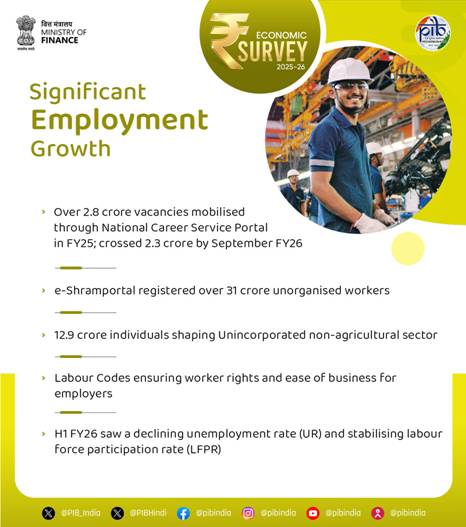
OVER 2.3 CRORE VACANCIES MOBILISED IN FIRST SIX MONTHS OF CURRENT FISCAL THROUGH NATIONAL CAREER SERVICE PORTAL

SOCIAL PROTECTION EXTENDED TO OVER 31 CRORE REGISTERED UNORGANISED WORKERS THROUGH E-SHRAM PORTAL

LABOUR CODES ENSURING WELFARE FOR WORKERS AND EASE OF BUSINESS FOR EMPLOYERS
AMID RISING FEMALE LABOUR FORCE, ECONOMIC SURVEY ACKNOWLEDGES NEED FOR FLEXI WORK HOURS

ENTREPRENEURIAL ACTIVITIES LEADING SELF-EMPLOYMENT REVOLUTION IN RURAL INDIA; 12.9 CRORE INDIVIDUALS (28% WOMEN) SHAPING UNINCORPORATED NON-FARM SECTOR

55% RISE IN NUMBER OF GIG WORKERS FROM FY21 TO FY25

The labour markets in India are undergoing significant structural transformations driven by digitalisation, green energy transition, and emerging forms of employment such as gig and platform work. In this backdrop, a series of significant initiatives by the Government of India continue to bring down unemployment, catalyse job creation and extend welfare cover to the workforce. This was stated by the Economic Survey 2025-26 tabled in Parliament today by Union Minister for Finance and Corporate Affairs Smt. Nirmala Sitharaman.

In the post-pandemic growth phase, the emphasis has shifted from the quantity of jobs to the quality of work, reflecting a more inclusive and sustainable vision of the labour market, the Survey notes. Recent initiatives aimed at promoting labour-intensive sectors and strengthening skill development underscore the Government’s renewed commitment to quality employment and human capital enhancement, with a view to fully harness India’s demographic dividend.

India has recorded significant employment growth in recent years, supported by structural reforms, tax rationalisation, and a sustained focus on skill development. Measures such as deregulation, GST 2.0, and labour reforms implemented by states have contributed to rising labour force participation and employment growth across industry and services, says the Survey.

CURRENT EMPLOYMENT TRENDS:

India has witnessed a positive trend in Female Labour Force Participation Rate (FLFPR) in recent years, rising from 23.3 per cent in 2017-18 to 41.7 per cent in 2023-24, alongside a decline in Unemployment Rate (UR) from 5.6 per cent to just 3.2 per cent, reflecting a shift toward greater inclusion and economic empowerment. The Economic Survey quotes data from several pertinent surveys to give an overview of India’s employment trends.

The quarterly and monthly Periodic Labour Force Survey (PLFS) data show a steady labour market with seasonal variations. It indicates that the period from April to September 2025 (H1 FY26) saw a declining unemployment rate (UR) in the current weekly status (CWS), a stabilising labour force participation rate (LFPR), and substantial employment levels, signalling an improvement in employment conditions. A total of 56.2 crore people (aged 15 years and above) were employed in Q2 FY26, reflecting a creation of around 8.7 lakh new jobs in Q2 compared to Q1 of FY26.

Citing insights drawn from PLFS data, the Survey says, “Rural employment is dominated by agricultural workers (57.7 per cent) and self-employment (62.8 per cent), with women workers showing relatively higher participation in them. In contrast, urban employment is primarily concentrated in the services sector (62.0 per cent), with regular wage or salaried jobs making up the largest share (49.8 per cent).”

The Annual Survey of Industries (ASI), which covers the organised manufacturing sector, results for FY24 highlight the manufacturing sector’s resilience, showing a 6 per cent YoY increase in employment over the previous year. This translates to an addition of over 10 lakh jobs in FY24 compared to FY23. “The sector added more than 57 lakh jobs over the past decade, between FY15 and FY24, with a CAGR of 4 per cent,” says the Economic Survey.

According to the Quarterly Bulletin of Unincorporated Sector Enterprises (QBUSE), the unincorporated non-agricultural sector comprises a total of 7.9 crore establishments, employing 12.9 crore individuals. The share of working owners among total employed workers in the sector increased from 58.9 per cent in 2023-24 to 60 per cent in Q2 FY26, indicating a shift towards self-employment and entrepreneurial activities. The rural workforce in the sector was six crore in Q2 FY26, indicating the significant contribution of unincorporated enterprises to rural economic activities. Additionally, women represent 28.7 per cent of the workforce in the sector. The increasing trend of digitisation in the unincorporated non-agricultural sector is reflected in the rising use of the internet among business units, which increased steadily from 26 per cent in 2023-24 to 39 per cent in Q2 FY26.

EMPOWERING THE WORKFORCE:

The Economic Survey highlights the role of recent policy initiatives in identifying unorganised workers and enhancing their integration with the formal economy through the welfare and skill development systems.

e-Shram:

The Survey draws attention to the e-Shram portal as a key institutional mechanism for extending social protection to unorganised workers, and bridging the gap between informal and formal employment. The portal serves as a National Database of Unorganised Workers, which includes data on construction workers, migrant workers, gig and platform workers, street vendors, domestic workers, and agriculture workers. “As of January 2026, the portal has over 31 crore registered unorganised workers, marking a significant advancement in India’s efforts to formalise and support its informal workforce. Notably, women account for 54 per cent of total registrants, substantially strengthening the reach of gender-focused welfare schemes,” the document states.

The e-Shram platform facilitates the identification of job opportunities, apprenticeship opportunities, and skilling linkages, helping workers transition to improved employment prospects. These efforts align with the broader vision of enhancing productivity and social protection for India’s informal workforce.

National Career Service Portal:

Launched in 2015, the National Career Service (NCS) portal has emerged as a one-stop solution connecting job seekers, employers, training providers and career guidance and counselling agencies. It offers a range of services, including free registration, job application processing, interview assistance, and other employment-related services, and a multi-lingual helpline.

“Since its launch, the portal has evolved into a key employment facilitation platform, with over 5.9 crore registered job seekers and 53 lakh job providers across diverse sectors and mobilising approximately 8 crore vacancies,” states the Economic Survey. “It recorded over a 200 per cent increase in job vacancies in FY24 compared to FY23. Vacancies mobilised exceeded 2.8 crore in FY25 and have already crossed 2.3 crore by September FY26,” the document adds.

In addition, the NCS portal’s integration with the Ministry of External Affairs’ e-Migrate system enables certified recruiting agencies to post verified international job vacancies and provides job seekers with access to global opportunities under safe and monitored conditions. Further, its integration with the Skill India Digital Hub (SIDH) enables candidates to enhance their skill sets before applying for jobs. The portal is partnering with private portals to provide free online training on 'career skills' and ‘digital skills’. Currently, the portal is integrated with 30 State employment portals, including seven states/UTs, which are directly using it for job seeker registrations, the Survey elaborates.

CATALYSING JOB GROWTH THROUGH LABOUR CODES:

The Economic Survey 2025-26 highlights the potential of the Labour Codes to catalyse job growth and accelerate economic development. The four Labour Codes- Code on Wages 2019, Industrial Relations Code 2020, Code on Social Security 2020, and Occupational Safety, Health and Working Conditions Code 2020 have consolidated 29 central laws to streamline regulations and extend protections to workers. The implementation of these Codes was notified on 21 November 2025.

The Survey notes that the Codes have attempted to strike a balance between regulation and flexibility, while protecting worker rights and ensuring social security for workers. They are a result of the deliberations held in the tripartite meeting of the government, employers, industry representatives, and various trade unions from 2015 to 2019.

“Implementing the Codes marks the first step towards the labour market transformation. The transition will require coordination and investment from the private sector,” the Survey states. “Companies must enhance their systems, update policies, re-evaluate workforce models, and improve their digital readiness to remain competitive. While the Codes offer a unified framework, it is up to the private sector to integrate this framework into daily operations,” it further suggests.

THE NEW FRONTIERS OF THE GIG WORKFORCE:

The recent developments in digital platforms and policy reforms are reshaping work structures, fostering flexibility while promoting formalization, underlines the Economic Survey. The Labour Codes have formally recognised gig and platform workers, expanding social security, welfare funds, and benefit portability.

The gig economy, encompassing delivery, ridesharing, and freelancing, has witnessed structural growth, transitioning informal jobs into ecosystem-integrated roles. “From 77 lakh workers in FY21, the sector witnessed a 55 per cent increase to 120 lakh workers in FY25, driven by smartphone penetration among over 80 crore users and 15 billion UPI transactions per month. Now representing over 2 per cent of the total workforce in India, growth of gig workers outpaces overall employment, with non-agricultural gigs projected to constitute 6.7 per cent of the workforce by 2029-30, contributing ₹2.35 lakh crore to GDP,” states the Survey document.

As the gig economy expands, its impact on employment and economic growth will become increasingly evident. While it offers unprecedented opportunities for revenue generation and economic diversification, addressing its challenges is crucial to ensuring long-term, equitable growth.

NEED FOR FLEXI WORK HOURS:

Employment patterns have important gender dimensions. The proportion of women engaged in self-employment or contributing to household enterprises, especially in rural areas, is relatively high. The findings of the Time Use Survey (TUS) conducted by the Ministry of Statistics and Programme Implementation (MoSPI) enables the measurement of the time individuals spend on different activities. According to the TUS 2024, as quoted by the Economic Survey document, women are the main caregivers, with 41 per cent of females aged 15-59 years participating in caregiving for their household members; male participation in this age group was 21.4 per cent.

Evidence from the survey also highlights that the combined time spent on paid and unpaid activities by female members is higher than that of men. Female household members spend significantly more time on unpaid activities than men. While women participating in paid work contribute a considerable amount of time, their overall participation remains lower than that of men. The estimates highlight the dual burden of work on female workers in terms of caregiving activities and unpaid work, which may explain their desirability or inclination towards flexible work models.

Topics

Acts Income Tax
