

Loading...

Top
Help
×

By creating an account you can:

Logo TaxTMI
Call Us / Help / Feedback

Contact Us At :

E-mail: [email protected]

Call / WhatsApp at: +91 99117 96707

For more information, Check Contact Us

FAQs :

To know Frequently Asked Questions, Check FAQs

Most Asked Video Tutorials :

For more tutorials, Check Video Tutorials

Submit Feedback/Suggestion :

Email :
Please provide your email address so we can follow up on your feedback.
Category :
Description :
Min 15 characters 0/2000
Make Most of Text Search
  1. Checkout this video tutorial: How to search effectively on TaxTMI.
  2. Put words in double quotes for exact word search, eg: "income tax"
  3. Avoid noise words such as : 'and, of, the, a'
  4. Sort by Relevance to get the most relevant document.
  5. Press Enter to add multiple terms/multiple phrases, and then click on Search to Search.
  6. Text Search
  7. The system will try to fetch results that contains ALL your words.
  8. Once you add keywords, you'll see a new 'Search In' filter that makes your results even more precise.
  9. Text Search
Add to...
You have not created any category. Kindly create one to bookmark this item!
Create New Category
Hide
Title :
Description :
❮❮ Hide
Default View
Expand ❯❯
Close ✕
🔎 News - Adv. Search
TEXT SEARCH:

Press 'Enter' to add multiple search terms. Rules for Better Search

Search In:
Main Text + AI Text
  • Main Text
  • Main Text + AI Text
  • AI Text
Category: ?
Categorized by AI
---- All Categories ----
  • ---- All Categories ----
  • Income Tax
  • GST
  • Customs, DGFT & SEZ
  • FEMA & RBI
  • Corp. Laws, SEBI & IBC
  • PMLA, Black Money & ED
  • Budget
  • News and Press Release
  • PTI News
Month:
---- All Months ----
  • ---- All Months ----
  • January
  • February
  • March
  • April
  • May
  • June
  • July
  • August
  • September
  • October
  • November
  • December
Year:
---- All Years ----
  • ---- All Years ----
  • 2026
  • 2025
  • 2024
  • 2023
  • 2022
  • 2021
  • 2020
  • 2019
  • 2018
  • 2017
  • 2016
  • 2015
  • 2014
  • 2013
  • 2012
  • 2011
Sort By: ?
In Sort By 'Default', exact matches for text search are shown at the top, followed by the remaining results in their regular order.
Relevance Default Date
    Marching ahead with Responsibility and Growth - Keynote Address[Contributions by RBI colleague Shri Mohammed Majidullah, General Manager] delivered by...
    CCI directs Trustees’ Association of India, IDBI Trusteeship Services Ltd, Axis Trustee Services and SBI CAP Trustee Company to cease and desist fro...
    The Digital Textile Printer Revolution: How Konica Minolta NASSENGER is Preparing India for the Next Global Textile Opportunity
    Union minister Goyal hails 7.8 pc GDP growth; lauds Modi, takes dig at Oppn
    SC disposes of SEBI's pleas against NSE after Rs 1500-crore settlement
    India-US trade pact to be finalised once US offers preferential rate: Goyal
    Business Nextgen Finance Raises Rs 215 Crore in Equity to Accelerate MSME Lending
    Drugs: ED raids in 4 states; over 2 dozen offenders, foreign links under scanner
    Razorpay Launches a Conversational AI Account Manager 'RAY' on WhatsApp For Businesses, in Partnership with IndusInd Bank
    AssetPlus Launches Portfolio Management Services to Help MFD Partners Grow and Retain High-Net-Worth Clients
    APEDA Facilitates Flag-Off of 18 MT of NPOP-Certified Ethnic Rice from Tripura for Export to Austria and the Netherlands
    VR LIVIN’s ‘THE FIRST’ Records Sale of 20 Villas Within Two Days of Launch
    IAAPI Calls for GST Rationalisation to Support Growth and Consumer Demand in India’s Amusement Industry
    ED raids multiple locations in Keralam in hybrid ganja smuggling money laundering case
    Rupee jumps 47 paise to 94.26 against US dollar in early trade
    ED raids multiple locations in Kolkata in bank loan fraud case
    Commerce & Industry Minister Shri Piyush Goyal Calls Upon Auto Component Industry To Go Global
    18th Meeting of Heads of IP Offices of BRICS Countries Held in New Delhi
    India’s Sovereign Credit Rating upgraded to 'A-' with Stable Outlook by Japan Credit Rating Agency
    Secretary, DFS Chairs Review Meeting on Financial and Business Performance of Public Sector General Insurance Companies (PSGICs)
❯❯
Maximize Maximize Maximize
0 / 200
Expand Note
Add to Folder

No Folders have been created

+

Are you sure you want to delete "My most important" ?

NOTE:

News
Showing Results for :
Reset Filters
Results Found:
Show All Summaries Hide All Summaries
September 3, 2026
Show AI Summary
Responsible NBFC and HFC growth requires technology-enabled inclusion, proportionate regulation, sound governance, liquidity discipline, customer protection and cyber resilience.
NBFCs and HFCs can complement bank-led credit delivery through last-mile reach, sector-specific expertise, digital infrastructure, consent-based data sharing and cash-flow-based underwriting. Sustainable growth requires strong liquidity risk management, governance, compliance culture, diversified funding, stress testing, early-warning systems, dynamic provisioning and sound underwriting standards. Proportionate scale-based regulation, digital lending standards and a substance-over-form approach seek to support innovation while preserving financial stability. Customer protection, responsible lending, grievance redressal, fair recovery conduct, cyber resilience and protection of customer data remain essential.
September 3, 2026
Show AI Summary
Debenture trusteeship fee fixing constitutes cartelisation by constraining independent pricing and restricting service availability in the market.
Collective minimum-fee fixing for debenture trusteeship services prevented trustees from making independent commercial pricing decisions and constituted cartelisation. Prescription of a benchmark fee limited and controlled the supply or market for such services by directing association members and non-members not to serve debenture issuers below that fee. The conduct contravened Section 3(3)(a) and Section 3(3)(b) read with Section 3(1) of the Competition Act, 2002.
September 3, 2026
Show AI Summary
Digital textile printing enables flexible industrial production, shorter lead times, reduced screen dependency and sustainability-focused manufacturing for export markets.
Digital textile printing is presented as an industrial alternative to conventional screen printing, allowing direct production from digital design files with faster design changes, shorter lead times and flexibility across varying order quantities. Single-pass systems support high-volume production through fixed printing units and continuous fabric movement, while multipass platforms provide flexible production across natural, synthetic and specialised textiles. Digital production is associated with printing closer to demand, eliminating physical screens, reducing unnecessary production, and addressing wastewater reduction, chemical compliance, traceability and responsible manufacturing expectations.
September 3, 2026
Show AI Summary
Economic growth and infrastructure investment were presented as supporting exports, skilled employment, connectivity, and long-term development.
Economic growth, export expansion and infrastructure investment are presented as interconnected drivers of India's development, global standing and employment opportunities. Infrastructure expenditure, railway expansion and improved transport connectivity are identified as measures intended to facilitate movement, simplify transportation, support trade and exports, and strengthen industrial and commercial activity. These measures are associated with the objective of a developed India by 2047 and enhanced employment, business and growth opportunities.
September 3, 2026
Show AI Summary
Co-location and dark fibre settlement addressed allegations of preferential market-data access and speed advantages in trading.
SEBI's co-location and dark fibre matters involving NSE concerned allegations that certain stockbrokers obtained unfair preferential speed advantages to access market data and execute trades ahead of other investors. NSE pursued settlement applications covering both matters, and revised settlement terms increased the cumulative amount. Payments made by NSE together completed the agreed settlement amount.
September 3, 2026
Show AI Summary
Preferential tariff treatment remains the condition for finalising the bilateral trade agreement and improving Indian export competitiveness.
Finalisation of the India-US Bilateral Trade Agreement is contingent on the United States extending preferential tariff treatment to India relative to competing supplier countries. Further negotiations are required following changes in the United States tariff environment. A comparative tariff advantage is intended to improve the price competitiveness of Indian goods in the United States market, particularly against competitors benefiting from lower duties under least-developed-country preferences or trade agreements.
September 3, 2026
Show AI Summary
MSME secured lending equity capital, subject to regulatory approval, supports expansion without management-control change in operations.
Business Nextgen Finance Private Limited, a non-deposit taking non-banking financial company registered with the Reserve Bank of India, has raised Rs 215 crore in equity capital to expand secured credit for micro, small and medium enterprises. The transaction received prior Reserve Bank of India approval. The capital base will support secured lending scale-up, geographic expansion, technology investment and wider access to formal credit in underserved markets. The investment does not involve a change in management or day-to-day control.
September 3, 2026
Show AI Summary
Money-laundering probes into narcotics trafficking rely on predicate police and narcotics cases and examine cross-border linkages.
Money-laundering investigation under the Prevention of Money Laundering Act involves coordinated searches in connection with multiple narcotics-trafficking matters. The investigation is founded on police and Narcotics Control Bureau FIRs and linked chargesheets concerning separate drug-trafficking allegations, including alleged trafficking in methamphetamine, marijuana and MDMA with suspected cross-border linkages.
September 3, 2026
Show AI Summary
Conversational AI account management enables businesses to access payment information, settlement support, refunds, and payment links through WhatsApp.
RAY is a conversational AI account manager on WhatsApp that enables businesses to access payment information, support, and operational actions through messages or voice notes. It can provide payment summaries, analyse payment activity, monitor settlement status, generate payment links, and issue refunds. The AI assistant is designed to proactively identify payment-health issues, flag settlement events, recommend actions, and use merchant-specific context to support payment management without dashboard navigation.
September 3, 2026
Show AI Summary
Portfolio management services distribution enables certified mutual fund distributors to digitally onboard and report for eligible high-net-worth clients through AssetPlus.
AssetPlus has launched Portfolio Management Services for certified Mutual Fund Distributor partners to digitally onboard, track, manage and report PMS investments for eligible high-net-worth clients. PMS distribution requires NISM Series-XXI-A certification and operates within the APRN distributor-registration framework. PMS comprises individually managed portfolios run by SEBI-registered Portfolio Managers and held in clients' demat accounts. The minimum investment is Rs. 50 lakh, and offerings are governed by the SEBI (Portfolio Managers) Regulations, 2020. The platform provides daily reconciliation of holdings, performance and valuations.
September 3, 2026
Show AI Summary
NPOP-certified ethnic rice exports strengthen organic producer access to international markets through certification, traceability, and organised export production.
NPOP-certified ethnic rice exports from Tripura to Austria and the Netherlands connect local farmers and Farmer Producer Companies with international markets through organised, export-oriented production. The initiative emphasises certification, traceability, food safety and quality as requirements for access to markets for certified organic products. Buyer-seller linkages support export opportunities, while coordinated organic value-chain engagement strengthens certification and quality systems and supports producers in meeting international standards.
September 3, 2026
Show AI Summary
Gated residential community launch combines smart-home villas, extensive lifestyle amenities and planned expansion into future residential developments.
VR LIVIN Ventures LLP launched 'THE FIRST', an 83-villa gated residential community in Madhavaram, North Chennai, which recorded sales of 20 villas during its first two launch days. The development includes smart-home villas and more than 50 lifestyle amenities, with access to nearby metro connectivity and social infrastructure. It forms part of the company's intended expansion of residential projects in Chennai and other South Indian locations.
September 3, 2026
Show AI Summary
GST rationalisation for amusement park admissions could lower ticket prices, stimulate consumer demand, and support investment without input tax credit.
GST rationalisation for amusement park, water park and indoor entertainment admission tickets is sought through a flat 5% GST rate without Input Tax Credit. The proposed rate is intended to reduce ticket prices, improve affordability and increase customer demand in a capital-intensive tourism and entertainment sector. Many smaller and mid-sized operators report limited ability to offset GST liability through ITC. Lower taxation is projected to support facility expansion, revenue growth, new investment, employment and reinvestment in recreational services.
September 3, 2026
Show AI Summary
Money laundering linked to hybrid ganja smuggling involves alleged illicit cross-border transfers and foreign-exchange violations.
Enforcement Directorate searches form part of a money-laundering investigation into alleged hybrid ganja smuggling from Thailand. A case under the Prevention of Money Laundering Act concerns suspected laundering of drug-trafficking proceeds and transfer of funds to Thailand through illegal channels. The inquiry also examines possible foreign-exchange violations and an alleged arrangement involving carriers, visas and funds for transporting narcotic substances.
September 3, 2026
Show AI Summary
Foreign-currency deposit mobilisation supports currency appreciation while creating surplus-liquidity sterilisation pressures through deposit swaps in domestic banking markets.
Foreign-currency deposit mobilisation strengthened foreign-exchange liquidity and supported rupee appreciation. FCNR(B) deposits, together with overseas foreign-currency borrowings and external commercial borrowings, increased aggregate foreign-currency resources. Bank swaps of such deposits with the central bank may create surplus banking-system liquidity and a sterilisation challenge, while oil prices, global yields, dollar movements and foreign equity inflows remain relevant currency-market factors.
September 3, 2026
Show AI Summary
Money laundering investigation examines alleged diversion of bank loans from a power project to group entities and personal use.
Money laundering investigation under the Prevention of Money Laundering Act concerns alleged diversion of bank loans obtained by Kohinoor Power for a power plant in Jharkhand. The loan proceeds were allegedly transferred to other group entities and used personally. Searches were conducted at eleven premises associated with the group's promoters, directors and auditors. The company entered liquidation proceedings before the National Company Law Tribunal, with limited recovery for creditors.
September 3, 2026
Show AI Summary
Globalisation of auto component manufacturing is linked to trade access, resilient supply chains, technology adoption, safety, and vehicle scrappage.
The auto component industry is encouraged to expand globally through reciprocal market access, overseas manufacturing, international investment and trade partnerships. Supply-chain resilience is to be strengthened through indigenisation of vulnerable products, access to critical minerals, and domestic capacity in auto components, speciality steel, technical textiles and semiconductors. Priority is also given to high-value integrated solutions, artificial intelligence-enabled quality control, vehicle safety and industrial parks offering manufacturing infrastructure. Vehicle scrappage requires coordinated government incentives and fair industry valuation to support replacement demand for new-age vehicles.
September 3, 2026
Show AI Summary
Updated IP cooperation guidelines strengthen cross-border innovation, patent examination coordination, traditional knowledge protection, and geographical indication commercialisation.
IP BRICS Heads adopted Updated Operational Guidelines to direct result-oriented intellectual property cooperation, promote cross-border innovation, and reinforce joint engagement in global IP standards. Priority areas include protection of traditional knowledge and traditional systems of medicine, reinforced patent examination cooperation, exchange of search results, patent analytics, and geographical indication protection and commercialisation. Coordination mechanisms and periodic progress reviews are emphasised for effective implementation and continuity of cooperation.
September 3, 2026
Show AI Summary
Sovereign credit rating upgrade reflects resilient growth, improved fiscal expenditure quality, stronger financial systems, and a robust external position.
India's long-term foreign-currency and local-currency issuer ratings were upgraded from 'BBB+' to 'A-', with a Stable Outlook, reflecting resilient economic growth, improved fiscal expenditure quality, strengthened financial-sector soundness, and a robust external position. Fiscal improvement is linked to greater capital expenditure and lower fiscal deficit. Financial resilience is supported by improved banking and non-banking sector asset quality and capital adequacy. External strength arises from a contained current account deficit, services surplus, and foreign-exchange reserves exceeding short-term external debt.
September 3, 2026
Show AI Summary
Public sector general insurance performance requires profitable underwriting, lower claim ratios, digitalisation, standardised monitoring, and quality grievance redressal.
Public Sector General Insurance Companies were advised to focus on profitable business lines, reduce the Incurred Claim Ratio, and accelerate technology use and digitalisation while optimising related expenditure. They are to improve insurance penetration, density, outreach and customer awareness, particularly in underserved segments, while reducing protection gaps. A robust, standardised KPI framework should enable comparable financial and non-financial performance assessment and be reviewed quarterly. Customer grievances require expeditious and quality redressal.

News

Back

All News

Showing Results for :
Reset Filters
No Records Found

News

Showing Results for : Reset Filters

RIGHT SKILLING, ENTREPRENEURIAL SPIRIT AND GOVERNMENT INITIATIVES CONTINUE TO BRING DOWN UNEMPLOYMENT, SAYS THE ECONOMIC SURVEY 2025-26

January 29, 2026

Contents
Summary
Note

Note

-

Bookmark

Print

Print

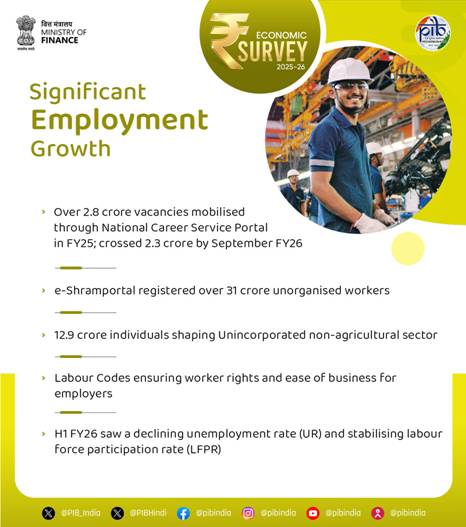
OVER 2.3 CRORE VACANCIES MOBILISED IN FIRST SIX MONTHS OF CURRENT FISCAL THROUGH NATIONAL CAREER SERVICE PORTAL

SOCIAL PROTECTION EXTENDED TO OVER 31 CRORE REGISTERED UNORGANISED WORKERS THROUGH E-SHRAM PORTAL

LABOUR CODES ENSURING WELFARE FOR WORKERS AND EASE OF BUSINESS FOR EMPLOYERS
AMID RISING FEMALE LABOUR FORCE, ECONOMIC SURVEY ACKNOWLEDGES NEED FOR FLEXI WORK HOURS

ENTREPRENEURIAL ACTIVITIES LEADING SELF-EMPLOYMENT REVOLUTION IN RURAL INDIA; 12.9 CRORE INDIVIDUALS (28% WOMEN) SHAPING UNINCORPORATED NON-FARM SECTOR

55% RISE IN NUMBER OF GIG WORKERS FROM FY21 TO FY25

The labour markets in India are undergoing significant structural transformations driven by digitalisation, green energy transition, and emerging forms of employment such as gig and platform work. In this backdrop, a series of significant initiatives by the Government of India continue to bring down unemployment, catalyse job creation and extend welfare cover to the workforce. This was stated by the Economic Survey 2025-26 tabled in Parliament today by Union Minister for Finance and Corporate Affairs Smt. Nirmala Sitharaman.

In the post-pandemic growth phase, the emphasis has shifted from the quantity of jobs to the quality of work, reflecting a more inclusive and sustainable vision of the labour market, the Survey notes. Recent initiatives aimed at promoting labour-intensive sectors and strengthening skill development underscore the Government’s renewed commitment to quality employment and human capital enhancement, with a view to fully harness India’s demographic dividend.

India has recorded significant employment growth in recent years, supported by structural reforms, tax rationalisation, and a sustained focus on skill development. Measures such as deregulation, GST 2.0, and labour reforms implemented by states have contributed to rising labour force participation and employment growth across industry and services, says the Survey.

CURRENT EMPLOYMENT TRENDS:

India has witnessed a positive trend in Female Labour Force Participation Rate (FLFPR) in recent years, rising from 23.3 per cent in 2017-18 to 41.7 per cent in 2023-24, alongside a decline in Unemployment Rate (UR) from 5.6 per cent to just 3.2 per cent, reflecting a shift toward greater inclusion and economic empowerment. The Economic Survey quotes data from several pertinent surveys to give an overview of India’s employment trends.

The quarterly and monthly Periodic Labour Force Survey (PLFS) data show a steady labour market with seasonal variations. It indicates that the period from April to September 2025 (H1 FY26) saw a declining unemployment rate (UR) in the current weekly status (CWS), a stabilising labour force participation rate (LFPR), and substantial employment levels, signalling an improvement in employment conditions. A total of 56.2 crore people (aged 15 years and above) were employed in Q2 FY26, reflecting a creation of around 8.7 lakh new jobs in Q2 compared to Q1 of FY26.

Citing insights drawn from PLFS data, the Survey says, “Rural employment is dominated by agricultural workers (57.7 per cent) and self-employment (62.8 per cent), with women workers showing relatively higher participation in them. In contrast, urban employment is primarily concentrated in the services sector (62.0 per cent), with regular wage or salaried jobs making up the largest share (49.8 per cent).”

The Annual Survey of Industries (ASI), which covers the organised manufacturing sector, results for FY24 highlight the manufacturing sector’s resilience, showing a 6 per cent YoY increase in employment over the previous year. This translates to an addition of over 10 lakh jobs in FY24 compared to FY23. “The sector added more than 57 lakh jobs over the past decade, between FY15 and FY24, with a CAGR of 4 per cent,” says the Economic Survey.

According to the Quarterly Bulletin of Unincorporated Sector Enterprises (QBUSE), the unincorporated non-agricultural sector comprises a total of 7.9 crore establishments, employing 12.9 crore individuals. The share of working owners among total employed workers in the sector increased from 58.9 per cent in 2023-24 to 60 per cent in Q2 FY26, indicating a shift towards self-employment and entrepreneurial activities. The rural workforce in the sector was six crore in Q2 FY26, indicating the significant contribution of unincorporated enterprises to rural economic activities. Additionally, women represent 28.7 per cent of the workforce in the sector. The increasing trend of digitisation in the unincorporated non-agricultural sector is reflected in the rising use of the internet among business units, which increased steadily from 26 per cent in 2023-24 to 39 per cent in Q2 FY26.

EMPOWERING THE WORKFORCE:

The Economic Survey highlights the role of recent policy initiatives in identifying unorganised workers and enhancing their integration with the formal economy through the welfare and skill development systems.

e-Shram:

The Survey draws attention to the e-Shram portal as a key institutional mechanism for extending social protection to unorganised workers, and bridging the gap between informal and formal employment. The portal serves as a National Database of Unorganised Workers, which includes data on construction workers, migrant workers, gig and platform workers, street vendors, domestic workers, and agriculture workers. “As of January 2026, the portal has over 31 crore registered unorganised workers, marking a significant advancement in India’s efforts to formalise and support its informal workforce. Notably, women account for 54 per cent of total registrants, substantially strengthening the reach of gender-focused welfare schemes,” the document states.

The e-Shram platform facilitates the identification of job opportunities, apprenticeship opportunities, and skilling linkages, helping workers transition to improved employment prospects. These efforts align with the broader vision of enhancing productivity and social protection for India’s informal workforce.

National Career Service Portal:

Launched in 2015, the National Career Service (NCS) portal has emerged as a one-stop solution connecting job seekers, employers, training providers and career guidance and counselling agencies. It offers a range of services, including free registration, job application processing, interview assistance, and other employment-related services, and a multi-lingual helpline.

“Since its launch, the portal has evolved into a key employment facilitation platform, with over 5.9 crore registered job seekers and 53 lakh job providers across diverse sectors and mobilising approximately 8 crore vacancies,” states the Economic Survey. “It recorded over a 200 per cent increase in job vacancies in FY24 compared to FY23. Vacancies mobilised exceeded 2.8 crore in FY25 and have already crossed 2.3 crore by September FY26,” the document adds.

In addition, the NCS portal’s integration with the Ministry of External Affairs’ e-Migrate system enables certified recruiting agencies to post verified international job vacancies and provides job seekers with access to global opportunities under safe and monitored conditions. Further, its integration with the Skill India Digital Hub (SIDH) enables candidates to enhance their skill sets before applying for jobs. The portal is partnering with private portals to provide free online training on 'career skills' and ‘digital skills’. Currently, the portal is integrated with 30 State employment portals, including seven states/UTs, which are directly using it for job seeker registrations, the Survey elaborates.

CATALYSING JOB GROWTH THROUGH LABOUR CODES:

The Economic Survey 2025-26 highlights the potential of the Labour Codes to catalyse job growth and accelerate economic development. The four Labour Codes- Code on Wages 2019, Industrial Relations Code 2020, Code on Social Security 2020, and Occupational Safety, Health and Working Conditions Code 2020 have consolidated 29 central laws to streamline regulations and extend protections to workers. The implementation of these Codes was notified on 21 November 2025.

The Survey notes that the Codes have attempted to strike a balance between regulation and flexibility, while protecting worker rights and ensuring social security for workers. They are a result of the deliberations held in the tripartite meeting of the government, employers, industry representatives, and various trade unions from 2015 to 2019.

“Implementing the Codes marks the first step towards the labour market transformation. The transition will require coordination and investment from the private sector,” the Survey states. “Companies must enhance their systems, update policies, re-evaluate workforce models, and improve their digital readiness to remain competitive. While the Codes offer a unified framework, it is up to the private sector to integrate this framework into daily operations,” it further suggests.

THE NEW FRONTIERS OF THE GIG WORKFORCE:

The recent developments in digital platforms and policy reforms are reshaping work structures, fostering flexibility while promoting formalization, underlines the Economic Survey. The Labour Codes have formally recognised gig and platform workers, expanding social security, welfare funds, and benefit portability.

The gig economy, encompassing delivery, ridesharing, and freelancing, has witnessed structural growth, transitioning informal jobs into ecosystem-integrated roles. “From 77 lakh workers in FY21, the sector witnessed a 55 per cent increase to 120 lakh workers in FY25, driven by smartphone penetration among over 80 crore users and 15 billion UPI transactions per month. Now representing over 2 per cent of the total workforce in India, growth of gig workers outpaces overall employment, with non-agricultural gigs projected to constitute 6.7 per cent of the workforce by 2029-30, contributing ₹2.35 lakh crore to GDP,” states the Survey document.

As the gig economy expands, its impact on employment and economic growth will become increasingly evident. While it offers unprecedented opportunities for revenue generation and economic diversification, addressing its challenges is crucial to ensuring long-term, equitable growth.

NEED FOR FLEXI WORK HOURS:

Employment patterns have important gender dimensions. The proportion of women engaged in self-employment or contributing to household enterprises, especially in rural areas, is relatively high. The findings of the Time Use Survey (TUS) conducted by the Ministry of Statistics and Programme Implementation (MoSPI) enables the measurement of the time individuals spend on different activities. According to the TUS 2024, as quoted by the Economic Survey document, women are the main caregivers, with 41 per cent of females aged 15-59 years participating in caregiving for their household members; male participation in this age group was 21.4 per cent.

Evidence from the survey also highlights that the combined time spent on paid and unpaid activities by female members is higher than that of men. Female household members spend significantly more time on unpaid activities than men. While women participating in paid work contribute a considerable amount of time, their overall participation remains lower than that of men. The estimates highlight the dual burden of work on female workers in terms of caregiving activities and unpaid work, which may explain their desirability or inclination towards flexible work models.

Topics

Acts Income Tax
