

Loading...

Top
Help
×

By creating an account you can:

Logo TaxTMI
Call Us / Help / Feedback

Contact Us At :

E-mail: [email protected]

Call / WhatsApp at: +91 99117 96707

For more information, Check Contact Us

FAQs :

To know Frequently Asked Questions, Check FAQs

Most Asked Video Tutorials :

For more tutorials, Check Video Tutorials

Submit Feedback/Suggestion :

Email :
Please provide your email address so we can follow up on your feedback.
Category :
Description :
Min 15 characters 0/2000
Make Most of Text Search
  1. Checkout this video tutorial: How to search effectively on TaxTMI.
  2. Put words in double quotes for exact word search, eg: "income tax"
  3. Avoid noise words such as : 'and, of, the, a'
  4. Sort by Relevance to get the most relevant document.
  5. Press Enter to add multiple terms/multiple phrases, and then click on Search to Search.
  6. Text Search
  7. The system will try to fetch results that contains ALL your words.
  8. Once you add keywords, you'll see a new 'Search In' filter that makes your results even more precise.
  9. Text Search
Add to...
You have not created any category. Kindly create one to bookmark this item!
Create New Category
Hide
Title :
Description :
❮❮ Hide
Default View
Expand ❯❯
Close ✕
🔎 News - Adv. Search
TEXT SEARCH:

Press 'Enter' to add multiple search terms. Rules for Better Search

Search In:
Main Text + AI Text
  • Main Text
  • Main Text + AI Text
  • AI Text
Category: ?
Categorized by AI
---- All Categories ----
  • ---- All Categories ----
  • Income Tax
  • GST
  • Customs, DGFT & SEZ
  • FEMA & RBI
  • Corp. Laws, SEBI & IBC
  • PMLA, Black Money & ED
  • Budget
  • News and Press Release
  • PTI News
Month:
---- All Months ----
  • ---- All Months ----
  • January
  • February
  • March
  • April
  • May
  • June
  • July
  • August
  • September
  • October
  • November
  • December
Year:
---- All Years ----
  • ---- All Years ----
  • 2026
  • 2025
  • 2024
  • 2023
  • 2022
  • 2021
  • 2020
  • 2019
  • 2018
  • 2017
  • 2016
  • 2015
  • 2014
  • 2013
  • 2012
  • 2011
Sort By: ?
In Sort By 'Default', exact matches for text search are shown at the top, followed by the remaining results in their regular order.
Relevance Default Date
    India Must Build Resilient, Globally Integrated Healthcare Supply Chains: Commerce and Industry Minister Shri Piyush Goyal at Bharat Health Global Exp...
    Rupee rises 4 paise to 94.39 against US dollar in early trade
    Jantar Mantar student stir, mass struggles could impact Assembly polls: MA Baby
    FDA awaiting response from restaurants at Mumbai Cricket Association premises: Mundhe
    India emerges as key diesel supplier to Europe as Russian, US flows falter
    Trump keeps heralding an economic boom, but even a solid jobs report is causing problems for him
    Telangana CM urges TCS'' HyperVault to launch its Hyderabad AI data centre by June 2028
    CBI FIR against Subhash Chandra for 'inflating' net worth to secure Rs 980 Cr in loans
    TCS subsidiary HyperVault to invest Rs 70,000 cr to develop Hyderabad AI data centre
    CBI FIR against Subhash Chandra for 'inflation' of net worth to secure nearly Rs 1,000-cr in loans
    Union Minister of Commerce & Industry Shri Piyush Goyal Calls for Nationwide FTA Utilisation Drive to Expand India’s Global Trade Footprint
    Union Minister of Commerce & Industry Shri Piyush Goyal Calls Upon Automotive Industry to Deepen Localisation, Expand Exports and Prepare to Serve Glo...
    GeM and Textiles Committee Sign MoU to Boost Procurement of Recycled and Upcycled Textiles
    India–EU FTA Opens Huge Opportunities for Farmers, MSMEs, Innovators, Startups and Businesses in India and Europe: Commerce and Industry Minister Sh...
    First Batch of Corporate Mitra Course Commences with 2879 Learners registered
    NFRA Constitutes Advisory Committee on Audit Quality, Assurance and Technology
    ED arrests ex-panchayat CEO who allotted govt funds for fake marriages during COVID lockdown
    Goyal blames market conditions for Jet Airways' downfall; ED says he 'bled airline to death'
    Rupee rises 8 paise to close at 94.43 against US dollar
    NSE gets regulatory nod for Rs 30,000 cr IPO, the biggest so far
❯❯
Maximize Maximize Maximize
0 / 200
Expand Note
Add to Folder

No Folders have been created

+

Are you sure you want to delete "My most important" ?

NOTE:

News
Showing Results for :
Reset Filters
Results Found:
Show All Summaries Hide All Summaries
September 7, 2026
Show AI Summary
Healthcare supply-chain resilience requires diversified sourcing, global investment, domestic innovation, and stronger medical-device production supported by enabling infrastructure.
Healthcare supply-chain resilience requires diversified sourcing, restoration of domestic capacity in Active Pharmaceutical Ingredients and Key Starting Materials, and continued imports where necessary through multiple suppliers and geographies. Pharmaceutical industry growth should move beyond generics towards research, development, patented products, new molecules, biosimilars and biotechnology. Regulatory convergence should support clinical trials, patenting and new-product introduction. Government support is contemplated for medical value travel, healthcare infrastructure, bulk drug parks, plug-and-play facilities, medical-device component production and scientific validation of Ayush products.
September 7, 2026
Show AI Summary
Foreign exchange market pressures offset rupee support from FCNR inflows amid higher crude oil and dollar demand.
The rupee gained marginally against the US dollar, supported by FCNR-related dollar inflows and robust liquidity. Elevated Brent crude prices, safe-haven dollar demand and geopolitical tensions constrained this support. Higher oil prices may enlarge India's import bill, increase dollar demand and pressure the rupee, although rising foreign-exchange reserves indicated external-sector strength.
September 6, 2026
Show AI Summary
Census data privacy and electoral integrity concerns emerge alongside calls to repeal insolvency law and protect political dissent.
CPI(M) called for repeal of the Insolvency and Bankruptcy Code, alleging that insolvency processes enabled diversion of public resources. It questioned economic growth figures against agricultural weakness, mining contraction, higher input costs, inflation, unemployment and malnutrition. The party also raised Census data privacy concerns over caste-data collection, potential linkage with government databases, and possible implications for citizenship, electoral rolls and future delimitation.
September 6, 2026
Show AI Summary
Food business licensing: Third-party restaurant operators require their own licences and cannot operate under another entity's registration.
Food Business Operator licensing requires the entity holding a food licence or registration to itself conduct the licensed food business at the specified premises. A third-party operator cannot operate under another entity's licence or registration and must obtain its own licence or registration. Regulatory notices concerning such arrangements may also address hygiene lapses and structural violations, followed by consideration of the operators' responses.
September 6, 2026
Show AI Summary
European diesel supply dependence on alternative refiners grows amid constrained exports, weakening transatlantic flows, and restricted shipping routes.
European diesel supply is becoming increasingly dependent on Indian refining capacity as Russian diesel and gasoil exports remain constrained by export restrictions, refinery disruptions and port outages, while US shipments to Europe have weakened. Alternative supply routes offer limited additional clean-product volumes because reduced tanker crossings and lower ship-to-ship transfers offshore Oman constrain flows through the Strait of Hormuz. Low diesel inventories, seasonal demand and planned refinery maintenance increase exposure to supply disruptions.
September 5, 2026
Show AI Summary
Tariff-driven inflation and elevated borrowing costs constrain growth, while durable deficit reduction may require spending restraint and tax increases.
Persistent inflation, elevated interest rates and rising public debt constrain economic growth policy. Tariffs and oil shortages are identified as contributing to inflationary pressures, while lower interest rates could increase money flows and worsen inflation. Tariffs, tax cuts, artificial intelligence productivity gains and anti-fraud measures are advanced as mechanisms to support growth, investment and domestic employment. Fiscal sustainability, however, cannot be achieved through growth alone where social security and healthcare costs exceed revenue growth; deficit reduction may require slower spending, spending reductions and tax increases.
September 5, 2026
Show AI Summary
AI data centre development receives state support for a high-capacity campus and accelerated commissioning timetable.
HyperVault's proposed artificial-intelligence data-centre campus in Hyderabad is planned on 264 acres, with investment projected at up to Rs 70,000 crore and capacity of up to 1 GW. The campus is intended to provide high-density, liquid-cooled computing infrastructure for frontier AI companies and hyperscalers. Telangana's Chief Minister sought inauguration by June 2, 2028, while assuring required governmental sanctions and support. The project is estimated to create 7,000 jobs.
September 5, 2026
Show AI Summary
Inflated net-worth certificates allegedly enabled secured lending, triggering fraud, breach-of-trust and asset-stripping allegations after default.
Alleged inflation of net-worth certificates is said to have induced approval and disbursal of two corporate loan facilities aggregating Rs 980 crore, each secured by continuing personal guarantees. The facilities subsequently defaulted. The FIR alleges that materially higher net-worth representations made in 2018 were later contradicted during insolvency proceedings, and attributes the lending to collusion among the guarantor, borrower entities and their officers. Allegations include cheating, creation of false documents, misappropriation and misapplication of loan funds, breach of trust, and asset stripping intended to frustrate recovery.
September 5, 2026
Show AI Summary
AI data centre infrastructure investment enables phased deployment of high-density, liquid-cooled computing capacity using green and water-neutral design.
HyperVault plans to develop an artificial intelligence data-centre campus on 264 acres in Hyderabad, with capacity of up to 1 GW and investment by HyperVault and its partners of up to Rs 70,000 crore. The facility is intended to provide high-density, liquid-cooled computing infrastructure for frontier AI companies and hyperscalers. Development will proceed in phases according to customer demand and technology requirements, incorporating green-energy use and water-neutral design principles.
September 5, 2026
Show AI Summary
Alleged inflation of personal net worth underpins fraud and breach-of-trust accusations over secured corporate lending.
CBI registration of an FIR concerns allegations that inflated personal net-worth certificates were used to secure corporate loan facilities from Life Insurance Corporation Housing Finance Ltd. The lender alleges that the certificates influenced lending decisions, the facilities subsequently defaulted, and later insolvency proceedings disclosed inconsistency between the represented and asserted net-worth figures. Allegations include collusion with borrower entities, false documentation, cheating, misappropriation of loan funds, and breach of lender trust.
September 5, 2026
Show AI Summary
Free trade agreement utilisation requires district-level exporter support, rules-of-origin assistance, standards compliance, and coordinated market-access outreach nationwide.
Free Trade Agreement utilisation is to be advanced through coordinated action by central and state governments, sectoral ministries, Export Promotion Councils, industry associations and local export-support institutions. Preferential treatment is assessed against tariff rates faced by competing countries, while export competitiveness depends on scale, quality, customer trust and timely delivery. The Export Promotion Mission supports export credit, digitised compliance and FTA documentation, including rules-of-origin certification. District-level identification of products, clusters, new exporters and practical constraints, supported by workshops and rapid online facilitation, is intended to deepen market access.
September 5, 2026
Show AI Summary
Automotive localisation and export competitiveness are prioritised through global-standard manufacturing, technology partnerships, sustainable mobility, and government infrastructure support.
Automotive-sector localisation, export expansion and global-standard manufacturing are prioritised to strengthen India's role in global production and trade. Companies are urged to invest in technology, innovation, research and development, use domestic scale for overseas markets, and avoid supplying inferior products domestically. Trade agreements are positioned as channels for market access, technology absorption and exports. Greater indigenisation is encouraged through component localisation, technology collaborations and expanded exports, supported by critical minerals, batteries, indigenous energy sources, research funding, plug-and-play infrastructure and industrial ecosystems.
September 5, 2026
Show AI Summary
Circular textile procurement integrates certification, product categories and seller support to expand government markets for recycled materials.
Memorandum of Understanding for circular textile procurement links certification, standardisation and public-market access for recycled and upcycled products made from textile waste, scrap and second-hand clothes. The Textiles Committee will identify, verify, certify and recognise eligible producers and support specifications, catalogues and capacity building. Government e Marketplace will create dedicated product categories, onboard sellers, facilitate online market linkages, promote products to government buyers, and provide training and handholding to recyclers and upcyclers.
September 5, 2026
Show AI Summary
India-EU Free Trade Agreement promotes tariff reduction, market access, investment resilience, and India-Belgium industrial and skills cooperation.
India-EU Free Trade Agreement is presented as reducing or removing tariffs on more than 95 per cent of Indian and European goods exports while protecting sensitive sectors on both sides. It is intended to expand trade, investment and economic resilience, with the Port of Antwerp-Bruges serving as a major gateway for Indian exports into European markets. India-Belgium cooperation is identified in gems and jewellery, semiconductors, green hydrogen, advanced manufacturing, agriculture and food processing, supported by mutual recognition, workforce mobility, skills development and technology collaboration.
September 5, 2026
Show AI Summary
MSME compliance capacity-building programme launches structured learning and workplace training to develop certified paraprofessional support.
Corporate Mitra Course has commenced to develop trained and certified paraprofessionals capable of providing affordable business and regulatory compliance support to Micro, Small and Medium Enterprises. The 12-month programme includes six months of structured academic learning and six months of on-the-job training in professional firms. Its digital learning system offers recorded lectures, reference materials, assessments and learner-support facilities. The programme aims to strengthen MSME formalisation, ease of doing business, trust, transparency, accountability and orderly growth.
September 5, 2026
Show AI Summary
Audit quality advisory committee broadens expert input on assurance, technology, and stakeholder perspectives in oversight.
NFRA has constituted an Advisory Committee on Audit Quality, Assurance and Technology under Rules 15 and 16 of the National Financial Reporting Authority Rules, 2018. The Committee will provide expert inputs and suggestions on matters significantly affecting audit quality, while supporting functions relating to awareness of auditing and accounting standards. Its members represent professionals, chief financial officers, audit committees, independent directors, technology experts, regulators and industry.
September 4, 2026
Show AI Summary
Money laundering allegations over fraudulent marriage-assistance disbursements prompted investigation into false credentials and ineligible beneficiary payments.
Alleged money laundering arose from fraudulent disbursement of marriage-assistance funds intended for daughters of registered construction workers. The allegations include approvals and releases for suspicious marriage cases, use of bank accounts opened or misused on false credentials, multiple cash withdrawals, and extension of benefits to ineligible persons. Investigation under the Prevention of Money Laundering Act followed an economic-offences FIR concerning suspected misuse of the welfare scheme.
September 4, 2026
Show AI Summary
Money-laundering allegations: discharge plea attributes airline's financial collapse to macroeconomic conditions and denies loan siphoning through sales agents.
Money-laundering proceedings arising from alleged bank fraud concern claims that loans advanced to an airline were siphoned off. The discharge application attributes the airline's financial collapse to adverse macroeconomic conditions rather than fraudulent conduct or laundering, denies diversion through General Sales Agents, and maintains that related payments were board-approved and disclosed. It also contests the treatment of the bank's outstanding claim as funds received by the founder, while the investigating agency alleges systemic fraud, loan diversion and laundering.
September 4, 2026
Show AI Summary
Foreign exchange market conditions supported rupee appreciation, while oil prices and geopolitical tensions limited potential gains.
Foreign exchange market conditions supported the rupee's appreciation by 8 paise to 94.43 against the US dollar, aided by positive domestic equity markets, improved risk appetite, foreign capital inflows and foreign institutional buying. Reserve Bank of India intervention was also cited as support. Elevated crude oil prices, safe-haven dollar demand and United States-Iran tensions were identified as factors limiting further gains. India's foreign exchange reserves increased to a new all-time high during the relevant reporting week.
September 4, 2026
Show AI Summary
Offer-for-sale IPO clearance enables existing exchange shareholders to monetise holdings, while sale proceeds remain outside the exchange.
Regulatory clearance permits the National Stock Exchange to proceed with an initial public offering structured wholly as an offer for sale by existing shareholders. The proposed issue does not raise fresh capital, and sale proceeds will accrue to the selling shareholders rather than the exchange. Revised offer documents were required after addition of a selling shareholder, triggering a fresh public-feedback period. The offering follows settlement of co-location and dark-fibre matters and governance and compliance measures addressing regulatory concerns.

News

Back

All News

Showing Results for :
Reset Filters
No Records Found

News

Showing Results for : Reset Filters

RIGHT SKILLING, ENTREPRENEURIAL SPIRIT AND GOVERNMENT INITIATIVES CONTINUE TO BRING DOWN UNEMPLOYMENT, SAYS THE ECONOMIC SURVEY 2025-26

January 29, 2026

Contents
Summary
Note

Note

-

Bookmark

Print

Print

OVER 2.3 CRORE VACANCIES MOBILISED IN FIRST SIX MONTHS OF CURRENT FISCAL THROUGH NATIONAL CAREER SERVICE PORTAL

SOCIAL PROTECTION EXTENDED TO OVER 31 CRORE REGISTERED UNORGANISED WORKERS THROUGH E-SHRAM PORTAL

LABOUR CODES ENSURING WELFARE FOR WORKERS AND EASE OF BUSINESS FOR EMPLOYERS
AMID RISING FEMALE LABOUR FORCE, ECONOMIC SURVEY ACKNOWLEDGES NEED FOR FLEXI WORK HOURS

ENTREPRENEURIAL ACTIVITIES LEADING SELF-EMPLOYMENT REVOLUTION IN RURAL INDIA; 12.9 CRORE INDIVIDUALS (28% WOMEN) SHAPING UNINCORPORATED NON-FARM SECTOR

55% RISE IN NUMBER OF GIG WORKERS FROM FY21 TO FY25

The labour markets in India are undergoing significant structural transformations driven by digitalisation, green energy transition, and emerging forms of employment such as gig and platform work. In this backdrop, a series of significant initiatives by the Government of India continue to bring down unemployment, catalyse job creation and extend welfare cover to the workforce. This was stated by the Economic Survey 2025-26 tabled in Parliament today by Union Minister for Finance and Corporate Affairs Smt. Nirmala Sitharaman.

In the post-pandemic growth phase, the emphasis has shifted from the quantity of jobs to the quality of work, reflecting a more inclusive and sustainable vision of the labour market, the Survey notes. Recent initiatives aimed at promoting labour-intensive sectors and strengthening skill development underscore the Government’s renewed commitment to quality employment and human capital enhancement, with a view to fully harness India’s demographic dividend.

India has recorded significant employment growth in recent years, supported by structural reforms, tax rationalisation, and a sustained focus on skill development. Measures such as deregulation, GST 2.0, and labour reforms implemented by states have contributed to rising labour force participation and employment growth across industry and services, says the Survey.
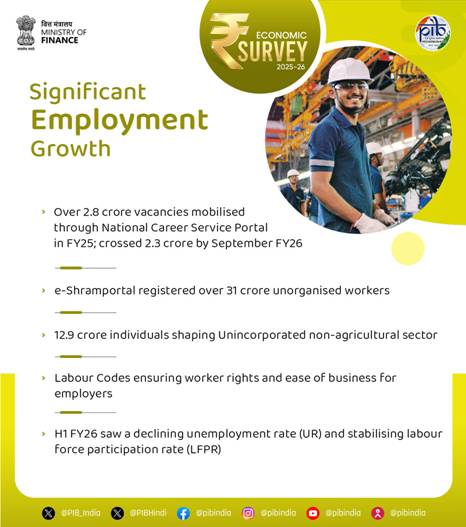

CURRENT EMPLOYMENT TRENDS:

India has witnessed a positive trend in Female Labour Force Participation Rate (FLFPR) in recent years, rising from 23.3 per cent in 2017-18 to 41.7 per cent in 2023-24, alongside a decline in Unemployment Rate (UR) from 5.6 per cent to just 3.2 per cent, reflecting a shift toward greater inclusion and economic empowerment. The Economic Survey quotes data from several pertinent surveys to give an overview of India’s employment trends.

The quarterly and monthly Periodic Labour Force Survey (PLFS) data show a steady labour market with seasonal variations. It indicates that the period from April to September 2025 (H1 FY26) saw a declining unemployment rate (UR) in the current weekly status (CWS), a stabilising labour force participation rate (LFPR), and substantial employment levels, signalling an improvement in employment conditions. A total of 56.2 crore people (aged 15 years and above) were employed in Q2 FY26, reflecting a creation of around 8.7 lakh new jobs in Q2 compared to Q1 of FY26.

Citing insights drawn from PLFS data, the Survey says, “Rural employment is dominated by agricultural workers (57.7 per cent) and self-employment (62.8 per cent), with women workers showing relatively higher participation in them. In contrast, urban employment is primarily concentrated in the services sector (62.0 per cent), with regular wage or salaried jobs making up the largest share (49.8 per cent).”

The Annual Survey of Industries (ASI), which covers the organised manufacturing sector, results for FY24 highlight the manufacturing sector’s resilience, showing a 6 per cent YoY increase in employment over the previous year. This translates to an addition of over 10 lakh jobs in FY24 compared to FY23. “The sector added more than 57 lakh jobs over the past decade, between FY15 and FY24, with a CAGR of 4 per cent,” says the Economic Survey.

According to the Quarterly Bulletin of Unincorporated Sector Enterprises (QBUSE), the unincorporated non-agricultural sector comprises a total of 7.9 crore establishments, employing 12.9 crore individuals. The share of working owners among total employed workers in the sector increased from 58.9 per cent in 2023-24 to 60 per cent in Q2 FY26, indicating a shift towards self-employment and entrepreneurial activities. The rural workforce in the sector was six crore in Q2 FY26, indicating the significant contribution of unincorporated enterprises to rural economic activities. Additionally, women represent 28.7 per cent of the workforce in the sector. The increasing trend of digitisation in the unincorporated non-agricultural sector is reflected in the rising use of the internet among business units, which increased steadily from 26 per cent in 2023-24 to 39 per cent in Q2 FY26.

EMPOWERING THE WORKFORCE:

The Economic Survey highlights the role of recent policy initiatives in identifying unorganised workers and enhancing their integration with the formal economy through the welfare and skill development systems.

e-Shram:

The Survey draws attention to the e-Shram portal as a key institutional mechanism for extending social protection to unorganised workers, and bridging the gap between informal and formal employment. The portal serves as a National Database of Unorganised Workers, which includes data on construction workers, migrant workers, gig and platform workers, street vendors, domestic workers, and agriculture workers. “As of January 2026, the portal has over 31 crore registered unorganised workers, marking a significant advancement in India’s efforts to formalise and support its informal workforce. Notably, women account for 54 per cent of total registrants, substantially strengthening the reach of gender-focused welfare schemes,” the document states.

The e-Shram platform facilitates the identification of job opportunities, apprenticeship opportunities, and skilling linkages, helping workers transition to improved employment prospects. These efforts align with the broader vision of enhancing productivity and social protection for India’s informal workforce.

National Career Service Portal:

Launched in 2015, the National Career Service (NCS) portal has emerged as a one-stop solution connecting job seekers, employers, training providers and career guidance and counselling agencies. It offers a range of services, including free registration, job application processing, interview assistance, and other employment-related services, and a multi-lingual helpline.

“Since its launch, the portal has evolved into a key employment facilitation platform, with over 5.9 crore registered job seekers and 53 lakh job providers across diverse sectors and mobilising approximately 8 crore vacancies,” states the Economic Survey. “It recorded over a 200 per cent increase in job vacancies in FY24 compared to FY23. Vacancies mobilised exceeded 2.8 crore in FY25 and have already crossed 2.3 crore by September FY26,” the document adds.

In addition, the NCS portal’s integration with the Ministry of External Affairs’ e-Migrate system enables certified recruiting agencies to post verified international job vacancies and provides job seekers with access to global opportunities under safe and monitored conditions. Further, its integration with the Skill India Digital Hub (SIDH) enables candidates to enhance their skill sets before applying for jobs. The portal is partnering with private portals to provide free online training on 'career skills' and ‘digital skills’. Currently, the portal is integrated with 30 State employment portals, including seven states/UTs, which are directly using it for job seeker registrations, the Survey elaborates.

CATALYSING JOB GROWTH THROUGH LABOUR CODES:

The Economic Survey 2025-26 highlights the potential of the Labour Codes to catalyse job growth and accelerate economic development. The four Labour Codes- Code on Wages 2019, Industrial Relations Code 2020, Code on Social Security 2020, and Occupational Safety, Health and Working Conditions Code 2020 have consolidated 29 central laws to streamline regulations and extend protections to workers. The implementation of these Codes was notified on 21 November 2025.

The Survey notes that the Codes have attempted to strike a balance between regulation and flexibility, while protecting worker rights and ensuring social security for workers. They are a result of the deliberations held in the tripartite meeting of the government, employers, industry representatives, and various trade unions from 2015 to 2019.

“Implementing the Codes marks the first step towards the labour market transformation. The transition will require coordination and investment from the private sector,” the Survey states. “Companies must enhance their systems, update policies, re-evaluate workforce models, and improve their digital readiness to remain competitive. While the Codes offer a unified framework, it is up to the private sector to integrate this framework into daily operations,” it further suggests.

THE NEW FRONTIERS OF THE GIG WORKFORCE:

The recent developments in digital platforms and policy reforms are reshaping work structures, fostering flexibility while promoting formalization, underlines the Economic Survey. The Labour Codes have formally recognised gig and platform workers, expanding social security, welfare funds, and benefit portability.

The gig economy, encompassing delivery, ridesharing, and freelancing, has witnessed structural growth, transitioning informal jobs into ecosystem-integrated roles. “From 77 lakh workers in FY21, the sector witnessed a 55 per cent increase to 120 lakh workers in FY25, driven by smartphone penetration among over 80 crore users and 15 billion UPI transactions per month. Now representing over 2 per cent of the total workforce in India, growth of gig workers outpaces overall employment, with non-agricultural gigs projected to constitute 6.7 per cent of the workforce by 2029-30, contributing ₹2.35 lakh crore to GDP,” states the Survey document.

As the gig economy expands, its impact on employment and economic growth will become increasingly evident. While it offers unprecedented opportunities for revenue generation and economic diversification, addressing its challenges is crucial to ensuring long-term, equitable growth.

NEED FOR FLEXI WORK HOURS:

Employment patterns have important gender dimensions. The proportion of women engaged in self-employment or contributing to household enterprises, especially in rural areas, is relatively high. The findings of the Time Use Survey (TUS) conducted by the Ministry of Statistics and Programme Implementation (MoSPI) enables the measurement of the time individuals spend on different activities. According to the TUS 2024, as quoted by the Economic Survey document, women are the main caregivers, with 41 per cent of females aged 15-59 years participating in caregiving for their household members; male participation in this age group was 21.4 per cent.

Evidence from the survey also highlights that the combined time spent on paid and unpaid activities by female members is higher than that of men. Female household members spend significantly more time on unpaid activities than men. While women participating in paid work contribute a considerable amount of time, their overall participation remains lower than that of men. The estimates highlight the dual burden of work on female workers in terms of caregiving activities and unpaid work, which may explain their desirability or inclination towards flexible work models.

Topics

Acts Income Tax
