

Loading...

Top
Help
×

By creating an account you can:

Logo TaxTMI
Call Us / Help / Feedback

Contact Us At :

E-mail: [email protected]

Call / WhatsApp at: +91 99117 96707

For more information, Check Contact Us

FAQs :

To know Frequently Asked Questions, Check FAQs

Most Asked Video Tutorials :

For more tutorials, Check Video Tutorials

Submit Feedback/Suggestion :

Email :
Please provide your email address so we can follow up on your feedback.
Category :
Description :
Min 15 characters 0/2000
Make Most of Text Search
  1. Checkout this video tutorial: How to search effectively on TaxTMI.
  2. Put words in double quotes for exact word search, eg: "income tax"
  3. Avoid noise words such as : 'and, of, the, a'
  4. Sort by Relevance to get the most relevant document.
  5. Press Enter to add multiple terms/multiple phrases, and then click on Search to Search.
  6. Text Search
  7. The system will try to fetch results that contains ALL your words.
  8. Once you add keywords, you'll see a new 'Search In' filter that makes your results even more precise.
  9. Text Search
Add to...
You have not created any category. Kindly create one to bookmark this item!
Create New Category
Hide
Title :
Description :
❮❮ Hide
Default View
Expand ❯❯
Close ✕
🔎 News - Adv. Search
TEXT SEARCH:

Press 'Enter' to add multiple search terms. Rules for Better Search

Search In:
Main Text + AI Text
  • Main Text
  • Main Text + AI Text
  • AI Text
Category: ?
Categorized by AI
---- All Categories ----
  • ---- All Categories ----
  • Income Tax
  • GST
  • Customs, DGFT & SEZ
  • FEMA & RBI
  • Corp. Laws, SEBI & IBC
  • PMLA, Black Money & ED
  • Budget
  • News and Press Release
  • PTI News
Month:
---- All Months ----
  • ---- All Months ----
  • January
  • February
  • March
  • April
  • May
  • June
  • July
  • August
  • September
  • October
  • November
  • December
Year:
---- All Years ----
  • ---- All Years ----
  • 2026
  • 2025
  • 2024
  • 2023
  • 2022
  • 2021
  • 2020
  • 2019
  • 2018
  • 2017
  • 2016
  • 2015
  • 2014
  • 2013
  • 2012
  • 2011
Sort By: ?
In Sort By 'Default', exact matches for text search are shown at the top, followed by the remaining results in their regular order.
Relevance Default Date
    CBI FIR against Subhash Chandra for 'inflation' of net worth to secure nearly Rs 1,000-cr in loans
    Union Minister of Commerce & Industry Shri Piyush Goyal Calls for Nationwide FTA Utilisation Drive to Expand India’s Global Trade Footprint
    Union Minister of Commerce & Industry Shri Piyush Goyal Calls Upon Automotive Industry to Deepen Localisation, Expand Exports and Prepare to Serve Glo...
    GeM and Textiles Committee Sign MoU to Boost Procurement of Recycled and Upcycled Textiles
    India–EU FTA Opens Huge Opportunities for Farmers, MSMEs, Innovators, Startups and Businesses in India and Europe: Commerce and Industry Minister Sh...
    First Batch of Corporate Mitra Course Commences with 2879 Learners registered
    NFRA Constitutes Advisory Committee on Audit Quality, Assurance and Technology
    ED arrests ex-panchayat CEO who allotted govt funds for fake marriages during COVID lockdown
    Goyal blames market conditions for Jet Airways' downfall; ED says he 'bled airline to death'
    Rupee rises 8 paise to close at 94.43 against US dollar
    NSE gets regulatory nod for Rs 30,000 cr IPO, the biggest so far
    Sensex rebounds 362 pts, snaps 4-day losses on strong rally in metal, oil shares
    Forex kitty jumps USD 11.47 bn to fresh all-time high of USD 740.8 bn
    NSE gets Sebi nod for Rs 30,000-cr IPO, one of India's largest public issues
    'Policing the Republic': Book traces history of personal security, from Pharaohs to presidents
    Rupee rises 5 paise to 94.46 against US dollar in early trade
    No sensitivity of India compromised in trade pact with US: Goyal
    About 100 highway plazas used illegal apps to collect toll from vehicles not bearing FASTag stickers: ED
    CBI conducts course on financial crimes for officers from ITEC-member countries
    Delhi workers welfare board blacklists firm for over 20,000 'unauthorised' Aadhaar transactions
❯❯
Maximize Maximize Maximize
0 / 200
Expand Note
Add to Folder

No Folders have been created

+

Are you sure you want to delete "My most important" ?

NOTE:

News
Showing Results for :
Reset Filters
Results Found:
Show All Summaries Hide All Summaries
September 5, 2026
Show AI Summary
Alleged inflation of personal net worth underpins fraud and breach-of-trust accusations over secured corporate lending.
CBI registration of an FIR concerns allegations that inflated personal net-worth certificates were used to secure corporate loan facilities from Life Insurance Corporation Housing Finance Ltd. The lender alleges that the certificates influenced lending decisions, the facilities subsequently defaulted, and later insolvency proceedings disclosed inconsistency between the represented and asserted net-worth figures. Allegations include collusion with borrower entities, false documentation, cheating, misappropriation of loan funds, and breach of lender trust.
September 5, 2026
Show AI Summary
Free trade agreement utilisation requires district-level exporter support, rules-of-origin assistance, standards compliance, and coordinated market-access outreach nationwide.
Free Trade Agreement utilisation is to be advanced through coordinated action by central and state governments, sectoral ministries, Export Promotion Councils, industry associations and local export-support institutions. Preferential treatment is assessed against tariff rates faced by competing countries, while export competitiveness depends on scale, quality, customer trust and timely delivery. The Export Promotion Mission supports export credit, digitised compliance and FTA documentation, including rules-of-origin certification. District-level identification of products, clusters, new exporters and practical constraints, supported by workshops and rapid online facilitation, is intended to deepen market access.
September 5, 2026
Show AI Summary
Automotive localisation and export competitiveness are prioritised through global-standard manufacturing, technology partnerships, sustainable mobility, and government infrastructure support.
Automotive-sector localisation, export expansion and global-standard manufacturing are prioritised to strengthen India's role in global production and trade. Companies are urged to invest in technology, innovation, research and development, use domestic scale for overseas markets, and avoid supplying inferior products domestically. Trade agreements are positioned as channels for market access, technology absorption and exports. Greater indigenisation is encouraged through component localisation, technology collaborations and expanded exports, supported by critical minerals, batteries, indigenous energy sources, research funding, plug-and-play infrastructure and industrial ecosystems.
September 5, 2026
Show AI Summary
Circular textile procurement integrates certification, product categories and seller support to expand government markets for recycled materials.
Memorandum of Understanding for circular textile procurement links certification, standardisation and public-market access for recycled and upcycled products made from textile waste, scrap and second-hand clothes. The Textiles Committee will identify, verify, certify and recognise eligible producers and support specifications, catalogues and capacity building. Government e Marketplace will create dedicated product categories, onboard sellers, facilitate online market linkages, promote products to government buyers, and provide training and handholding to recyclers and upcyclers.
September 5, 2026
Show AI Summary
India-EU Free Trade Agreement promotes tariff reduction, market access, investment resilience, and India-Belgium industrial and skills cooperation.
India-EU Free Trade Agreement is presented as reducing or removing tariffs on more than 95 per cent of Indian and European goods exports while protecting sensitive sectors on both sides. It is intended to expand trade, investment and economic resilience, with the Port of Antwerp-Bruges serving as a major gateway for Indian exports into European markets. India-Belgium cooperation is identified in gems and jewellery, semiconductors, green hydrogen, advanced manufacturing, agriculture and food processing, supported by mutual recognition, workforce mobility, skills development and technology collaboration.
September 5, 2026
Show AI Summary
MSME compliance capacity-building programme launches structured learning and workplace training to develop certified paraprofessional support.
Corporate Mitra Course has commenced to develop trained and certified paraprofessionals capable of providing affordable business and regulatory compliance support to Micro, Small and Medium Enterprises. The 12-month programme includes six months of structured academic learning and six months of on-the-job training in professional firms. Its digital learning system offers recorded lectures, reference materials, assessments and learner-support facilities. The programme aims to strengthen MSME formalisation, ease of doing business, trust, transparency, accountability and orderly growth.
September 5, 2026
Show AI Summary
Audit quality advisory committee broadens expert input on assurance, technology, and stakeholder perspectives in oversight.
NFRA has constituted an Advisory Committee on Audit Quality, Assurance and Technology under Rules 15 and 16 of the National Financial Reporting Authority Rules, 2018. The Committee will provide expert inputs and suggestions on matters significantly affecting audit quality, while supporting functions relating to awareness of auditing and accounting standards. Its members represent professionals, chief financial officers, audit committees, independent directors, technology experts, regulators and industry.
September 4, 2026
Show AI Summary
Money laundering allegations over fraudulent marriage-assistance disbursements prompted investigation into false credentials and ineligible beneficiary payments.
Alleged money laundering arose from fraudulent disbursement of marriage-assistance funds intended for daughters of registered construction workers. The allegations include approvals and releases for suspicious marriage cases, use of bank accounts opened or misused on false credentials, multiple cash withdrawals, and extension of benefits to ineligible persons. Investigation under the Prevention of Money Laundering Act followed an economic-offences FIR concerning suspected misuse of the welfare scheme.
September 4, 2026
Show AI Summary
Money-laundering allegations: discharge plea attributes airline's financial collapse to macroeconomic conditions and denies loan siphoning through sales agents.
Money-laundering proceedings arising from alleged bank fraud concern claims that loans advanced to an airline were siphoned off. The discharge application attributes the airline's financial collapse to adverse macroeconomic conditions rather than fraudulent conduct or laundering, denies diversion through General Sales Agents, and maintains that related payments were board-approved and disclosed. It also contests the treatment of the bank's outstanding claim as funds received by the founder, while the investigating agency alleges systemic fraud, loan diversion and laundering.
September 4, 2026
Show AI Summary
Foreign exchange market conditions supported rupee appreciation, while oil prices and geopolitical tensions limited potential gains.
Foreign exchange market conditions supported the rupee's appreciation by 8 paise to 94.43 against the US dollar, aided by positive domestic equity markets, improved risk appetite, foreign capital inflows and foreign institutional buying. Reserve Bank of India intervention was also cited as support. Elevated crude oil prices, safe-haven dollar demand and United States-Iran tensions were identified as factors limiting further gains. India's foreign exchange reserves increased to a new all-time high during the relevant reporting week.
September 4, 2026
Show AI Summary
Offer-for-sale IPO clearance enables existing exchange shareholders to monetise holdings, while sale proceeds remain outside the exchange.
Regulatory clearance permits the National Stock Exchange to proceed with an initial public offering structured wholly as an offer for sale by existing shareholders. The proposed issue does not raise fresh capital, and sale proceeds will accrue to the selling shareholders rather than the exchange. Revised offer documents were required after addition of a selling shareholder, triggering a fresh public-feedback period. The offering follows settlement of co-location and dark-fibre matters and governance and compliance measures addressing regulatory concerns.
September 4, 2026
Show AI Summary
Equity market resilience was tempered by profit booking, geopolitical tensions, global rate expectations and domestic liquidity.
Equity markets registered a recovery after four consecutive losing sessions, led by buying in metal, private banking, oil and gas, housing finance, telecommunication, insurance, commodities and financial services shares. The benchmark equity index closed higher, while the broader index recorded a modest gain after retreating from an intraday level above the psychological threshold during the newly introduced Closing Auction Session. Investor sentiment was supported by easing interest-rate concerns, strong earnings momentum, resilient economic growth and domestic demand, but was constrained by profit booking, geopolitical tensions and crude-oil price risks.
September 4, 2026
Show AI Summary
Forex reserve management reflects rising foreign currency assets and gold holdings, alongside marginal declines in SDRs and IMF reserve position.
India's foreign exchange reserves increased to a fresh all-time high, supported principally by higher foreign currency assets and gold reserves. Reserve accumulation has continued after concessional foreign-exchange swap initiatives introduced amid local-currency depreciation. Foreign currency assets, expressed in United States dollar terms, also reflect valuation effects from movements in currencies such as the euro, pound and yen. Special drawing rights and the reserve position with the International Monetary Fund declined marginally.
September 4, 2026
Show AI Summary
IPO regulatory clearance enables further public issue preparations, with existing shareholders proposing a complete offer for sale.
SEBI's final observations on the proposed initial public offering enable the National Stock Exchange to undertake further public-issue preparations, subject to applicable regulatory requirements. The proposed issue is structured entirely as an offer for sale, under which existing shareholders would divest a portion of their holdings rather than the exchange issuing new shares. The draft red herring prospectus contemplates sale of 14.89 crore shares, representing nearly 6 per cent of the exchange's stake.
September 4, 2026
Show AI Summary
Personal security frameworks evolved from elite guards into intelligence-led protection systems, while VIP culture can distort their necessity.
Personal security evolved from elite guards into structured systems combining physical protection, intelligence, technology and specialised protocols. Prime Ministerial security in India was reorganised after the 1984 assassination of Prime Minister Indira Gandhi by her bodyguards. A commission recommended a single protective agency, leading to the formation of the Special Protection Group in 1985. Statutory parameters introduced in 1988 sought to rationalise and scientifically streamline protection arrangements. Advanced technology, training, intelligence and protocols do not eliminate personal-protection vulnerabilities, and security is characterised as a necessity rather than a status symbol.
September 4, 2026
Show AI Summary
Rupee exchange-rate movement reflects foreign-currency deposit inflows, central-bank intervention, oil-price risks and changing market risk appetite.
Foreign-exchange liquidity measures, including a special central-bank programme for foreign-currency deposits, generated substantial inflows that supported the rupee. Inflows from foreign-currency deposits, overseas foreign-currency borrowings and external commercial borrowings strengthened market conditions. Rupee appreciation was also supported by foreign equity inflows and risk appetite, but remained vulnerable to higher crude-oil prices, US-Iran tensions, safe-haven demand for the US dollar and possible disruption to oil flows through the Strait of Hormuz.
September 3, 2026
Show AI Summary
Trade agreement consultations safeguard farmer, worker, MSME and sectoral sensitivities while phased bilateral tariff negotiations continue.
India-US bilateral trade agreement negotiations are being pursued on the stated basis that Indian sensitivities will not be compromised. The agreement's text remains non-public, while the government position identifies farmers, fishers, micro, small and medium enterprises, workers, handloom and handicrafts sectors, and the automobile industry as protected considerations. The arrangement is described as a first tranche, with further engagement contemplated following changes in the United States tariff landscape.
September 3, 2026
Show AI Summary
Unauthorised toll collection apps allegedly generated fake receipts, concealed non-FASTag collections, and triggered a money-laundering investigation.
Unauthorised digital applications allegedly enabled toll collection from vehicles without FASTag stickers outside the official reporting system. Mobdata and Any were allegedly used to generate unauthorised or fake toll receipts, conceal collections from NHAI, and monitor such collections through dedicated portals. A PMLA investigation followed an FIR alleging fraudulent toll collection, with digital forensic material indicating use of the mechanism across around 100 toll plazas. Searches resulted in seizure of financial and digital records and freezing of bank accounts.
September 3, 2026
Show AI Summary
Economic offence investigations: cross-border training strengthens officers' practical skills in investigation, prosecution, procedures, and handling complex financial crimes.
Capacity-building training under the Indian Technical and Economic Cooperation programme equipped officers from member countries with practical skills for investigating economic offences. It covered varied forms of financial and economic crime, cross-border impact, challenges in investigation and prosecution, standard operating procedures, and investigative best practices. The specialised law-enforcement engagement aims to strengthen international cooperation and investigative capacity in economic-offence matters.
September 3, 2026
Show AI Summary
Unauthorised Aadhaar credential use triggers blacklisting and procurement debarment following alleged post-termination enrolment and update transactions.
Alleged unauthorised use of Aadhaar Registrar/EA Code credentials after termination of an operational engagement led the Delhi Construction and Other Workers Welfare Board to blacklist MDS Solution Pvt Ltd. UIDAI communication indicated that Aadhaar-related activity allegedly continued after cancellation through the Board's credentials. The Board lodged a police complaint, barred the firm from its tenders, procurement processes, empanelment and contract awards, and recommended consideration of action under applicable rules and policies.

News

Back

All News

Showing Results for :
Reset Filters
No Records Found

News

Showing Results for : Reset Filters

“INDIA’S MOVEMENT FROM SWADESHI TO STRATEGIC RESILIENCE, AND FROM RESILIENCE TO STRATEGIC INDISPENSABILITY, CANNOT BE ACHIEVED THROUGH INSULATION ALONE”: ECONOMIC SURVEY 2025-26

January 29, 2026

Contents
Summary
Note

Note

-

Bookmark

Print

Print

STRATEGIC INDISPENSABILITY DEMANDS MAKING INDIA A SOURCE OF STABILITY AND VALUE RATHER THAN ONLY A PARTICIPANT IN GLOBAL MARKETS, STATES ECONOMIC SURVEY

“INSTITUTIONAL INCENTIVE STRUCTURE THAT ENCOURAGES ACTION, EXPERIMENTATION, AND LEARNING UNDER UNCERTAINTY IS INDIA’S OVERARCHING PRIORITY”: ECONOMIC SURVEY 2025-26

THE NEW ‘COMPLIANCE REDUCTION AND DEREGULATION INITIATIVE’ HAS IDENTIFIED 23 PRIORITY AREAS ACROSS FIVE BROAD SECTORS FOR STATE LEVEL DEREGULATION;76% OF ACTIONABLE REFORMS ALREADY IMPLEMENTED

Economic Survey 2025-26 states that India’s transition from Swadeshi to strategic resilience, and ultimately to strategic indispensability, will be determined not only by how fast the economy grows, but by whether domestic capabilities become embedded in global production systems in ways that enhance reliability, learning, and external stability. It further states that strategic resilience rests on the State’s ability to anticipate vulnerabilities, coordinate across institutions, and respond under stress without disorder. Strategic indispensability demands more: the capacity to build capabilities that others depend upon, making India a source of stability and value rather than only a participant in global markets.

The Survey also notes that a world of deep uncertainty requires a shift towards an entrepreneurial state, not to replace markets, but to act under uncertainty, structure risk, and learn systematically.  Hence it argues for institutional incentive structure that encourages action, experimentation, and learning under uncertainty as India’s overarching priority. It also adds that no country that has successfully navigated structural transformation attempted to make its entire bureaucracy entrepreneurial. Equally, it may not be possible for the bureaucracy to be entrepreneurial all the time, because stability and predictability too are necessary traits of good administration. Instead, successful states created bounded institutional spaces - zones where experimentation was permitted, accountability rules were differentiated, and learning was explicit.

Economic Survey says that policies that operate in uncharted terrain, whether in industrial strategy, financial regulation, technology governance, or social policy, cannot be optimised beforehand. They must be tested, revised, and sometimes abandoned. Political leadership must send consistent signals that reversible failure is acceptable, experimentation is necessary, and course correction is a mark of competence rather than weakness. Institutional forgiveness becomes meaningful only when it is paired with a clear distinction between good-faith error and malfeasance.

Economic Survey adds that in the decades ahead, India will face decisions for which there are no manuals. In each case, outcomes will depend less on the correctness of initial choices and more on the State’s capacity to learn, revise, and act with confidence under uncertainty. It also states that the ability of the State to learn, correct course, and act with confidence under uncertainty ultimately depends on how responsibilities, authority, and ownership are organised within its institutions. India’s most consequential constraint today is no longer the absence of policy intent, ideas, or resources, but the incentive structures within institutions that shape how decisions are taken under uncertainty. It cautions that in a world defined by uncertainty, it is not the most controlling states that will succeed, but those that learn fastest, adapt most intelligently, and retain the confidence to correct course.

The Survey notes that a State’s capacity is not a single reform agenda, but a composite outcome shaped by how decisions are taken, how risk and failure are processed, how administration is organised around outcomes, how regulation is designed and delivered, and how incentives shape the behaviour of officials, firms, and citizens.

State capability is also a function of the human systems through which public authority is exercised in practice. As governance challenges become more complex, the quality of public outcomes increasingly depends on how civil servants interpret roles, exercise judgment, and engage with citizens. State capacity is the foundation on which strategic resilience is built and the pathway through which strategic indispensability becomes possible. Capacity is therefore not built by proclamation, but through steady alignment across institutional systems. It is co-created through the everyday behaviour of the State, firms, and citizens, and rests on a shared obligation and a reciprocal contract across the three.

Economic Survey also says that Regulation is one of the most consequential interfaces between the state and the economy. Regulatory capacity is a question of institutional design as much as it is of intent or effort, spanning rule-making, enforcement, accountability, and the structuring of delegated authority. Regulatory capacity depends on how formal powers granted to regulators are structured, exercised, and constrained through institutional design. Some important considerations in the institutional design choices are Clarity in rulemaking and guidance, Separation within authority, Regulatory boards that anchor accountability, Proportionality and discipline in enforcement, Due process as an operational norm, Democratic anchoring and transparency and Democratic anchoring and transparency.

It stresses that Regulators need experts capable of balancing freedom with oversight, while businesses require professionals who can harness this freedom to drive growth while adhering to regulations. The Survey suggests that Schools of Regulatory Studies could be established either as new stand-alone institutions or as additions to existing institutions to provide for these talents. It also states that delays in most regulatory processes, including approvals, investigations, enforcement actions, disputes, and appeals, impose real economic costs. To address this, decisions must be subject to strict timelines, with provisions for deemed approvals when authorities fail to act within prescribed periods.

The Survey notes that in India, the private corporate sector is not merely a subject of regulation; it is a structural participant in the incentive environment that determines whether the state upgrades its capacity or governs through discretion. When firms compete on productivity, quality, and performance, they develop a direct interest in strong, predictable, and impartial public institutions.

If the private corporate sector co-shapes the incentive environment in which state capacity evolves, citizens shape it even more pervasively through the daily norms that determine whether public systems must rely on enforcement or can function through internalised responsibility. When citizens internalise norms of responsibility in shared spaces, treat learning as a habit, respect physical and technical work, use technology without becoming captive to it, and understand that today’s comfort can sometimes become tomorrow’s burden, they will reduce the state's need for constant enforcement, and create the trust on which institutional capacity grows.

The Survey notes that competing in the global big league, whether in manufacturing, logistics, institutions, or elite sports, requires incurring near-term costs for returns that are uncertain, delayed, and often invisible in the short term. Where delayed gratification weakens, systems begin to substitute shortcuts for capability, visibility for depth, and speed for learning.
Screenshot 2026-01-28 143615.png

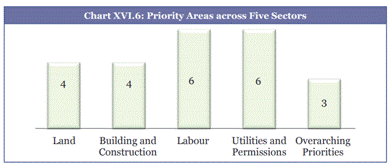
The Survey adds that the ongoing Compliance Reduction and Deregulation Initiative identified 23 Priority Areas across five broad sectors for State level deregulation. These Priority Areas were identified through extensive consultations with Central Ministries, States, industry associations, and knowledge partners. Deregulation, when pursued as a continuous and coordinated governance process, is not a retreat of the State but a strengthening of it. What distinguishes this exercise from earlier deregulation drives is not only the number of reforms, but the institutional process: cross-agency coordination, iterative problem-solving with States, and real-time learning, which touch the core elements of state capacity.

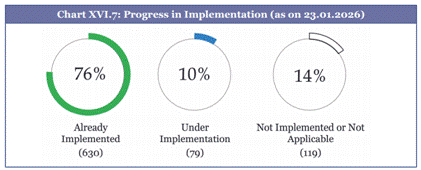
With 36 States and Union Territories expected to implement 23 Priority Areas each, the total number of actionable reforms across the country amounts to 828.
Screenshot 2026-01-28 143713.png

As of 23 January 2026, 630 Priority Areas, representing 76 per cent of the total, have already been implemented. Another 79 Priority Areas, accounting for 10 per cent, are under active implementation.

Economic Survey concludes that the nature of the challenge now facing India is changing and its recent economic performance has demonstrated that macroeconomic stability and growth can be sustained even in a turbulent global environment. In a more uncertain world, risk is unavoidable. The advantage lies in managing it better. Countries that can act before certainty emerges, correct course without paralysis, and align incentives across the State, firms, and citizens are better placed to convert growth into influence. State capacity is therefore not an administrative concern at the margin. It is the foundation on which strategic resilience is built and the pathway through which strategic indispensability becomes possible.

Topics

Acts Income Tax
