

Loading...

Top
Help
×

By creating an account you can:

Logo TaxTMI
Call Us / Help / Feedback

Contact Us At :

E-mail: [email protected]

Call / WhatsApp at: +91 99117 96707

For more information, Check Contact Us

FAQs :

To know Frequently Asked Questions, Check FAQs

Most Asked Video Tutorials :

For more tutorials, Check Video Tutorials

Submit Feedback/Suggestion :

Email :
Please provide your email address so we can follow up on your feedback.
Category :
Description :
Min 15 characters 0/2000
Make Most of Text Search
  1. Checkout this video tutorial: How to search effectively on TaxTMI.
  2. Put words in double quotes for exact word search, eg: "income tax"
  3. Avoid noise words such as : 'and, of, the, a'
  4. Sort by Relevance to get the most relevant document.
  5. Press Enter to add multiple terms/multiple phrases, and then click on Search to Search.
  6. Text Search
  7. The system will try to fetch results that contains ALL your words.
  8. Once you add keywords, you'll see a new 'Search In' filter that makes your results even more precise.
  9. Text Search
Add to...
You have not created any category. Kindly create one to bookmark this item!
Create New Category
Hide
Title :
Description :
❮❮ Hide
Default View
Expand ❯❯
Close ✕
🔎 News - Adv. Search
TEXT SEARCH:

Press 'Enter' to add multiple search terms. Rules for Better Search

Search In:
Main Text + AI Text
  • Main Text
  • Main Text + AI Text
  • AI Text
Category: ?
Categorized by AI
---- All Categories ----
  • ---- All Categories ----
  • Income Tax
  • GST
  • Customs, DGFT & SEZ
  • FEMA & RBI
  • Corp. Laws, SEBI & IBC
  • PMLA, Black Money & ED
  • Budget
  • News and Press Release
  • PTI News
Month:
---- All Months ----
  • ---- All Months ----
  • January
  • February
  • March
  • April
  • May
  • June
  • July
  • August
  • September
  • October
  • November
  • December
Year:
---- All Years ----
  • ---- All Years ----
  • 2026
  • 2025
  • 2024
  • 2023
  • 2022
  • 2021
  • 2020
  • 2019
  • 2018
  • 2017
  • 2016
  • 2015
  • 2014
  • 2013
  • 2012
  • 2011
Sort By: ?
In Sort By 'Default', exact matches for text search are shown at the top, followed by the remaining results in their regular order.
Relevance Default Date
    US banning dairy products, most alcoholic beverages and motorcycles from Canada
    Trump moves to bar Canadian products from US contracts as Canada's retaliatory tariffs take effect
    Bajaj Finance Acquires 5% Stake in TrueFan AI as part of Finserv Intelligence
    SC dismisses BDPL's plea, brings one of India's longest-running corporate disputes to end
    CMRL case: ED writes to Keralam DGP seeking FIR against ex-CM Vijayan, daughter and son-in-law
    RSP MP Premachandran seeks CPI(M) stand on ED probe into Pinarayi Vijayan, family
    UpTik Strengthens Strategic Advisory Board with Appointment of Mr. Rajaram and Mr. Bala Swaminathan
    SC rejects proposal of Parsvnath Developers for homebuyers, asked it to file another
    India faces higher oil import costs as crude prices surge on West Asia supply risks
    Swyom Advisors Marks Three Years of Operations at 'Beyond Alpha: Chapter 3' in Mumbai
    CMRL case: ED writes to Kerala DGP seeking FIR against ex-CM Vijayan, daughter Veena, son-in-law
    ED writes to Kerala DGP seeking FIR against ex-CM Vijayan, daughter, son-in-law in CMRL case
    China's exports pick up in August, jumping 25% as its trade surplus widens
    Rupee falls 10 paise to 94.66 against US dollar in early trade
    Union Finance Minister meets delegation of bank employees representing different Public Sector Banks (PSBs)
    China's exports pick up in August, jumping 25% on strong demand for autos and high tech goods
    TMC calls ED searches political vendetta, bid to divert attention from Delhi building collapse
    Valmiki Corporation 'scam': ED questions ex-K'taka minister B Nagendra again
    Allahabad HC seeks Centre, UP response over learning licence issued in dead man's name
    Axis Bank sees religious tourism, defence, MSMEs as key growth areas in UP
❯❯
Maximize Maximize Maximize
0 / 200
Expand Note
Add to Folder

No Folders have been created

+

Are you sure you want to delete "My most important" ?

NOTE:

News
Showing Results for :
Reset Filters
Results Found:
Show All Summaries Hide All Summaries
September 9, 2026
Show AI Summary
Reciprocal trade restrictions bar dairy, alcohol, motorcycles, and procurement access after retaliatory import tariffs escalate bilateral dispute.
United States trade measures prohibit Canadian dairy products, most alcoholic beverages and motorcycles, and exclude Canadian products from large, long-term government contracts until full and fair reciprocity is available for American products. Canada has imposed retaliatory tariffs on hundreds of American goods, maintaining that countermeasures are necessary where Canadian businesses face United States tariffs. The dispute has prompted Canada to pursue domestic investment, infrastructure development and trade diversification, including exploration of closer European Union cooperation.
September 9, 2026
Show AI Summary
Government procurement reciprocity excludes Canadian products from long-term contracts as retaliatory tariffs intensify the bilateral trade dispute.
Government procurement reciprocity has been invoked to make Canadian products ineligible for large, long-term United States government contracts until "full and fair reciprocity" is afforded to American products. Canada has imposed retaliatory tariffs on hundreds of American products to prevent tariff-free entry of those goods while Canadian businesses remain subject to United States tariffs. Canada also identifies trade diversification, domestic investment, infrastructure development and deeper European Union cooperation as measures to reduce economic dependence and preserve policy autonomy.
September 8, 2026
Show AI Summary
Strategic equity investment in AI video technology supports expanded enterprise automation, personalised communication, and startup innovation collaboration.
Bajaj Finance acquired a 5% equity stake in TrueFan AI through Finserv Intelligence, an applied research and innovation initiative supporting scalable technology enterprises. The investment follows existing use of TrueFan AI's platform for personalised customer engagement and dealer enablement. The parties intend to expand collaboration in personalised marketing, high-volume video generation, live-avatar assistance, multilingual communication, learning and development, and digital onboarding. The partnership combines equity participation with development of technological capabilities and long-term strategic value.
September 8, 2026
Show AI Summary
Corporate share transaction validity was sustained after allegations of altered control and financial impropriety were rejected in prolonged proceedings.
The National Company Law Appellate Tribunal set aside the Tribunal's decision after considering historical corporate records and contemporaneous material, rejecting allegations of financial impropriety concerning the private placement and share transfers. It upheld the relevant corporate decisions and transactions. The Supreme Court declined to interfere with the appellate determination, concluding the prolonged challenge brought by Bhagwati Developers Private Limited.
September 8, 2026
Show AI Summary
PMLA information-sharing enables a police FIR request over alleged bribery, sham consultancy payments, and suspected fund routing.
Enforcement Directorate used PMLA information-sharing powers to seek a police FIR over alleged bribery, sham consultancy payments, and laundering of funds linked to CMRL and Exalogic Solutions. The allegations concern purported payments for IT consultancy services, use of Exalogic Solutions as a corporate vehicle for routing payments, and alleged transfers of funds to Dubai. The investigation also draws on allegations of fictitious corporate expenditure that generated cash for unlawful payments.
September 8, 2026
Show AI Summary
PMLA information-sharing in alleged consultancy payments enables police FIR registration and potential money-laundering proceedings thereafter.
Section 66(2) of the Prevention of Money Laundering Act permits the Enforcement Directorate to share criminal-investigation findings with law-enforcement agencies for registration of a fresh FIR or complaint. A police case registered on that information can form the basis for a PMLA case. In the reported investigation, FIR registration was sought on evidence gathered during the PMLA probe and searches concerning alleged consultancy payments.
September 8, 2026
Show AI Summary
Governance and risk oversight gain focus as strategic advisers support institutional-grade alternative credit operations for MSMEs.
Strategic Advisory Board appointments add Mr. Rajaram and Mr. Bala Swaminathan to UpTik's advisory leadership for its invoice discounting and alternative credit operations. Their respective experience in structured finance, regulatory compliance, banking operations, treasury and institutional finance is intended to strengthen governance, risk oversight, compliance, credit-management frameworks and institutional partnerships. The appointments support expansion of transparent and responsible alternative credit access for MSMEs.
September 8, 2026
Show AI Summary
Homebuyer claims and delayed possession require a comprehensive proposal, while frozen accounts remain unavailable for insolvency operations.
Proceedings concerning delayed real-estate projects require a fresh comprehensive proposal addressing possession, refunds, delayed-possession compensation, and enforcement-related claims of all homebuyers across the developer's group entities. An inadequate proposal may lead to appointment of a High-Powered Committee to assume relevant responsibilities. Frozen bank accounts remain under restraint, and a request by the Insolvency Resolution Professional to operate an account for company affairs was not entertained. The proceedings also raise concerns over enforcement of real-estate regulatory directions and protection of homebuyers facing prolonged delays.
September 8, 2026
Show AI Summary
Crude oil price volatility heightens India's import, inflation and fuel-retailer margin pressures amid West Asia supply disruptions.
Elevated crude prices arising from West Asia supply and maritime-transit risks increase India's oil import costs and may pressure the trade balance and currency. Higher international crude prices can feed into domestic inflation through fuel, transport and energy costs, depending on domestic price pass-through and the duration of the increase. Retail fuel-price restraint may compress fuel-retailer margins and increase LPG under-recoveries. Refiners, distributors, airlines, petrochemical businesses and other energy-intensive sectors also face higher costs, particularly where crude, LPG and naphtha supplies depend on regional transit flows.
September 8, 2026
Show AI Summary
Alternative investment fund private placements require eligible investors and governing offering documents, with market-risk and no-advice disclosures.
Alternative Investment Fund units are not offered through public solicitation. Subscriptions, purchases or dealings in units may occur only by private placement to eligible investors and on the terms of the relevant private placement memorandum and constitutive documents. The material is not investment advice or a recommendation concerning securities or companies. Securities-market investments carry market risk, and past performance does not assure future results. Category III fund management is also associated with investment-process assessment, risk governance and institutional infrastructure.
September 8, 2026
Show AI Summary
PMLA information-sharing mechanism triggers requested corruption FIR based on alleged consultancy payments and suspected proceeds of crime.
The requested police case concerns allegations that CMRL made fraudulent payments to Exalogic Solutions, a now-defunct company, by representing them as consideration for IT consultancy services. The investigation also alleged generation of proceeds of crime by CMRL management and persons connected with the recipient company. Searches reportedly resulted in seizure of handwritten notes containing details of certain fund transfers to Dubai.
September 8, 2026
Show AI Summary
PMLA information-sharing mechanism supports police FIR referral based on alleged CMRL-linked payments and investigation material.
PMLA information-sharing power under section 66(2) permits the Enforcement Directorate to transmit money-laundering investigation findings and material recovered through searches to a law-enforcement agency for consideration of a fresh FIR or complaint. An FIR registered on that basis may also support a PMLA case. Registration was reportedly sought in relation to alleged CMRL-linked bribery involving purported fraudulent consultancy payments and material said to record fund transfers to Dubai.
September 8, 2026
Show AI Summary
Export-led growth in technology goods and autos widens trade imbalances amid tariffs, strategic supply constraints, and diversification.
China's export growth accelerated in August, driven by demand for automobiles and high-technology goods, while imports also rose and the trade surplus widened. Export growth continued to outpace imports, supported by expanded shipments to Southeast Asia, Latin America and Africa and by rising exports of electric vehicles, industrial machinery and semiconductors. Reliance on exports amid weak domestic consumption and investment contributed to concerns over global economic imbalances and continuing strategic trade tensions.
September 8, 2026
Show AI Summary
Foreign-exchange intervention supports rupee stability amid elevated oil prices, geopolitical tensions, and shifting global market indicators.
Rupee depreciation in the interbank foreign-exchange market reflected elevated Brent crude prices, Middle East geopolitical tensions and weaker investor confidence. RBI dollar sales and foreign-currency inflows under special schemes supported range-bound currency trading despite external pressures. A softer dollar index, foreign institutional equity purchases, inflation data and the Federal Open Market Committee meeting were identified as relevant indicators for currency-market direction.
September 8, 2026
Show AI Summary
Performance-linked incentives for public sector bank executives are kept in abeyance pending bipartite settlement and joint note discussions.
Implementation of the Performance Linked Incentive Scheme for Public Sector Bank executives is kept in abeyance for FY 2025-26 following employee concerns about its structure. The scheme will be considered during ongoing Bipartite Settlement and Joint Note discussions. Employee representatives also raised issues concerning ex-gratia benefits and medical facilities for retired employees. The concerns are to be addressed through dialogue, consultation and mutual understanding.
September 8, 2026
Show AI Summary
Customs trade data show stronger export and import growth, driven by automotive and high-technology demand.
China's customs trade indicators for August record export growth of 25% year-on-year, accelerating from July's 23.9% rate, supported by demand for automobiles and high-technology goods. Imports rose 28.2% year-on-year, up from July's 27.5% growth. Higher import and export values produced a trade surplus of $119.1 billion, widening from $112.5 billion in July.
September 8, 2026
Show AI Summary
Money-laundering searches of media-linked premises prompted allegations of political vendetta, while investigators cited suspected funding and circulation irregularities.
Enforcement Directorate searches at premises linked to a Rajya Sabha member and an Urdu daily were undertaken in connection with a money-laundering investigation. The investigation arose from a police FIR and concerned allegations of material promoting communal disharmony, unaccounted cash transactions, suspicious funding, overstated circulation figures to secure government advertising, and advertising-linked funding connected with a Dubai-based entity. The political party disputed the action, alleging political motivation and targeting of a media voice.
September 8, 2026
Show AI Summary
Money-laundering investigation into alleged Valmiki Corporation fund diversion includes renewed questioning and scrutiny of related irregularities.
Money-laundering investigation concerning alleged misappropriation of Karnataka Maharishi Valmiki Scheduled Tribes Development Corporation Limited funds involved further recording of a former minister's statement under the Prevention of Money Laundering Act. The inquiry follows earlier questioning, arrest, grant of bail and filing of a chargesheet over alleged fund-transfer irregularities. The former minister denied involvement, characterised the matter as bank fraud, and stated that no documents were sought during the inquiry.
September 7, 2026
Show AI Summary
Aadhaar-based learning licence authentication faces challenge over age verification, identity safeguards, and compliance with prescribed licensing formalities.
Aadhaar-based online processing of learning and driving licence applications is challenged on the ground that Aadhaar is not valid proof of age and that reliance on Aadhaar details may enable issue of licences to underage applicants. Allegations that licences were issued using a deceased person's Aadhaar number and despite an obscene uploaded photograph raise identity-verification and security concerns. The Union and State maintain that Aadhaar alone does not result in licence issuance because prescribed formalities must also be completed.
September 7, 2026
Show AI Summary
Digital payment transparency for religious institutions supports direct trust-account donations, reconciliation, and technology-led banking services.
Digital donation collection facilities for temples and religious establishments include kiosks, Bharat Bill Payment System payments and UPI QR-code payments. Donations may be credited directly to the relevant trust account, supported by transaction reconciliation and digital records to improve transparency and ease of transactions. Technology services also cover municipal dues payments and property-tax assessment, alongside banking support for defence-sector ecosystems, MSMEs, agriculture and priority-sector lending.

News

Back

All News

Showing Results for :
Reset Filters
No Records Found

News

Showing Results for : Reset Filters

“INDIA’S MOVEMENT FROM SWADESHI TO STRATEGIC RESILIENCE, AND FROM RESILIENCE TO STRATEGIC INDISPENSABILITY, CANNOT BE ACHIEVED THROUGH INSULATION ALONE”: ECONOMIC SURVEY 2025-26

January 29, 2026

Contents
Summary
Note

Note

-

Bookmark

Print

Print

STRATEGIC INDISPENSABILITY DEMANDS MAKING INDIA A SOURCE OF STABILITY AND VALUE RATHER THAN ONLY A PARTICIPANT IN GLOBAL MARKETS, STATES ECONOMIC SURVEY

“INSTITUTIONAL INCENTIVE STRUCTURE THAT ENCOURAGES ACTION, EXPERIMENTATION, AND LEARNING UNDER UNCERTAINTY IS INDIA’S OVERARCHING PRIORITY”: ECONOMIC SURVEY 2025-26

THE NEW ‘COMPLIANCE REDUCTION AND DEREGULATION INITIATIVE’ HAS IDENTIFIED 23 PRIORITY AREAS ACROSS FIVE BROAD SECTORS FOR STATE LEVEL DEREGULATION;76% OF ACTIONABLE REFORMS ALREADY IMPLEMENTED

Economic Survey 2025-26 states that India’s transition from Swadeshi to strategic resilience, and ultimately to strategic indispensability, will be determined not only by how fast the economy grows, but by whether domestic capabilities become embedded in global production systems in ways that enhance reliability, learning, and external stability. It further states that strategic resilience rests on the State’s ability to anticipate vulnerabilities, coordinate across institutions, and respond under stress without disorder. Strategic indispensability demands more: the capacity to build capabilities that others depend upon, making India a source of stability and value rather than only a participant in global markets.

The Survey also notes that a world of deep uncertainty requires a shift towards an entrepreneurial state, not to replace markets, but to act under uncertainty, structure risk, and learn systematically.  Hence it argues for institutional incentive structure that encourages action, experimentation, and learning under uncertainty as India’s overarching priority. It also adds that no country that has successfully navigated structural transformation attempted to make its entire bureaucracy entrepreneurial. Equally, it may not be possible for the bureaucracy to be entrepreneurial all the time, because stability and predictability too are necessary traits of good administration. Instead, successful states created bounded institutional spaces - zones where experimentation was permitted, accountability rules were differentiated, and learning was explicit.

Economic Survey says that policies that operate in uncharted terrain, whether in industrial strategy, financial regulation, technology governance, or social policy, cannot be optimised beforehand. They must be tested, revised, and sometimes abandoned. Political leadership must send consistent signals that reversible failure is acceptable, experimentation is necessary, and course correction is a mark of competence rather than weakness. Institutional forgiveness becomes meaningful only when it is paired with a clear distinction between good-faith error and malfeasance.

Economic Survey adds that in the decades ahead, India will face decisions for which there are no manuals. In each case, outcomes will depend less on the correctness of initial choices and more on the State’s capacity to learn, revise, and act with confidence under uncertainty. It also states that the ability of the State to learn, correct course, and act with confidence under uncertainty ultimately depends on how responsibilities, authority, and ownership are organised within its institutions. India’s most consequential constraint today is no longer the absence of policy intent, ideas, or resources, but the incentive structures within institutions that shape how decisions are taken under uncertainty. It cautions that in a world defined by uncertainty, it is not the most controlling states that will succeed, but those that learn fastest, adapt most intelligently, and retain the confidence to correct course.

The Survey notes that a State’s capacity is not a single reform agenda, but a composite outcome shaped by how decisions are taken, how risk and failure are processed, how administration is organised around outcomes, how regulation is designed and delivered, and how incentives shape the behaviour of officials, firms, and citizens.

State capability is also a function of the human systems through which public authority is exercised in practice. As governance challenges become more complex, the quality of public outcomes increasingly depends on how civil servants interpret roles, exercise judgment, and engage with citizens. State capacity is the foundation on which strategic resilience is built and the pathway through which strategic indispensability becomes possible. Capacity is therefore not built by proclamation, but through steady alignment across institutional systems. It is co-created through the everyday behaviour of the State, firms, and citizens, and rests on a shared obligation and a reciprocal contract across the three.

Economic Survey also says that Regulation is one of the most consequential interfaces between the state and the economy. Regulatory capacity is a question of institutional design as much as it is of intent or effort, spanning rule-making, enforcement, accountability, and the structuring of delegated authority. Regulatory capacity depends on how formal powers granted to regulators are structured, exercised, and constrained through institutional design. Some important considerations in the institutional design choices are Clarity in rulemaking and guidance, Separation within authority, Regulatory boards that anchor accountability, Proportionality and discipline in enforcement, Due process as an operational norm, Democratic anchoring and transparency and Democratic anchoring and transparency.

It stresses that Regulators need experts capable of balancing freedom with oversight, while businesses require professionals who can harness this freedom to drive growth while adhering to regulations. The Survey suggests that Schools of Regulatory Studies could be established either as new stand-alone institutions or as additions to existing institutions to provide for these talents. It also states that delays in most regulatory processes, including approvals, investigations, enforcement actions, disputes, and appeals, impose real economic costs. To address this, decisions must be subject to strict timelines, with provisions for deemed approvals when authorities fail to act within prescribed periods.

The Survey notes that in India, the private corporate sector is not merely a subject of regulation; it is a structural participant in the incentive environment that determines whether the state upgrades its capacity or governs through discretion. When firms compete on productivity, quality, and performance, they develop a direct interest in strong, predictable, and impartial public institutions.

If the private corporate sector co-shapes the incentive environment in which state capacity evolves, citizens shape it even more pervasively through the daily norms that determine whether public systems must rely on enforcement or can function through internalised responsibility. When citizens internalise norms of responsibility in shared spaces, treat learning as a habit, respect physical and technical work, use technology without becoming captive to it, and understand that today’s comfort can sometimes become tomorrow’s burden, they will reduce the state's need for constant enforcement, and create the trust on which institutional capacity grows.

The Survey notes that competing in the global big league, whether in manufacturing, logistics, institutions, or elite sports, requires incurring near-term costs for returns that are uncertain, delayed, and often invisible in the short term. Where delayed gratification weakens, systems begin to substitute shortcuts for capability, visibility for depth, and speed for learning.
Screenshot 2026-01-28 143615.png

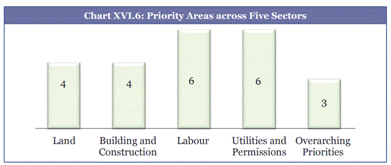
The Survey adds that the ongoing Compliance Reduction and Deregulation Initiative identified 23 Priority Areas across five broad sectors for State level deregulation. These Priority Areas were identified through extensive consultations with Central Ministries, States, industry associations, and knowledge partners. Deregulation, when pursued as a continuous and coordinated governance process, is not a retreat of the State but a strengthening of it. What distinguishes this exercise from earlier deregulation drives is not only the number of reforms, but the institutional process: cross-agency coordination, iterative problem-solving with States, and real-time learning, which touch the core elements of state capacity.

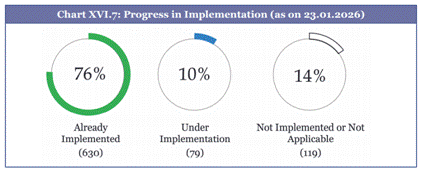
With 36 States and Union Territories expected to implement 23 Priority Areas each, the total number of actionable reforms across the country amounts to 828.
Screenshot 2026-01-28 143713.png

As of 23 January 2026, 630 Priority Areas, representing 76 per cent of the total, have already been implemented. Another 79 Priority Areas, accounting for 10 per cent, are under active implementation.

Economic Survey concludes that the nature of the challenge now facing India is changing and its recent economic performance has demonstrated that macroeconomic stability and growth can be sustained even in a turbulent global environment. In a more uncertain world, risk is unavoidable. The advantage lies in managing it better. Countries that can act before certainty emerges, correct course without paralysis, and align incentives across the State, firms, and citizens are better placed to convert growth into influence. State capacity is therefore not an administrative concern at the margin. It is the foundation on which strategic resilience is built and the pathway through which strategic indispensability becomes possible.

Topics

Acts Income Tax
