

Loading...

Top
Help
×

By creating an account you can:

Logo TaxTMI
Call Us / Help / Feedback

Contact Us At :

E-mail: [email protected]

Call / WhatsApp at: +91 99117 96707

For more information, Check Contact Us

FAQs :

To know Frequently Asked Questions, Check FAQs

Most Asked Video Tutorials :

For more tutorials, Check Video Tutorials

Submit Feedback/Suggestion :

Email :
Please provide your email address so we can follow up on your feedback.
Category :
Description :
Min 15 characters 0/2000
Make Most of Text Search
  1. Checkout this video tutorial: How to search effectively on TaxTMI.
  2. Put words in double quotes for exact word search, eg: "income tax"
  3. Avoid noise words such as : 'and, of, the, a'
  4. Sort by Relevance to get the most relevant document.
  5. Press Enter to add multiple terms/multiple phrases, and then click on Search to Search.
  6. Text Search
  7. The system will try to fetch results that contains ALL your words.
  8. Once you add keywords, you'll see a new 'Search In' filter that makes your results even more precise.
  9. Text Search
Add to...
You have not created any category. Kindly create one to bookmark this item!
Create New Category
Hide
Title :
Description :
❮❮ Hide
Default View
Expand ❯❯
Close ✕
🔎 News - Adv. Search
TEXT SEARCH:

Press 'Enter' to add multiple search terms. Rules for Better Search

Search In:
Main Text + AI Text
  • Main Text
  • Main Text + AI Text
  • AI Text
Category: ?
Categorized by AI
---- All Categories ----
  • ---- All Categories ----
  • Income Tax
  • GST
  • Customs, DGFT & SEZ
  • FEMA & RBI
  • Corp. Laws, SEBI & IBC
  • PMLA, Black Money & ED
  • Budget
  • News and Press Release
  • PTI News
Month:
---- All Months ----
  • ---- All Months ----
  • January
  • February
  • March
  • April
  • May
  • June
  • July
  • August
  • September
  • October
  • November
  • December
Year:
---- All Years ----
  • ---- All Years ----
  • 2026
  • 2025
  • 2024
  • 2023
  • 2022
  • 2021
  • 2020
  • 2019
  • 2018
  • 2017
  • 2016
  • 2015
  • 2014
  • 2013
  • 2012
  • 2011
Sort By: ?
In Sort By 'Default', exact matches for text search are shown at the top, followed by the remaining results in their regular order.
Relevance Default Date
    Commerce Secretary Shri Rajesh Agrawal Co-Chairs India-Brazil 8th Trade Monitoring Mechanism Meeting
    NPCI International and Uzbekistan’s NIPC Partner to Enable UPI Payments Across Uzbekistan via UZQR
    Flymore Aviation Expands Access to Aviation Education Through Affordable Mobile Learning App
    Rajnath to review performances of 16 defence PSUs with focus on indigenous tech, innovation
    SC dismisses SBI's plea challenging NCLAT order on PF, gratuity dues to ex-Jet Airways staffers
    Rupee rises 26 paise to close at 95.17 against US dollar
    India Has Solved Financial Access. Has It Solved Financial Confidence?
    Hyundai Capital Officially Launches Financial Services Operations in India
    Pinarayi Vijayan slams NCLT order on Subhash Chandra repayment plan
    Rupee falls 13 paise to 95.56 against US dollar in early trade
    CBN seizes 66.80 lakh psychotropic tablets in major inter-state pharmaceutical diversion case under Operation Vajra 2.0; one arrested
    DRI seizes around 18 Kg Amphetamine and MDMA in two operations as it intensifies crackdown on synthetic drugs; Four persons arrested
    India–Chile CEPA Negotiations Advance; Commerce Secretary Shri Rajesh Agrawal Meets Chilean Vice-Minister Paula Estévez Weinstein
    Sugar prices remain firm across India despite govt measures to check rise
    Keralam MVD to introduce Aadhaar OTP verification for 60 more services from Sept 21
    Dissenting creditors alleged family-linked entities cast 61.78 pc votes that cleared Chandra's insolvency plan
    Over 2.63L appear in NEET-PG; re-test announced for candidates at 2 Jaipur centres
    Delhi Lakshmi Yojana RD maturity set for July 2029, year of next Lok Sabha polls
    India emerges as key petrol supplier to Russia as refinery attacks disrupt fuel supplies
    Judiciary proactively responded to emerging fraudulent schemes like digital arrest: CJI
❯❯
Maximize Maximize Maximize
0 / 200
Expand Note
Add to Folder

No Folders have been created

+

Are you sure you want to delete "My most important" ?

NOTE:

News
Showing Results for :
Reset Filters
Results Found:
Show All Summaries Hide All Summaries
August 31, 2026
Show AI Summary
Trade facilitation and pharmaceutical market access advance through regulatory cooperation, preferential trade modernisation, and reciprocal agricultural access.
India and Brazil are advancing bilateral trade, investment and economic cooperation through a diversified partnership focused on pharmaceuticals, chemicals, engineering goods and machinery. India-MERCOSUR engagement is being pursued through early finalisation of Terms of Reference for expansion and modernisation of the Preferential Trade Agreement. Pharmaceutical market access is supported by regulatory cooperation under the CDSCO-ANVISA MoU. Agricultural trade facilitation includes phytosanitary processes, reciprocal market access work and mutual recognition of Electronic Certificates of Origin, alongside multilateral coordination through BRICS, the G20 and the WTO.
August 31, 2026
Show AI Summary
Cross-border UPI merchant acceptance enables Indian travellers to make UZQR payments at merchants throughout Uzbekistan.
Cross-border UPI merchant acceptance in Uzbekistan allows Indian travellers to make instant person-to-merchant payments through UPI-enabled applications by scanning the interoperable UZQR code. Integration with the Unified National QR infrastructure extends acceptance across retail, hospitality and service merchants. Regulatory approvals support HUMO's role as NIPL's authorised partner for cross-border merchant acceptance, reducing reliance on international cards and cash.
August 31, 2026
Show AI Summary
Mobile-first aviation education supports accessible, self-paced certification-led learning and career awareness across aviation roles and geographic locations.
Flymore Aviation LLP operates a mobile-first aviation learning platform intended to make specialised aviation education more accessible and affordable for aspiring pilots, cabin crew and other aviation-sector professionals. The app provides structured, self-paced aviation courses aimed at building industry knowledge, supporting certification-led skill development, improving career awareness and assisting employment readiness across aviation functions. Course delivery through a digital platform is positioned as an alternative to location-dependent and high-cost classroom training.
August 31, 2026
Show AI Summary
Indigenous defence technology and exports anchor the annual performance review of public sector defence enterprises.
Annual performance review of 16 Defence Public Sector Undertakings is scheduled with emphasis on indigenous technology, innovation, self-reliance and enhancement of defence exports. Chairpersons and managing directors of seven specified undertakings will present dividends attributable to the Government's equity shareholding. Publications cover self-reliance, student awareness of defence technologies, and modernisation and indigenisation roadmaps. Reported performance includes growth in turnover, profit after tax and defence exports.
August 31, 2026
Show AI Summary
Employee provident fund and gratuity dues remain protected outside the liquidation estate despite competing financial creditor claims in insolvency proceedings.
Employee provident fund and gratuity dues of former Jet Airways workmen and employees were required to be paid in full by the liquidator. The NCLAT position upheld treats statutory employee dues relating to provident fund, gratuity and pension funds as outside the liquidation estate, protecting them from competing creditor claims. Financial creditors had argued that such dues should be distributed through the liquidation estate unless dedicated funds existed at the commencement of liquidation. The underlying questions of law remain open for an appropriate case.
August 31, 2026
Show AI Summary
Rupee exchange-rate support amid dollar strength and oil risks as foreign-currency deposit flows bolster market sentiment.
Foreign-exchange market conditions saw the rupee recover from early losses amid possible Reserve Bank of India intervention to contain significant depreciation. Higher US Treasury yields, a broader dollar rally, rising crude oil prices and geopolitical supply risks pressured the currency. The special USD-INR forex swap facility for FCNR(B) deposits, Overseas Foreign Currency Borrowings and External Commercial Borrowings mobilised foreign-exchange inflows supported by non-resident Indian participation, strengthening market sentiment.
August 31, 2026
Show AI Summary
Financial confidence gaps persist when opaque financial journeys, dark patterns and unclear communication deter informed consumer participation.
Financial-service digitisation may expand access without ensuring consumer confidence where customers cannot understand processes, assess risks or feel secure in financial decisions. Opaque claims, redemptions, eligibility criteria and approval stages can weaken trust and discourage insurance, investment and credit participation. Hidden charges, complex documentation, forced bundling and target-driven sales practices may further impair informed choice. Greater transparency, simplified communications, real-time process visibility and AI-assisted guidance are identified as measures to reduce cognitive friction and strengthen consumer control.
August 31, 2026
Show AI Summary
NBFC licensing enables Hyundai Capital India to begin wholesale dealer financing while preparing retail finance and risk-management infrastructure.
Hyundai Capital India has commenced financial services operations after obtaining a non-banking financial company licence from the Reserve Bank of India. Initial operations concentrate on wholesale financing for local automotive dealers. Operations are intended to expand the dealer-financing network, sales infrastructure and risk-management systems across India, supporting a subsequent phased introduction of retail financing for individual customers.
August 31, 2026
Show AI Summary
Personal insolvency resolution approval faces criticism over low creditor recovery and alleged family-linked voting influence in the resolution process.
Personal insolvency resolution approval concerning Subhash Chandra involved a repayment plan of Rs 6.5 crore against admitted creditor claims exceeding Rs 22,000 crore. Objections were raised regarding the voting influence exercised by entities linked to the debtor's family in relation to the resolution process. Pinarayi Vijayan criticised the approval, alleging preferential treatment of powerful corporate interests.
August 31, 2026
Show AI Summary
Foreign exchange market intervention seeks to limit rupee depreciation amid oil-price pressure, dollar strength, and capital outflows.
Foreign exchange market conditions put the rupee under depreciation pressure amid higher crude oil prices, geopolitical risks, stronger US dollar conditions, expectations of tighter US monetary policy and foreign equity outflows. RBI market intervention was reported to contain significant depreciation. Improved foreign-currency non-resident bank deposit flows and higher foreign exchange reserves supported investor sentiment and the external liquidity position.
August 31, 2026
Show AI Summary
Psychotropic medicine diversion faces NDPS enforcement where controlled tablets allegedly travel without statutory documentation and traceability details.
Enforcement action under the Narcotic Drugs and Psychotropic Substances Act, 1985 addressed alleged inter-State diversion of psychotropic medicines transported without statutory documentation. A truck carrying Alprazolam, Tramadol, Nitrazepam and Clonazepam tablets was intercepted; the medicines and vehicle were seized and one suspect was arrested. Preliminary examination indicated erasure of identifying batch and date details and transport of region-restricted medicines without invoices, bilty or e-way bills. Investigation concerns the manufacturing, supply and distribution network involved.
August 31, 2026
Show AI Summary
Synthetic-drug trafficking enforcement targets rail-borne amphetamine and MDMA consignments through baggage interceptions, seizures, follow-up delivery operations, and arrests.
Synthetic-drug trafficking enforcement involved two intelligence-led railway-station operations targeting amphetamine and MDMA transportation and receipt. Baggage intercepted at Bengaluru contained a crystalline substance preliminarily indicating amphetamine, while a separate Pune interception recovered substances purported to be amphetamine and MDMA tablets. The contraband and related packing material were seized under the Narcotic Drugs and Psychotropic Substances Act, 1985. Follow-up delivery action identified alleged receivers, and the carriers and alleged receivers were arrested under that statutory framework.
August 31, 2026
Show AI Summary
India-Chile CEPA negotiations seek a balanced framework to expand trade, investment, technology cooperation and resilient supply chains.
India-Chile CEPA negotiations are being advanced toward conclusion by the end of the year through a balanced and commercially meaningful framework. The proposed partnership is intended to strengthen bilateral economic ties, expand trade and investment, and create equitable opportunities for businesses and people in both countries. Cooperation is envisaged in technology, talent and resilient supply chains, alongside enhanced engagement in healthcare, pharmaceuticals, energy, minerals, agriculture, machinery and engineering.
August 30, 2026
Show AI Summary
Sugar price controls face persistent retail and wholesale price firmness despite duty-free imports, stockholding restrictions, and export prohibition.
Sugar retail and wholesale prices remained elevated despite measures intended to curb price increases, including duty-free imports of raw sugar, tighter stockholding norms for bulk users and dealers, and a prohibition on sugar exports. Ex-mill rates declined following the permitted duty-free imports, although customary margins continued between ex-mill, wholesale, and retail prices. Projected sugar production is lower than earlier estimates, while annual domestic demand remains substantial.
August 30, 2026
Show AI Summary
Aadhaar OTP verification expands online vehicle and licensing services, reducing physical visits and curbing intermediary exploitation.
Aadhaar-based OTP verification will be extended to additional vehicle- and driving-licence-related services through the Vahan and Sarathi portals. The digital arrangement is intended to reduce physical visits to transport offices, prevent intermediary exploitation arising from delayed processing, and enable applications to be processed on a first-come, first-served basis. Physical attendance will remain necessary for vehicle inspections, identification of legal heirs, personal hearings, and authentication where Aadhaar OTP verification fails.
August 30, 2026
Show AI Summary
Related-party creditor voting in personal insolvency turned on whether the debtor held majority ownership or direct board control.
Dissenting lenders challenged the admission and voting rights of five creditors alleged to be family-linked associate or related entities, contending that their voting share enabled approval of a personal insolvency repayment plan. They alleged invalid post-moratorium guarantee invocations, undisclosed liabilities, inadequate claim scrutiny and incorrect voting-share computation. The third member rejected the voting-rights challenge, treating associate status as requiring the debtor's personal majority shareholding or direct board control, and accepted the repayment plan.
August 30, 2026
Show AI Summary
Examination continuity and candidate fairness require re-examination where power failures prevent completion, alongside review of infrastructure accountability.
NEET-PG 2026 examination continuity was disrupted for candidates at two Jaipur centres because of internal power-supply failures attributable to the technological partner and examination-conducting agency. A re-examination has been scheduled for the affected candidates, with the venue and revised admit cards to be communicated separately. Action against the entities responsible for ensuring adequate examination infrastructure is under consideration.
August 30, 2026
Show AI Summary
Women's monthly assistance eligibility restricts benefits to qualifying households and channels payments through deposits or restricted digital wallets.
Delhi Lakshmi Yojana provides monthly financial assistance to eligible women through recurring deposits and restricted Central Bank Digital Currency wallets. Recurring deposits are locked until July 31, 2029, subject to possible review of the maturity period after two years from launch. Eligibility requires a qualifying woman to be the eldest female family member, meet income, residence and voter-registration requirements, and satisfy household restrictions. Income-tax payers, GST filers, government employees, higher-electricity-consuming households and four-wheeler-owning households are excluded.
August 30, 2026
Show AI Summary
Gasoline trade amid refinery disruptions relies on sanctioned fleets and dark ship-to-ship transfers, alongside continuing fuel export restrictions.
Russian refinery disruption has increased gasoline imports and made India a significant supplier of gasoline to Russia. Indian supplies were principally linked to the Vadinar refinery, and increased Indian purchases of Russian crude may mean exported gasoline was produced from Russian crude. Russia has retained a gasoline export ban while domestic production remains disrupted. India-origin cargoes imported during August were carried on sanctioned fleets and involved dark ship-to-ship transfers, including transfers conducted with automatic identification system signals switched off.
August 30, 2026
Show AI Summary
Digital arrest fraud: judicial responses seek a distinct offence while preserving due process and proportionality in economic-crime enforcement.
Suo motu consideration of digital-arrest fraud reflects a proactive judicial response to video-call scams involving impersonation of police, judicial officials or bureaucrats. The Union and the States have been directed to assess the problem, with a call for a distinct offence carrying proportionate penalties. Economic-crime enforcement remains subject to safeguards requiring written grounds of arrest and preventing pre-trial detention from becoming punishment. Due process, proportionality and the presumption of innocence remain central constraints.

News

Back

All News

Showing Results for :
Reset Filters
No Records Found

News

Showing Results for : Reset Filters

INDIA ADOPTS A DEVELOPMENT-CENTRED, WHOLE-OF-ECONOMY CLIMATE STRATEGY: INTEGRATES ADAPTATION, MITIGATION AND BEHAVIOURAL CHANGE WITHIN ITS DEVELOPMENT MODEL, SAYS ECONOMIC SURVEY 2025-26

January 29, 2026

Contents
Summary
Note

Note

-

Bookmark

Print

Print

INDIA’S ADAPTATION AND RESILIENCE-RELATED DOMESTIC SPENDING SURGED FROM 3.7 PER CENT OF THE GDP IN FY16 TO 5.6 PER CENT OF THE GDP IN FY22

FY 26 SAW ACCELERATED CLEAN ENERGY AND STRATEGIC TRANSITIONS THROUGH RAPID RENEWABLE CAPACITY ADDITION, DIVERSIFICATION INTO GREEN HYDROGEN AND NUCLEAR SECTORS

SHARE OF INSTALLED POWER CAPACITY FROM NON-FOSSIL FUEL SOURCES STANDS AT 51.93% AS ON END OF DECEMBER 2025

CRITICAL MINERALS ALONG WITH TECHNOLOGY ARE DETERMINING FACTORS IN GLOBAL ENERGY TRANSITION: ECONOMIC SURVEY 2025-26

INDIA’S STRATEGY FOR CRITICAL MINERALS REFLECTS A BALANCED FOCUS ON DOMESTIC CAPABILITIES AND INTERNATIONAL PARTNERSHIPS

STRONG GOVERNANCE FRAMEWORKS NECESSARY TO ENSURE CLIMATE FINANCE SUPPORTS GROWTH WITHOUT COMPROMISING MACROECONOMIC STABILITY

The global climate change agenda has reached an inflexion point, what was once framed as a straightforward moral and technological transition toward a net-zero future is today marked by complex trade-offs, capacity constraints and a widening gap between ambition and operational reality stated the Economic Survey 2025-26 tabled in Parliament today by Union Minister for Finance and Corporate Affairs, Smt Nirmala Sitharaman.

The Economic Survey highlights that introduction of complex systems too quickly without buffers, redundancy and institutional capacity, the system is likely to become fragile instead of thriving. Stating that climate policy should prioritise human welfare, particularly for poorer and climate vulnerable societies, the Survey observes that development is, in itself, a form of adaptation. The Economic Survey therefore identifies adaptation central to India’s climate strategy.

For India, achieving sustained growth and rising living standards will require a substantial expansion in the supply of affordable and reliable electricity. Renewable energy will play a major and growing role in this expansion; however, capacity additions alone do not automatically translate into a dependable supply – the Survey says. India must, therefore, approach the coming decade not as a climate policy problem in isolation, but as a broader energy system strategy.

Adaptation: Strengthening climate resilience

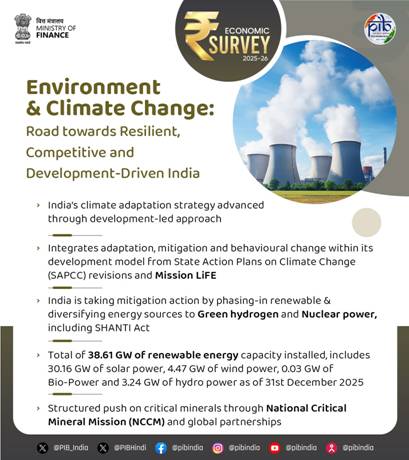
Integrating climate adaptation and resilience into development plans is essential for sustainable growth. India’s climate adaptation strategy is predominantly advanced through a development-led approach, utilising domestic public investment in core development sectors, the Survey observes. India’s adaptation and resilience-related domestic spending surged from 3.7 per cent of the GDP in FY16 to 5.6 per cent of the GDP in FY22.

The National Action Plan on Climate Change (NAPCC) spearheads climate action through nine missions. Many of these are focused on adaptation. While The National Mission on Sustainable Agriculture promotes climate resilient farming, the National Water Mission emphasises conservation and fair access through integrated resource management. The Survey also takes examples of other missions too, to highlight how they have been part of the adaptation efforts.

National frameworks and programmes provide policy coherence, financial support, and institutional mechanisms, while States contextualise and operationalise these interventions through sectoral policies, public programmes, and local institutions, the Survey says. The State Action Plans on Climate Change (SAPCCs) are crucial tools for translating NAPCC's broader objectives into actionable steps. The Survey highlights that as Indian cities continue to grow at a rapid pace, internalising climate risk into the fabric of urban planning, means considering how climate change affects land use, infrastructure, and the services provided to residents.
Chapter-10---Environment-and-Climate-Change---English.jpg

Mitigation: Transition to a low-carbon economy

India is adopting a multifaceted approach to mitigate global warming by diversifying its energy sources and enhancing access while also increasing the share of non-fossil fuels, improving energy efficiency, and promoting stability across its energy systems. The Economic Survey highlights some examples from European countries such as Netherlands, Germany, Spain etc to show the risks associated with transitions that outpace investments in baseload generation, transmission, and system flexibility. India’s energy transition is being pursued through a combination of initiatives across various sectors, including nuclear, solar, and wind energy, green hydrogen, battery storage, and critical minerals, which help address both energy security and transition imperatives simultaneously. The Survey also provides some of the recent examples of such measures.

India has already surpassed the goal of 50 per cent installed power capacity from non-fossil fuel sources, which stood at 51.93% at the end of December 2025, supported by record annual additions of renewable energy capacity. The progress in expanding non-fossil fuel-based power capacity has been supported by a wide variety of initiatives to boost renewable energy systems. Additionally, new measures are being taken to support other clean sources of energy such as the National Nuclear Mission, the Green Hydrogen Mission, and the Bio Energy Programme. Despite the progress in expanding non-fossil fuel energy, challenges remain. The Survey identifies material and storage requirements as two roadblocks to greater utilisation of these energy sources.

Critical Minerals as a Determinant of Energy Transition

The Economic Survey says that the global energy transition is no longer solely determined by technology; it is increasingly constrained by who controls critical minerals. Metals like Lithium, cobalt, nickel, copper, and rare earth elements have become the new strategic chokepoints in shaping the contours of a low-carbon economy. As demand accelerates, advanced economies are responding by promoting standards-based critical mineral markets, emphasising sustainability, traceability, and governance.

India’s strategy reflects the balance with a focus on domestic capabilities through the National Critical Mineral Mission along with suitable incentive mechanism, while engaging in international partnerships like the Minerals Security Partnership and the Indo-Pacific Economic Framework. The Government of India has launched the National Critical Mineral Mission as a strategic initiative to secure the supply chain of minerals essential for renewable energy and storage technologies. Meanwhile, the government's joint venture, Khanij Bidesh India Ltd. (KABIL), has acquired 15,703 hectares in Argentina for lithium mining, alongside partnerships in Australia and Chile.

India has adopted the landmark Sustainable Harnessing and Advancement of Nuclear Energy for Transforming India (SHANTI) Act in December 2025. The new framework enables private sector participation in key activities, including plant operations, power generation, equipment manufacturing and carrying out research and innovations in the field of peaceful uses of atomic energy.

Carbon Credit Trading Scheme: from framework to implementation

The government adopted the Carbon Credit Trading Scheme (CCTS) in June 2023, operating through a dual mechanism that incorporates mandatory compliance and voluntary offset approaches. This framework leverages the existing Perform, Achieve and Trade (PAT) scheme infrastructure, gradually transitioning it into a fully operational compliance carbon market. Under the Offset Mechanism, Non-Obligated Entities may voluntarily register projects that reduce, remove, or avoid greenhouse gas emissions to earn CCCs. This mechanism enables mitigation outcomes from entities outside the compliance framework and incentivises climate action in these areas.

Mission LiFE

The Mission LiFE - Lifestyle for Environment, an initiative introduced in 2021, at COP26 in Glasgow, connects individual and community behaviour change with efforts to deal with climate change. The Economic Survey terms Mission LiFE as an integral part of India’s Nationally Determined Contributions. Majority of India’s climate-oriented schemes are fundamentally aligned with the ethos of Mission LiFE, as they combine government interventions with behavioural and lifestyle shifts at the household, community and enterprise levels. India’s climate strategy is not confined to emissions targets or technologies alone, but is deliberately designed to reshape consumption patterns, social norms and daily choices, making Mission LiFE not a parallel initiative but the behavioural foundation underlying most climate policies in the country, the Survey says.

Climate Finance

The current levels of climate finance fall short of the requirements of developing countries to meet their climate ambitions.The Economic Survey highlights that despite sustained global efforts, the gap between sustainable development ambitions and available financing has continued to widen—particularly for developing countries—reaching an estimated USD 4 trillion. International public finance to developing economies remains limited, and domestic actors continue to dominate global climate finance, accounting for nearly 80 per cent of total flows. These patterns embedded in the international financial architecture reflect a persistent and clear bias in favour of developed countries.

The Survey states that India faces global challenges in climate finance which remains skewed towards mature sectors such as solar, wind energy and energy efficiency. Critical areas, including adaptation, financing for MSMEs, urban infrastructure, and hard-to-abate industries, remain underfunded. Currently, around 83 per cent of India’s finance for mitigation and 98 per cent of finance for adaptation is sourced domestically.

Bridging the Finance Gap in the Indian Context

India has adopted a two-pronged strategy for scaling up finance for climate action from both domestic and international sources.

Strengthening the Domestic Financial System

Specialised Institutions such as IREDA, NABARD, SIDBI, Power Finance Corporation Ltd., and Rural Electrification Corporation Ltd. are already working in the low-carbon/renewable energy space, promoting the adoption of sustainability practices and encouraging green investments through key initiatives and schemes. These institutions support climate project preparation and augment the bankability of projects through catalytic capital, which closely intersect with India’s development priorities including climate action.

SEBI’s Business Responsibility and Sustainability Reporting (BRSR) framework, green bond guidelines and IFSCA's guidance on sustainability-linked lending have improved disclosure quality and investor confidence in climate-related investments.

Deep and Liquid Bond Markets

Bond markets are crucial for financing climate infrastructure, which requires substantial upfront capital and extended repayment horizons. Deeper, more liquid bond markets can provide long-term, stable, and scalable financing at predictable costs.

Sovereign green bonds (SGBs) have been issued to fund low-carbon public infrastructure, providing policy signalling and market benchmarks.

On one hand, mature markets are important for attracting investments from institutional investors, which have long-term capital at their disposal. On the other hand, bond markets provide an important platform for local administrative bodies to raise local-currency finance for climate-aligned functions, such as water supply, waste management, and green energy, tailored to area-specific adaptation and resilience needs. The Survey highlights that urban local bodies in Indore, Ghaziabad, Ahmedabad, and Vadodara have issued green bonds in line with SEBI’s green bond framework. Municipal green bonds can unlock USD 2.5–6.9 billion for local bodies driven climate action over the next 5–10 years. Besides, government of India has now issued sovereign green bonds worth ₹15,000 crore in FY26, with the cumulative issuance reaching ₹72,697 crore since FY23.

The Survey also mentions Greenium—the yield advantage of green bonds over comparable conventional bonds—has been observed across several sovereign issuers, but its magnitude and persistence vary significantly by market. Cross-country experience shows that greenium outcomes depend less on investor intent alone and more on market design, liquidity, credibility, and reporting frameworks. India’s Greenium is categorised as Intermittent (0-6 bps) on the basis of clear sovereign green bond framework; strong domestic institutional demand; policy signalling value.

International Climate Finance and the Role of Multilateral Development Banks

The Survey clearly mentions that Global capital markets are flush with funds, yet flows to sustainable development and climate projects in the Global South remain constrained by entrenched risk aversion embedded in the architecture of global finance. This is most evident in the operating models of Multilateral Development Banks (MDBs) and in the prudential regulations of developed countries. MDBs continue to prioritise low-risk, sovereign-backed lending and the preservation of AAA ratings, limiting balance-sheet recycling and private capital mobilisation. A shift toward balance-sheet optimisation—from “originate-to-hold” to “originate-to-share”—is essential to reposition MDBs as global risk managers, utilising guarantees, insurance, and blended finance to attract private investment.

Topics

Acts Income Tax
