

Loading...

Top
Help
×

By creating an account you can:

Logo TaxTMI
Call Us / Help / Feedback

Contact Us At :

E-mail: [email protected]

Call / WhatsApp at: +91 99117 96707

For more information, Check Contact Us

FAQs :

To know Frequently Asked Questions, Check FAQs

Most Asked Video Tutorials :

For more tutorials, Check Video Tutorials

Submit Feedback/Suggestion :

Email :
Please provide your email address so we can follow up on your feedback.
Category :
Description :
Min 15 characters 0/2000
Make Most of Text Search
  1. Checkout this video tutorial: How to search effectively on TaxTMI.
  2. Put words in double quotes for exact word search, eg: "income tax"
  3. Avoid noise words such as : 'and, of, the, a'
  4. Sort by Relevance to get the most relevant document.
  5. Press Enter to add multiple terms/multiple phrases, and then click on Search to Search.
  6. Text Search
  7. The system will try to fetch results that contains ALL your words.
  8. Once you add keywords, you'll see a new 'Search In' filter that makes your results even more precise.
  9. Text Search
Add to...
You have not created any category. Kindly create one to bookmark this item!
Create New Category
Hide
Title :
Description :
❮❮ Hide
Default View
Expand ❯❯
Close ✕
🔎 News - Adv. Search
TEXT SEARCH:

Press 'Enter' to add multiple search terms. Rules for Better Search

Search In:
Main Text + AI Text
  • Main Text
  • Main Text + AI Text
  • AI Text
Category: ?
Categorized by AI
---- All Categories ----
  • ---- All Categories ----
  • Income Tax
  • GST
  • Customs, DGFT & SEZ
  • FEMA & RBI
  • Corp. Laws, SEBI & IBC
  • PMLA, Black Money & ED
  • Budget
  • News and Press Release
  • PTI News
Month:
---- All Months ----
  • ---- All Months ----
  • January
  • February
  • March
  • April
  • May
  • June
  • July
  • August
  • September
  • October
  • November
  • December
Year:
---- All Years ----
  • ---- All Years ----
  • 2026
  • 2025
  • 2024
  • 2023
  • 2022
  • 2021
  • 2020
  • 2019
  • 2018
  • 2017
  • 2016
  • 2015
  • 2014
  • 2013
  • 2012
  • 2011
Sort By: ?
In Sort By 'Default', exact matches for text search are shown at the top, followed by the remaining results in their regular order.
Relevance Default Date
    ED writes to Kerala DGP seeking FIR against ex-CM Vijayan, daughter, son-in-law in CMRL case
    China's exports pick up in August, jumping 25% as its trade surplus widens
    Rupee falls 10 paise to 94.66 against US dollar in early trade
    Union Finance Minister meets delegation of bank employees representing different Public Sector Banks (PSBs)
    China's exports pick up in August, jumping 25% on strong demand for autos and high tech goods
    TMC calls ED searches political vendetta, bid to divert attention from Delhi building collapse
    Valmiki Corporation 'scam': ED questions ex-K'taka minister B Nagendra again
    Allahabad HC seeks Centre, UP response over learning licence issued in dead man's name
    Axis Bank sees religious tourism, defence, MSMEs as key growth areas in UP
    Rupee falls 13 paise to close at 94.56 against US dollar
    Vimal Elaichi makers move Delhi HC against Maharashtra FDA notice to 3 actors
    As world faced turmoil, India forged partnerships to maintain its economic growth: Shah
    Haryana govt, RBI review measures to tackle financial frauds
    Union law minister Meghwal inaugurates ITAT's new premises in Kolkata
    Enabling Filing of Appeals in Cases Involving NIL or Zero Demand Amount
    DGFT Introduces Open API Facility for Certificate of Origin on the Trade Connect e-Platform
    Amid global turmoil, India maintained momentum of its economic growth, says Amit Shah
    Zaggle Brings Cricket and Business Together in Hyderabad; Hosts Padma Bhushan Dr. Sunil Gavaskar
    AI may accelerate anti-competitive practices in digital markets: CCI chief
    Union Minister of Commerce and Industry Shri Piyush Goyal Calls for India to Emerge as a Global Medical and Healthcare Destination
❯❯
Maximize Maximize Maximize
0 / 200
Expand Note
Add to Folder

No Folders have been created

+

Are you sure you want to delete "My most important" ?

NOTE:

News
Showing Results for :
Reset Filters
Results Found:
Show All Summaries Hide All Summaries
September 8, 2026
Show AI Summary
PMLA information-sharing mechanism supports police FIR referral based on alleged CMRL-linked payments and investigation material.
PMLA information-sharing power under section 66(2) permits the Enforcement Directorate to transmit money-laundering investigation findings and material recovered through searches to a law-enforcement agency for consideration of a fresh FIR or complaint. An FIR registered on that basis may also support a PMLA case. Registration was reportedly sought in relation to alleged CMRL-linked bribery involving purported fraudulent consultancy payments and material said to record fund transfers to Dubai.
September 8, 2026
Show AI Summary
Export-led growth in technology goods and autos widens trade imbalances amid tariffs, strategic supply constraints, and diversification.
China's export growth accelerated in August, driven by demand for automobiles and high-technology goods, while imports also rose and the trade surplus widened. Export growth continued to outpace imports, supported by expanded shipments to Southeast Asia, Latin America and Africa and by rising exports of electric vehicles, industrial machinery and semiconductors. Reliance on exports amid weak domestic consumption and investment contributed to concerns over global economic imbalances and continuing strategic trade tensions.
September 8, 2026
Show AI Summary
Foreign-exchange intervention supports rupee stability amid elevated oil prices, geopolitical tensions, and shifting global market indicators.
Rupee depreciation in the interbank foreign-exchange market reflected elevated Brent crude prices, Middle East geopolitical tensions and weaker investor confidence. RBI dollar sales and foreign-currency inflows under special schemes supported range-bound currency trading despite external pressures. A softer dollar index, foreign institutional equity purchases, inflation data and the Federal Open Market Committee meeting were identified as relevant indicators for currency-market direction.
September 8, 2026
Show AI Summary
Performance-linked incentives for public sector bank executives are kept in abeyance pending bipartite settlement and joint note discussions.
Implementation of the Performance Linked Incentive Scheme for Public Sector Bank executives is kept in abeyance for FY 2025-26 following employee concerns about its structure. The scheme will be considered during ongoing Bipartite Settlement and Joint Note discussions. Employee representatives also raised issues concerning ex-gratia benefits and medical facilities for retired employees. The concerns are to be addressed through dialogue, consultation and mutual understanding.
September 8, 2026
Show AI Summary
Customs trade data show stronger export and import growth, driven by automotive and high-technology demand.
China's customs trade indicators for August record export growth of 25% year-on-year, accelerating from July's 23.9% rate, supported by demand for automobiles and high-technology goods. Imports rose 28.2% year-on-year, up from July's 27.5% growth. Higher import and export values produced a trade surplus of $119.1 billion, widening from $112.5 billion in July.
September 8, 2026
Show AI Summary
Money-laundering searches of media-linked premises prompted allegations of political vendetta, while investigators cited suspected funding and circulation irregularities.
Enforcement Directorate searches at premises linked to a Rajya Sabha member and an Urdu daily were undertaken in connection with a money-laundering investigation. The investigation arose from a police FIR and concerned allegations of material promoting communal disharmony, unaccounted cash transactions, suspicious funding, overstated circulation figures to secure government advertising, and advertising-linked funding connected with a Dubai-based entity. The political party disputed the action, alleging political motivation and targeting of a media voice.
September 8, 2026
Show AI Summary
Money-laundering investigation into alleged Valmiki Corporation fund diversion includes renewed questioning and scrutiny of related irregularities.
Money-laundering investigation concerning alleged misappropriation of Karnataka Maharishi Valmiki Scheduled Tribes Development Corporation Limited funds involved further recording of a former minister's statement under the Prevention of Money Laundering Act. The inquiry follows earlier questioning, arrest, grant of bail and filing of a chargesheet over alleged fund-transfer irregularities. The former minister denied involvement, characterised the matter as bank fraud, and stated that no documents were sought during the inquiry.
September 7, 2026
Show AI Summary
Aadhaar-based learning licence authentication faces challenge over age verification, identity safeguards, and compliance with prescribed licensing formalities.
Aadhaar-based online processing of learning and driving licence applications is challenged on the ground that Aadhaar is not valid proof of age and that reliance on Aadhaar details may enable issue of licences to underage applicants. Allegations that licences were issued using a deceased person's Aadhaar number and despite an obscene uploaded photograph raise identity-verification and security concerns. The Union and State maintain that Aadhaar alone does not result in licence issuance because prescribed formalities must also be completed.
September 7, 2026
Show AI Summary
Digital payment transparency for religious institutions supports direct trust-account donations, reconciliation, and technology-led banking services.
Digital donation collection facilities for temples and religious establishments include kiosks, Bharat Bill Payment System payments and UPI QR-code payments. Donations may be credited directly to the relevant trust account, supported by transaction reconciliation and digital records to improve transparency and ease of transactions. Technology services also cover municipal dues payments and property-tax assessment, alongside banking support for defence-sector ecosystems, MSMEs, agriculture and priority-sector lending.
September 7, 2026
Show AI Summary
Rupee exchange-rate movement reflected crude oil pressures, domestic equity weakness, foreign inflows, and a softer dollar.
Foreign-exchange market conditions resulted in the rupee closing weaker against the US dollar after initial support from foreign currency deposit inflows. Rising crude oil prices and weakness in domestic equity markets weighed on sentiment and offset support from a softer dollar and foreign investor equity purchases. Future movement may remain influenced by foreign inflows, crude oil prices, domestic market conditions, geopolitical tensions and inflation data.
September 7, 2026
Show AI Summary
Surrogate advertising allegations challenge notices targeting brand ambassadors and raise jurisdiction and hearing concerns for product promoters.
Challenge to surrogate advertising allegations concerns notices requiring brand ambassadors promoting Vimal Elaichi to prove that it differs from prohibited pan masala, halt promotions, and remove digital materials. The product promoter contests the notices because they were addressed only to the actors, it was not heard, and the regulator allegedly lacked jurisdiction to stop the advertisements. Territorial jurisdiction to entertain the challenge is also contested.
September 7, 2026
Show AI Summary
Free trade agreements and cyber-fraud prevention feature in India's stated strategy for economic growth, security, and digital protection.
India's external economic strategy relies on diplomatic engagement, strategic partnerships and free trade agreements to sustain growth amid geopolitical uncertainty. Cooperation extends to defence, technology, energy, investment and trade, as well as digital public infrastructure, disaster relief and capacity building. Internal and border security are treated as conditions for national development, while police responsibilities include community safety, maritime protection and tourist safety. Growing cyber-fraud risks linked to the digital economy are addressed through coordination with states and the national cybercrime helpline.
September 7, 2026
Show AI Summary
Financial fraud prevention advances through accessible complaints, cyber awareness, intelligence-sharing, and AI-based detection of mule accounts.
Financial-fraud prevention measures rely on coordinated review of alleged fraud, unauthorised deposit collection, complaints, market intelligence, investor protection and cyber threats. The SACHET portal supports market intelligence and complaints concerning unregulated financial activities through multilingual and accessibility features. MuleHunter.ai uses artificial intelligence and machine learning to identify mule accounts used in fraudulent fund flows. Financial-literacy programmes and accessible educational initiatives promote safe banking, fraud awareness and coordinated responses to cyber-enabled financial crime.
September 7, 2026
Show AI Summary
Technology-driven tax dispute resolution supports faster tribunal processes, reduced litigation, and improved taxpayer services through digital filing and assessments.
The Kolkata Bench of the Income Tax Appellate Tribunal is intended to expedite tax-dispute resolution across 12 states, including seven northeastern states, while advancing impartial, accessible and swift justice. Its administrative role includes improving justice delivery, reducing pendency and pursuing AI-driven digital transformation. The Income Tax Department and the Tribunal seek reduced litigation and improved taxpayer services through technology-driven measures, including faceless assessment and electronic filing.
September 7, 2026
Show AI Summary
Appeals against NIL or Zero GST demand orders are enabled where taxpayers paid liabilities before issuance of the order.
GST Portal validation restricting appeals against demand orders showing NIL or Zero demand has been removed where a liability dispute exists and the taxpayer made payment before issuance of the demand order. Taxpayers may challenge such orders by filing an appeal in Form GST APL-01, and may raise a ticket with the GST Helpdesk if filing difficulties arise.
September 7, 2026
Show AI Summary
Certificate of origin API integration enables exporters to submit applications, receive certificates, verify issuance, and reduce repetitive data entry.
Open API integration for Certificates of Origin enables eligible exporters to connect ERP, accounting and other business software with the Trade Connect e-Platform for electronic application submission. The facility covers preferential and non-preferential certificates, provides authentication, file-submission and certificate-verification APIs, and maintains a transaction ledger for application tracking. Security measures include digital signatures, password hashing, IP whitelisting and time-limited access tokens. Relevant origin criteria, fields and validation rules are automatically applied according to the selected trade agreement or certification scheme.
September 7, 2026
Show AI Summary
Free trade agreements and strategic partnerships were identified as supporting India's trade engagement and economic growth amid geopolitical disruption.
India's international economic engagement through free trade agreements and strategic partnerships was identified as a means of sustaining economic growth amid geopolitical disruption. Economic cooperation was described as extending across defence, technology, energy, investment and trade. Nine free trade agreements were stated to have been concluded by 2026, with further trade arrangements proposed with other countries. Pursuit of free trade agreements was linked to increasing trade and to reported first-quarter GDP growth in the financial year 2026-27.
September 7, 2026
Show AI Summary
Leadership, talent recognition and legacy framed a discussion linking cricketing performance with entrepreneurship and organisational responsibility.
No FEMA or RBI regulatory measure, compliance obligation, legal interpretation, or adjudicatory determination is identified. The subject matter concerns leadership, performance and entrepreneurship, with emphasis on preparation, decision-making under pressure, teamwork, recognising potential and supporting talent. Corporate success is linked with creating opportunities, contributing to society and building a lasting legacy. Zaggle is described as providing enterprise spend management, card-based financial products through banking partnerships and software offerings for corporate customers.
September 7, 2026
Show AI Summary
AI-driven digital markets require competition scrutiny of autonomous pricing, self-preferencing, discriminatory pricing, tying, and market manipulation.
Artificial intelligence may accelerate anti-competitive conduct in digital markets through self-preferencing, discriminatory pricing, tying and market manipulation. Agentic AI may create particular concerns where it monitors competitors' prices and autonomously responds without direct human intervention. Competition law aims to prevent anti-competitive practices, promote competition, protect consumers and preserve freedom of trade, while allowing legitimate growth and innovation. Market dominance is not objectionable in itself; concern arises from abuse of dominance through exclusionary or exploitative practices.
September 7, 2026
Show AI Summary
Healthcare innovation and supply-chain self-reliance are prioritised through trade access, investment, research collaboration, testing infrastructure, and quality standards.
Healthcare-sector development priorities seek to expand medical devices, diagnostics, digital health, research, and pharmaceutical machinery through exports, import substitution, and services growth. Free trade agreements are presented as supporting preferential market access, services opportunities, and mobility. Sectoral growth is linked to startup incubation, intellectual-property capability, international research collaboration, technology transfer, and joint ventures. Healthcare self-reliance requires indigenous equipment, critical components, resilient supply chains, shared testing and certification infrastructure, and uncompromising quality standards.

News

Back

All News

Showing Results for :
Reset Filters
No Records Found

News

Showing Results for : Reset Filters

INDIA ADOPTS A DEVELOPMENT-CENTRED, WHOLE-OF-ECONOMY CLIMATE STRATEGY: INTEGRATES ADAPTATION, MITIGATION AND BEHAVIOURAL CHANGE WITHIN ITS DEVELOPMENT MODEL, SAYS ECONOMIC SURVEY 2025-26

January 29, 2026

Contents
Summary
Note

Note

-

Bookmark

Print

Print

INDIA’S ADAPTATION AND RESILIENCE-RELATED DOMESTIC SPENDING SURGED FROM 3.7 PER CENT OF THE GDP IN FY16 TO 5.6 PER CENT OF THE GDP IN FY22

FY 26 SAW ACCELERATED CLEAN ENERGY AND STRATEGIC TRANSITIONS THROUGH RAPID RENEWABLE CAPACITY ADDITION, DIVERSIFICATION INTO GREEN HYDROGEN AND NUCLEAR SECTORS

SHARE OF INSTALLED POWER CAPACITY FROM NON-FOSSIL FUEL SOURCES STANDS AT 51.93% AS ON END OF DECEMBER 2025

CRITICAL MINERALS ALONG WITH TECHNOLOGY ARE DETERMINING FACTORS IN GLOBAL ENERGY TRANSITION: ECONOMIC SURVEY 2025-26

INDIA’S STRATEGY FOR CRITICAL MINERALS REFLECTS A BALANCED FOCUS ON DOMESTIC CAPABILITIES AND INTERNATIONAL PARTNERSHIPS

STRONG GOVERNANCE FRAMEWORKS NECESSARY TO ENSURE CLIMATE FINANCE SUPPORTS GROWTH WITHOUT COMPROMISING MACROECONOMIC STABILITY

The global climate change agenda has reached an inflexion point, what was once framed as a straightforward moral and technological transition toward a net-zero future is today marked by complex trade-offs, capacity constraints and a widening gap between ambition and operational reality stated the Economic Survey 2025-26 tabled in Parliament today by Union Minister for Finance and Corporate Affairs, Smt Nirmala Sitharaman.

The Economic Survey highlights that introduction of complex systems too quickly without buffers, redundancy and institutional capacity, the system is likely to become fragile instead of thriving. Stating that climate policy should prioritise human welfare, particularly for poorer and climate vulnerable societies, the Survey observes that development is, in itself, a form of adaptation. The Economic Survey therefore identifies adaptation central to India’s climate strategy.

For India, achieving sustained growth and rising living standards will require a substantial expansion in the supply of affordable and reliable electricity. Renewable energy will play a major and growing role in this expansion; however, capacity additions alone do not automatically translate into a dependable supply – the Survey says. India must, therefore, approach the coming decade not as a climate policy problem in isolation, but as a broader energy system strategy.

Adaptation: Strengthening climate resilience

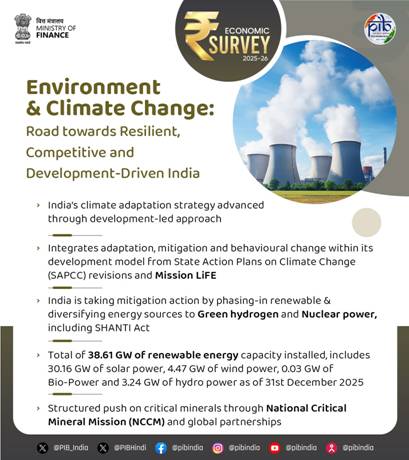
Integrating climate adaptation and resilience into development plans is essential for sustainable growth. India’s climate adaptation strategy is predominantly advanced through a development-led approach, utilising domestic public investment in core development sectors, the Survey observes. India’s adaptation and resilience-related domestic spending surged from 3.7 per cent of the GDP in FY16 to 5.6 per cent of the GDP in FY22.

The National Action Plan on Climate Change (NAPCC) spearheads climate action through nine missions. Many of these are focused on adaptation. While The National Mission on Sustainable Agriculture promotes climate resilient farming, the National Water Mission emphasises conservation and fair access through integrated resource management. The Survey also takes examples of other missions too, to highlight how they have been part of the adaptation efforts.

National frameworks and programmes provide policy coherence, financial support, and institutional mechanisms, while States contextualise and operationalise these interventions through sectoral policies, public programmes, and local institutions, the Survey says. The State Action Plans on Climate Change (SAPCCs) are crucial tools for translating NAPCC's broader objectives into actionable steps. The Survey highlights that as Indian cities continue to grow at a rapid pace, internalising climate risk into the fabric of urban planning, means considering how climate change affects land use, infrastructure, and the services provided to residents.
Chapter-10---Environment-and-Climate-Change---English.jpg

Mitigation: Transition to a low-carbon economy

India is adopting a multifaceted approach to mitigate global warming by diversifying its energy sources and enhancing access while also increasing the share of non-fossil fuels, improving energy efficiency, and promoting stability across its energy systems. The Economic Survey highlights some examples from European countries such as Netherlands, Germany, Spain etc to show the risks associated with transitions that outpace investments in baseload generation, transmission, and system flexibility. India’s energy transition is being pursued through a combination of initiatives across various sectors, including nuclear, solar, and wind energy, green hydrogen, battery storage, and critical minerals, which help address both energy security and transition imperatives simultaneously. The Survey also provides some of the recent examples of such measures.

India has already surpassed the goal of 50 per cent installed power capacity from non-fossil fuel sources, which stood at 51.93% at the end of December 2025, supported by record annual additions of renewable energy capacity. The progress in expanding non-fossil fuel-based power capacity has been supported by a wide variety of initiatives to boost renewable energy systems. Additionally, new measures are being taken to support other clean sources of energy such as the National Nuclear Mission, the Green Hydrogen Mission, and the Bio Energy Programme. Despite the progress in expanding non-fossil fuel energy, challenges remain. The Survey identifies material and storage requirements as two roadblocks to greater utilisation of these energy sources.

Critical Minerals as a Determinant of Energy Transition

The Economic Survey says that the global energy transition is no longer solely determined by technology; it is increasingly constrained by who controls critical minerals. Metals like Lithium, cobalt, nickel, copper, and rare earth elements have become the new strategic chokepoints in shaping the contours of a low-carbon economy. As demand accelerates, advanced economies are responding by promoting standards-based critical mineral markets, emphasising sustainability, traceability, and governance.

India’s strategy reflects the balance with a focus on domestic capabilities through the National Critical Mineral Mission along with suitable incentive mechanism, while engaging in international partnerships like the Minerals Security Partnership and the Indo-Pacific Economic Framework. The Government of India has launched the National Critical Mineral Mission as a strategic initiative to secure the supply chain of minerals essential for renewable energy and storage technologies. Meanwhile, the government's joint venture, Khanij Bidesh India Ltd. (KABIL), has acquired 15,703 hectares in Argentina for lithium mining, alongside partnerships in Australia and Chile.

India has adopted the landmark Sustainable Harnessing and Advancement of Nuclear Energy for Transforming India (SHANTI) Act in December 2025. The new framework enables private sector participation in key activities, including plant operations, power generation, equipment manufacturing and carrying out research and innovations in the field of peaceful uses of atomic energy.

Carbon Credit Trading Scheme: from framework to implementation

The government adopted the Carbon Credit Trading Scheme (CCTS) in June 2023, operating through a dual mechanism that incorporates mandatory compliance and voluntary offset approaches. This framework leverages the existing Perform, Achieve and Trade (PAT) scheme infrastructure, gradually transitioning it into a fully operational compliance carbon market. Under the Offset Mechanism, Non-Obligated Entities may voluntarily register projects that reduce, remove, or avoid greenhouse gas emissions to earn CCCs. This mechanism enables mitigation outcomes from entities outside the compliance framework and incentivises climate action in these areas.

Mission LiFE

The Mission LiFE - Lifestyle for Environment, an initiative introduced in 2021, at COP26 in Glasgow, connects individual and community behaviour change with efforts to deal with climate change. The Economic Survey terms Mission LiFE as an integral part of India’s Nationally Determined Contributions. Majority of India’s climate-oriented schemes are fundamentally aligned with the ethos of Mission LiFE, as they combine government interventions with behavioural and lifestyle shifts at the household, community and enterprise levels. India’s climate strategy is not confined to emissions targets or technologies alone, but is deliberately designed to reshape consumption patterns, social norms and daily choices, making Mission LiFE not a parallel initiative but the behavioural foundation underlying most climate policies in the country, the Survey says.

Climate Finance

The current levels of climate finance fall short of the requirements of developing countries to meet their climate ambitions.The Economic Survey highlights that despite sustained global efforts, the gap between sustainable development ambitions and available financing has continued to widen—particularly for developing countries—reaching an estimated USD 4 trillion. International public finance to developing economies remains limited, and domestic actors continue to dominate global climate finance, accounting for nearly 80 per cent of total flows. These patterns embedded in the international financial architecture reflect a persistent and clear bias in favour of developed countries.

The Survey states that India faces global challenges in climate finance which remains skewed towards mature sectors such as solar, wind energy and energy efficiency. Critical areas, including adaptation, financing for MSMEs, urban infrastructure, and hard-to-abate industries, remain underfunded. Currently, around 83 per cent of India’s finance for mitigation and 98 per cent of finance for adaptation is sourced domestically.

Bridging the Finance Gap in the Indian Context

India has adopted a two-pronged strategy for scaling up finance for climate action from both domestic and international sources.

Strengthening the Domestic Financial System

Specialised Institutions such as IREDA, NABARD, SIDBI, Power Finance Corporation Ltd., and Rural Electrification Corporation Ltd. are already working in the low-carbon/renewable energy space, promoting the adoption of sustainability practices and encouraging green investments through key initiatives and schemes. These institutions support climate project preparation and augment the bankability of projects through catalytic capital, which closely intersect with India’s development priorities including climate action.

SEBI’s Business Responsibility and Sustainability Reporting (BRSR) framework, green bond guidelines and IFSCA's guidance on sustainability-linked lending have improved disclosure quality and investor confidence in climate-related investments.

Deep and Liquid Bond Markets

Bond markets are crucial for financing climate infrastructure, which requires substantial upfront capital and extended repayment horizons. Deeper, more liquid bond markets can provide long-term, stable, and scalable financing at predictable costs.

Sovereign green bonds (SGBs) have been issued to fund low-carbon public infrastructure, providing policy signalling and market benchmarks.

On one hand, mature markets are important for attracting investments from institutional investors, which have long-term capital at their disposal. On the other hand, bond markets provide an important platform for local administrative bodies to raise local-currency finance for climate-aligned functions, such as water supply, waste management, and green energy, tailored to area-specific adaptation and resilience needs. The Survey highlights that urban local bodies in Indore, Ghaziabad, Ahmedabad, and Vadodara have issued green bonds in line with SEBI’s green bond framework. Municipal green bonds can unlock USD 2.5–6.9 billion for local bodies driven climate action over the next 5–10 years. Besides, government of India has now issued sovereign green bonds worth ₹15,000 crore in FY26, with the cumulative issuance reaching ₹72,697 crore since FY23.

The Survey also mentions Greenium—the yield advantage of green bonds over comparable conventional bonds—has been observed across several sovereign issuers, but its magnitude and persistence vary significantly by market. Cross-country experience shows that greenium outcomes depend less on investor intent alone and more on market design, liquidity, credibility, and reporting frameworks. India’s Greenium is categorised as Intermittent (0-6 bps) on the basis of clear sovereign green bond framework; strong domestic institutional demand; policy signalling value.

International Climate Finance and the Role of Multilateral Development Banks

The Survey clearly mentions that Global capital markets are flush with funds, yet flows to sustainable development and climate projects in the Global South remain constrained by entrenched risk aversion embedded in the architecture of global finance. This is most evident in the operating models of Multilateral Development Banks (MDBs) and in the prudential regulations of developed countries. MDBs continue to prioritise low-risk, sovereign-backed lending and the preservation of AAA ratings, limiting balance-sheet recycling and private capital mobilisation. A shift toward balance-sheet optimisation—from “originate-to-hold” to “originate-to-share”—is essential to reposition MDBs as global risk managers, utilising guarantees, insurance, and blended finance to attract private investment.

Topics

Acts Income Tax
