
Just a moment...

Top
Help
×

By creating an account you can:

Logo TaxTMI
>
Call Us / Help / Feedback

Contact Us At :

E-mail: [email protected]

Call / WhatsApp at: +91 99117 96707

For more information, Check Contact Us

FAQs :

To know Frequently Asked Questions, Check FAQs

Most Asked Video Tutorials :

For more tutorials, Check Video Tutorials

Submit Feedback/Suggestion :

Email :
Please provide your email address so we can follow up on your feedback.
Category :
Description :
Min 15 characters0/2000
Add to...
You have not created any category. Kindly create one to bookmark this item!
Create New Category
Hide
Title :
Description :
❮❮ Hide
Default View
Expand ❯❯
Close ✕
🔎 News - Adv. Search
TEXT SEARCH:

Press 'Enter' to add multiple search terms. Rules for Better Search

Search In:
Main Text + AI Text
  • Main Text
  • Main Text + AI Text
  • AI Text
Category: ?
Categorized by AI
---- All Categories ----
  • ---- All Categories ----
  • Income Tax
  • GST
  • Customs, DGFT & SEZ
  • FEMA & RBI
  • Corp. Laws, SEBI & IBC
  • PMLA, Black Money & ED
  • Budget
  • News and Press Release
  • PTI News
Month:
---- All Months ----
  • ---- All Months ----
  • January
  • February
  • March
  • April
  • May
  • June
  • July
  • August
  • September
  • October
  • November
  • December
Year:
---- All Years ----
  • ---- All Years ----
  • 2026
  • 2025
  • 2024
  • 2023
  • 2022
  • 2021
  • 2020
  • 2019
  • 2018
  • 2017
  • 2016
  • 2015
  • 2014
  • 2013
  • 2012
  • 2011
Sort By: ?
In Sort By 'Default', exact matches for text search are shown at the top, followed by the remaining results in their regular order.
RelevanceDefaultDate
    Sensex trades higher, Nifty flat post RBI policy
    India's services sector growth hits four-and-a-half-year low in July on weak demand: PMI
    SC grants interim bail to businessman Anwar Dhebar in manpower commission 'scam' case
    The Taxation and Other Laws Amendment Bill 2026 - Introduced in Lok Sabha on 4th August 2026
    RBI marginally raises FY27 GDP growth projection to 6.7 pc, lowers inflation forecast
    Collaboration, Inclusion and Entrepreneurship: How SIDBI MSME Samvaad Is Shaping the Future of India’s MSME Ecosystem
    RBI keeps policy rate unchanged for third time in row in FY27 amid West Asia crisis
    RBI keeps policy rate unchanged for third time in row amid West Asia crisis
    Markets climb in early trade on falling crude oil prices; RBI monetary policy decision awaited
    Rupee jumps 39 paise to 94.89 against US dollar ahead of RBI monetary policy decision
    Punjab govt committed to paying all valid dues; legal options being examined: FM Cheema
    ED searches multiple locations in Punjab, Chandigarh in PMLA case against PSIEC officials
    Rupee gains 9 paise against US dollar
    India, US working towards interim trade agreement: MEA
    Govt to adopt appropriate measures to mitigate fuel price volatility: MoS Finance
    Taxation laws (Amendment) Bill to attract more foreign capital, provide policy certainty introduced in LS
    Champion Mirabai Chanu Unveils MMTC-PAMP's 'Virasat' Recycled Gold Coin to Celebrate India's 80th Year of Independence
    Indian economy to hit USD 5-trillion mark in FY29 as per IMF: FM
    SVC Co-operative Bank Concludes 120th Annual General Meeting, Reaffirms Growth, Governance and Digital Focus
    Rupee falls 3 paise to close at 95.40 against US dollar
❯❯
MaximizeMaximizeMaximize
0 / 200
Expand Note
Add to Folder

No Folders have been created

    +

    Are you sure you want to delete "My most important" ?

    NOTE:

    News
    Showing Results for :
    Reset Filters
    Results Found:
    Show All SummariesHide All Summaries
    August 5, 2026
    Show AI Summary
    Closing auction price discovery for eligible derivatives shares begins as monetary policy retains the repo rate and neutral stance.
    The Reserve Bank retained the repo rate with a neutral stance amid uncertainty over energy prices and supply disruptions. Stock exchanges introduced the Closing Auction Session in the equity cash segment for eligible shares with futures and options contracts. This auction-based mechanism determines closing prices of eligible stocks and aims to make price discovery more transparent and robust.
    August 5, 2026
    Show AI Summary
    Services-sector growth slowed as weaker demand, competition and postponed orders moderated business activity, while employment improved modestly.
    Services-sector growth slowed as domestic and export orders moderated amid weaker demand, competitive pressures, softer market conditions and postponed orders. Output continued to expand, but at its weakest pace in more than four years. Employment growth improved modestly, while input costs rose and firms increased selling prices. Business confidence remained positive but declined, and the composite output indicator weakened due principally to the sharp slowdown in services activity.
    August 5, 2026
    Show AI Summary
    Interim bail conditions require residence outside the state and trial attendance in alleged manpower commission corruption proceedings.
    Interim bail was granted to Anwar Dhebar in a matter involving alleged corruption and an illegal commission mechanism linked to a state marketing corporation. Conditions require him to remain outside Chhattisgarh, attend the trial court, and provide his residential address. The allegations concern manpower supply agencies allegedly being compelled to pay commissions for clearance of legitimate bills, with proceeds routed through intermediaries. The case was registered under the Indian Penal Code and the Prevention of Corruption Act.
    August 5, 2026
    Show AI Summary
    Tax certainty measures revise fund-management safe harbours, electronic-payment charges, sectoral exemptions, business-trust treatment, and excess expenditure appropriation.
    The Taxation and Other Laws (Amendment) Bill, 2026 proposes to replace the Income-tax (Amendment) Ordinance, 2026 and amend payment-system and tax laws. It would prohibit charges on notified electronic payments, revise safe-harbour conditions for eligible investment funds and fund managers, and expand tax exemptions for Government securities, qualifying rough-diamond sales and bonded-warehouse component storage. It also modifies exemptions concerning electronic-goods contract manufacturing, data centres and business-trust dividends, while imposing a differentiated surcharge on qualifying special purpose vehicles. A separately included appropriation bill authorises excess expenditure from the Consolidated Fund of India.
    August 5, 2026
    Show AI Summary
    Growth and inflation projections reflect resilient domestic activity while energy volatility, supply disruptions, and food prices sustain inflation risks.
    Monetary policy projections for fiscal 2026-27 revise real GDP growth upward to 6.7 per cent and Consumer Price Index inflation downward to 5 per cent. Domestic activity is described as resilient amid global uncertainty, but inflationary risks persist from rainfall disruption, energy-price volatility, supply-chain uncertainty, and second-round effects of higher food, fuel and input costs. Core inflation is projected at 4.3 per cent for the fiscal year.
    August 5, 2026
    Show AI Summary
    Industry collaboration strengthens MSME competitiveness through shared resources, market linkages, capability building and inclusive support for women entrepreneurs.
    MSME development is linked to collaboration, knowledge-sharing, institutional support and capability building. Industry associations can provide networking, policy advocacy, business intelligence, skills programmes, shared infrastructure and market linkages, while collective procurement, shared logistics, digital commerce and export readiness may improve competitiveness. Women-led enterprises benefit from market-oriented capability development, mentorship, continuous learning, professional networks, capacity-building programmes and institutional support. The Development of Industry Associations initiative is intended to connect associations and facilitate the sharing of best practices.
    August 5, 2026
    Show AI Summary
    Monetary policy rate maintenance continues under a neutral stance amid energy disruption, inflation concerns and sustained currency depreciation.
    Monetary policy rate maintenance was continued with the repo rate retained at 5.25 per cent under a neutral stance amid uncertainty over energy prices and supply disruptions associated with the West Asia crisis. The growth forecast was marginally increased and the inflation projection reduced. Sustained rupee depreciation against the dollar was attributed to costly oil, capital outflows, widening trade deficits and a strong US dollar.
    August 5, 2026
    Show AI Summary
    Monetary policy rate pause maintains a neutral stance amid energy disruption, inflation concerns and sustained rupee depreciation pressures.
    Monetary policy rates were retained without change for a third consecutive review, with a neutral stance maintained amid uncertainty over energy prices and supply disruptions associated with the West Asia crisis. The policy assessment noted retail inflation above the medium-term target, alongside an upward revision to growth expectations and a downward revision to the inflation projection. Continued rupee depreciation was linked to higher oil prices, capital outflows, widening trade deficits and a stronger US dollar.
    August 5, 2026
    Show AI Summary
    Monetary policy expectations shape equity sentiment as softer crude prices and foreign investment support domestic financial assets.
    Equity market sentiment improved in early trading as lower crude oil prices and foreign fund inflows supported benchmark indices, while investors awaited the monetary policy decision. Softer crude prices, rupee recovery, improving global risk sentiment, resilient economic growth, corporate earnings and sustained foreign portfolio investment supported domestic financial assets, despite continuing global and geopolitical uncertainties.
    August 5, 2026
    Show AI Summary
    Foreign exchange market movement strengthens as lower crude prices and monetary policy signals influence the rupee's direction.
    Foreign exchange market movement saw the rupee appreciate against the US dollar in early trading, supported by lower crude oil prices, a softer dollar index, domestic equity gains and net foreign institutional investment. Market attention centred on the Reserve Bank of India's monetary policy decision, with expectations of an unchanged benchmark repo rate. Policy communication on inflation and developments in Hormuz-related talks were identified as factors that could influence the rupee's direction.
    August 4, 2026
    Show AI Summary
    Dearness allowance arrears must be cleared promptly, while the government examines legal remedies and continues its structured liquidation plan.
    Pending dearness allowance arrears of government employees and pensioners are to be cleared within a fortnight, with restraint on unproductive expenditure until admissible dues are paid. The government states that it will pay constitutionally and legally valid dues while examining the judgment, precedents and possible legal remedies. It attributes the arrears to delayed pay commission implementation and frozen dearness allowance, and states that a structured liquidation plan has been prepared and partly implemented.
    August 4, 2026
    Show AI Summary
    Money-laundering investigation examines alleged fraudulent industrial plot allotments, benami holdings and diversion of plots to residential use.
    A money-laundering investigation under the Prevention of Money Laundering Act examines alleged irregularities in industrial-plot allotments involving corporation officials, private persons, property dealers and alleged benamidars. The inquiry concerns alleged use of fictitious firms and false addresses to obtain plots, allotments to relatives and associates, and alleged diversion or change of land use from industrial to residential purposes. These activities are alleged to have generated private gains while causing loss to the public exchequer.
    August 4, 2026
    Show AI Summary
    Rupee exchange-rate movement gains support from capital inflows, while oil prices, dollar strength and monetary policy shape sentiment.
    Rupee exchange-rate movement was supported by foreign capital inflows and improved global risk sentiment, while elevated crude-oil prices and a stronger US dollar constrained gains. Market attention shifted to monetary policy, overseas dollar-deposit incentives and easier foreign access to government bonds, which were reported to support capital inflows and India's external position. A cautious approach to the benchmark repo rate was expected amid assessment of the West Asia conflict.
    August 4, 2026
    Show AI Summary
    Interim bilateral trade agreement negotiations continue as both sides work to finalise unresolved issues in the proposed arrangement.
    Interim bilateral trade agreement negotiations between India and the United States are continuing. Both sides have undertaken substantial work, while certain issues remain to be finalised before completion of the proposed interim trade arrangement. A United States Trade Representative delegation visited India to advance discussions. The text records the status of negotiations and identifies no concluded agreement or operative customs measure.
    August 4, 2026
    Show AI Summary
    Fuel-price volatility mitigation will combine fiscal measures, consumer protection, energy security and fiscal sustainability during external energy shocks.
    Fuel-price volatility is to be mitigated through fiscal and administrative measures that protect consumers while maintaining fiscal sustainability. The approach includes monitoring revenue and expenditure, reprioritising spending, and using fiscal measures when economic conditions require. Reduced central excise duty on petrol and diesel moderated the impact of elevated international crude prices and partly offset under-recoveries of public-sector oil marketing companies. Longer-term measures include revenue mobilisation, import diversification, Strategic Petroleum Reserves, cleaner fuels and energy efficiency.
    August 4, 2026
    Show AI Summary
    Tax policy certainty reforms propose easier fund management, data-centre access, electronics incentives and revised electronic-payment charging rules.
    The proposed Bill seeks to simplify conditions for foreign investment funds using fund managers in India without being treated as carrying on business in India, while retaining safeguards against misuse and round-tripping. It proposes removal of approval requirements for foreign cloud companies using Indian data centres and permits leased operation of Indian data centres. It also extends tax support for foreign companies participating in electronics contract manufacturing and component warehousing, preserves tax-free dividends for REIT and InvIT investors in specified circumstances, and removes the prohibition on Merchant Discount Rate charges for notified electronic payment modes.
    August 4, 2026
    Show AI Summary
    Responsible precious-metals recycling supports recycled-gold products, organised buyback channels and a more self-reliant domestic supply chain.
    Responsible precious-metals recycling is promoted through a commemorative recycled-gold coin intended to support domestic recycling, responsible sourcing and a self-reliant supply chain. The product is described as having certified purity authentication, tamper-proof packaging, a unique identification number and an assayer-certified minted card. The initiative seeks to reduce dependence on imported gold and expand organised, transparent recycling infrastructure. An organised silver buyback programme is also described as supporting secure consumer sales and a circular economy for precious metals.
    August 4, 2026
    Show AI Summary
    Broad-based growth strategy links tax reforms, trade resilience, industrial support and services development to medium-term economic expansion.
    The growth strategy combines agricultural productivity, manufacturing, MSME support, infrastructure, logistics, ease of doing business, streamlined income-tax and GST reforms, innovation, digitalisation, human-capital development, energy security, public capital expenditure, foreign direct investment liberalisation, export promotion, fiscal prudence and price stability. Trade resilience is to be strengthened through expanded trade agreements, while manufacturing, services, agriculture and strategic sectors receive targeted policy support. The material also reports secured-asset enforcement cases and recoveries by banks under the SARFAESI framework during FY25.
    August 4, 2026
    Show AI Summary
    Co-operative bank governance and financial disclosure support digital transformation, risk management, priority-sector lending and sustainable member-focused growth.
    Co-operative bank governance and financial disclosure were addressed at the annual general meeting, where the member-notice agenda was transacted and audited financial statements were presented. The bank reported growth in business, deposits and advances, together with net profit, asset quality, provisioning coverage and capital adequacy indicators. Its operational priorities include digital transformation, risk management, selective network expansion, customer service and operational discipline. Future priorities include retail and priority-sector lending, MSMEs, affordable housing and institutional deposits.
    August 4, 2026
    Show AI Summary
    Foreign-exchange market conditions weakened the rupee as oil prices, domestic equities and dollar strength shaped near-term currency expectations.
    The rupee weakened against the US dollar amid elevated crude oil prices, weaker domestic equities and a stronger dollar index, while foreign fund inflows moderated the decline. Attention shifted to the central bank's monetary policy meeting, with continuation of the existing benchmark policy rate anticipated. Earlier measures encouraging overseas dollar deposits and facilitating foreign participation in government bonds were reported to support capital inflows and India's external position.

    News

    Back

    All News

    Showing Results for :
    Reset Filters
      No Records Found

      News

      Back

      All News

      whatsappJoin Channel
      Showing Results for : Reset Filters

      GST Rationalistaion: Cultivating Growth, Crafting Prosperity in Mizoram

      October 13, 2025

      Contents
      Summary
      Note

      Note

      -

      Bookmark

      Print

      Print

      Key Takeaways

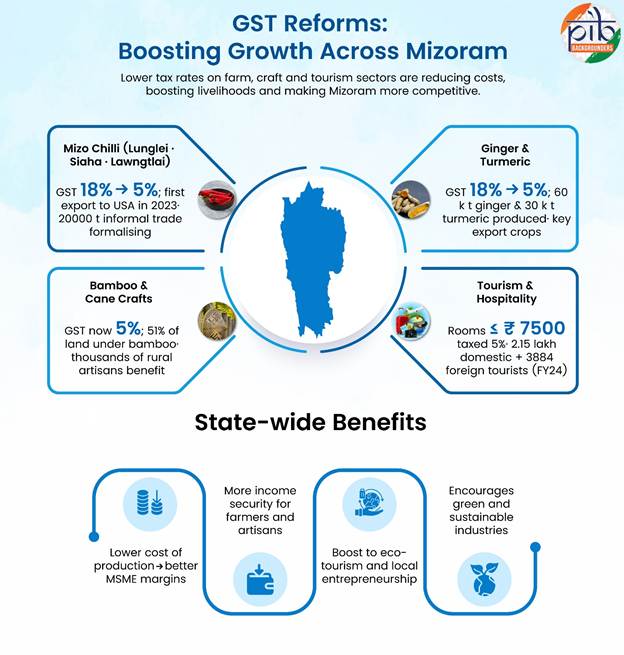
      • GST cut from 18% → 5% on processed Mizo Bird’s Eye Chilli, ginger and turmeric to benefit farmers and promote exports.
      • Processed fruit products, including passion fruit juice and pulp, now taxed at 5%creating jobs in local food units.
      • All bamboo and cane products brought under a 5% GST slab, supporting rural artisans and eco-friendly livelihoods.
      • Hotel rooms up to ₹7,500/night taxed at 5%, making Mizoram more attractive for travellers and boosting employment.

      Introduction

      Mizoram’s economy is deeply rooted in its land and forestsfrom organic spices and horticultural crops to bamboo crafts and eco-tourism. The state’s unique terrain and traditional farming practices give its products a distinct identity, with the Mizo Bird’s Eye Chilli recognised as a Geographical Indication (GI) product for its distinctive quality and flavour. The recent GST rate rationalisation provides a timely boost to these sectors, reducing tax burdens and improving income opportunities for farmers, artisans and entrepreneurs across the state.

      By lowering GST on key items, such as Mizo chilli, ginger, turmeric, bamboo and cane products, processed fruits, and tourism services, the reforms will make Mizoram’s goods more affordable and competitive while supporting employment across rural and semi-urban areas.
      Mizo Chilli (Bird’s Eye)

      The Mizo Bird’s Eye Chilli, a GI-tagged organic crop, is one of the most distinctive agricultural products of the state. It is mainly grown in the districts of Lunglei, Siaha and Lawngtlai, where the climate and soil are ideal for its cultivation. Farmers traditionally grow this crop through jhum (slash-and-burn) cultivation, making it an integral part of Mizoram’s farming culture and household income.

      Mizoram produced about 10,918 metric tonnes of Mizo chilli in 2020–21. A study conducted in Aizawl district during 2017–18 estimated an average gross income of ₹1.57 lakh per hectare, underlining its economic importance for small farmers.
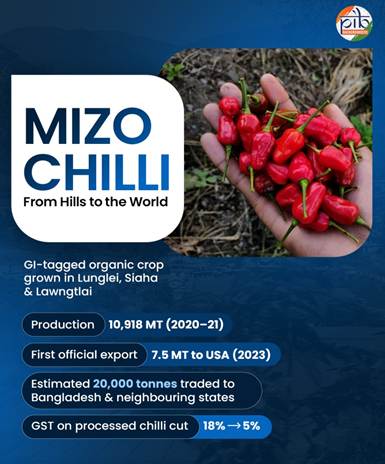
      The chilli is also finding new global markets, the state recorded its first official export of 7.5 metric tonnes to the United States in March 2023, while around 20,000 tonnes are estimated to be traded annually to Bangladesh and neighbouring states through informal channels. Small food processing and pickle units linked to the chilli also provide employment opportunities, typically engaging around 10 to 12 persons per unit.

      With GST reduced from 18% to 5% on processed and packaged chilli products, farmers and processors are expected to benefit directly. The lower rate will make packaged chilli more affordable in domestic markets, promote branding and value addition, and strengthen Mizoram’s export competitiveness. The reform will also help shift a significant portion of informal cross-border trade into the formal economy, ensuring better income security for farmers and small entrepreneurs.

      Ginger and Turmeric

      Ginger and turmeric are among Mizoram’s most important cash crops and exportable commodities. Cultivated across the state, these spices form a major part of local farming incomes.

      Mizoram’s total horticultural output was estimated nearly 708 thousand metric tonnes in 2023–24, which includes a substantial contribution from spices. In 2024–25, the state produced over 60,000 tonnes of ginger and nearly 30,000 tonnes of turmeric, reflecting the steady growth of spice cultivation in Mizoram’s hilly terrain and favourable climate. Together, these crops account for a major share of the state’s spice trade and are increasingly being promoted for export potential. Total merchandise exports from Mizoram stood at US$ 0.22 million in FY 2024–25 (up to February), with spices forming an important component of that basket.

      With GST reduced from 18% to 5% on processed and packaged products, value-added spice producers will benefit from lower input costs and better market access. The change is also expected to make Mizoram’s organic spices more competitive in both domestic and export markets, where consumer demand for natural and chemical-free produce continues to grow.

      Passion Fruit

      Mizoram is India’s third-largest producer of passion fruit, and cultivation is expanding rapidly due to favourable climatic conditions. In 2023–24, the state produced over 3.4 lakh tonnes of fruits, including passion fruit, spread across nearly 69,000 hectares. Passion fruit processing has created new entrepreneurial opportunities in juice and concentrate production, offering additional income for farmers and women’s groups.

      The reduction of GST on processed fruit products from 12–18% to 5% will make passion fruit juice and allied products more affordable and marketable. The reform is expected to encourage the growth of small-scale processing units, create local jobs, and help Mizoram tap into the growing national demand for health-oriented fruit beverages.
      Bamboo and Cane Crafts

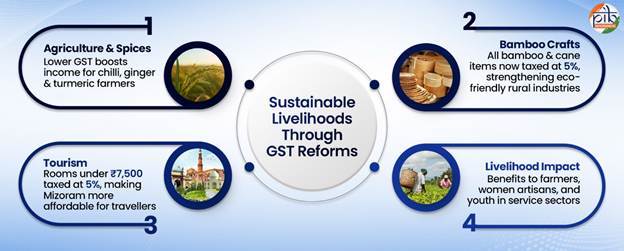
      Bamboo is deeply woven into Mizoram’s culture and economy. With nearly 51% of the state’s land area covered in bamboo, the material forms the backbone of the state’s handicraft and cottage industries. From furniture and household décor to baskets and utility products, bamboo and cane crafts reflect both the creativity and sustainability of Mizo artisans.

      These crafts are a vital source of income for rural households and play an important role in youth employment across the state. The sector continues to receive support under various government programmes aimed at improving design, skill development and value addition, helping artisans reach wider domestic and export markets.

      Under the new GST structure, bamboo furniture and all bamboo or cane handicraft products are now taxed at a uniform rate of 5%, down from the earlier higher slabs. The reduced rate will make bamboo products more affordable, stimulate domestic demand and enhance Mizoram’s competitiveness in the national handicraft market. With India’s bamboo industry valued at nearly ₹24,000 crore (in 2019), this reform opens up new opportunities for Mizoram’s artisans, promoting green livelihoods and sustainable rural growth.

      Tourism and Hospitality

      Tourism is fast emerging as a key engine of growth and employment in Mizoram. Blessed with scenic hills, lush forests and a vibrant cultural heritage, the state is positioning itself as a major destination for eco-tourism and adventure travel. Visitors are drawn to its serene landscapes, traditional festivals and community-based homestays that reflect the warmth and hospitality of Mizo culture.

      A 2014–15 government survey identified 4,038 employees working across 161 accommodation units in the state, reflecting the growing importance of tourism as a livelihood source. In 2023–24, Mizoram received 215,265 domestic and 3,884 foreign tourists, and the sector continues to generate both direct and indirect employment through hotels, tour operations, handicrafts, food services and transport.

      With rooms priced up to ₹7,500 now taxed at just 5%, and lower input costs for service providers, the reforms will make travel to Mizoram more affordable for visitors. The move is expected to encourage higher occupancy, promote local entrepreneurship in the hospitality sector and generate more employment for the youth in rural and urban centres alike.

      Conclusion

      The GST reforms offer broad-based benefits to Mizoram’s economy, from farmers cultivating GI-tagged Mizo chillies and spices to artisans crafting bamboo furniture and entrepreneurs in the tourism sector. Lower tax rates will reduce costs, boost domestic consumption, and strengthen the competitiveness of Mizoram’s natural and handmade products in wider markets.

      By combining traditional strengths with new opportunities in agri-processinghandicrafts and eco-tourism, these reforms will help sustain livelihoods, promote value addition and support Mizoram’s path toward inclusive and sustainable growth.

      Topics

      ActsIncome Tax
