 TaxTMI
 Login
 TaxTMI
Login
Loading...
Press 'Enter' to add multiple search terms. Rules for Better Search

Press 'Enter' after typing page number.
Press 'Enter' after typing page number.


No Folders have been created
Are you sure you want to delete "My most important" ?
NOTE:
Press 'Enter' after typing page number.
Press 'Enter' after typing page number.

All News
Press 'Enter' after typing page number.
All News
 Join Channel
Note

Bookmark

Share


Shri Gyaneshwar Kumar Singh, DG & CEO, IICA Highlights ESG Integration and IBC 3.0 at Corp-Con 2025
A National Conference was jointly organized by NALSAR University and the Institute of Company Secretaries of India (ICSI) at Hyderabad on 12th September 2025. Shri Gyaneshwar Kumar Singh, Director General and CEO of the Indian Institute of Corporate Affairs, was invited as the Chief Guest.
The inaugural session of Corp-Con 2025, themed Environmental, Social and Governance (ESG) and the Insolvency and Bankruptcy Code (IBC), took place at the SAARC Law Hall under the chairmanship of Prof. Srikrishna Deva Rao, Vice-Chancellor of NALSAR.
In his address, Shri Gyaneshwar Kumar Singh elaborated on integrating ESG into corporate law, the relevance of stakeholder theory, the mediation role of IBC, and the forthcoming IBC 3.0 amendments. He stressed the importance of building trust and fostering collective responsibility among all stakeholders.
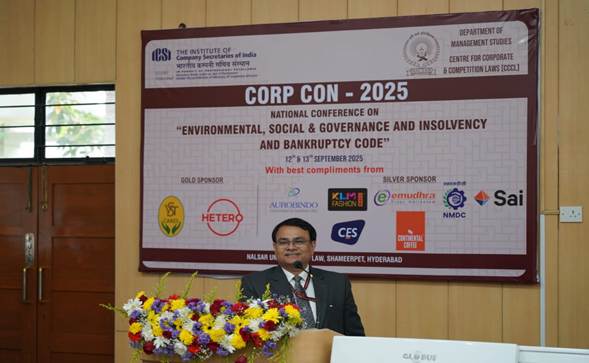
The proceedings commenced with a warm welcome to dignitaries and delegates, the ceremonial lamp-lighting, and the rendition of the ICSI motto song Satyam Vada, Dharam Chara.
In his inaugural remarks, the Vice-Chancellor underscored the importance of self-reliance, environmental sustainability, and the application of ESG principles, drawing references from landmark cases such as M.C. Mehta (1985) and T.N. Godavarman. He also highlighted the significance of the NALSAR–ICSI collaboration in advancing ESG and IBL studies, noting that selected papers from the conference would be published.
The session was marked by thought-provoking addresses from distinguished speakers. CS P. S. Rao reflected on his experiences in takeovers, mergers, insolvency, and restructuring, offering insights into the evolution and practical challenges of ESG in corporate governance.
Shri Inderjit Shaw emphasized embedding sustainability into daily life, ESG curricula, stakeholder engagement, and shared best practices from companies such as Tata, Infosys, and Mahindra. CS Ranjit Pandey articulated ESG as a necessity rather than an option, clearly distinguishing it from CSR, and discussed the supporting institutional and legal frameworks.
The session concluded with the presentation of souvenirs and a formal vote of thanks by Prof. P. Sreenivasa Subbha Rao, who acknowledged the contributions of participants, organizers, and collaborators.

