 TaxTMI
 Login
 TaxTMI
Login
Loading...
Press 'Enter' to add multiple search terms. Rules for Better Search

Press 'Enter' after typing page number.
Press 'Enter' after typing page number.


No Folders have been created
Are you sure you want to delete "My most important" ?
NOTE:
Press 'Enter' after typing page number.
Press 'Enter' after typing page number.

All News
Press 'Enter' after typing page number.
All News

Note

Bookmark

Share


112 Financial Institutions are live both as Financial Information Providers (FIP) and Financial Information Users (FIU), while 56 are live solely as FIP, and 410 as FIU
Over 2.2 billion financial accounts are now enabled for secure, consent-based data-sharing through the AA framework, with 112.34 million users having already linked their accounts
The Account Aggregator (AA) framework was officially launched on September 2, 2021, establishing a secure, consent-based system for financial data sharing. In 2016, the Reserve Bank of India issued the Master Directions for the Account Aggregator (AA) ecosystem.
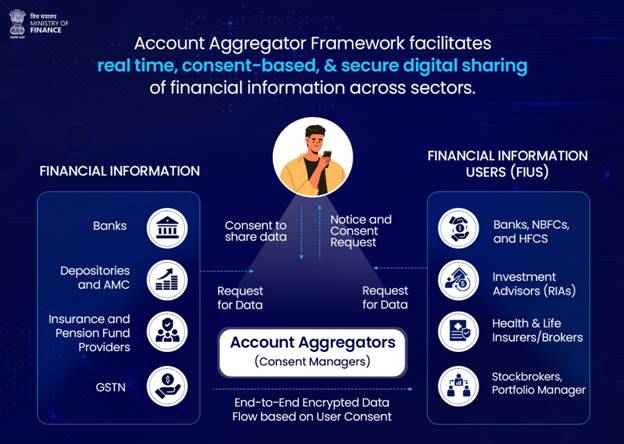
The AA Framework, allows users to aggregate their financial information (like bank accounts, investments, loans, etc.) from multiple sources and share it with service providers (e.g., lenders, wealth managers) for services like loan applications or financial planning. AAs act as intermediaries, ensuring data privacy and user control through encrypted, permission-driven data sharing.
During G20 India Presidency in 2023, AA was recognised as a foundational Digital Public Infrastructure (DPI) serving as the data exchange layer, complementing the identity (Aadhaar) and payments (UPI) layers. The role and impact of AA have been acknowledged in key G20 documents, including the “Policy Recommendations for Advancing Financial Inclusion and Productivity Gains through Digital Public Infrastructure” (2023). Its significance is also detailed in the “Report of India’s G20 Task Force on Digital Public Infrastructure” (July 2024)".
Since then, the ecosystem has grown rapidly and is witnessing accelerated adoption across banking, securities, insurance and pension sectors, strengthening India’s DPI. As on date, 112 Financial Institutions have gone live both as Financial Information Providers (FIP) and Financial Information Users (FIU), while 56 have gone live solely as FIP and 410 as FIU. Over 2.2 billion financial accounts are now enabled for secure, consent-based data sharing through the AA framework, with 112.34 million users having already linked their accounts, underscoring the growing scale and trust in this transformative initiative.
The AA ecosystem is poised to unlock new frontiers in formal credit access, especially for MSMEs and personal lending, contributing meaningfully to India’s journey towards Viksit Bharat @2047.
Launch & Timeline: RBI Master Directions (2016):
https://www.rbi.org.in/scripts/BS_ViewMasDirections.aspx?id=10598
Ecosystem Reach & Participants: Accounts, FIU and FIP (October 2024):
https://financialservices.gov.in/beta/en/account-aggregator-framework

