

Loading...

Top
Help
×

By creating an account you can:

Logo TaxTMI
Call Us / Help / Feedback

Contact Us At :

E-mail: [email protected]

Call / WhatsApp at: +91 99117 96707

For more information, Check Contact Us

FAQs :

To know Frequently Asked Questions, Check FAQs

Most Asked Video Tutorials :

For more tutorials, Check Video Tutorials

Submit Feedback/Suggestion :

Email :
Please provide your email address so we can follow up on your feedback.
Category :
Description :
Min 15 characters 0/2000
Make Most of Text Search
  1. Checkout this video tutorial: How to search effectively on TaxTMI.
  2. Put words in double quotes for exact word search, eg: "income tax"
  3. Avoid noise words such as : 'and, of, the, a'
  4. Sort by Relevance to get the most relevant document.
  5. Press Enter to add multiple terms/multiple phrases, and then click on Search to Search.
  6. Text Search
  7. The system will try to fetch results that contains ALL your words.
  8. Once you add keywords, you'll see a new 'Search In' filter that makes your results even more precise.
  9. Text Search
Add to...
You have not created any category. Kindly create one to bookmark this item!
Create New Category
Hide
Title :
Description :
❮❮ Hide
Default View
Expand ❯❯
Close ✕
🔎 News - Adv. Search
TEXT SEARCH:

Press 'Enter' to add multiple search terms. Rules for Better Search

Search In:
Main Text + AI Text
  • Main Text
  • Main Text + AI Text
  • AI Text
Category: ?
Categorized by AI
---- All Categories ----
  • ---- All Categories ----
  • Income Tax
  • GST
  • Customs, DGFT & SEZ
  • FEMA & RBI
  • Corp. Laws, SEBI & IBC
  • PMLA, Black Money & ED
  • Budget
  • News and Press Release
  • PTI News
Month:
---- All Months ----
  • ---- All Months ----
  • January
  • February
  • March
  • April
  • May
  • June
  • July
  • August
  • September
  • October
  • November
  • December
Year:
---- All Years ----
  • ---- All Years ----
  • 2026
  • 2025
  • 2024
  • 2023
  • 2022
  • 2021
  • 2020
  • 2019
  • 2018
  • 2017
  • 2016
  • 2015
  • 2014
  • 2013
  • 2012
  • 2011
Sort By: ?
In Sort By 'Default', exact matches for text search are shown at the top, followed by the remaining results in their regular order.
Relevance Default Date
    Amid global turmoil, India maintained momentum of its economic growth, says Amit Shah
    Zaggle Brings Cricket and Business Together in Hyderabad; Hosts Padma Bhushan Dr. Sunil Gavaskar
    AI may accelerate anti-competitive practices in digital markets: CCI chief
    Union Minister of Commerce and Industry Shri Piyush Goyal Calls for India to Emerge as a Global Medical and Healthcare Destination
    Union Minister of Commerce and Industry Shri Piyush Goyal Calls for Trained Caregivers and Wider Hospital Participation in Heal in India Gateway
    Rupee falls 7 paise to close at 94.50 against US dollar
    India Must Build Resilient, Globally Integrated Healthcare Supply Chains: Commerce and Industry Minister Shri Piyush Goyal at Bharat Health Global Exp...
    Rupee rises 4 paise to 94.39 against US dollar in early trade
    Jantar Mantar student stir, mass struggles could impact Assembly polls: MA Baby
    FDA awaiting response from restaurants at Mumbai Cricket Association premises: Mundhe
    India emerges as key diesel supplier to Europe as Russian, US flows falter
    Trump keeps heralding an economic boom, but even a solid jobs report is causing problems for him
    Telangana CM urges TCS'' HyperVault to launch its Hyderabad AI data centre by June 2028
    CBI FIR against Subhash Chandra for 'inflating' net worth to secure Rs 980 Cr in loans
    TCS subsidiary HyperVault to invest Rs 70,000 cr to develop Hyderabad AI data centre
    CBI FIR against Subhash Chandra for 'inflation' of net worth to secure nearly Rs 1,000-cr in loans
    Union Minister of Commerce & Industry Shri Piyush Goyal Calls for Nationwide FTA Utilisation Drive to Expand India’s Global Trade Footprint
    Union Minister of Commerce & Industry Shri Piyush Goyal Calls Upon Automotive Industry to Deepen Localisation, Expand Exports and Prepare to Serve Glo...
    GeM and Textiles Committee Sign MoU to Boost Procurement of Recycled and Upcycled Textiles
    India–EU FTA Opens Huge Opportunities for Farmers, MSMEs, Innovators, Startups and Businesses in India and Europe: Commerce and Industry Minister Sh...
❯❯
Maximize Maximize Maximize
0 / 200
Expand Note
Add to Folder

No Folders have been created

+

Are you sure you want to delete "My most important" ?

NOTE:

News
Showing Results for :
Reset Filters
Results Found:
Show All Summaries Hide All Summaries
September 7, 2026
Show AI Summary
Free trade agreements and strategic partnerships were identified as supporting India's trade engagement and economic growth amid geopolitical disruption.
India's international economic engagement through free trade agreements and strategic partnerships was identified as a means of sustaining economic growth amid geopolitical disruption. Economic cooperation was described as extending across defence, technology, energy, investment and trade. Nine free trade agreements were stated to have been concluded by 2026, with further trade arrangements proposed with other countries. Pursuit of free trade agreements was linked to increasing trade and to reported first-quarter GDP growth in the financial year 2026-27.
September 7, 2026
Show AI Summary
Leadership, talent recognition and legacy framed a discussion linking cricketing performance with entrepreneurship and organisational responsibility.
No FEMA or RBI regulatory measure, compliance obligation, legal interpretation, or adjudicatory determination is identified. The subject matter concerns leadership, performance and entrepreneurship, with emphasis on preparation, decision-making under pressure, teamwork, recognising potential and supporting talent. Corporate success is linked with creating opportunities, contributing to society and building a lasting legacy. Zaggle is described as providing enterprise spend management, card-based financial products through banking partnerships and software offerings for corporate customers.
September 7, 2026
Show AI Summary
AI-driven digital markets require competition scrutiny of autonomous pricing, self-preferencing, discriminatory pricing, tying, and market manipulation.
Artificial intelligence may accelerate anti-competitive conduct in digital markets through self-preferencing, discriminatory pricing, tying and market manipulation. Agentic AI may create particular concerns where it monitors competitors' prices and autonomously responds without direct human intervention. Competition law aims to prevent anti-competitive practices, promote competition, protect consumers and preserve freedom of trade, while allowing legitimate growth and innovation. Market dominance is not objectionable in itself; concern arises from abuse of dominance through exclusionary or exploitative practices.
September 7, 2026
Show AI Summary
Healthcare innovation and supply-chain self-reliance are prioritised through trade access, investment, research collaboration, testing infrastructure, and quality standards.
Healthcare-sector development priorities seek to expand medical devices, diagnostics, digital health, research, and pharmaceutical machinery through exports, import substitution, and services growth. Free trade agreements are presented as supporting preferential market access, services opportunities, and mobility. Sectoral growth is linked to startup incubation, intellectual-property capability, international research collaboration, technology transfer, and joint ventures. Healthcare self-reliance requires indigenous equipment, critical components, resilient supply chains, shared testing and certification infrastructure, and uncompromising quality standards.
September 7, 2026
Show AI Summary
Medical value tourism quality standards prioritise verified hospitals, ethical treatment, transparent pricing, and seamless international patient care.
Medical value tourism is proposed to expand through trained caregivers, transparent treatment packages, ethical hospital practices, seamless reimbursement and cashless-payment systems, telemedicine, and verified hospital participation. International patients are intended to receive care through accredited quality systems, supported by interpreters, global outreach, and coordinated healthcare networks. Expansion beyond metropolitan areas must maintain equivalent high-quality care for domestic and foreign patients without discrimination. Certification systems are expected to remain professionally independent and free from unethical influence.
September 7, 2026
Show AI Summary
Foreign exchange market pressures from rising crude oil and weak domestic equities constrained rupee support from foreign inflows.
Foreign exchange market conditions caused the rupee to depreciate against the US dollar despite support from FCNR dollar inflows and a softer dollar. Rising crude oil prices, weak domestic equities and global headwinds constrained gains. The outlook remained dependent on foreign inflows, dollar movements, crude prices, market sentiment and inflation data, with geopolitical tensions capable of increasing pressure on the currency.
September 7, 2026
Show AI Summary
Healthcare supply-chain resilience requires diversified sourcing, global investment, domestic innovation, and stronger medical-device production supported by enabling infrastructure.
Healthcare supply-chain resilience requires diversified sourcing, restoration of domestic capacity in Active Pharmaceutical Ingredients and Key Starting Materials, and continued imports where necessary through multiple suppliers and geographies. Pharmaceutical industry growth should move beyond generics towards research, development, patented products, new molecules, biosimilars and biotechnology. Regulatory convergence should support clinical trials, patenting and new-product introduction. Government support is contemplated for medical value travel, healthcare infrastructure, bulk drug parks, plug-and-play facilities, medical-device component production and scientific validation of Ayush products.
September 7, 2026
Show AI Summary
Foreign exchange market pressures offset rupee support from FCNR inflows amid higher crude oil and dollar demand.
The rupee gained marginally against the US dollar, supported by FCNR-related dollar inflows and robust liquidity. Elevated Brent crude prices, safe-haven dollar demand and geopolitical tensions constrained this support. Higher oil prices may enlarge India's import bill, increase dollar demand and pressure the rupee, although rising foreign-exchange reserves indicated external-sector strength.
September 6, 2026
Show AI Summary
Census data privacy and electoral integrity concerns emerge alongside calls to repeal insolvency law and protect political dissent.
CPI(M) called for repeal of the Insolvency and Bankruptcy Code, alleging that insolvency processes enabled diversion of public resources. It questioned economic growth figures against agricultural weakness, mining contraction, higher input costs, inflation, unemployment and malnutrition. The party also raised Census data privacy concerns over caste-data collection, potential linkage with government databases, and possible implications for citizenship, electoral rolls and future delimitation.
September 6, 2026
Show AI Summary
Food business licensing: Third-party restaurant operators require their own licences and cannot operate under another entity's registration.
Food Business Operator licensing requires the entity holding a food licence or registration to itself conduct the licensed food business at the specified premises. A third-party operator cannot operate under another entity's licence or registration and must obtain its own licence or registration. Regulatory notices concerning such arrangements may also address hygiene lapses and structural violations, followed by consideration of the operators' responses.
September 6, 2026
Show AI Summary
European diesel supply dependence on alternative refiners grows amid constrained exports, weakening transatlantic flows, and restricted shipping routes.
European diesel supply is becoming increasingly dependent on Indian refining capacity as Russian diesel and gasoil exports remain constrained by export restrictions, refinery disruptions and port outages, while US shipments to Europe have weakened. Alternative supply routes offer limited additional clean-product volumes because reduced tanker crossings and lower ship-to-ship transfers offshore Oman constrain flows through the Strait of Hormuz. Low diesel inventories, seasonal demand and planned refinery maintenance increase exposure to supply disruptions.
September 5, 2026
Show AI Summary
Tariff-driven inflation and elevated borrowing costs constrain growth, while durable deficit reduction may require spending restraint and tax increases.
Persistent inflation, elevated interest rates and rising public debt constrain economic growth policy. Tariffs and oil shortages are identified as contributing to inflationary pressures, while lower interest rates could increase money flows and worsen inflation. Tariffs, tax cuts, artificial intelligence productivity gains and anti-fraud measures are advanced as mechanisms to support growth, investment and domestic employment. Fiscal sustainability, however, cannot be achieved through growth alone where social security and healthcare costs exceed revenue growth; deficit reduction may require slower spending, spending reductions and tax increases.
September 5, 2026
Show AI Summary
AI data centre development receives state support for a high-capacity campus and accelerated commissioning timetable.
HyperVault's proposed artificial-intelligence data-centre campus in Hyderabad is planned on 264 acres, with investment projected at up to Rs 70,000 crore and capacity of up to 1 GW. The campus is intended to provide high-density, liquid-cooled computing infrastructure for frontier AI companies and hyperscalers. Telangana's Chief Minister sought inauguration by June 2, 2028, while assuring required governmental sanctions and support. The project is estimated to create 7,000 jobs.
September 5, 2026
Show AI Summary
Inflated net-worth certificates allegedly enabled secured lending, triggering fraud, breach-of-trust and asset-stripping allegations after default.
Alleged inflation of net-worth certificates is said to have induced approval and disbursal of two corporate loan facilities aggregating Rs 980 crore, each secured by continuing personal guarantees. The facilities subsequently defaulted. The FIR alleges that materially higher net-worth representations made in 2018 were later contradicted during insolvency proceedings, and attributes the lending to collusion among the guarantor, borrower entities and their officers. Allegations include cheating, creation of false documents, misappropriation and misapplication of loan funds, breach of trust, and asset stripping intended to frustrate recovery.
September 5, 2026
Show AI Summary
AI data centre infrastructure investment enables phased deployment of high-density, liquid-cooled computing capacity using green and water-neutral design.
HyperVault plans to develop an artificial intelligence data-centre campus on 264 acres in Hyderabad, with capacity of up to 1 GW and investment by HyperVault and its partners of up to Rs 70,000 crore. The facility is intended to provide high-density, liquid-cooled computing infrastructure for frontier AI companies and hyperscalers. Development will proceed in phases according to customer demand and technology requirements, incorporating green-energy use and water-neutral design principles.
September 5, 2026
Show AI Summary
Alleged inflation of personal net worth underpins fraud and breach-of-trust accusations over secured corporate lending.
CBI registration of an FIR concerns allegations that inflated personal net-worth certificates were used to secure corporate loan facilities from Life Insurance Corporation Housing Finance Ltd. The lender alleges that the certificates influenced lending decisions, the facilities subsequently defaulted, and later insolvency proceedings disclosed inconsistency between the represented and asserted net-worth figures. Allegations include collusion with borrower entities, false documentation, cheating, misappropriation of loan funds, and breach of lender trust.
September 5, 2026
Show AI Summary
Free trade agreement utilisation requires district-level exporter support, rules-of-origin assistance, standards compliance, and coordinated market-access outreach nationwide.
Free Trade Agreement utilisation is to be advanced through coordinated action by central and state governments, sectoral ministries, Export Promotion Councils, industry associations and local export-support institutions. Preferential treatment is assessed against tariff rates faced by competing countries, while export competitiveness depends on scale, quality, customer trust and timely delivery. The Export Promotion Mission supports export credit, digitised compliance and FTA documentation, including rules-of-origin certification. District-level identification of products, clusters, new exporters and practical constraints, supported by workshops and rapid online facilitation, is intended to deepen market access.
September 5, 2026
Show AI Summary
Automotive localisation and export competitiveness are prioritised through global-standard manufacturing, technology partnerships, sustainable mobility, and government infrastructure support.
Automotive-sector localisation, export expansion and global-standard manufacturing are prioritised to strengthen India's role in global production and trade. Companies are urged to invest in technology, innovation, research and development, use domestic scale for overseas markets, and avoid supplying inferior products domestically. Trade agreements are positioned as channels for market access, technology absorption and exports. Greater indigenisation is encouraged through component localisation, technology collaborations and expanded exports, supported by critical minerals, batteries, indigenous energy sources, research funding, plug-and-play infrastructure and industrial ecosystems.
September 5, 2026
Show AI Summary
Circular textile procurement integrates certification, product categories and seller support to expand government markets for recycled materials.
Memorandum of Understanding for circular textile procurement links certification, standardisation and public-market access for recycled and upcycled products made from textile waste, scrap and second-hand clothes. The Textiles Committee will identify, verify, certify and recognise eligible producers and support specifications, catalogues and capacity building. Government e Marketplace will create dedicated product categories, onboard sellers, facilitate online market linkages, promote products to government buyers, and provide training and handholding to recyclers and upcyclers.
September 5, 2026
Show AI Summary
India-EU Free Trade Agreement promotes tariff reduction, market access, investment resilience, and India-Belgium industrial and skills cooperation.
India-EU Free Trade Agreement is presented as reducing or removing tariffs on more than 95 per cent of Indian and European goods exports while protecting sensitive sectors on both sides. It is intended to expand trade, investment and economic resilience, with the Port of Antwerp-Bruges serving as a major gateway for Indian exports into European markets. India-Belgium cooperation is identified in gems and jewellery, semiconductors, green hydrogen, advanced manufacturing, agriculture and food processing, supported by mutual recognition, workforce mobility, skills development and technology collaboration.

News

Back

All News

Showing Results for :
Reset Filters
No Records Found

News

Showing Results for : Reset Filters

MoSPI organized a National Workshop on “Using Alternate Data Sources and Frontier Technologies for Policy Making” during 5-6 June 2025

June 7, 2025

Contents
Summary
Note

Note

-

Bookmark

Print

Print

Need of the best policy which blends both traditional and alternative data sources, says Prof. Ajay Kumar Sood, PSA to GoI

Need for institutionalized hybrid data ecosystem which has equal place for traditional & alternate data sources: Prof. Abhay Karandikar, Secretary, DST

Alternate data sources can be used in real time to supplement traditional data sources for policy making: Dr. Saurabh Garg, Secretary, MoSPI

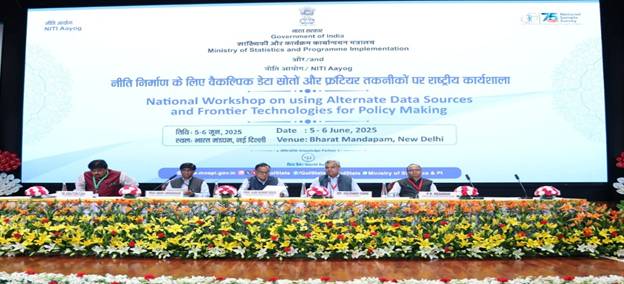
The Ministry of Statistics and Programme Implementation (MoSPI), in collaboration with NITI Aayog and the World Bank as knowledge partner, conducted a two-day National Workshop on ‘Using Alternate Data Sources and Frontier Technologies for Policy Making’ at Bharat Mandapam, New Delhi during 5-6 June, 2025.

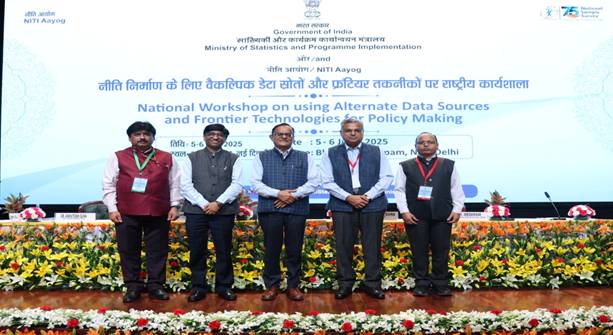
The National Workshop concluded with a Valedictory Session on 6 June, 2025.  The Valedictory Session was graced by Prof. Ajay Kumar Sood, Principal Scientific Advisor (PSA) to GoI as the Chief Guest; Prof. Abhay Karandikar, Secretary, D/o Science and Technology; Dr. Saurabh GargSecretary, MoSPI and Shri P.R. Meshram, Director General, MoSPI.  The two-day workshop was attended by over 450 participants from central ministries, state governments, international organisations including the World Bank, academic and research institutions, and private sector entities.

In his address, Prof. Ajay Kumar Sood, Principal Scientific Advisor to GoI and the Chief Guest of the event emphasized that alternate data sources and frontier technologies are increasingly becoming critical for policy making. These high frequency indicators are more dynamic and offer timely insights, enabling policies to be more agile and responsive. While traditional data sources reflect where we have been, the alternate data sources indicate where we are heading. He added that though alternate data sources provide real time information at a much granular level, they cannot replace tradition data sources. He emphasized the need for the best policy which blends both traditional and alternative data sources. He highlighted various use-cases where alternate data sources have been effectively used. He stressed on the need for collaboration between Government, academia, researchers, industry and international organizations for effective use of new technologies. He also called for ethical deployment of AI and said that data security and privacy concerns cannot be compromised. Further, he asserted that the development of techno-legal framework for Digital Public Infrastructure is a gift of India to the World.
Prof. Abhay Karandikar, Secretary, D/o Science and Technology in his address remarked that the policy making process is a complex exercise which involve gathering of data, consultation with stakeholders and drawing insights. AI/ML has facilitated timely processing of data for designing actionable policies. In this age and time, challenge is not to collect data but how to make sense of the data. The real challenge lies in addressing issues relating to data privacy, data security, regulatory framework, and institutional readiness. He emphasized on the need for institutionalized hybrid data ecosystem which has equal place for both traditional and alternate data sources.  

Dr. Saurabh Garg, Secretary, MoSPI, in his address emphasized on the need of fostering collaboration with various stakeholders for developing a robust statistical system to address the data needs for policy making. He opined that as survey data becomes available with a time lag; alternate data sources can be used to supplement traditional data sources for policy making in real time. While quoting the United Nations Fundamental Principles of Official Statistics, he emphasized that for statistical purposes best combination of the four data sources, namely surveys, censuses, administrative records and alternate data sources may be drawn with quality and timeliness along with limiting cost and respondent burden. He expected that in next 3-6 months, MoSPI will be able to implement some of the use cases that have been identified to harness alternate data sources and the application of frontier technologies.  He thanked World Bank for conceptualizing and NITI Aayog for collaborating with MoSPI in organizing this workshop and expressed that India will be at the forefront of integrating alternate data sources and frontier technologies in the National Statistical Frameworks.

In the welcome address, Shri P.R. Meshram, Director General (Data Governance) expressed gratitude to NITI Aayog, World Bank, and other participants for their active involvement during the course of two-days event. He added that the workshop has not only deepened our understanding of the challenges in integration of alternate data sources in the statistical system of the country, but also helped charting out the solutions to the challenges.
The key highlights of the four technical sessions on the subjects, viz, AI and Data Science for Official Statistics; Mobile Phone Data for Tourism Statistics; Geo-spatial Data for Sampling, Ocean Accounting and Data Dissemination and Scanner data for CPI compilation held during Workshop were also discussed during the valedictory session along with key takeaways. Some of the salient points of the technical sessions are as under:

(i)  AI and Data Science for Official Statistics:

Technical sessions on the subject started with setting the context for use of AI and data science in official statistics and identifying key stakeholders. Way forward for National Statistics Office considering the stage it is in i.e. from pilot stage to production stage was discussed during the session. Shri Abhishek Singh, CEO India AI and Ms Debjani Ghosh, Chief Architect, Frontier Tech Hub, NITI Aayog, Shri Ankit Bose, Head AI, NASSCOM, Prof. Balaraman Ravindran, IIT-Madras, Mr. Richard Campbell, UK ONS; and Mr. Thomas Danielewitz, Ms. Malar Veerappan, Ms. Shreya Dutt from World Bank were among the key speakers.

(ii)  Mobile Phone Data for Tourism Statistics:

Technical Sessions on the subject focused on discussion to devise a methodological framework using mobile phone data for tourism statistics tailored to Indian needs and covered relevant issues like data privacy and regulatory challenges. Use-cases from other countries for tourism, urban mobility and infrastructure assessment were discussed during the technical session. Shri Safi A. Rizvi Advisor, NDMA, Mr. Siim Esko, International Project Development Lead, Positium, Ms. Esperanza Magpantay, Senior Statistician, International Telecommunication Union, Ms. Titi Kanti Lestari, Atma Jaya University, Indonesia, Mr. Asit Kadyan, D/o Telecommunication, GoI and Mr. Sagar Mathur, Vice President, Airtel were among the key speakers.

(iii)  Geo-spatial Data for Sampling, Ocean Accounting and Data Dissemination:

Technical Sessions on Geo-spatial Data for Sampling, Ocean Accounting and Data Dissemination of the workshop highlighted the transformative potential of geospatial technologies in enhancing official statistics, with a focus on updating sampling frames in urban areas, improving data collection, integration, and dissemination. The latter part of the technical session was devoted for exploring the application of geospatial data in ocean accounting. The session featured enriching presentations and discussions by Mr. Richard Campbell, Deputy Director, UK Office for National Statistics; Ms. Kate Hess, Solution Engineer, ESRI; Shri Srikant Shastri, Chairperson, Geospatial Data Promotion & Development Committee; and Ms. Anija Shukla, Environment Specialist, World Bank, Ms. Rashmi Verma, Co-Founder, MapMyIndia along with experts from NRSC, INCOIS, NCCR and various academic and research institutions. Speakers demonstrated advanced geospatial tools integrated with AI techniques for feature extraction, change detection, and spatial stratification, showcasing use cases that illustrated the value of GIS-AI convergence for dynamic visualizations, real-time dashboards, and evidence-based policymaking.

(iv)  Scanner data for CPI compilation:

Technical sessions on the subject covered concepts and methodologies related to scanner data, web scraping techniques, requisite IT infrastructure and other available alternative data sources for integration in Consumer Price Index (CPI). Key speakers in the session were Mr. Federico Polidoro, World Bank; Mr. Luigi Palumbo from Bank of Italy, Prof. Himanshu from JNU, Dr. Aditi Chaubal from IIT Bombay, Shri Anand Agarwal from V-Mart, Ms. Sonu Shah from Nielsen IQ and many others from industry and academic organisations. Sessions provided valuable insights for accelerating MoSPI’s ongoing efforts for integration of alternative data sources, particularly scanner data and e-commerce data in CPI compilation methodology.

The workshop concluded with the vote of thanks by Dr. Ashutosh Ojha, DDG, MoSPI. He expressed gratitude to the Chief Guest, other dignitaries, participants from Multilateral agencies, industries, academia, researchers as well as officers from both central and state governments for gracing the event.

Topics

Acts Income Tax
