

Loading...

Top
Help
×

By creating an account you can:

Logo TaxTMI
Call Us / Help / Feedback

Contact Us At :

E-mail: [email protected]

Call / WhatsApp at: +91 99117 96707

For more information, Check Contact Us

FAQs :

To know Frequently Asked Questions, Check FAQs

Most Asked Video Tutorials :

For more tutorials, Check Video Tutorials

Submit Feedback/Suggestion :

Email :
Please provide your email address so we can follow up on your feedback.
Category :
Description :
Min 15 characters 0/2000
Make Most of Text Search
  1. Checkout this video tutorial: How to search effectively on TaxTMI.
  2. Put words in double quotes for exact word search, eg: "income tax"
  3. Avoid noise words such as : 'and, of, the, a'
  4. Sort by Relevance to get the most relevant document.
  5. Press Enter to add multiple terms/multiple phrases, and then click on Search to Search.
  6. Text Search
  7. The system will try to fetch results that contains ALL your words.
  8. Once you add keywords, you'll see a new 'Search In' filter that makes your results even more precise.
  9. Text Search
Add to...
You have not created any category. Kindly create one to bookmark this item!
Create New Category
Hide
Title :
Description :
❮❮ Hide
Default View
Expand ❯❯
Close ✕
🔎 News - Adv. Search
TEXT SEARCH:

Press 'Enter' to add multiple search terms. Rules for Better Search

Search In:
Main Text + AI Text
  • Main Text
  • Main Text + AI Text
  • AI Text
Category: ?
Categorized by AI
---- All Categories ----
  • ---- All Categories ----
  • Income Tax
  • GST
  • Customs, DGFT & SEZ
  • FEMA & RBI
  • Corp. Laws, SEBI & IBC
  • PMLA, Black Money & ED
  • Budget
  • News and Press Release
  • PTI News
Month:
---- All Months ----
  • ---- All Months ----
  • January
  • February
  • March
  • April
  • May
  • June
  • July
  • August
  • September
  • October
  • November
  • December
Year:
---- All Years ----
  • ---- All Years ----
  • 2026
  • 2025
  • 2024
  • 2023
  • 2022
  • 2021
  • 2020
  • 2019
  • 2018
  • 2017
  • 2016
  • 2015
  • 2014
  • 2013
  • 2012
  • 2011
Sort By: ?
In Sort By 'Default', exact matches for text search are shown at the top, followed by the remaining results in their regular order.
Relevance Default Date
    As world faced turmoil, India forged partnerships to maintain its economic growth: Shah
    Haryana govt, RBI review measures to tackle financial frauds
    Union law minister Meghwal inaugurates ITAT's new premises in Kolkata
    Enabling Filing of Appeals in Cases Involving NIL or Zero Demand Amount
    DGFT Introduces Open API Facility for Certificate of Origin on the Trade Connect e-Platform
    Amid global turmoil, India maintained momentum of its economic growth, says Amit Shah
    Zaggle Brings Cricket and Business Together in Hyderabad; Hosts Padma Bhushan Dr. Sunil Gavaskar
    AI may accelerate anti-competitive practices in digital markets: CCI chief
    Union Minister of Commerce and Industry Shri Piyush Goyal Calls for India to Emerge as a Global Medical and Healthcare Destination
    Union Minister of Commerce and Industry Shri Piyush Goyal Calls for Trained Caregivers and Wider Hospital Participation in Heal in India Gateway
    Rupee falls 7 paise to close at 94.50 against US dollar
    India Must Build Resilient, Globally Integrated Healthcare Supply Chains: Commerce and Industry Minister Shri Piyush Goyal at Bharat Health Global Exp...
    Rupee rises 4 paise to 94.39 against US dollar in early trade
    Jantar Mantar student stir, mass struggles could impact Assembly polls: MA Baby
    FDA awaiting response from restaurants at Mumbai Cricket Association premises: Mundhe
    India emerges as key diesel supplier to Europe as Russian, US flows falter
    Trump keeps heralding an economic boom, but even a solid jobs report is causing problems for him
    Telangana CM urges TCS'' HyperVault to launch its Hyderabad AI data centre by June 2028
    CBI FIR against Subhash Chandra for 'inflating' net worth to secure Rs 980 Cr in loans
    TCS subsidiary HyperVault to invest Rs 70,000 cr to develop Hyderabad AI data centre
❯❯
Maximize Maximize Maximize
0 / 200
Expand Note
Add to Folder

No Folders have been created

+

Are you sure you want to delete "My most important" ?

NOTE:

News
Showing Results for :
Reset Filters
Results Found:
Show All Summaries Hide All Summaries
September 7, 2026
Show AI Summary
Free trade agreements and cyber-fraud prevention feature in India's stated strategy for economic growth, security, and digital protection.
India's external economic strategy relies on diplomatic engagement, strategic partnerships and free trade agreements to sustain growth amid geopolitical uncertainty. Cooperation extends to defence, technology, energy, investment and trade, as well as digital public infrastructure, disaster relief and capacity building. Internal and border security are treated as conditions for national development, while police responsibilities include community safety, maritime protection and tourist safety. Growing cyber-fraud risks linked to the digital economy are addressed through coordination with states and the national cybercrime helpline.
September 7, 2026
Show AI Summary
Financial fraud prevention advances through accessible complaints, cyber awareness, intelligence-sharing, and AI-based detection of mule accounts.
Financial-fraud prevention measures rely on coordinated review of alleged fraud, unauthorised deposit collection, complaints, market intelligence, investor protection and cyber threats. The SACHET portal supports market intelligence and complaints concerning unregulated financial activities through multilingual and accessibility features. MuleHunter.ai uses artificial intelligence and machine learning to identify mule accounts used in fraudulent fund flows. Financial-literacy programmes and accessible educational initiatives promote safe banking, fraud awareness and coordinated responses to cyber-enabled financial crime.
September 7, 2026
Show AI Summary
Technology-driven tax dispute resolution supports faster tribunal processes, reduced litigation, and improved taxpayer services through digital filing and assessments.
The Kolkata Bench of the Income Tax Appellate Tribunal is intended to expedite tax-dispute resolution across 12 states, including seven northeastern states, while advancing impartial, accessible and swift justice. Its administrative role includes improving justice delivery, reducing pendency and pursuing AI-driven digital transformation. The Income Tax Department and the Tribunal seek reduced litigation and improved taxpayer services through technology-driven measures, including faceless assessment and electronic filing.
September 7, 2026
Show AI Summary
Appeals against NIL or Zero GST demand orders are enabled where taxpayers paid liabilities before issuance of the order.
GST Portal validation restricting appeals against demand orders showing NIL or Zero demand has been removed where a liability dispute exists and the taxpayer made payment before issuance of the demand order. Taxpayers may challenge such orders by filing an appeal in Form GST APL-01, and may raise a ticket with the GST Helpdesk if filing difficulties arise.
September 7, 2026
Show AI Summary
Certificate of origin API integration enables exporters to submit applications, receive certificates, verify issuance, and reduce repetitive data entry.
Open API integration for Certificates of Origin enables eligible exporters to connect ERP, accounting and other business software with the Trade Connect e-Platform for electronic application submission. The facility covers preferential and non-preferential certificates, provides authentication, file-submission and certificate-verification APIs, and maintains a transaction ledger for application tracking. Security measures include digital signatures, password hashing, IP whitelisting and time-limited access tokens. Relevant origin criteria, fields and validation rules are automatically applied according to the selected trade agreement or certification scheme.
September 7, 2026
Show AI Summary
Free trade agreements and strategic partnerships were identified as supporting India's trade engagement and economic growth amid geopolitical disruption.
India's international economic engagement through free trade agreements and strategic partnerships was identified as a means of sustaining economic growth amid geopolitical disruption. Economic cooperation was described as extending across defence, technology, energy, investment and trade. Nine free trade agreements were stated to have been concluded by 2026, with further trade arrangements proposed with other countries. Pursuit of free trade agreements was linked to increasing trade and to reported first-quarter GDP growth in the financial year 2026-27.
September 7, 2026
Show AI Summary
Leadership, talent recognition and legacy framed a discussion linking cricketing performance with entrepreneurship and organisational responsibility.
No FEMA or RBI regulatory measure, compliance obligation, legal interpretation, or adjudicatory determination is identified. The subject matter concerns leadership, performance and entrepreneurship, with emphasis on preparation, decision-making under pressure, teamwork, recognising potential and supporting talent. Corporate success is linked with creating opportunities, contributing to society and building a lasting legacy. Zaggle is described as providing enterprise spend management, card-based financial products through banking partnerships and software offerings for corporate customers.
September 7, 2026
Show AI Summary
AI-driven digital markets require competition scrutiny of autonomous pricing, self-preferencing, discriminatory pricing, tying, and market manipulation.
Artificial intelligence may accelerate anti-competitive conduct in digital markets through self-preferencing, discriminatory pricing, tying and market manipulation. Agentic AI may create particular concerns where it monitors competitors' prices and autonomously responds without direct human intervention. Competition law aims to prevent anti-competitive practices, promote competition, protect consumers and preserve freedom of trade, while allowing legitimate growth and innovation. Market dominance is not objectionable in itself; concern arises from abuse of dominance through exclusionary or exploitative practices.
September 7, 2026
Show AI Summary
Healthcare innovation and supply-chain self-reliance are prioritised through trade access, investment, research collaboration, testing infrastructure, and quality standards.
Healthcare-sector development priorities seek to expand medical devices, diagnostics, digital health, research, and pharmaceutical machinery through exports, import substitution, and services growth. Free trade agreements are presented as supporting preferential market access, services opportunities, and mobility. Sectoral growth is linked to startup incubation, intellectual-property capability, international research collaboration, technology transfer, and joint ventures. Healthcare self-reliance requires indigenous equipment, critical components, resilient supply chains, shared testing and certification infrastructure, and uncompromising quality standards.
September 7, 2026
Show AI Summary
Medical value tourism quality standards prioritise verified hospitals, ethical treatment, transparent pricing, and seamless international patient care.
Medical value tourism is proposed to expand through trained caregivers, transparent treatment packages, ethical hospital practices, seamless reimbursement and cashless-payment systems, telemedicine, and verified hospital participation. International patients are intended to receive care through accredited quality systems, supported by interpreters, global outreach, and coordinated healthcare networks. Expansion beyond metropolitan areas must maintain equivalent high-quality care for domestic and foreign patients without discrimination. Certification systems are expected to remain professionally independent and free from unethical influence.
September 7, 2026
Show AI Summary
Foreign exchange market pressures from rising crude oil and weak domestic equities constrained rupee support from foreign inflows.
Foreign exchange market conditions caused the rupee to depreciate against the US dollar despite support from FCNR dollar inflows and a softer dollar. Rising crude oil prices, weak domestic equities and global headwinds constrained gains. The outlook remained dependent on foreign inflows, dollar movements, crude prices, market sentiment and inflation data, with geopolitical tensions capable of increasing pressure on the currency.
September 7, 2026
Show AI Summary
Healthcare supply-chain resilience requires diversified sourcing, global investment, domestic innovation, and stronger medical-device production supported by enabling infrastructure.
Healthcare supply-chain resilience requires diversified sourcing, restoration of domestic capacity in Active Pharmaceutical Ingredients and Key Starting Materials, and continued imports where necessary through multiple suppliers and geographies. Pharmaceutical industry growth should move beyond generics towards research, development, patented products, new molecules, biosimilars and biotechnology. Regulatory convergence should support clinical trials, patenting and new-product introduction. Government support is contemplated for medical value travel, healthcare infrastructure, bulk drug parks, plug-and-play facilities, medical-device component production and scientific validation of Ayush products.
September 7, 2026
Show AI Summary
Foreign exchange market pressures offset rupee support from FCNR inflows amid higher crude oil and dollar demand.
The rupee gained marginally against the US dollar, supported by FCNR-related dollar inflows and robust liquidity. Elevated Brent crude prices, safe-haven dollar demand and geopolitical tensions constrained this support. Higher oil prices may enlarge India's import bill, increase dollar demand and pressure the rupee, although rising foreign-exchange reserves indicated external-sector strength.
September 6, 2026
Show AI Summary
Census data privacy and electoral integrity concerns emerge alongside calls to repeal insolvency law and protect political dissent.
CPI(M) called for repeal of the Insolvency and Bankruptcy Code, alleging that insolvency processes enabled diversion of public resources. It questioned economic growth figures against agricultural weakness, mining contraction, higher input costs, inflation, unemployment and malnutrition. The party also raised Census data privacy concerns over caste-data collection, potential linkage with government databases, and possible implications for citizenship, electoral rolls and future delimitation.
September 6, 2026
Show AI Summary
Food business licensing: Third-party restaurant operators require their own licences and cannot operate under another entity's registration.
Food Business Operator licensing requires the entity holding a food licence or registration to itself conduct the licensed food business at the specified premises. A third-party operator cannot operate under another entity's licence or registration and must obtain its own licence or registration. Regulatory notices concerning such arrangements may also address hygiene lapses and structural violations, followed by consideration of the operators' responses.
September 6, 2026
Show AI Summary
European diesel supply dependence on alternative refiners grows amid constrained exports, weakening transatlantic flows, and restricted shipping routes.
European diesel supply is becoming increasingly dependent on Indian refining capacity as Russian diesel and gasoil exports remain constrained by export restrictions, refinery disruptions and port outages, while US shipments to Europe have weakened. Alternative supply routes offer limited additional clean-product volumes because reduced tanker crossings and lower ship-to-ship transfers offshore Oman constrain flows through the Strait of Hormuz. Low diesel inventories, seasonal demand and planned refinery maintenance increase exposure to supply disruptions.
September 5, 2026
Show AI Summary
Tariff-driven inflation and elevated borrowing costs constrain growth, while durable deficit reduction may require spending restraint and tax increases.
Persistent inflation, elevated interest rates and rising public debt constrain economic growth policy. Tariffs and oil shortages are identified as contributing to inflationary pressures, while lower interest rates could increase money flows and worsen inflation. Tariffs, tax cuts, artificial intelligence productivity gains and anti-fraud measures are advanced as mechanisms to support growth, investment and domestic employment. Fiscal sustainability, however, cannot be achieved through growth alone where social security and healthcare costs exceed revenue growth; deficit reduction may require slower spending, spending reductions and tax increases.
September 5, 2026
Show AI Summary
AI data centre development receives state support for a high-capacity campus and accelerated commissioning timetable.
HyperVault's proposed artificial-intelligence data-centre campus in Hyderabad is planned on 264 acres, with investment projected at up to Rs 70,000 crore and capacity of up to 1 GW. The campus is intended to provide high-density, liquid-cooled computing infrastructure for frontier AI companies and hyperscalers. Telangana's Chief Minister sought inauguration by June 2, 2028, while assuring required governmental sanctions and support. The project is estimated to create 7,000 jobs.
September 5, 2026
Show AI Summary
Inflated net-worth certificates allegedly enabled secured lending, triggering fraud, breach-of-trust and asset-stripping allegations after default.
Alleged inflation of net-worth certificates is said to have induced approval and disbursal of two corporate loan facilities aggregating Rs 980 crore, each secured by continuing personal guarantees. The facilities subsequently defaulted. The FIR alleges that materially higher net-worth representations made in 2018 were later contradicted during insolvency proceedings, and attributes the lending to collusion among the guarantor, borrower entities and their officers. Allegations include cheating, creation of false documents, misappropriation and misapplication of loan funds, breach of trust, and asset stripping intended to frustrate recovery.
September 5, 2026
Show AI Summary
AI data centre infrastructure investment enables phased deployment of high-density, liquid-cooled computing capacity using green and water-neutral design.
HyperVault plans to develop an artificial intelligence data-centre campus on 264 acres in Hyderabad, with capacity of up to 1 GW and investment by HyperVault and its partners of up to Rs 70,000 crore. The facility is intended to provide high-density, liquid-cooled computing infrastructure for frontier AI companies and hyperscalers. Development will proceed in phases according to customer demand and technology requirements, incorporating green-energy use and water-neutral design principles.

News

Back

All News

Showing Results for :
Reset Filters
No Records Found

News

Showing Results for : Reset Filters

Results of Comprehensive Modular Survey: Telecom, 2025 (January – March, 2025)

May 30, 2025

Contents
Summary
Note

Note

-

Bookmark

Print

Print

Key highlights:

  • In rural areas, approximately 96.8 percent of persons in the age group 15-29 years used mobile phones at least once during the last three months for making personal calls and/ or accessing the internet. The use of mobile phones is estimated at 97.6 percent in urban areas.
  • In the age group 15-29 years, around 95.5 percent of persons own a smartphone among those persons who own a mobile phone (including smart phone) in rural areas. In urban areas, about 97.6 percent persons own a smartphone in the same age group.  
  • In rural areas, approximately 92.7 percent persons in the age group 15-29 years used the internet at least once during last three months. Whereas, in urban areas, about 95.7 percent persons of the same age group used the internet.
  • Among the persons in the age group 15-29 years who reported the ability to perform online banking transactions, about 99.5 percent persons reported to have the ability to perform online banking transactions through UPI.
  • In India, approximately 85.5 percent of households possessed at least one smartphone.   
  • Around 86.3 percent households in India have access to internet within the household premises.

Among the individuals in the age group 15-29 years, approximately 97.1 percent persons reported using a mobile phone (including smartphones) during the last three months from the date of survey.

As a part of the 80th round of the National Sample Survey (NSS), the Comprehensive Modular Survey: Telecom (CMS: T) was conducted from January to March, 2025. This initiative marks a significant step by National Statistics Office (NSO) towards implementing short-duration, focused surveys. This survey was undertaken with the primary objective to meet the requirements of the line ministry/ department of Government of India and there was no State participation in CMS: T. This survey was conducted along with the ongoing ‘Household Social Consumption: Health’ survey of NSS 80th round. The survey collected data on various aspects of mobile and internet usage at both the household and individual levels. Additionally, information on selected ICT skills was also captured. In this survey, data was collected through CAPI (Computer-Assisted Personal Interviews). The report is available on the Ministry’s website (http://www.mospi.gov.in).

Sample Design:

In this survey, a two-stage stratified sampling design was used, where First Stage Units (FSU) were villages/sub-units/sub-divisions in rural areas and Urban Frame Survey (UFS) blocks/sub-units/ sub-divisions in urban areas. The FSUs were allocated to States and UTs in proportion to the projected population figures as on 1st October 2024 as available from the report, ‘Population Projections for India and States 2011-2036’ of the Technical Group on Population Projections, Ministry of Health and Family Welfare, Government of India. The Second Stage Units (SSUs) were households in both rural and urban areas. The selection of FSUs and SSUs was done using Simple Random Sampling without Replacement (SRSWOR).

Survey Coverage:

The survey covered the whole of the India Union except for some villages of Andaman and Nicobar Islands which were difficult to access. At the all-India level, the total number of first-stage units (FSUs) surveyed was 4,382 (2,395 in rural areas and 1,987 in urban areas). The total number of households surveyed was 34,950 (19,071 in rural areas and 15,879 in urban areas) and the total number of persons enumerated was 1,42,065 (82,573 in rural areas and 59,492 in urban areas).

Important Caveat:

In rural area, around 92.7 percent persons in the age group 15-29 years used internet during last three months preceding the date of survey. In urban areas the use of internet, in the same age group, estimated at 95.7 percentage.

The primary objective of the CMS: T was to generate national-level estimates of telecom and ICT skills related indicators. However, state-level estimates based on the available sample observations have been generated and presented in this report. Therefore, users should interpret the survey results at the sub-national level with careful consideration of the associated sample size in the domain and Relative Standard Error (RSE). The information on the execution/ability to perform the ICT skills was collected based on the reporting of the informant only. While collecting this information, no tests of the ICT skills of the informants were performed. Furthermore, with reference to the information collected on online purchases, only goods have been taken into account, while services have been excluded.

It is also important to note that the survey-based estimated totals were used exclusively for calculating rates and ratios. These totals are not intended to serve as definitive population-level counts. Therefore, using these totals to directly interpret the estimates in absolute terms or for extrapolation, may lead to misleading conclusions and is not recommended. Users of the data are requested to interpret the findings with due consideration of these statistical limitations.

Major findings of the survey:

  1. Use of mobile telephone:

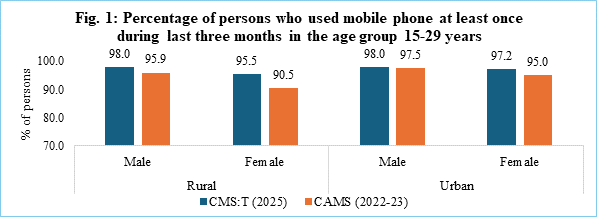
In CMS: T, a person was considered as ‘used a mobile phone (smartphone as well as mobile phone other than smartphone)’ if s/he used it for the purpose of making personal calls and/or accessing the internet at least once during the last three months preceding the date of survey. Among youth aged 15–29 years, approximately 97.1 percent reported the mobile phone usage in the last three months. As per the findings of the Comprehensive Annual Modular Survey (CAMS), 2022–23, conducted as part of the NSS 79th Round, the corresponding figure for this age group was estimated at 94.2[1] percent. Gender-sector-wise comparative estimates of percentage of persons used mobile in the age group 15-29 years are shown in Figure 1.     
  1. Mobile ownership:

In rural area around 79.2 percent males and 75.6 percent females in the age group ‘15 years and above’ own a smartphone among those who own a mobile phone. Whereas, in urban area the percentage estimated at around 89.4 and 86.2 percent for male and female, respectively, for the same age group.

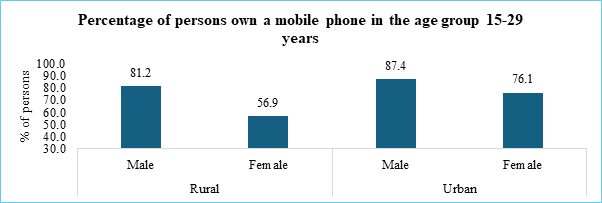
In this survey, mobile phone ownership was defined as having a device with an active SIM card for personal use, including employer-provided phones and those not registered in the user’s name. Individuals with only SIM cards were excluded. While determining ownership, joint ownership of a single mobile phone is not considered; in such cases, ownership is determined based on the majority use criterion. At the all-India level, in the age group 15-29 years, approximately 73.4 percent persons own a mobile phone. Gender-sector-wise estimates of mobile ownership for the persons in the age group 15-29 years are shown in Figure 2.
  1. Use of internet:   

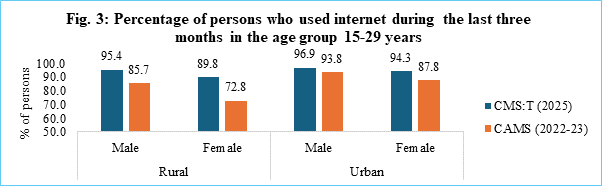
In the survey, a person was considered as ‘used internet’ if s/he accessed internet at least once during last 3 months, from any location, for any purpose and using any type of device (e.g. mobile, desktop, laptop, tablet, etc.). In the age group 15-29 years, around 94.3 percent persons used the internet at least once during last 3 months preceding the date of survey. Gender-sector-wise comparative estimates with CAMS, 2022-23 for the percentage of persons used internet in the age group 15-29 years are shown in Figure 3.
(iv) Sent messages with attached files

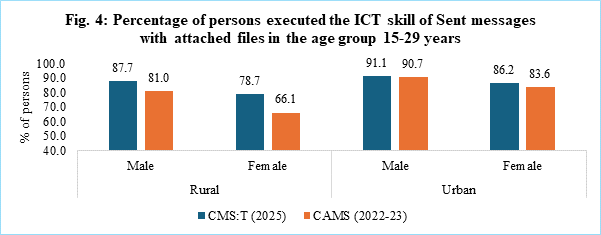
About 85.1 percent persons in the age group 15-29 years reported execution of the skill of ‘sent messages (e.g., e-mail, messaging service, SMS) with attached files (e.g., documents, pictures, video)’, using mobile or computer-like devices, during the last three months preceding the date of survey.

Whereas, 77.7 percent persons in the same age group reported execution of the skill during 2022-23 (CAMS, NSS 79th Round). Figure 4 gives gender-sector-wise comparative estimates of the percentage of persons executed the ICT skill in the age group 15-29 years during 2025 and 2022-23.


Indicator

Rural

Urban

Male

Female

Male

Female

15-24 years

Percentage persons used mobile during last three months preceding the date of survey

98.0

95.7

97.6

96.9

Percentage of persons own a mobile phone

74.8

51.7

82.7

69.5

Percentage of persons used the internet during last three months preceding the date of survey

95.7

91.1

97.0

95.0

Percentage of persons sent messages with attached files during last three months preceding the date of survey

87.7

80.4

91.9

87.7

15 years and

above

Percentage persons used mobile during last three months preceding the date of survey

89.5

76.3

95.0

86.8

Percentage of persons own a mobile phone

80.7

48.4

90.0

71.8

Percentage of persons used the internet during last three months preceding the date of survey

72.1

57.6

85.5

74.0

Percentage of persons sent messages with attached files during last three months preceding the date of survey

67.2

50.9

79.1

65.8

households

Percentage of households possessed at least one smartphone

82.1

91.3

Percentage of households have access to internet facility within household premises

83.3

91.6


Topics

Acts Income Tax
