

Loading...

Top
Help
×

By creating an account you can:

Logo TaxTMI
Call Us / Help / Feedback

Contact Us At :

E-mail: [email protected]

Call / WhatsApp at: +91 99117 96707

For more information, Check Contact Us

FAQs :

To know Frequently Asked Questions, Check FAQs

Most Asked Video Tutorials :

For more tutorials, Check Video Tutorials

Submit Feedback/Suggestion :

Email :
Please provide your email address so we can follow up on your feedback.
Category :
Description :
Min 15 characters 0/2000
Make Most of Text Search
  1. Checkout this video tutorial: How to search effectively on TaxTMI.
  2. Put words in double quotes for exact word search, eg: "income tax"
  3. Avoid noise words such as : 'and, of, the, a'
  4. Sort by Relevance to get the most relevant document.
  5. Press Enter to add multiple terms/multiple phrases, and then click on Search to Search.
  6. Text Search
  7. The system will try to fetch results that contains ALL your words.
  8. Once you add keywords, you'll see a new 'Search In' filter that makes your results even more precise.
  9. Text Search
Add to...
You have not created any category. Kindly create one to bookmark this item!
Create New Category
Hide
Title :
Description :
❮❮ Hide
Default View
Expand ❯❯
Close ✕
🔎 News - Adv. Search
TEXT SEARCH:

Press 'Enter' to add multiple search terms. Rules for Better Search

Search In:
Main Text + AI Text
  • Main Text
  • Main Text + AI Text
  • AI Text
Category: ?
Categorized by AI
---- All Categories ----
  • ---- All Categories ----
  • Income Tax
  • GST
  • Customs, DGFT & SEZ
  • FEMA & RBI
  • Corp. Laws, SEBI & IBC
  • PMLA, Black Money & ED
  • Budget
  • News and Press Release
  • PTI News
Month:
---- All Months ----
  • ---- All Months ----
  • January
  • February
  • March
  • April
  • May
  • June
  • July
  • August
  • September
  • October
  • November
  • December
Year:
---- All Years ----
  • ---- All Years ----
  • 2026
  • 2025
  • 2024
  • 2023
  • 2022
  • 2021
  • 2020
  • 2019
  • 2018
  • 2017
  • 2016
  • 2015
  • 2014
  • 2013
  • 2012
  • 2011
Sort By: ?
In Sort By 'Default', exact matches for text search are shown at the top, followed by the remaining results in their regular order.
Relevance Default Date
    CBN seizes 66.80 lakh psychotropic tablets in major inter-state pharmaceutical diversion case under Operation Vajra 2.0; one arrested
    DRI seizes around 18 Kg Amphetamine and MDMA in two operations as it intensifies crackdown on synthetic drugs; Four persons arrested
    India–Chile CEPA Negotiations Advance; Commerce Secretary Shri Rajesh Agrawal Meets Chilean Vice-Minister Paula Estévez Weinstein
    Sugar prices remain firm across India despite govt measures to check rise
    Keralam MVD to introduce Aadhaar OTP verification for 60 more services from Sept 21
    Dissenting creditors alleged family-linked entities cast 61.78 pc votes that cleared Chandra's insolvency plan
    Over 2.63L appear in NEET-PG; re-test announced for candidates at 2 Jaipur centres
    Delhi Lakshmi Yojana RD maturity set for July 2029, year of next Lok Sabha polls
    India emerges as key petrol supplier to Russia as refinery attacks disrupt fuel supplies
    Judiciary proactively responded to emerging fraudulent schemes like digital arrest: CJI
    After HC rap, FDA withdraws licence cancellation and suspension orders against Cipla, MCA eateries
    HC slams FDA for ‘pedantic’ view, clears reopening of 5 eateries at MCA premises
    Commerce Secretary Shri Rajesh Agrawal Leads 4th India–Argentina JTC Meeting; Both Sides Reaffirm Commitment to Deepen Strategic and Economic Partne...
    MCA convenes ‘Tech for Professionals’ Workshop on Building India’s Digital Infrastructure for Professional Services
    DRI seizes 76 kg methamphetamine tablets in two operations along North-Eastern frontier
    Sebi bars Trafiksol ITS, its promoters from securities market for 1 year; slaps Rs 1.05 cr fine
    Sebi bars Debock Industries, its MD Mukesh Singh for 7 years; slaps penalty
    CPI(M) hits out at NCLT over Subhash Chandra's Rs 6.5-Cr repayment plan against Rs 22,006-Cr claims
    Good corporate governance central to India's development: Jitendra Singh
    DHFL case: ED freezes bank deposits worth Rs 51.75 crore
❯❯
Maximize Maximize Maximize
0 / 200
Expand Note
Add to Folder

No Folders have been created

+

Are you sure you want to delete "My most important" ?

NOTE:

News
Showing Results for :
Reset Filters
Results Found:
Show All Summaries Hide All Summaries
August 31, 2026
Show AI Summary
Psychotropic medicine diversion faces NDPS enforcement where controlled tablets allegedly travel without statutory documentation and traceability details.
Enforcement action under the Narcotic Drugs and Psychotropic Substances Act, 1985 addressed alleged inter-State diversion of psychotropic medicines transported without statutory documentation. A truck carrying Alprazolam, Tramadol, Nitrazepam and Clonazepam tablets was intercepted; the medicines and vehicle were seized and one suspect was arrested. Preliminary examination indicated erasure of identifying batch and date details and transport of region-restricted medicines without invoices, bilty or e-way bills. Investigation concerns the manufacturing, supply and distribution network involved.
August 31, 2026
Show AI Summary
Synthetic-drug trafficking enforcement targets rail-borne amphetamine and MDMA consignments through baggage interceptions, seizures, follow-up delivery operations, and arrests.
Synthetic-drug trafficking enforcement involved two intelligence-led railway-station operations targeting amphetamine and MDMA transportation and receipt. Baggage intercepted at Bengaluru contained a crystalline substance preliminarily indicating amphetamine, while a separate Pune interception recovered substances purported to be amphetamine and MDMA tablets. The contraband and related packing material were seized under the Narcotic Drugs and Psychotropic Substances Act, 1985. Follow-up delivery action identified alleged receivers, and the carriers and alleged receivers were arrested under that statutory framework.
August 31, 2026
Show AI Summary
India-Chile CEPA negotiations seek a balanced framework to expand trade, investment, technology cooperation and resilient supply chains.
India-Chile CEPA negotiations are being advanced toward conclusion by the end of the year through a balanced and commercially meaningful framework. The proposed partnership is intended to strengthen bilateral economic ties, expand trade and investment, and create equitable opportunities for businesses and people in both countries. Cooperation is envisaged in technology, talent and resilient supply chains, alongside enhanced engagement in healthcare, pharmaceuticals, energy, minerals, agriculture, machinery and engineering.
August 30, 2026
Show AI Summary
Sugar price controls face persistent retail and wholesale price firmness despite duty-free imports, stockholding restrictions, and export prohibition.
Sugar retail and wholesale prices remained elevated despite measures intended to curb price increases, including duty-free imports of raw sugar, tighter stockholding norms for bulk users and dealers, and a prohibition on sugar exports. Ex-mill rates declined following the permitted duty-free imports, although customary margins continued between ex-mill, wholesale, and retail prices. Projected sugar production is lower than earlier estimates, while annual domestic demand remains substantial.
August 30, 2026
Show AI Summary
Aadhaar OTP verification expands online vehicle and licensing services, reducing physical visits and curbing intermediary exploitation.
Aadhaar-based OTP verification will be extended to additional vehicle- and driving-licence-related services through the Vahan and Sarathi portals. The digital arrangement is intended to reduce physical visits to transport offices, prevent intermediary exploitation arising from delayed processing, and enable applications to be processed on a first-come, first-served basis. Physical attendance will remain necessary for vehicle inspections, identification of legal heirs, personal hearings, and authentication where Aadhaar OTP verification fails.
August 30, 2026
Show AI Summary
Related-party creditor voting in personal insolvency turned on whether the debtor held majority ownership or direct board control.
Dissenting lenders challenged the admission and voting rights of five creditors alleged to be family-linked associate or related entities, contending that their voting share enabled approval of a personal insolvency repayment plan. They alleged invalid post-moratorium guarantee invocations, undisclosed liabilities, inadequate claim scrutiny and incorrect voting-share computation. The third member rejected the voting-rights challenge, treating associate status as requiring the debtor's personal majority shareholding or direct board control, and accepted the repayment plan.
August 30, 2026
Show AI Summary
Examination continuity and candidate fairness require re-examination where power failures prevent completion, alongside review of infrastructure accountability.
NEET-PG 2026 examination continuity was disrupted for candidates at two Jaipur centres because of internal power-supply failures attributable to the technological partner and examination-conducting agency. A re-examination has been scheduled for the affected candidates, with the venue and revised admit cards to be communicated separately. Action against the entities responsible for ensuring adequate examination infrastructure is under consideration.
August 30, 2026
Show AI Summary
Women's monthly assistance eligibility restricts benefits to qualifying households and channels payments through deposits or restricted digital wallets.
Delhi Lakshmi Yojana provides monthly financial assistance to eligible women through recurring deposits and restricted Central Bank Digital Currency wallets. Recurring deposits are locked until July 31, 2029, subject to possible review of the maturity period after two years from launch. Eligibility requires a qualifying woman to be the eldest female family member, meet income, residence and voter-registration requirements, and satisfy household restrictions. Income-tax payers, GST filers, government employees, higher-electricity-consuming households and four-wheeler-owning households are excluded.
August 30, 2026
Show AI Summary
Gasoline trade amid refinery disruptions relies on sanctioned fleets and dark ship-to-ship transfers, alongside continuing fuel export restrictions.
Russian refinery disruption has increased gasoline imports and made India a significant supplier of gasoline to Russia. Indian supplies were principally linked to the Vadinar refinery, and increased Indian purchases of Russian crude may mean exported gasoline was produced from Russian crude. Russia has retained a gasoline export ban while domestic production remains disrupted. India-origin cargoes imported during August were carried on sanctioned fleets and involved dark ship-to-ship transfers, including transfers conducted with automatic identification system signals switched off.
August 30, 2026
Show AI Summary
Digital arrest fraud: judicial responses seek a distinct offence while preserving due process and proportionality in economic-crime enforcement.
Suo motu consideration of digital-arrest fraud reflects a proactive judicial response to video-call scams involving impersonation of police, judicial officials or bureaucrats. The Union and the States have been directed to assess the problem, with a call for a distinct offence carrying proportionate penalties. Economic-crime enforcement remains subject to safeguards requiring written grounds of arrest and preventing pre-trial detention from becoming punishment. Due process, proportionality and the presumption of innocence remain central constraints.
August 29, 2026
Show AI Summary
Natural justice in licensing enforcement requires meaningful hearing and reasoned orders before cancellation or suspension of regulated operations.
Natural justice in regulatory licensing enforcement requires a meaningful hearing, proper legal analysis, and a reasoned decision before licence cancellation or suspension. Maharashtra FDA withdrew cancellation of drug-sale licences after criticism of the procedure adopted. Food-safety enforcement against restaurants was also reconsidered where the premises were substantially compliant, despite licences being issued to one entity and operations being conducted by another. A fresh notice, hearing on the contractual arrangement, and reasoned order were required before further licensing action.
August 29, 2026
Show AI Summary
Food-safety licensing compliance supports reopening while contractual operation requires notice, hearing, and a reasoned regulatory decision.
Food-safety licence suspension of five eateries was reconsidered after a fresh inspection recorded 88 per cent compliance. The suspension had continued because a third-party operator ran the eateries while licences remained in the association's name, despite no identified legal prohibition. The Food and Drug Administration proposed a fresh notice, hearing, and reasoned order on the contractual arrangement, while current compliance permitted services to resume.
August 29, 2026
Show AI Summary
Market access and regulatory cooperation advance agricultural, pharmaceutical, digital, and trade integration priorities across the bilateral economic partnership.
India-Argentina cooperation focused on expanding bilateral trade, reducing non-tariff barriers, facilitating investment, and strengthening market access. Sanitary and phytosanitary discussions progressed for Indian agricultural products, while pharmaceutical engagement covered regulatory upgrading and reduced entry barriers. Mining and lithium-sector engagement, digital services, space technology, telecommunications, artificial intelligence and digital infrastructure were identified as priority areas. The India-MERCOSUR Preferential Trade Agreement, Terms of Reference and digital certificates of origin were considered mechanisms for trade facilitation and economic integration. Business discussions addressed commercial partnerships across agriculture, minerals, energy, pharmaceuticals, healthcare, banking and telecommunications.
August 29, 2026
Show AI Summary
Shared digital infrastructure for professional services aims to expand technology access, interoperability, capability development and secure adoption across firms.
MCA and IICA are developing a government-backed digital public good ecosystem for domestic professional services, particularly small and medium practices. The framework proposes curated technology access, learning and capability development, and knowledge and practice infrastructure. It is intended to improve access to technology and professional knowledge while complementing existing institutional and market-based systems. Consultations address interoperability, common standards, cybersecurity, affordable access, implementation, change management, openness, competition and technology adoption suited to differing levels of digital readiness.
August 29, 2026
Show AI Summary
Methamphetamine trafficking enforcement targets concealed cross-border transport, with seizures, vehicle confiscation, arrests and stringent penalties under narcotics law.
Methamphetamine trafficking enforcement under the Narcotic Drugs and Psychotropic Substances Act, 1985 involved intelligence-led seizures of tablets in Assam and Mizoram, along with the vehicles allegedly used for transportation and arrests of two vehicle occupants. Field testing indicated the presence of amphetamine. The tablets were concealed in fabricated cavities within a truck and car, with preliminary investigation indicating alleged cross-border smuggling into Mizoram. Methamphetamine is a notified psychotropic substance, and illicit manufacture, possession, transportation and trafficking attract stringent penal consequences.
August 29, 2026
Show AI Summary
IPO disclosure integrity triggers one-year market access bar for issuer and promoter-directors over fabricated quotation and misleading financial disclosures.
SEBI restrained Trafiksol ITS Technologies Ltd. and its promoter-directors from accessing or dealing in the securities market for one year and imposed monetary penalties over irregularities in its SME IPO. The action concerned overstated financial disclosures, inadequate disclosure of issue expenditure and a potential merchant-banker conflict, and proposed use of IPO proceeds based on a fabricated software-vendor quotation. The listing was deferred and IPO proceeds were placed in an interest-bearing escrow account. One promoter was directly involved in procuring the quotation, while the other failed to exercise due diligence.
August 29, 2026
Show AI Summary
Securities market fraud involving fictitious transactions triggered market bans, disgorgement, fund restoration, and governance restrictions.
SEBI imposed securities-market restrictions, disgorgement directions and monetary penalties in relation to alleged accounting fraud involving fictitious sales, purchases, circular transactions and fraudulent ledger entries. The alleged inflation of financial results facilitated migration to the NSE main board and was followed by fraudulent preferential allotments, a bonus issue and a rights issue. Rights issue proceeds were found to have been diverted, requiring restoration with applicable interest. The company and its managing director received seven-year market prohibitions, with additional governance restrictions applying to the managing director.
August 28, 2026
Show AI Summary
Insolvency debt settlements: political criticism alleges severe creditor haircuts favour influential corporate borrowers over ordinary debtors.
CPI(M) criticised approval of a repayment plan involving Zee Group founder Subhash Chandra, asserting that repayment of Rs 6.5 crore against creditor claims of Rs 22,006.57 crore undermines fairness in insolvency debt settlement. It alleged severe creditor haircuts and bias favouring influential corporate borrowers. The party linked the settlement to an alleged pattern of large borrowers resolving liabilities at steep discounts, shifting the burden to taxpayers and small depositors while smaller borrowers face coercive recovery measures.
August 28, 2026
Show AI Summary
Corporate governance requires company secretaries to promote ethical practices, transparency, responsibility and institutional accountability across economic ecosystems.
Good corporate governance is central to development and depends on responsible governance, ethical practices, transparency, institutional accountability and professional excellence. Company Secretaries have an expanding role in strengthening governance practices through professional expertise. Professional institutions should promote governance standards, support institutional excellence, and evolve their practices in response to changing requirements. Their wider contribution lies in fostering a culture of ethical entrepreneurship, responsibility, transparency and sound governance.
August 28, 2026
Show AI Summary
Proceeds-of-crime tracing prompts freezing of deposits linked to structured disposal of foreign property in a bank-loan fraud investigation.
Money-laundering investigation into alleged bank-loan fraud involving DHFL has resulted in the freezing of bank deposits held by Al Jalore Trading FZE under the Prevention of Money Laundering Act. A United Kingdom property was allegedly disposed of through a purported loan arrangement that created an encumbrance to settle an Indian liability. Sale proceeds were credited to Al Jalore Trading FZE's Indian bank account rather than to the registered owner, indicating alleged dissipation of proceeds of crime through a structured foreign-property transaction.

News

Back

All News

Showing Results for :
Reset Filters
No Records Found

News

Showing Results for : Reset Filters

Findings of the Forward-Looking Survey on Private Sector CAPEX Investment Intentions (Survey period: November 2024 to January 2025)

April 30, 2025

Contents
Summary
Note

Note

-

Bookmark

Print

Print

Private Corporate Sector CAPEX: Three-Year Trends and Future Outlook:

Key findings:

  • The average Gross Fixed Assets per enterprise in the private corporate sector increased from ₹3,151.9 crore in 2021–22 to ₹3,279.4 crore in 2022–23 (4% growth), and further to ₹4,183.3 crore in 2023–24, reflecting a significant 27.5% growth.
  • The estimated CAPEX per enterprise for the years 2021–22, 2022–23, and 2023–24 was ₹109.2 crore, ₹148.8 crore and ₹107.6 crore respectively.
  • The estimated provisional capital expenditure per enterprise for purchasing new assets in 2024–25 is ₹172.2 crore.
  • Overall increase of 66.3% in aggregate CAPEX (unweighted) over the four-year period from 2021-22 to 2024-25.
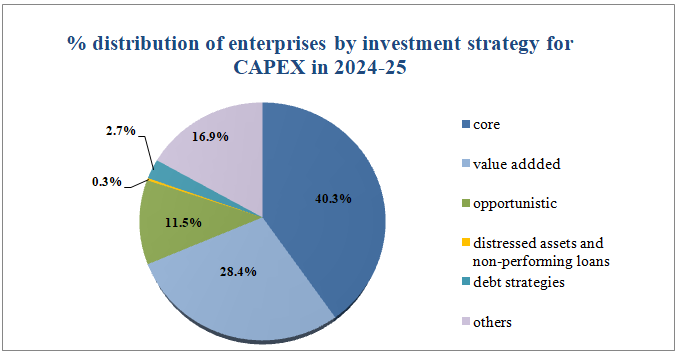
  • The strategy of 40.3% of enterprises is to undertake CAPEX on core assets during 2024–25, followed by 28.4% to invest in value addition to existing assets

Survey Background:

In 2022–23, the Parliamentary Standing Committee recommended that the Ministry of Statistics and Programme Implementation (MoSPI) develop a comprehensive methodology to capture capital expenditure (CAPEX) data from the private sector. Survey instruments designed to capture data on past investments, projected CAPEX for the next two years, and the breakdown of investments by asset type were developed in alignment with the specifications of the Department of Economic Affairs (DEA), Ministry of Finance.

Responding to this recommendation, the National Statistical Office (NSO) conducted the inaugural Forward-Looking Survey on Private Sector CAPEX Investment Intentions between November 2024 and January 2025. This marked the first initiative of MoSPI to engage the corporate sector through a self-administered, web-based survey platform, supported by chatbot assistance, to collect structured CAPEX data. MoSPI has released the findings of the survey in the form of a comprehensive booklet. A brief overview of key aspects, such as survey coverage, sampling methodology, and data collection process, is included in the Endnote.

The primary objective of the CAPEX survey is to estimate the CAPEX trends of private corporate sector enterprises from the past three financial years (2021-22, 2022-23 & 2023-24) along with anticipated capital expenditure for the current year (2024-25) and upcoming financial years (2025-26).

Key advantages of the Survey:

Capital expenditure (CAPEX) plays a crucial role in contributing to national investment and enhancing the stock of physical assets within the economy. It leads to the creation of long-term assets, which not only generate revenue for many years but also improve the overall operational efficiency of economic activities. CAPEX is fundamental to expanding production capacity, thereby serving as a catalyst for accelerated economic growth. This growth, in turn, supports job creation and enhances labour productivity.

Comprehensive data on CAPEX will be a valuable asset for a wide range of stakeholders, including government departments, private enterprises, trade associations, researchers, and other relevant entities. It will enable evidence-based policy formulation through the analysis of trends in future investments. Furthermore, a clear understanding of CAPEX patterns and scale can assist enterprises in making strategic, data-driven investment decisions, guided by the insights derived from survey findings.

Important Caveat:

In this inaugural edition of the survey, industry participation varied, with an overall response rate of 58.3% (58.6% in the census sector and 57.2% in the sample sector). Respondents appeared cautious in disclosing CAPEX plans, often pending management approvals. Certain entities, such as Special Purpose Vehicles (SPVs) involved in infrastructure projects, were excluded from the survey frame as they report no turnover despite high CAPEX. Meanwhile, some included SPVs had no future investment plans due to project completion. As this is the first round of the survey, the findings may be seen as indicative and subject to refinement in future iterations. It is also important to note that the results reflect responses from larger enterprises above specified turnover thresholds and may not represent the entire private corporate sector. Users are advised to interpret the results keeping these limitations in mind.

Insights and Way Forward for Future Survey Conduct

The Forward-Looking Survey on Private Sector Capex Investment Intentions, the first of its kind by the NSO, was conducted under the Collection of Statistics Act, 2008. Notices were issued to selected enterprises, explaining the survey's objectives and assuring confidentiality. However, some enterprises questioned the legitimacy of notices containing portal credentials, leading to multiple cyber risk concerns. Explaining portal usage and submission procedures over the phone was challenging. Data analysis revealed issues such as incorrect unit entries (e.g., Rupees instead of Rupees thousands) and non-responses to follow-up queries. Enterprises also faced difficulties in selecting correct NIC codes and estimating future investments when official data was unavailable.

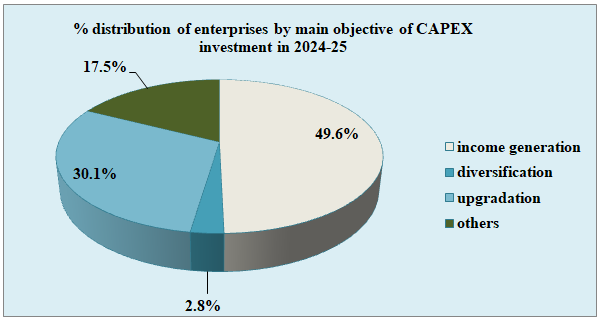
CAPEX tends to rise when enterprises pursue growth strategies rather than maintain current operations. Despite challenges like weak demand, geopolitical tensions, and high borrowing costs, about 30% of firms plan to invest in upgradation in 2024–25, supporting the sharp increase in CAPEX for that year. The slightly lower intended CAPEX for 2025–26, though still above 2023–24 levels, reflects cautious planning after a strong 2024–25. Overall, the trend indicates growing corporate confidence and a judicious approach to investment amid improving economic certainty.

While the response rate and results were generally promising, this initial round of the survey can be considered as an experimental phase, providing valuable insights to refine the questionnaire, methodology, estimation processes, and overall implementation. The lessons learned will guide improvements for future surveys, with necessary adjustments to various aspects of the survey process. Moving forward, responding enterprises will be engaged more proactively before the survey, with concerns about the authenticity of the online survey being addressed, assistance provided in understanding the questionnaire, confidentiality of individual responses ensured, and field personnel deployed to support enterprises in overcoming technical and conceptual challenges in completing future-oriented surveys. Additionally, the survey will incorporate qualitative inputs, such as reasons for year-on-year changes in investment, to gain deeper insights into enterprise-level CAPEX intentions and trends. The next round of the CAPEX survey is expected to be conducted during October to December 2025.

Key highlights from the CAPEX results:

Aggregated (Unweighted, i.e. without applying any multiplier) CAPEX during (2021-22 to 2025-26)

A total of 2,172 enterprises submitted complete information for all five years of the reference period, forming a fixed panel. The aggregated (unweighted) CAPEX data from this panel of enterprises serves as a reliable basis for analyzing capital expenditure trends over the five-year period, as presented below. The results show an overall increase of 66.3% in aggregate CAPEX (unweighted) over the four-year period from 2021-22 to 2024-25.:

                (in ₹ Crore)

Actual CAPEX in 2021-22

Actual CAPEX

2022-23

Actual CAPEX

2023-24

Intended CAPEX in

2024-25

Intended CAPEX

in 2025-26

394,681.5

572,199.7

422,183.3

656,492.7

488,865.5

Out of the 3,064 responding enterprises, 2,172 reported their Capex intentions for 2025–26. The data indicates a cautious approach by respondents in declaring their capital expenditure plans. Therefore, the Capex data for 2025–26 should be interpreted with caution, considering the conservative approach and apprehension shown by the responding enterprises in reporting these figures. However, the results show an overall increase of 23.9% in aggregate CAPEX (unweighted) during 2021-22 to 2025-26 for this fixed panel of 2,172 enterprises.

Estimated Key Indicators for past years (2021-22 to 2023-24) by Industry of Activity as per National Industry of Classification (Activity Categories)

The average Gross Fixed Asset (GFA) per enterprise in the private corporate sector was estimated at ₹3,151.9 crore in 2021–22. It increased by 4.0% to ₹3,279.4 crores in 2022–23, and further grew by 27.5% to reach ₹4,183.3 crore in 2023–24.

The highest GFA per enterprise, exceeding ₹14,000 crore, was observed in the industry category ‘Electricity, Gas, Steam, and Air Conditioning Supply’, followed by ‘Manufacturing” enterprises (₹7,000 crore to ₹10,000 crore). Enterprises principally engaged in manufacturing activities accounted for more than 65% of the total Gross fixed asset[1] in private corporate sector over the past three years from 2021-22 to 2023-24 followed by enterprises engaged in ‘Electricity, Gas, Steam, and Air Conditioning Supply’ (8%-10%).

In 2021–22, the estimated actual CAPEX per enterprise was ₹109.3 crore, compared to the proposed value of ₹102.7 crore, resulting in a realisation ratio of 106.41 %. A similar trend was observed in 2022–23, where the estimated value of actual CAPEX per enterprise reached ₹148.8 crore against a proposed value of ₹133.3 crore, also yielding a realisation ratio exceeding 100%. For 2023–24, the realisation ratio stands at 99.7%, with the estimated actual CAPEX per enterprise at ₹107.6 and the proposed CAPEX at ₹107.9.

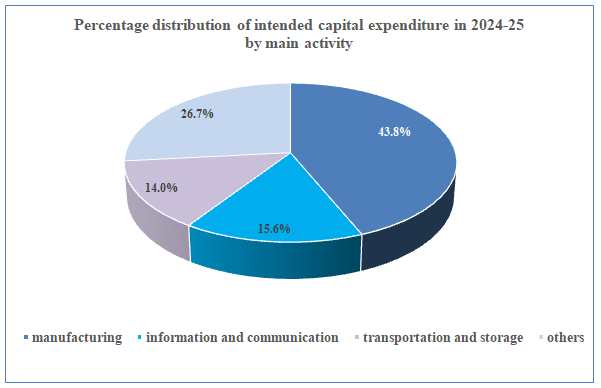
The estimated provisional capital expenditure per enterprise for acquiring new assets in 2024–25 stands at ₹172.2 crore. Among the sectors, manufacturing enterprises account for the largest share at 43.8%, followed by those in ‘Information and Communication Activities’ (15.6%) and ‘Transportation and Storage Activities’ (14.0%).
Estimated Key Indicators for 2023-24 by Asset Groups

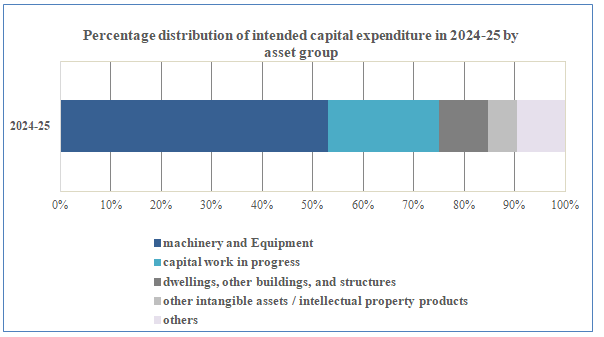
The estimated provisional capital expenditure per enterprise for acquiring new assets in 2024–25 stands at ₹172.2 crore. Out of the total capital expenditure provisionally incurred in the year 2024-25, nearly 53.1% were utilized for purchasing machinery & equipment. The amount allocated for ‘capital work in progress’ (22.0%) and purchasing ‘dwellings, other buildings and structures’ (9.7%) had the next highest share of allocation.
Strategy of CAPEX in 2024-25

According to survey estimates, nearly 40.3% of enterprises plan to undertake CAPEX on core assets during 2024–25. Additionally, 28.4% intend to invest in value addition to existing assets, while around 11.5% focus on opportunistic assets, and 2.7% on debt strategies. The strategy of investing in distressed assets and non-performing loans was adopted by less than one-half of a percent of enterprises. Meanwhile, about 16.9% allocated their CAPEX towards other diverse investment strategies.
Objectives of CAPEX in 2024-25

The survey estimates indicate that nearly 49.6% of private corporate sector enterprises undertook CAPEX in 2024–25 primarily for income generation. An additional 30.1% directed their investments toward upgradation, while around 2.8% focused on diversification. Remaining 17.5% of enterprises reported using their CAPEX for other reasons.
The results of CAPEX survey are provided in the booklet which is available in the website of the Ministry (https://www.mospi.gov.in). To protect the confidentiality of CAPEX investment plans of individual enterprises, the Steering Committee of NSS Surveys recommended that unit-level data of CAPEX survey would not be disseminated.

Endnote: A brief about the coverage, sampling scheme, sample size and data collection mechanism in the Forward-Looking Survey on Private Sector CAPEX Investment Intentions:

A. Coverage:

The survey covered large private corporate sector enterprises that play a significant role in their respective sectors. The sampling frame was madeusing data from active enterprises registered with the Ministry of Corporate Affairs (MCA), filtered based on annual turnover thresholds achieved in at least one of the last three financial years. The eligibility criteria were as follows:

  • Manufacturing enterprises with an annual turnover of ₹400 crore or more
  • Trade enterprises with an annual turnover of ₹300 crore or more
  • Other enterprises with an annual turnover of ₹100 crore or more

Based on these criteria, the final survey frame consisted of 16,025 enterprises.

B. Sampling Scheme:

Eligible enterprises were initially categorized into seventeen (17) strata based on their Principal Business Activity as reported in the MGT-7 Form of the Ministry of Corporate Affairs (MCA). In strata with 100 or fewer enterprises, all units were included in the Census Sector for complete enumeration.

For strata with more than 100 enterprises, the selection process involved identifying Census Sector Enterprises and Sample Sector Enterprises. To determine the Census Sector, enterprises were ranked in descending order based on (i) the highest fixed asset value in the past three years and (ii) the fixed asset value of latest reported year. The top enterprises accounting for 90% of asset value (or 80% for Construction and Trade) from either list were classified as Census Sector Enterprises. The remaining units formed the Sample Sector, from which 10% were randomly selected using Simple Random Sampling without Replacement (SRSWOR), with allocation proportional to each stratum’s size and variation.

C. Sample Size:

The sample size for the survey was of 5,380 enterprises: 4,145 enterprises in the Census Sector and 1,235 enterprises in sample sector.

DData Collection Mechanism:

The survey was conducted under the provisions of the Collection of Statistics Act, 2008, with prior notices sent to all selected enterprises outlining the survey’s objective and intended use of the data. Confidentiality of individual responses was strictly maintained, and no unit-level data would be disseminated. A secure, dedicated web portal was developed to enable selected enterprises to complete and submit the survey questionnaire online. The portal included background information on the survey, reasons for a unit’s selection, and chatbot support to assist respondents in understanding key concepts and definitions.

Topics

Acts Income Tax
