

Loading...

Top
Help
×

By creating an account you can:

Logo TaxTMI
Call Us / Help / Feedback

Contact Us At :

E-mail: [email protected]

Call / WhatsApp at: +91 99117 96707

For more information, Check Contact Us

FAQs :

To know Frequently Asked Questions, Check FAQs

Most Asked Video Tutorials :

For more tutorials, Check Video Tutorials

Submit Feedback/Suggestion :

Email :
Please provide your email address so we can follow up on your feedback.
Category :
Description :
Min 15 characters 0/2000
Make Most of Text Search
  1. Checkout this video tutorial: How to search effectively on TaxTMI.
  2. Put words in double quotes for exact word search, eg: "income tax"
  3. Avoid noise words such as : 'and, of, the, a'
  4. Sort by Relevance to get the most relevant document.
  5. Press Enter to add multiple terms/multiple phrases, and then click on Search to Search.
  6. Text Search
  7. The system will try to fetch results that contains ALL your words.
  8. Once you add keywords, you'll see a new 'Search In' filter that makes your results even more precise.
  9. Text Search
Add to...
You have not created any category. Kindly create one to bookmark this item!
Create New Category
Hide
Title :
Description :
❮❮ Hide
Default View
Expand ❯❯
Close ✕
🔎 News - Adv. Search
TEXT SEARCH:

Press 'Enter' to add multiple search terms. Rules for Better Search

Search In:
Main Text + AI Text
  • Main Text
  • Main Text + AI Text
  • AI Text
Category: ?
Categorized by AI
---- All Categories ----
  • ---- All Categories ----
  • Income Tax
  • GST
  • Customs, DGFT & SEZ
  • FEMA & RBI
  • Corp. Laws, SEBI & IBC
  • PMLA, Black Money & ED
  • Budget
  • News and Press Release
  • PTI News
Month:
---- All Months ----
  • ---- All Months ----
  • January
  • February
  • March
  • April
  • May
  • June
  • July
  • August
  • September
  • October
  • November
  • December
Year:
---- All Years ----
  • ---- All Years ----
  • 2026
  • 2025
  • 2024
  • 2023
  • 2022
  • 2021
  • 2020
  • 2019
  • 2018
  • 2017
  • 2016
  • 2015
  • 2014
  • 2013
  • 2012
  • 2011
Sort By: ?
In Sort By 'Default', exact matches for text search are shown at the top, followed by the remaining results in their regular order.
Relevance Default Date
    DRI seizes over 42 kg foreign-origin gold worth more than RS. 65 crore in crackdown on gold smuggling
    MoSPI signs MoU with Thapar Institute of Engineering & Technology, Punjab for undertaking a Research Study
    NCLT forms historic 5-member bench to decide on Subhash Chandra's Rs 6.5 cr repayment plan
    NCLT fails to arrive majority decision on Subhash Chandra's Rs 6.5 cr repayment plan
    Rupee rises 21 paise to close at 95.22 against US dollar
    Record 7.5 cr ITRs filed for AY'27, deadline ends midnight tonight
    Monthly Review of Accounts of Union Government of India upto the month of July 2026 (FY 2026-27)
    Subhash Chandra drops mention of Ambani allegations, shifts focus to settling Essel debt
    NATIONAL ACCOUNTS STATISTICS - 2026 PUBLICATION
    Commerce Secretary Shri Rajesh Agrawal Co-Chairs India-Brazil 8th Trade Monitoring Mechanism Meeting
    NPCI International and Uzbekistan’s NIPC Partner to Enable UPI Payments Across Uzbekistan via UZQR
    Flymore Aviation Expands Access to Aviation Education Through Affordable Mobile Learning App
    Rajnath to review performances of 16 defence PSUs with focus on indigenous tech, innovation
    SC dismisses SBI's plea challenging NCLAT order on PF, gratuity dues to ex-Jet Airways staffers
    Rupee rises 26 paise to close at 95.17 against US dollar
    India Has Solved Financial Access. Has It Solved Financial Confidence?
    Hyundai Capital Officially Launches Financial Services Operations in India
    Pinarayi Vijayan slams NCLT order on Subhash Chandra repayment plan
    Rupee falls 13 paise to 95.56 against US dollar in early trade
    CBN seizes 66.80 lakh psychotropic tablets in major inter-state pharmaceutical diversion case under Operation Vajra 2.0; one arrested
❯❯
Maximize Maximize Maximize
0 / 200
Expand Note
Add to Folder

No Folders have been created

+

Are you sure you want to delete "My most important" ?

NOTE:

News
Showing Results for :
Reset Filters
Results Found:
Show All Summaries Hide All Summaries
September 1, 2026
Show AI Summary
Gold smuggling enforcement targets transit abuse, concealed carriage, and border routes through coordinated seizures and arrests nationwide.
Intelligence-led enforcement against organised gold smuggling resulted in the seizure of over 42 kg of foreign-origin gold and around 10 kg of foreign-origin silver, collectively valued at more than Rs. 65 crore, and the arrest of 25 persons. Operations targeted networks using airport transit routes, airport personnel, land-border corridors, coastal routes, and domestic road transport. Gold was concealed in wax, compound, paste, raw-chain and bar forms, including through body concealment, internally secreted capsules, clothing, and specially created cavities.
September 1, 2026
Show AI Summary
Predictive consumption-expenditure framework will use household survey data to support poverty estimation, consumption analysis, and economic planning.
MoSPI and Thapar Institute of Engineering & Technology have entered into a memorandum of understanding for a research study to develop a predictive and analytical framework for monthly consumption expenditure in India. The study will use Household Consumption Expenditure Survey data to estimate Monthly Per Capita Consumption Expenditure at national and state levels, analyse household consumption patterns, and generate evidence relevant to poverty estimation and broader economic planning.
August 31, 2026
Show AI Summary
Personal insolvency repayment plans: conflicting views on binding dissenting creditors prompted reconsideration through an expanded adjudicatory bench.
National Company Law Tribunal constituted a five-member bench after conflicting views on a personal insolvency repayment plan left no majority position for a formal order. The central issue is whether creditor approval of the plan binds dissenting creditors and extinguishes their claims against the personal guarantor. One view preserved dissenting creditors' independent recovery rights, while another applied the creditor-approved plan uniformly to all creditors. Disagreement also concerns the Adjudicating Authority's power to examine the resolution professional's report of the creditors' meeting.
August 31, 2026
Show AI Summary
Personal insolvency repayment plans raise unresolved questions on dissenting creditors' rights and uniform extinguishment of claims.
Personal insolvency proceedings were referred for fresh adjudication because no majority emerged on the repayment plan. The Technical Member rejected the plan; the Judicial Member confined it to consenting creditors while preserving dissentents' recovery rights; and the Third Member approved it with uniform extinguishment of all creditors' claims. The dispute concerns whether creditor approval under section 115(1) binds dissenting creditors, the effect of section 79(2)(g), and the Adjudicating Authority's power to examine the Resolution Professional's creditors' meeting report.
August 31, 2026
Show AI Summary
Rupee exchange-rate support through suspected intervention and FCNR(B) inflows offset pressure from dollar strength and higher crude prices.
Rupee exchange-rate movement reflected a recovery from early losses to close stronger against the US dollar, amid market expectations of Reserve Bank of India support at lower trading levels. Pressure arose from higher US Treasury yields, possible US rate-hike expectations and a broad dollar rally. Suspected intervention, FCNR(B)-related foreign-currency flows and the special USD-INR forex swap facility supported sentiment, while rising crude prices, geopolitical supply risks and foreign institutional equity outflows remained adverse factors.
August 31, 2026
Show AI Summary
Income-tax return filing for non-audit business and professional taxpayers closes at midnight, requiring use of applicable forms.
Income-tax return filing for Assessment Year 2026-27 reaches its due date on 31 August 2026 for taxpayers having business or professional income who are not subject to audit. Such taxpayers may file the applicable ITR-3, ITR-4, ITR-5 or ITR-7. ITR-3 applies to individuals and Hindu Undivided Families with proprietary business or professional income, ITR-4 to small and medium taxpayers, and ITR-5 to firms, limited liability partnerships and cooperative societies.
August 31, 2026
Show AI Summary
Monthly fiscal accounts track receipt composition, expenditure allocation, tax devolution, interest payments, and major subsidy outgo through July.
Union Government monthly accounts through July 2026 record total receipts comprising net tax revenue, non-tax revenue and non-debt capital receipts, with tax devolution transferred to State Governments. Total expenditure is divided between revenue and capital expenditure. Revenue expenditure includes interest payments and major subsidies.
August 31, 2026
Show AI Summary
Personal guarantor insolvency distinguishes guarantee liability from borrower debt while creditor voting challenges question repayment-plan approval.
Personal insolvency proceedings concerning personal guarantees distinguish a guarantor's liability from the underlying borrowing entities' debts. Claims against the guarantor arise from guarantees furnished for loans obtained by Essel Group-associated entities, while the borrowers' repayment obligations remain enforceable and creditors may pursue corporate assets and securities. Dissenting lenders have challenged the resolution-plan voting process, alleging that family-linked associates or related parties should have been excluded from committee of creditors voting.
August 31, 2026
Show AI Summary
National accounts revisions align GDP and sectoral estimates with updated price, production and banking service indicators.
National Accounts Statistics-2026 incorporates updated Producer Price Index, Index of Industrial Production and Banking Services Price Index series with base year 2022-23 into annual and quarterly GDP estimates. The revised indicators expand coverage, update weights and improve price mapping for national-account activities. GDP and gross value added estimates from 2022-23 onwards are revised at current and constant prices, with sector-specific effects in mining and quarrying, manufacturing, trade services, general government and departmental enterprises. Supply and Use Tables for 2022-23 and 2023-24 are also updated.
August 31, 2026
Show AI Summary
Trade facilitation and pharmaceutical market access advance through regulatory cooperation, preferential trade modernisation, and reciprocal agricultural access.
India and Brazil are advancing bilateral trade, investment and economic cooperation through a diversified partnership focused on pharmaceuticals, chemicals, engineering goods and machinery. India-MERCOSUR engagement is being pursued through early finalisation of Terms of Reference for expansion and modernisation of the Preferential Trade Agreement. Pharmaceutical market access is supported by regulatory cooperation under the CDSCO-ANVISA MoU. Agricultural trade facilitation includes phytosanitary processes, reciprocal market access work and mutual recognition of Electronic Certificates of Origin, alongside multilateral coordination through BRICS, the G20 and the WTO.
August 31, 2026
Show AI Summary
Cross-border UPI merchant acceptance enables Indian travellers to make UZQR payments at merchants throughout Uzbekistan.
Cross-border UPI merchant acceptance in Uzbekistan allows Indian travellers to make instant person-to-merchant payments through UPI-enabled applications by scanning the interoperable UZQR code. Integration with the Unified National QR infrastructure extends acceptance across retail, hospitality and service merchants. Regulatory approvals support HUMO's role as NIPL's authorised partner for cross-border merchant acceptance, reducing reliance on international cards and cash.
August 31, 2026
Show AI Summary
Mobile-first aviation education supports accessible, self-paced certification-led learning and career awareness across aviation roles and geographic locations.
Flymore Aviation LLP operates a mobile-first aviation learning platform intended to make specialised aviation education more accessible and affordable for aspiring pilots, cabin crew and other aviation-sector professionals. The app provides structured, self-paced aviation courses aimed at building industry knowledge, supporting certification-led skill development, improving career awareness and assisting employment readiness across aviation functions. Course delivery through a digital platform is positioned as an alternative to location-dependent and high-cost classroom training.
August 31, 2026
Show AI Summary
Indigenous defence technology and exports anchor the annual performance review of public sector defence enterprises.
Annual performance review of 16 Defence Public Sector Undertakings is scheduled with emphasis on indigenous technology, innovation, self-reliance and enhancement of defence exports. Chairpersons and managing directors of seven specified undertakings will present dividends attributable to the Government's equity shareholding. Publications cover self-reliance, student awareness of defence technologies, and modernisation and indigenisation roadmaps. Reported performance includes growth in turnover, profit after tax and defence exports.
August 31, 2026
Show AI Summary
Employee provident fund and gratuity dues remain protected outside the liquidation estate despite competing financial creditor claims in insolvency proceedings.
Employee provident fund and gratuity dues of former Jet Airways workmen and employees were required to be paid in full by the liquidator. The NCLAT position upheld treats statutory employee dues relating to provident fund, gratuity and pension funds as outside the liquidation estate, protecting them from competing creditor claims. Financial creditors had argued that such dues should be distributed through the liquidation estate unless dedicated funds existed at the commencement of liquidation. The underlying questions of law remain open for an appropriate case.
August 31, 2026
Show AI Summary
Rupee exchange-rate support amid dollar strength and oil risks as foreign-currency deposit flows bolster market sentiment.
Foreign-exchange market conditions saw the rupee recover from early losses amid possible Reserve Bank of India intervention to contain significant depreciation. Higher US Treasury yields, a broader dollar rally, rising crude oil prices and geopolitical supply risks pressured the currency. The special USD-INR forex swap facility for FCNR(B) deposits, Overseas Foreign Currency Borrowings and External Commercial Borrowings mobilised foreign-exchange inflows supported by non-resident Indian participation, strengthening market sentiment.
August 31, 2026
Show AI Summary
Financial confidence gaps persist when opaque financial journeys, dark patterns and unclear communication deter informed consumer participation.
Financial-service digitisation may expand access without ensuring consumer confidence where customers cannot understand processes, assess risks or feel secure in financial decisions. Opaque claims, redemptions, eligibility criteria and approval stages can weaken trust and discourage insurance, investment and credit participation. Hidden charges, complex documentation, forced bundling and target-driven sales practices may further impair informed choice. Greater transparency, simplified communications, real-time process visibility and AI-assisted guidance are identified as measures to reduce cognitive friction and strengthen consumer control.
August 31, 2026
Show AI Summary
NBFC licensing enables Hyundai Capital India to begin wholesale dealer financing while preparing retail finance and risk-management infrastructure.
Hyundai Capital India has commenced financial services operations after obtaining a non-banking financial company licence from the Reserve Bank of India. Initial operations concentrate on wholesale financing for local automotive dealers. Operations are intended to expand the dealer-financing network, sales infrastructure and risk-management systems across India, supporting a subsequent phased introduction of retail financing for individual customers.
August 31, 2026
Show AI Summary
Personal insolvency resolution approval faces criticism over low creditor recovery and alleged family-linked voting influence in the resolution process.
Personal insolvency resolution approval concerning Subhash Chandra involved a repayment plan of Rs 6.5 crore against admitted creditor claims exceeding Rs 22,000 crore. Objections were raised regarding the voting influence exercised by entities linked to the debtor's family in relation to the resolution process. Pinarayi Vijayan criticised the approval, alleging preferential treatment of powerful corporate interests.
August 31, 2026
Show AI Summary
Foreign exchange market intervention seeks to limit rupee depreciation amid oil-price pressure, dollar strength, and capital outflows.
Foreign exchange market conditions put the rupee under depreciation pressure amid higher crude oil prices, geopolitical risks, stronger US dollar conditions, expectations of tighter US monetary policy and foreign equity outflows. RBI market intervention was reported to contain significant depreciation. Improved foreign-currency non-resident bank deposit flows and higher foreign exchange reserves supported investor sentiment and the external liquidity position.
August 31, 2026
Show AI Summary
Psychotropic medicine diversion faces NDPS enforcement where controlled tablets allegedly travel without statutory documentation and traceability details.
Enforcement action under the Narcotic Drugs and Psychotropic Substances Act, 1985 addressed alleged inter-State diversion of psychotropic medicines transported without statutory documentation. A truck carrying Alprazolam, Tramadol, Nitrazepam and Clonazepam tablets was intercepted; the medicines and vehicle were seized and one suspect was arrested. Preliminary examination indicated erasure of identifying batch and date details and transport of region-restricted medicines without invoices, bilty or e-way bills. Investigation concerns the manufacturing, supply and distribution network involved.

News

Back

All News

Showing Results for :
Reset Filters
No Records Found

News

Showing Results for : Reset Filters

Findings of the Forward-Looking Survey on Private Sector CAPEX Investment Intentions (Survey period: November 2024 to January 2025)

April 30, 2025

Contents
Summary
Note

Note

-

Bookmark

Print

Print

Private Corporate Sector CAPEX: Three-Year Trends and Future Outlook:

Key findings:

  • The average Gross Fixed Assets per enterprise in the private corporate sector increased from ₹3,151.9 crore in 2021–22 to ₹3,279.4 crore in 2022–23 (4% growth), and further to ₹4,183.3 crore in 2023–24, reflecting a significant 27.5% growth.
  • The estimated CAPEX per enterprise for the years 2021–22, 2022–23, and 2023–24 was ₹109.2 crore, ₹148.8 crore and ₹107.6 crore respectively.
  • The estimated provisional capital expenditure per enterprise for purchasing new assets in 2024–25 is ₹172.2 crore.
  • Overall increase of 66.3% in aggregate CAPEX (unweighted) over the four-year period from 2021-22 to 2024-25.
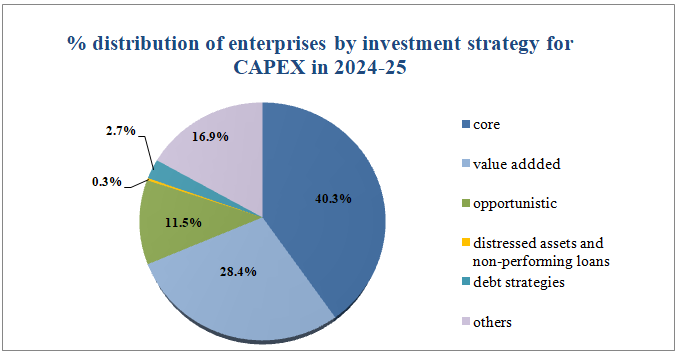
  • The strategy of 40.3% of enterprises is to undertake CAPEX on core assets during 2024–25, followed by 28.4% to invest in value addition to existing assets

Survey Background:

In 2022–23, the Parliamentary Standing Committee recommended that the Ministry of Statistics and Programme Implementation (MoSPI) develop a comprehensive methodology to capture capital expenditure (CAPEX) data from the private sector. Survey instruments designed to capture data on past investments, projected CAPEX for the next two years, and the breakdown of investments by asset type were developed in alignment with the specifications of the Department of Economic Affairs (DEA), Ministry of Finance.

Responding to this recommendation, the National Statistical Office (NSO) conducted the inaugural Forward-Looking Survey on Private Sector CAPEX Investment Intentions between November 2024 and January 2025. This marked the first initiative of MoSPI to engage the corporate sector through a self-administered, web-based survey platform, supported by chatbot assistance, to collect structured CAPEX data. MoSPI has released the findings of the survey in the form of a comprehensive booklet. A brief overview of key aspects, such as survey coverage, sampling methodology, and data collection process, is included in the Endnote.

The primary objective of the CAPEX survey is to estimate the CAPEX trends of private corporate sector enterprises from the past three financial years (2021-22, 2022-23 & 2023-24) along with anticipated capital expenditure for the current year (2024-25) and upcoming financial years (2025-26).

Key advantages of the Survey:

Capital expenditure (CAPEX) plays a crucial role in contributing to national investment and enhancing the stock of physical assets within the economy. It leads to the creation of long-term assets, which not only generate revenue for many years but also improve the overall operational efficiency of economic activities. CAPEX is fundamental to expanding production capacity, thereby serving as a catalyst for accelerated economic growth. This growth, in turn, supports job creation and enhances labour productivity.

Comprehensive data on CAPEX will be a valuable asset for a wide range of stakeholders, including government departments, private enterprises, trade associations, researchers, and other relevant entities. It will enable evidence-based policy formulation through the analysis of trends in future investments. Furthermore, a clear understanding of CAPEX patterns and scale can assist enterprises in making strategic, data-driven investment decisions, guided by the insights derived from survey findings.

Important Caveat:

In this inaugural edition of the survey, industry participation varied, with an overall response rate of 58.3% (58.6% in the census sector and 57.2% in the sample sector). Respondents appeared cautious in disclosing CAPEX plans, often pending management approvals. Certain entities, such as Special Purpose Vehicles (SPVs) involved in infrastructure projects, were excluded from the survey frame as they report no turnover despite high CAPEX. Meanwhile, some included SPVs had no future investment plans due to project completion. As this is the first round of the survey, the findings may be seen as indicative and subject to refinement in future iterations. It is also important to note that the results reflect responses from larger enterprises above specified turnover thresholds and may not represent the entire private corporate sector. Users are advised to interpret the results keeping these limitations in mind.

Insights and Way Forward for Future Survey Conduct

The Forward-Looking Survey on Private Sector Capex Investment Intentions, the first of its kind by the NSO, was conducted under the Collection of Statistics Act, 2008. Notices were issued to selected enterprises, explaining the survey's objectives and assuring confidentiality. However, some enterprises questioned the legitimacy of notices containing portal credentials, leading to multiple cyber risk concerns. Explaining portal usage and submission procedures over the phone was challenging. Data analysis revealed issues such as incorrect unit entries (e.g., Rupees instead of Rupees thousands) and non-responses to follow-up queries. Enterprises also faced difficulties in selecting correct NIC codes and estimating future investments when official data was unavailable.

CAPEX tends to rise when enterprises pursue growth strategies rather than maintain current operations. Despite challenges like weak demand, geopolitical tensions, and high borrowing costs, about 30% of firms plan to invest in upgradation in 2024–25, supporting the sharp increase in CAPEX for that year. The slightly lower intended CAPEX for 2025–26, though still above 2023–24 levels, reflects cautious planning after a strong 2024–25. Overall, the trend indicates growing corporate confidence and a judicious approach to investment amid improving economic certainty.

While the response rate and results were generally promising, this initial round of the survey can be considered as an experimental phase, providing valuable insights to refine the questionnaire, methodology, estimation processes, and overall implementation. The lessons learned will guide improvements for future surveys, with necessary adjustments to various aspects of the survey process. Moving forward, responding enterprises will be engaged more proactively before the survey, with concerns about the authenticity of the online survey being addressed, assistance provided in understanding the questionnaire, confidentiality of individual responses ensured, and field personnel deployed to support enterprises in overcoming technical and conceptual challenges in completing future-oriented surveys. Additionally, the survey will incorporate qualitative inputs, such as reasons for year-on-year changes in investment, to gain deeper insights into enterprise-level CAPEX intentions and trends. The next round of the CAPEX survey is expected to be conducted during October to December 2025.

Key highlights from the CAPEX results:

Aggregated (Unweighted, i.e. without applying any multiplier) CAPEX during (2021-22 to 2025-26)

A total of 2,172 enterprises submitted complete information for all five years of the reference period, forming a fixed panel. The aggregated (unweighted) CAPEX data from this panel of enterprises serves as a reliable basis for analyzing capital expenditure trends over the five-year period, as presented below. The results show an overall increase of 66.3% in aggregate CAPEX (unweighted) over the four-year period from 2021-22 to 2024-25.:

                (in ₹ Crore)

Actual CAPEX in 2021-22

Actual CAPEX

2022-23

Actual CAPEX

2023-24

Intended CAPEX in

2024-25

Intended CAPEX

in 2025-26

394,681.5

572,199.7

422,183.3

656,492.7

488,865.5

Out of the 3,064 responding enterprises, 2,172 reported their Capex intentions for 2025–26. The data indicates a cautious approach by respondents in declaring their capital expenditure plans. Therefore, the Capex data for 2025–26 should be interpreted with caution, considering the conservative approach and apprehension shown by the responding enterprises in reporting these figures. However, the results show an overall increase of 23.9% in aggregate CAPEX (unweighted) during 2021-22 to 2025-26 for this fixed panel of 2,172 enterprises.

Estimated Key Indicators for past years (2021-22 to 2023-24) by Industry of Activity as per National Industry of Classification (Activity Categories)

The average Gross Fixed Asset (GFA) per enterprise in the private corporate sector was estimated at ₹3,151.9 crore in 2021–22. It increased by 4.0% to ₹3,279.4 crores in 2022–23, and further grew by 27.5% to reach ₹4,183.3 crore in 2023–24.

The highest GFA per enterprise, exceeding ₹14,000 crore, was observed in the industry category ‘Electricity, Gas, Steam, and Air Conditioning Supply’, followed by ‘Manufacturing” enterprises (₹7,000 crore to ₹10,000 crore). Enterprises principally engaged in manufacturing activities accounted for more than 65% of the total Gross fixed asset[1] in private corporate sector over the past three years from 2021-22 to 2023-24 followed by enterprises engaged in ‘Electricity, Gas, Steam, and Air Conditioning Supply’ (8%-10%).

In 2021–22, the estimated actual CAPEX per enterprise was ₹109.3 crore, compared to the proposed value of ₹102.7 crore, resulting in a realisation ratio of 106.41 %. A similar trend was observed in 2022–23, where the estimated value of actual CAPEX per enterprise reached ₹148.8 crore against a proposed value of ₹133.3 crore, also yielding a realisation ratio exceeding 100%. For 2023–24, the realisation ratio stands at 99.7%, with the estimated actual CAPEX per enterprise at ₹107.6 and the proposed CAPEX at ₹107.9.

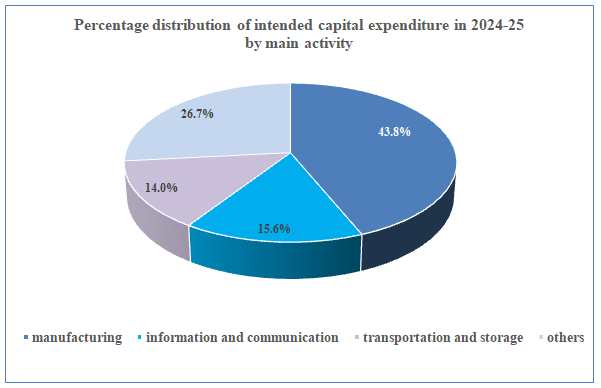
The estimated provisional capital expenditure per enterprise for acquiring new assets in 2024–25 stands at ₹172.2 crore. Among the sectors, manufacturing enterprises account for the largest share at 43.8%, followed by those in ‘Information and Communication Activities’ (15.6%) and ‘Transportation and Storage Activities’ (14.0%).
Estimated Key Indicators for 2023-24 by Asset Groups

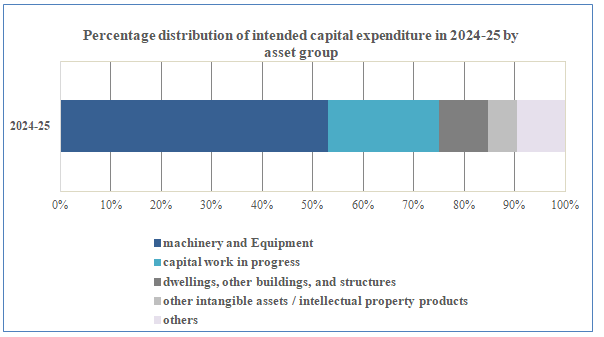
The estimated provisional capital expenditure per enterprise for acquiring new assets in 2024–25 stands at ₹172.2 crore. Out of the total capital expenditure provisionally incurred in the year 2024-25, nearly 53.1% were utilized for purchasing machinery & equipment. The amount allocated for ‘capital work in progress’ (22.0%) and purchasing ‘dwellings, other buildings and structures’ (9.7%) had the next highest share of allocation.
Strategy of CAPEX in 2024-25

According to survey estimates, nearly 40.3% of enterprises plan to undertake CAPEX on core assets during 2024–25. Additionally, 28.4% intend to invest in value addition to existing assets, while around 11.5% focus on opportunistic assets, and 2.7% on debt strategies. The strategy of investing in distressed assets and non-performing loans was adopted by less than one-half of a percent of enterprises. Meanwhile, about 16.9% allocated their CAPEX towards other diverse investment strategies.
Objectives of CAPEX in 2024-25

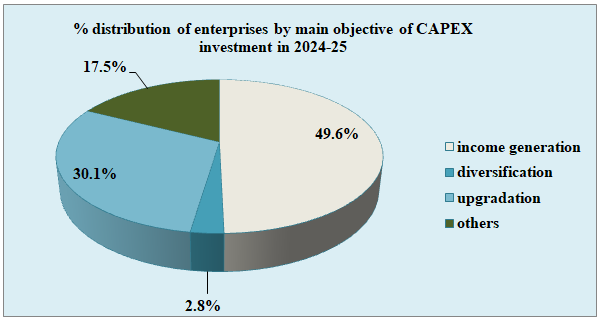
The survey estimates indicate that nearly 49.6% of private corporate sector enterprises undertook CAPEX in 2024–25 primarily for income generation. An additional 30.1% directed their investments toward upgradation, while around 2.8% focused on diversification. Remaining 17.5% of enterprises reported using their CAPEX for other reasons.
The results of CAPEX survey are provided in the booklet which is available in the website of the Ministry (https://www.mospi.gov.in). To protect the confidentiality of CAPEX investment plans of individual enterprises, the Steering Committee of NSS Surveys recommended that unit-level data of CAPEX survey would not be disseminated.

Endnote: A brief about the coverage, sampling scheme, sample size and data collection mechanism in the Forward-Looking Survey on Private Sector CAPEX Investment Intentions:

A. Coverage:

The survey covered large private corporate sector enterprises that play a significant role in their respective sectors. The sampling frame was madeusing data from active enterprises registered with the Ministry of Corporate Affairs (MCA), filtered based on annual turnover thresholds achieved in at least one of the last three financial years. The eligibility criteria were as follows:

  • Manufacturing enterprises with an annual turnover of ₹400 crore or more
  • Trade enterprises with an annual turnover of ₹300 crore or more
  • Other enterprises with an annual turnover of ₹100 crore or more

Based on these criteria, the final survey frame consisted of 16,025 enterprises.

B. Sampling Scheme:

Eligible enterprises were initially categorized into seventeen (17) strata based on their Principal Business Activity as reported in the MGT-7 Form of the Ministry of Corporate Affairs (MCA). In strata with 100 or fewer enterprises, all units were included in the Census Sector for complete enumeration.

For strata with more than 100 enterprises, the selection process involved identifying Census Sector Enterprises and Sample Sector Enterprises. To determine the Census Sector, enterprises were ranked in descending order based on (i) the highest fixed asset value in the past three years and (ii) the fixed asset value of latest reported year. The top enterprises accounting for 90% of asset value (or 80% for Construction and Trade) from either list were classified as Census Sector Enterprises. The remaining units formed the Sample Sector, from which 10% were randomly selected using Simple Random Sampling without Replacement (SRSWOR), with allocation proportional to each stratum’s size and variation.

C. Sample Size:

The sample size for the survey was of 5,380 enterprises: 4,145 enterprises in the Census Sector and 1,235 enterprises in sample sector.

DData Collection Mechanism:

The survey was conducted under the provisions of the Collection of Statistics Act, 2008, with prior notices sent to all selected enterprises outlining the survey’s objective and intended use of the data. Confidentiality of individual responses was strictly maintained, and no unit-level data would be disseminated. A secure, dedicated web portal was developed to enable selected enterprises to complete and submit the survey questionnaire online. The portal included background information on the survey, reasons for a unit’s selection, and chatbot support to assist respondents in understanding key concepts and definitions.

Topics

Acts Income Tax
