

Loading...

Top
Help
×

By creating an account you can:

Logo TaxTMI
Call Us / Help / Feedback

Contact Us At :

E-mail: [email protected]

Call / WhatsApp at: +91 99117 96707

For more information, Check Contact Us

FAQs :

To know Frequently Asked Questions, Check FAQs

Most Asked Video Tutorials :

For more tutorials, Check Video Tutorials

Submit Feedback/Suggestion :

Email :
Please provide your email address so we can follow up on your feedback.
Category :
Description :
Min 15 characters 0/2000
Make Most of Text Search
  1. Checkout this video tutorial: How to search effectively on TaxTMI.
  2. Put words in double quotes for exact word search, eg: "income tax"
  3. Avoid noise words such as : 'and, of, the, a'
  4. Sort by Relevance to get the most relevant document.
  5. Press Enter to add multiple terms/multiple phrases, and then click on Search to Search.
  6. Text Search
  7. The system will try to fetch results that contains ALL your words.
  8. Once you add keywords, you'll see a new 'Search In' filter that makes your results even more precise.
  9. Text Search
Add to...
You have not created any category. Kindly create one to bookmark this item!
Create New Category
Hide
Title :
Description :
❮❮ Hide
Default View
Expand ❯❯
Close ✕
🔎 News - Adv. Search
TEXT SEARCH:

Press 'Enter' to add multiple search terms. Rules for Better Search

Search In:
Main Text + AI Text
  • Main Text
  • Main Text + AI Text
  • AI Text
Category: ?
Categorized by AI
---- All Categories ----
  • ---- All Categories ----
  • Income Tax
  • GST
  • Customs, DGFT & SEZ
  • FEMA & RBI
  • Corp. Laws, SEBI & IBC
  • PMLA, Black Money & ED
  • Budget
  • News and Press Release
  • PTI News
Month:
---- All Months ----
  • ---- All Months ----
  • January
  • February
  • March
  • April
  • May
  • June
  • July
  • August
  • September
  • October
  • November
  • December
Year:
---- All Years ----
  • ---- All Years ----
  • 2026
  • 2025
  • 2024
  • 2023
  • 2022
  • 2021
  • 2020
  • 2019
  • 2018
  • 2017
  • 2016
  • 2015
  • 2014
  • 2013
  • 2012
  • 2011
Sort By: ?
In Sort By 'Default', exact matches for text search are shown at the top, followed by the remaining results in their regular order.
Relevance Default Date
    Rupee rises 22 paise to close at 94.51 against US dollar
    Electrifying India's vehicles can cut its import bill by USD 125 billion by 2050: Study
    Loans to go beyond SHGs, women to get access to credit to expand livelihoods: Union minister Chouhan
    MIDC's role not just selling plots, but creation of conducive environment for development: CEO
    Decentro Wins Three Industry Honours for Fintech Infrastructure Innovation and Leadership in 2026
    Marching ahead with Responsibility and Growth - Keynote Address[Contributions by RBI colleague Shri Mohammed Majidullah, General Manager] delivered by...
    CCI directs Trustees’ Association of India, IDBI Trusteeship Services Ltd, Axis Trustee Services and SBI CAP Trustee Company to cease and desist fro...
    The Digital Textile Printer Revolution: How Konica Minolta NASSENGER is Preparing India for the Next Global Textile Opportunity
    Union minister Goyal hails 7.8 pc GDP growth; lauds Modi, takes dig at Oppn
    SC disposes of SEBI's pleas against NSE after Rs 1500-crore settlement
    India-US trade pact to be finalised once US offers preferential rate: Goyal
    Business Nextgen Finance Raises Rs 215 Crore in Equity to Accelerate MSME Lending
    Drugs: ED raids in 4 states; over 2 dozen offenders, foreign links under scanner
    Razorpay Launches a Conversational AI Account Manager 'RAY' on WhatsApp For Businesses, in Partnership with IndusInd Bank
    AssetPlus Launches Portfolio Management Services to Help MFD Partners Grow and Retain High-Net-Worth Clients
    APEDA Facilitates Flag-Off of 18 MT of NPOP-Certified Ethnic Rice from Tripura for Export to Austria and the Netherlands
    VR LIVIN’s ‘THE FIRST’ Records Sale of 20 Villas Within Two Days of Launch
    IAAPI Calls for GST Rationalisation to Support Growth and Consumer Demand in India’s Amusement Industry
    ED raids multiple locations in Keralam in hybrid ganja smuggling money laundering case
    Rupee jumps 47 paise to 94.26 against US dollar in early trade
❯❯
Maximize Maximize Maximize
0 / 200
Expand Note
Add to Folder

No Folders have been created

+

Are you sure you want to delete "My most important" ?

NOTE:

News
Showing Results for :
Reset Filters
Results Found:
Show All Summaries Hide All Summaries
September 3, 2026
Show AI Summary
FCNR(B) deposits strengthen foreign-exchange liquidity and support rupee appreciation alongside foreign portfolio inflows into government securities.
Foreign-currency inflows through FCNR(B) deposits, overseas foreign-currency borrowings and external commercial borrowings strengthened foreign-exchange liquidity and supported appreciation of the rupee against the US dollar. Foreign portfolio investment in government securities was linked to the abolition of withholding tax and long-term capital gains tax on such investment. Currency-market conditions were also influenced by foreign institutional equity purchases, global risk appetite, crude-oil prices and geopolitical tensions.
September 3, 2026
Show AI Summary
Electric vehicle adoption can reduce transport import dependence while domestic battery manufacturing increases projected long-term savings.
Electric-vehicle adoption across road-transport segments is projected to reduce dependence on imported petrol and diesel, notwithstanding continuing battery imports. Accelerated electrification could reduce vehicle-related import expenditure substantially by 2050 because reduced oil imports are expected to exceed battery-import costs. Domestic cell-manufacturing capacity may further increase savings by combining rapid vehicle electrification with battery localisation.
September 3, 2026
Show AI Summary
Women's livelihood credit access will extend beyond self-help groups through standardised loan formalities and coordinated banking support.
Women's access to credit for livelihood expansion is to extend beyond Self-Help Groups to individual women members. Loan accessibility concerns include distance from bank branches, repeated visits to complete formalities, and inconsistent banking procedures. Regular State Rural Livelihood Mission meetings, bank participation, training, helplines, process improvements and coordination with bankers are intended to reduce barriers. Loan formalities are to be standardised across banks through a uniform process involving RBI and NABARD.
September 3, 2026
Show AI Summary
Industrial development facilitation prioritises infrastructure, services, policy utilisation, and dry-port trade connectivity for businesses and agro-based farmers.
Industrial development facilitation extends beyond allocation of industrial plots to infrastructure development, services, and a favourable business environment. Industry-support policies seek to encourage participation by entrepreneurs, promote growth across sectors, and improve investment conditions without distinction between small and large enterprises. Dry-port infrastructure strengthens national and international trade connectivity, supporting import and export expansion for industrial and agro-based businesses.
September 3, 2026
Show AI Summary
Regulated fintech infrastructure recognition highlights integrated payment, identity and collections capabilities across embedded financial product delivery.
Decentro operates an integrated fintech infrastructure platform combining payment acceptance, identity verification, banking and AI-led collections through a unified integration layer. It holds Payment Aggregator authorisations for online and physical payments, a Payment Service Provider licence through its GIFT City entity, and certification for offline identity-verification workflows. These capabilities support embedded financial products, payment acceptance, lending collections and related financial workflows for enterprise users.
September 3, 2026
Show AI Summary
Responsible NBFC and HFC growth requires technology-enabled inclusion, proportionate regulation, sound governance, liquidity discipline, customer protection and cyber resilience.
NBFCs and HFCs can complement bank-led credit delivery through last-mile reach, sector-specific expertise, digital infrastructure, consent-based data sharing and cash-flow-based underwriting. Sustainable growth requires strong liquidity risk management, governance, compliance culture, diversified funding, stress testing, early-warning systems, dynamic provisioning and sound underwriting standards. Proportionate scale-based regulation, digital lending standards and a substance-over-form approach seek to support innovation while preserving financial stability. Customer protection, responsible lending, grievance redressal, fair recovery conduct, cyber resilience and protection of customer data remain essential.
September 3, 2026
Show AI Summary
Debenture trusteeship fee fixing constitutes cartelisation by constraining independent pricing and restricting service availability in the market.
Collective minimum-fee fixing for debenture trusteeship services prevented trustees from making independent commercial pricing decisions and constituted cartelisation. Prescription of a benchmark fee limited and controlled the supply or market for such services by directing association members and non-members not to serve debenture issuers below that fee. The conduct contravened Section 3(3)(a) and Section 3(3)(b) read with Section 3(1) of the Competition Act, 2002.
September 3, 2026
Show AI Summary
Digital textile printing enables flexible industrial production, shorter lead times, reduced screen dependency and sustainability-focused manufacturing for export markets.
Digital textile printing is presented as an industrial alternative to conventional screen printing, allowing direct production from digital design files with faster design changes, shorter lead times and flexibility across varying order quantities. Single-pass systems support high-volume production through fixed printing units and continuous fabric movement, while multipass platforms provide flexible production across natural, synthetic and specialised textiles. Digital production is associated with printing closer to demand, eliminating physical screens, reducing unnecessary production, and addressing wastewater reduction, chemical compliance, traceability and responsible manufacturing expectations.
September 3, 2026
Show AI Summary
Economic growth and infrastructure investment were presented as supporting exports, skilled employment, connectivity, and long-term development.
Economic growth, export expansion and infrastructure investment are presented as interconnected drivers of India's development, global standing and employment opportunities. Infrastructure expenditure, railway expansion and improved transport connectivity are identified as measures intended to facilitate movement, simplify transportation, support trade and exports, and strengthen industrial and commercial activity. These measures are associated with the objective of a developed India by 2047 and enhanced employment, business and growth opportunities.
September 3, 2026
Show AI Summary
Co-location and dark fibre settlement addressed allegations of preferential market-data access and speed advantages in trading.
SEBI's co-location and dark fibre matters involving NSE concerned allegations that certain stockbrokers obtained unfair preferential speed advantages to access market data and execute trades ahead of other investors. NSE pursued settlement applications covering both matters, and revised settlement terms increased the cumulative amount. Payments made by NSE together completed the agreed settlement amount.
September 3, 2026
Show AI Summary
Preferential tariff treatment remains the condition for finalising the bilateral trade agreement and improving Indian export competitiveness.
Finalisation of the India-US Bilateral Trade Agreement is contingent on the United States extending preferential tariff treatment to India relative to competing supplier countries. Further negotiations are required following changes in the United States tariff environment. A comparative tariff advantage is intended to improve the price competitiveness of Indian goods in the United States market, particularly against competitors benefiting from lower duties under least-developed-country preferences or trade agreements.
September 3, 2026
Show AI Summary
MSME secured lending equity capital, subject to regulatory approval, supports expansion without management-control change in operations.
Business Nextgen Finance Private Limited, a non-deposit taking non-banking financial company registered with the Reserve Bank of India, has raised Rs 215 crore in equity capital to expand secured credit for micro, small and medium enterprises. The transaction received prior Reserve Bank of India approval. The capital base will support secured lending scale-up, geographic expansion, technology investment and wider access to formal credit in underserved markets. The investment does not involve a change in management or day-to-day control.
September 3, 2026
Show AI Summary
Money-laundering probes into narcotics trafficking rely on predicate police and narcotics cases and examine cross-border linkages.
Money-laundering investigation under the Prevention of Money Laundering Act involves coordinated searches in connection with multiple narcotics-trafficking matters. The investigation is founded on police and Narcotics Control Bureau FIRs and linked chargesheets concerning separate drug-trafficking allegations, including alleged trafficking in methamphetamine, marijuana and MDMA with suspected cross-border linkages.
September 3, 2026
Show AI Summary
Conversational AI account management enables businesses to access payment information, settlement support, refunds, and payment links through WhatsApp.
RAY is a conversational AI account manager on WhatsApp that enables businesses to access payment information, support, and operational actions through messages or voice notes. It can provide payment summaries, analyse payment activity, monitor settlement status, generate payment links, and issue refunds. The AI assistant is designed to proactively identify payment-health issues, flag settlement events, recommend actions, and use merchant-specific context to support payment management without dashboard navigation.
September 3, 2026
Show AI Summary
Portfolio management services distribution enables certified mutual fund distributors to digitally onboard and report for eligible high-net-worth clients through AssetPlus.
AssetPlus has launched Portfolio Management Services for certified Mutual Fund Distributor partners to digitally onboard, track, manage and report PMS investments for eligible high-net-worth clients. PMS distribution requires NISM Series-XXI-A certification and operates within the APRN distributor-registration framework. PMS comprises individually managed portfolios run by SEBI-registered Portfolio Managers and held in clients' demat accounts. The minimum investment is Rs. 50 lakh, and offerings are governed by the SEBI (Portfolio Managers) Regulations, 2020. The platform provides daily reconciliation of holdings, performance and valuations.
September 3, 2026
Show AI Summary
NPOP-certified ethnic rice exports strengthen organic producer access to international markets through certification, traceability, and organised export production.
NPOP-certified ethnic rice exports from Tripura to Austria and the Netherlands connect local farmers and Farmer Producer Companies with international markets through organised, export-oriented production. The initiative emphasises certification, traceability, food safety and quality as requirements for access to markets for certified organic products. Buyer-seller linkages support export opportunities, while coordinated organic value-chain engagement strengthens certification and quality systems and supports producers in meeting international standards.
September 3, 2026
Show AI Summary
Gated residential community launch combines smart-home villas, extensive lifestyle amenities and planned expansion into future residential developments.
VR LIVIN Ventures LLP launched 'THE FIRST', an 83-villa gated residential community in Madhavaram, North Chennai, which recorded sales of 20 villas during its first two launch days. The development includes smart-home villas and more than 50 lifestyle amenities, with access to nearby metro connectivity and social infrastructure. It forms part of the company's intended expansion of residential projects in Chennai and other South Indian locations.
September 3, 2026
Show AI Summary
GST rationalisation for amusement park admissions could lower ticket prices, stimulate consumer demand, and support investment without input tax credit.
GST rationalisation for amusement park, water park and indoor entertainment admission tickets is sought through a flat 5% GST rate without Input Tax Credit. The proposed rate is intended to reduce ticket prices, improve affordability and increase customer demand in a capital-intensive tourism and entertainment sector. Many smaller and mid-sized operators report limited ability to offset GST liability through ITC. Lower taxation is projected to support facility expansion, revenue growth, new investment, employment and reinvestment in recreational services.
September 3, 2026
Show AI Summary
Money laundering linked to hybrid ganja smuggling involves alleged illicit cross-border transfers and foreign-exchange violations.
Enforcement Directorate searches form part of a money-laundering investigation into alleged hybrid ganja smuggling from Thailand. A case under the Prevention of Money Laundering Act concerns suspected laundering of drug-trafficking proceeds and transfer of funds to Thailand through illegal channels. The inquiry also examines possible foreign-exchange violations and an alleged arrangement involving carriers, visas and funds for transporting narcotic substances.
September 3, 2026
Show AI Summary
Foreign-currency deposit mobilisation supports currency appreciation while creating surplus-liquidity sterilisation pressures through deposit swaps in domestic banking markets.
Foreign-currency deposit mobilisation strengthened foreign-exchange liquidity and supported rupee appreciation. FCNR(B) deposits, together with overseas foreign-currency borrowings and external commercial borrowings, increased aggregate foreign-currency resources. Bank swaps of such deposits with the central bank may create surplus banking-system liquidity and a sterilisation challenge, while oil prices, global yields, dollar movements and foreign equity inflows remain relevant currency-market factors.

News

Back

All News

Showing Results for :
Reset Filters
No Records Found

News

Showing Results for : Reset Filters
Customs, DGFT & SEZ

RBI Issues April 2025 Policy Update

April 9, 2025

Contents
Plus +
Summary
Note

Note

-

Bookmark

Print

Print

RBI Cuts Repo Rate to 6%, Projects 6.5% GDP Growth for FY 2025-26

Introduction

The Monetary Policy Committee (MPC), in its 54th meeting and the first of the financial year 2025–26, unanimously decided to reduce the policy repo rate by 25 basis points, bringing it down to 6 per cent with immediate effect. The repo rate is the rate at which the Reserve Bank of India (RBI) lends money to commercial banks, and a cut in this rate is aimed at boosting lending and investment. This decision comes at a time when global economic conditions are becoming increasingly uncertain. Trade tensions have resurfaced, leading to a decline in crude oil prices, weakening of the US dollar, softening bond yields, and corrections in equity markets. While central banks across the world are adjusting their policies to address domestic concerns, they are doing so cautiously.
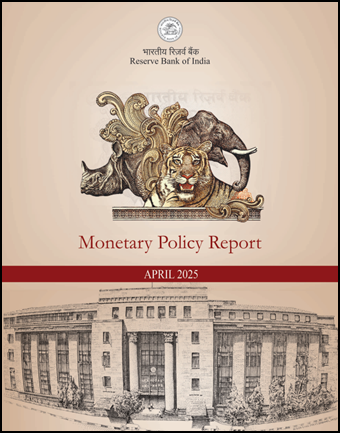
Within India, the outlook has shown signs of improvement. Inflation, particularly food inflation, has declined more than expected, offering some relief, though global and weather-related risks remain. Growth is recovering after a weak first half in the previous financial year, but it still falls short of the country’s potential. The Monetary Policy Report of April 2025, released alongside the MPC resolution, also outlines the GDP growth forecast and inflation projection for the coming months. This year also marks a milestone for the RBI as it completes 90 years since its establishment on 1st April 1935. Over the decades, it has evolved into a full-service central bank, balancing its roles of managing inflation, supporting growth, and ensuring financial stability.

Key Policy Decisions

  • The Monetary Policy Committee (MPC) unanimously decided to reduce the policy repo rate by 25 basis points, bringing it down to 6 per cent with immediate effect. The repo rate is the rate at which the Reserve Bank of India (RBI) lends money to commercial banks.
  • As a result, the Standing Deposit Facility (SDF) rate under the Liquidity Adjustment Facility (LAF) has been adjusted to 5.75 per cent. The SDF allows banks to park excess funds with the RBI without any collateral.
  • The Marginal Standing Facility (MSF) rate and the Bank Rate have both been revised to 6.25 per cent. MSF stands for Marginal Standing Facility, a provision made by the RBI that enables scheduled commercial banks to obtain overnight liquidity if inter-bank funds completely dry up. It is an emergency facility that allows banks to borrow at a rate higher than the repo rate.
  • These rate adjustments are consistent with the RBI’s objective of achieving the Consumer Price Index (CPI) inflation target of 4 per cent, within a flexible band of ±2 per cent, while also supporting economic growth.

Growth Assessment

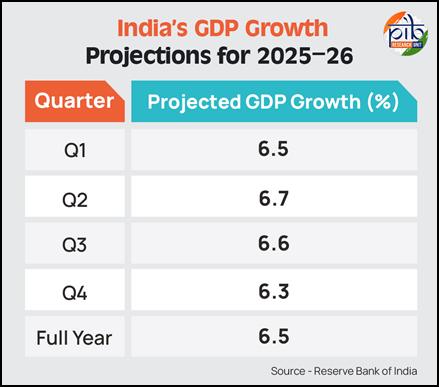
The Reserve Bank of India has projected real GDP growth at 6.5 per cent for 2025–26, maintaining the same rate as estimated for 2024–25, following a strong expansion of 9.2 per cent in the preceding year. The quarterly projections stand at 6.5 per cent in Q1, 6.7 per cent in Q2, 6.6 per cent in Q3, and 6.3 per cent in Q4. This marks a downward revision of 20 basis points from the February estimate, reflecting heightened global volatility. Agriculture remains on a positive footing, supported by healthy reservoir levels and robust crop production, which is expected to sustain rural demand. Manufacturing is showing early signs of revival amid improved business sentiment, and the services sector continues to demonstrate resilience.
On the investment side, activity is gaining pace on the back of higher capacity utilisation, continued government focus on infrastructure, and strong balance sheets of banks and corporates. Easing financial conditions have also aided this recovery. While services exports are likely to remain steady, merchandise exports could face headwinds from global uncertainties and trade disruptions. Looking ahead, the RBI has projected real GDP growth at 6.7 per cent for 2026–27, suggesting continued recovery momentum.

Inflation Outlook

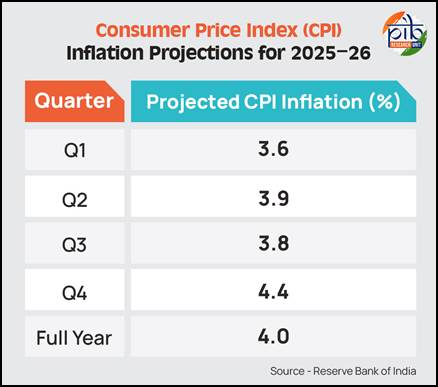
Headline inflation eased during January and February 2025, driven by a sharp decline in food prices. With uncertainties around the rabi crop largely resolved, and second advance estimates indicating record wheat output and higher pulse production than last year, food inflation is expected to soften further. This favourable trend is supported by robust kharif arrivals and a sharp fall in inflation expectations over the next three and twelve months, as reflected in recent surveys. The decline in crude oil prices has further strengthened the disinflationary outlook. Accordingly, Consumer Price Index (CPI) inflation for 2025–26 is projected at 4.0 per cent, with quarterly estimates at 3.6 per cent in Q1, 3.9 per cent in Q2, 3.8 per cent in Q3, and 4.4 per cent in Q4.
While the inflation outlook appears stable, global uncertainties and the possibility of weather-related supply shocks continue to pose upside risks to the inflation path. The Reserve Bank of India has assumed a normal monsoon in framing its projections, and it considers the risks to be evenly balanced at this stage.

External Sector Snapshot

  • Robust Services and Remittances: Services exports remained strong in January–February 2025, led by software, business, and transportation services. Net services and remittance receipts are expected to remain in large surplus, cushioning the merchandise trade deficit.
  • Sustainable Current Account Deficit: The current account deficit (CAD) for both 2024–25 and 2025–26 is projected to stay well within sustainable levels, supported by resilient external inflows.
  • Mixed Investment Flows: While gross FDI remained strong due to stable macroeconomic fundamentals, net FDI moderated because of higher repatriations and outward investments. Net FPI inflows touched USD 1.7 billion in 2024–25, driven by debt inflows despite equity outflows.
  • Healthy Forex Reserves: As of April 4, 2025, India’s foreign exchange reserves stood at USD 676.3 billion, offering an import cover of nearly 11 months and reflecting the strength of the external sector.

Liquidity and Financial Market Conditions

  • Liquidity Shortage and RBI Intervention: In January 2025, the banking system faced a shortage of funds, known as a liquidity deficit. To address this, the Reserve Bank of India (RBI) provided up to ₹3.1 lakh crore on 23rd January through the Liquidity Adjustment Facility (LAF) – a tool that allows banks to borrow money from the RBI for short periods to manage temporary mismatches in cash flow.
  • Improved Liquidity Position: The RBI later infused about ₹6.9 lakh crore into the system, and increased government spending in late March helped further. These actions improved the situation, and by 7th April 2025, the system had a liquidity surplus of ₹1.5 lakh crore – meaning there was more money available in banks for lending and investment.
  • Softening of Market Rates: With more liquidity available, the Weighted Average Call Rate (WACR) – the average interest rate at which banks lend to each other overnight – declined and hovered close to the repo rate, which is the interest rate at which the RBI lends money to commercial banks. This indicates stable short-term borrowing costs.
  • Lower Funding Costs in Debt Market: The difference between interest rates on Commercial Papers (CPs) and Certificates of Deposit (CDs) – short-term borrowing instruments used by companies and banks – and the 91-day Treasury Bill – a short-term government security – reduced. This narrowing of spreads means that borrowing became cheaper in financial markets. The RBI has stated it will continue to monitor these conditions and take action as needed to maintain sufficient liquidity.

Conclusion

The Monetary Policy Report of April 2025, released alongside the 54th meeting of the Monetary Policy Committee, reflects a balanced approach by the Reserve Bank of India (RBI) to support growth while maintaining price stability. The decision to cut the policy repo rate by 25 basis points to 6 per cent is underpinned by easing inflation, particularly in food prices, and a gradual recovery in economic activity. With GDP growth for 2025–26 projected at 6.5 per cent and inflation expected to remain within the 4 per cent target band, the report signals cautious optimism despite global uncertainties.

On the external front, robust services exports and strong remittance inflows have helped cushion the merchandise trade deficit, keeping the current account deficit at sustainable levels. Meanwhile, improved system liquidity, lower short-term borrowing costs, and stable foreign exchange reserves underscore the resilience of India’s financial system. The RBI has affirmed its commitment to closely monitor evolving conditions and take timely, calibrated measures to preserve macroeconomic and financial stability.

References:

Topics

Acts Income Tax
