

Loading...

Top
Help
×

By creating an account you can:

Logo TaxTMI
Call Us / Help / Feedback

Contact Us At :

E-mail: [email protected]

Call / WhatsApp at: +91 99117 96707

For more information, Check Contact Us

FAQs :

To know Frequently Asked Questions, Check FAQs

Most Asked Video Tutorials :

For more tutorials, Check Video Tutorials

Submit Feedback/Suggestion :

Email :
Please provide your email address so we can follow up on your feedback.
Category :
Description :
Min 15 characters 0/2000
Make Most of Text Search
  1. Checkout this video tutorial: How to search effectively on TaxTMI.
  2. Put words in double quotes for exact word search, eg: "income tax"
  3. Avoid noise words such as : 'and, of, the, a'
  4. Sort by Relevance to get the most relevant document.
  5. Press Enter to add multiple terms/multiple phrases, and then click on Search to Search.
  6. Text Search
  7. The system will try to fetch results that contains ALL your words.
  8. Once you add keywords, you'll see a new 'Search In' filter that makes your results even more precise.
  9. Text Search
Add to...
You have not created any category. Kindly create one to bookmark this item!
Create New Category
Hide
Title :
Description :
❮❮ Hide
Default View
Expand ❯❯
Close ✕
🔎 News - Adv. Search
TEXT SEARCH:

Press 'Enter' to add multiple search terms. Rules for Better Search

Search In:
Main Text + AI Text
  • Main Text
  • Main Text + AI Text
  • AI Text
Category: ?
Categorized by AI
---- All Categories ----
  • ---- All Categories ----
  • Income Tax
  • GST
  • Customs, DGFT & SEZ
  • FEMA & RBI
  • Corp. Laws, SEBI & IBC
  • PMLA, Black Money & ED
  • Budget
  • News and Press Release
  • PTI News
Month:
---- All Months ----
  • ---- All Months ----
  • January
  • February
  • March
  • April
  • May
  • June
  • July
  • August
  • September
  • October
  • November
  • December
Year:
---- All Years ----
  • ---- All Years ----
  • 2026
  • 2025
  • 2024
  • 2023
  • 2022
  • 2021
  • 2020
  • 2019
  • 2018
  • 2017
  • 2016
  • 2015
  • 2014
  • 2013
  • 2012
  • 2011
Sort By: ?
In Sort By 'Default', exact matches for text search are shown at the top, followed by the remaining results in their regular order.
Relevance Default Date
    ED arrests 3 more people in pan-India digital arrest case
    Rupee rises 6 paise to settle at 95.39 against US dollar
    Senior citizen threatened with terror funding case probe, duped of Rs 7.2 crore
    Rupee declines 10 paise to 95.55 against US dollar in early trade
    UK’s PG Paper welcomes SEBI review of fraud allegations against Indian firm
    'Neta-Company Loot Tribunal': Cong on NCLT haircut approval for Subhash Chandra
    S&P affirms India's 'BBB' sovereign rating; cites dynamic economy, policy stability
    Sugar prices ease marginally to Rs 64.33 per kg on Thursday
    ED freezes assets worth Rs 33 crore after raids against Gurugram realty group
    CARD91 Launches SpendFlow, a Commercial Card Platform Built for Enterprise Requirements
    Will talk to Japan on increasing basmati rice exports from India: Goyal
    Will consider Air India's biz strategy, other factors before deciding on additional fund requests: Singapore Airlines
    Commerce and Industry Minister Shri Piyush Goyal Concludes Japan Visit; Calls for Greater Japanese Investment and Stronger Industrial Partnerships wit...
    PM Jan Dhan Yojana Completes 12 Years of Transforming India’s Financial Inclusion Landscape
    Rassense Becomes First Indian CFS Company to Cross 5,000+ Employees; On Track to Cross INR 600 Crore in Revenue
    SVC Bank's Nationwide Cyber Safety Drive Reaches Over 19,061 Citizens Across 213 Housing Societies
    'Not haircut but mundan': Cong on NCLT clearing Subhash Chandra's Rs 6.5 crore payout
    Keralam: Escaped Assam prisoner reaches police station for Aadhaar card, flees again
    Women's Savings Account: Features that make opening one worth it
❯❯
Maximize Maximize Maximize
0 / 200
Expand Note
Add to Folder

No Folders have been created

+

Are you sure you want to delete "My most important" ?

NOTE:

News
Showing Results for :
Reset Filters
Results Found:
Show All Summaries Hide All Summaries
August 28, 2026
Show AI Summary
Digital arrest money laundering investigation tracks cyber-fraud proceeds through layered bank accounts, cash withdrawals, and foreign-exchange conversion.
Arrests under the Prevention of Money Laundering Act form part of an investigation into alleged digital arrest cyber fraud and laundering of fraud proceeds. Funds were reportedly routed through numerous bank accounts, withdrawn in cash, and converted into foreign currency through licensed money changers. The financial trail is linked to commodity trading, travel and foreign-exchange entities allegedly connected with cyber-fraud complaints and first information reports. The inquiry also identified alleged shell or dummy companies using proxy directors to conceal control and facilitate fund movement.
August 28, 2026
Show AI Summary
Foreign exchange intervention and lower crude prices supported rupee appreciation despite a stronger dollar and foreign institutional investor outflows.
Foreign exchange market conditions supported a six-paise appreciation of the rupee against the US dollar at the close of trading. Lower global crude oil prices and Reserve Bank of India intervention to limit significant rupee depreciation contributed to the movement. A marginal strengthening of the US dollar and foreign institutional investor equity outflows continued to exert pressure, while FCNR(B) scheme inflows supported the currency.
August 28, 2026
Show AI Summary
Cyber fraud impersonating enforcement officials coerced a senior citizen into bank and cryptocurrency transfers through terror-funding threats.
Cyber fraudsters allegedly impersonated public officials and threatened a senior citizen with implication in money laundering, terror funding and cybercrime. Using WhatsApp video calls and purported official notices, they allegedly induced the victim to transfer funds to multiple bank accounts and a cryptocurrency wallet on the pretext of proving innocence. The victim reportedly liquidated fixed deposits and mutual fund investments before identifying the deception and reporting it through the cybercrime helpline. A cyber police case was registered for further investigation.
August 28, 2026
Show AI Summary
Rupee depreciation against US dollar reflects foreign investor outflows and crude supply disruptions, moderated by weaker dollar and oil prices.
Foreign institutional investor outflows and disruptions in global crude oil supplies placed downward pressure on the rupee against the US dollar. A weaker dollar index and lower Brent crude prices moderated the decline. Market commentary anticipated a narrow trading range, with expected Reserve Bank of India protection at the upper end and oil importer, month-end, and importer demand supporting the lower end. Participants also monitored the US Federal Reserve Chair's Jackson Hole speech.
August 27, 2026
Show AI Summary
Emergency flood response measures coordinate rescues, suspend cross-border transport, and address risks to public safety.
Severe flash floods in Nepal and along the Nepal-Tibet border prompted cross-border rescue coordination for missing and stranded persons, warnings of continued downstream flood risk, and international relief support. Preventive public-safety measures included temporary suspension of an Indo-Nepal bus service. Separate developments included disruption of public services during an employee strike, investigation of an aircraft crash, market measures affecting sugar and onion prices, and proposed trade engagement for greater market access for basmati rice and processed food exports.
August 27, 2026
Show AI Summary
Regulatory review of fraud allegations requires timely consideration of representations while merits and standing remain undecided.
SEBI must consider and decide, within two weeks, representations alleging fraud by an Indian logistics company and its subsidiary. The allegations concern systematic over-invoicing of freight charges and forged documentation, with a parallel criminal investigation based on an FIR registered by the Delhi Police Economic Offences Wing. No determination has been made on the merits of the allegations or the complainant's standing to approach SEBI. The allegations and criminal proceedings were disclosed in IPO offer documents.
August 27, 2026
Show AI Summary
Personal insolvency repayment plans test creditor voting thresholds, valuation safeguards, and limits on commercial review under insolvency law.
Personal insolvency resolution under the Insolvency and Bankruptcy Code involved approval of a repayment plan providing for payment of Rs 6.25 crore to creditors and Rs 25 lakh towards process costs against admitted creditor claims of about Rs 22,006.57 crore. Objections by dissenting creditors were rejected because they held less than 20 per cent of voting share, while the plan received 80.81 per cent support. Valuation indicated that the personal estate was worth less than the amount offered, and the tribunal declined to replace creditor commercial wisdom or assess settlement adequacy.
August 27, 2026
Show AI Summary
Sovereign credit rating stability reflects policy continuity, infrastructure investment, external strength, and fiscal consolidation pressures.
India's sovereign credit rating retained a BBB stable outlook, supported by strong growth, an external balance sheet, stable institutions, policy predictability, and infrastructure investment. Public investment and consumer demand are expected to sustain growth and assist fiscal consolidation. Constraints include weak fiscal performance, elevated government debt and interest burdens, and low per-capita income. Long-term rating support depends on financing infrastructure investment without materially widening the current-account deficit and on reducing the fiscal deficit through stable fiscal and monetary policies.
August 27, 2026
Show AI Summary
Sugar import liberalisation and stockholding limits seek to moderate retail prices amid constrained domestic supply and restricted exports.
Sugar price-control measures combine duty-free raw sugar imports, stockholding limits for dealers and bulk consumers, and an export prohibition to address elevated retail prices and curb hoarding. Domestic supply remains constrained by reduced sugarcane output, prior exports and diversion of sugar to ethanol. Net production is estimated below projected domestic demand, while closing stocks are expected to remain limited. Import access, inventory restrictions and export controls therefore operate as market-stabilisation mechanisms.
August 27, 2026
Show AI Summary
Money-laundering investigation into alleged homebuyer fraud led to searches and freezing of assets linked to realty promoters.
Money-laundering proceedings were initiated under the Prevention of Money Laundering Act on the basis of police FIRs alleging fraudulent inducement and non-delivery of residential plots. Searches at premises linked to real estate promoters resulted in the seizure or freezing of luxury vehicles, jewellery, bank accounts and securities. The investigation alleges that substantial upfront payments for residential plots were received, but a significant portion of promised plots remained undelivered, and certain plots were allegedly sold to third parties without consent.
August 27, 2026
Show AI Summary
Commercial card governance enables configurable credit, approvals, virtual cards and controlled supplier payments across enterprise payment workflows.
SpendFlow combines commercial card program configuration, credit management, virtual cards, spend controls, approvals, supplier payments, billing and accounting in one architecture. It supports centrally governed rules with approved corporate-level variations, enterprise hierarchy management, and virtual cards linked to entities, employees, accounts or credit facilities. Multi-tier approvals and virtual-card supplier payments support controlled business payment functions, while core banking and ERP connectivity links card activity with banking and enterprise financial workflows.
August 27, 2026
Show AI Summary
Basmati rice market access may be pursued through trade agreement review, subject to import limits and safety standards.
Market access for Indian basmati rice may be pursued through review of the Comprehensive Economic Partnership Agreement, as rice remains a sensitive sector subject to import quantity limits and duties beyond permitted quantities. Processed food exports offer further opportunities where exporters comply with Japanese quality and safety standards. Bilateral cooperation also covers investment, supply chains, technology partnerships and capital flows supporting infrastructure, manufacturing and semiconductor ecosystems.
August 27, 2026
Show AI Summary
Capital allocation discipline governs consideration of further Air India funding alongside business strategy, cash flow and investment requirements.
Further capital investment in Air India will be evaluated by Singapore Airlines' board through a disciplined capital-allocation process. Assessment will consider the group's capital requirements, Air India's business strategy, operating cash flow, investment needs for aircraft and products, and multi-hub investments intended to support long-term growth and returns. As a significant minority shareholder, Singapore Airlines supports Air India's transformation programme with Tata Sons, but no commitment to provide additional capital is indicated.
August 27, 2026
Show AI Summary
Semiconductor investment cooperation anchors expanded India-Japan industrial partnerships across technology, manufacturing, clean energy, infrastructure, and financial services.
Semiconductor and artificial-intelligence cooperation centres on a six-pillar semiconductor strategy encompassing chip design, semiconductor machinery and materials, fabrication, ATMP/OSAT, research and development, and talent development. Japanese participation is sought across semiconductor materials and equipment, power semiconductors, electronics, AI, logistics and related advanced technologies. Development of semiconductor clusters is linked to reliable power, ultra-pure water, skilled manpower and social infrastructure.
August 27, 2026
Show AI Summary
Financial inclusion through basic bank accounts enables direct welfare transfers, digital payments, insurance access and credit for excluded households.
PMJDY provides unbanked adults with basic bank accounts without minimum-balance or maintenance-charge requirements, free RuPay debit cards with accident insurance cover, and eligible overdraft support. Through the JAM framework, PMJDY accounts enable direct transfer of welfare benefits using bank accounts, Aadhaar-based biometric verification and mobile connectivity, reducing intermediary involvement and delays. The scheme emphasises rural, semi-urban, marginalised and women account holders while supporting access to insurance, pensions, savings, digital payments and credit, including MUDRA loans.
August 27, 2026
Show AI Summary
Contract food services expansion strengthens Rassense's nationwide institutional operations through new academic partnerships and technology-led service delivery.
Rassense Pvt Ltd reports crossing a workforce of more than 5,000 employees and projects revenue exceeding INR 600 crore. Its contract food services operations serve educational institutions, corporate campuses, healthcare facilities and industrial locations. New operations at IIM Jammu, IIM Bangalore and IIT Guwahati strengthen its nationwide institutional presence. Expansion is supported by academic institution partnerships, local workforce development, operational excellence, and technology-led capabilities in food production, food waste reduction and supply-chain management.
August 27, 2026
Show AI Summary
Cyber fraud awareness promotes safe digital banking by teaching customers to verify communications, protect credentials, and report suspicious transactions.
Cyber-fraud awareness and digital banking safety were promoted through community sessions addressing phishing, impersonation, OTP and UPI fraud, QR-code scams, digital-arrest fraud, and fraudulent customer-care calls. Participants were guided to identify authentic banking communications, avoid sharing confidential credentials, verify callers and links before acting, and promptly report suspected unauthorised transactions. Customer vigilance, financial literacy, and institutional security measures were emphasised as complementary safeguards against digital financial fraud.
August 27, 2026
Show AI Summary
Personal insolvency repayment plans may be approved despite minimal creditor recovery when requisite voting support and comparative valuation support them.
Personal insolvency repayment plan approval was granted under the Insolvency and Bankruptcy Code, 2016, despite objections that creditor recoveries were negligible and the proposed payment uncertain. The plan received 80.81 per cent voting support, while dissenting creditors held less than 20 per cent voting share. Valuation showed that the debtor's personal estate was materially below the offered amount, and rejection could result in bankruptcy and lower recovery. Assessment of settlement adequacy was treated as a matter of creditor commercial wisdom.
August 27, 2026
Show AI Summary
Prison escape security lapses prompt coordinated tracing measures, transport monitoring, inter-state alerts, and a detailed custodial-security inquiry.
Prison escape and custodial-security lapses arose after a detainee escaped from Aluva Sub Jail, allegedly by using an under-construction structure within the premises to cross the compound wall. Following his later appearance at a police station seeking return of his Aadhaar card, search measures included a lookout circular, information sharing with police stations, railway-security coordination, and alerting police in Assam. A detailed inquiry has been initiated into the prison-security deficiencies enabling the escape.
August 27, 2026
Show AI Summary
Women's savings account selection depends on practical benefits, charges, eligibility, and banking needs rather than the account label.
Women's Savings Accounts may provide standard banking facilities together with additional services or benefits for eligible women. Their suitability depends on practical use of digital banking, transfers, payments, alerts, debit-card facilities, accessibility, security features, charges, and minimum-balance conditions. Since regular Savings Accounts may offer comparable facilities, the additional benefits should be assessed against associated costs and conditions. Selection should be based on comparison of eligibility, facilities, balance requirements, benefits, customer support, and authentication safeguards rather than the account's women-focused label alone.

News

Back

All News

Showing Results for :
Reset Filters
No Records Found

News

Showing Results for : Reset Filters
Customs, DGFT & SEZ

Make in India and the Capital Goods Revolution

April 3, 2025

Contents
Summary
Note

Note

-

Bookmark

Print

Print

Catalyzing Domestic Production and Technological Innovation

Introduction

According to the Ministry of Heavy Industries, heavy engineering and machine tools sector comprises of capital goods industry. India's capital goods sector is experiencing significant attention due to its critical role in driving industrial growth and economic development. This sector encompasses industries such as electrical equipment, machinery, and construction, which are essential for the country's infrastructure development. According to the Indian Electrical and Electronics Manufacturers’ Association (IEEMA), the electrical equipment industry witnessed consistent double-digit growth in power equipment, particularly transmission equipment and transformers, driven by domestic demand and international market expansion.

India is the third-largest market for construction equipment. Government initiatives have been instrumental in bolstering the capital goods sector. The Ministry of Heavy Industries has launched several policies to boost domestic production and reduce reliance on imports. These initiatives are part of the broader Make in India campaign (launched in 2014), which seeks to increase the manufacturing sector's contribution to GDP, generate employment, and improve technological capabilities. The capital goods sector is crucial to India's economic strategy, supporting large-scale manufacturing and infrastructure projects. With rapid urbanization, extensive infrastructure development, and strong government support, the sector is poised to drive sustainable industrial growth and elevate India's position in the global market.

Overview of the Heavy Industries and Engineering Sector
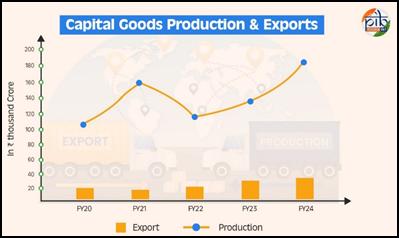
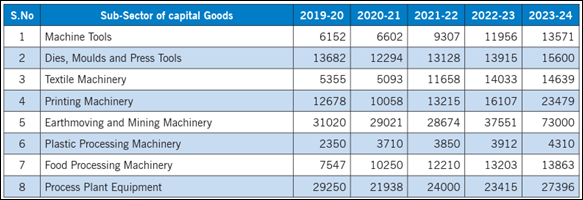
As per the present estimates, the Capital Goods industry contributes about 1.9% of GDP.  The Heavy Engineering and Machine Tool sector (capital goods industry) consists of the following major sub-sectors: Dies, Moulds and Press Tools; Plastic Machinery; Earthmoving and Mining Machinery; Metallurgical Machinery; Textile Machinery; Process Plant Equipment; Printing Machinery; and Food Processing Machinery. Due to catalytic effect of Ministry of Heavy Industries intervention, the production of capital goods sector has increased from Rs 2,29,533 crore in 2014-15 to Rs.4,29,001 crore in 2023-24. Production (in crores) by the sub-sectors of capital goods industry since 2019-20 are presented in the table below:
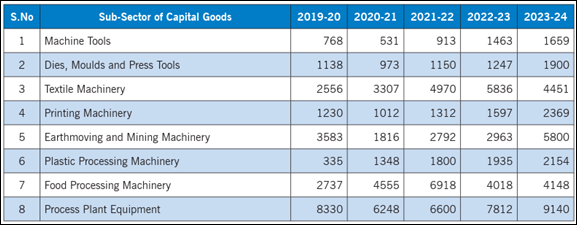
Exports (in crores) by the sub-sectors of capital goods industry since 2019-20 are presented in the table below:
The policy environment for the capital goods sector includes:

  • No industrial license is required for the sector.
  • FDI up to 100% permitted on automatic route (through RBI) except from the countries having land borders with India.
  • Quantum of payment for technology transfer, design and drawing, royalty, etc. to the foreign collaborator is not restricted.
  • There is no restriction on imports and exports.

The Union Budget 2025-26 proposes to add 35 additional capital goods for EV battery manufacturing, and 28 additional capital goods for mobile phone battery manufacturing to the list of exempted capital goods. This will boost domestic manufacture of lithium-ion battery, both for mobile phones and electric vehicles.

National Capital Goods Policy (2016)

The National Capital Goods Policy, formulated by the Ministry of Heavy Industries & Public Enterprises, is a comprehensive framework aims at boosting the capital goods sector in India. policy envisions increasing the sector's contribution to manufacturing activity from 12% (2016) to 20% by 2025. It seeks to make India one of the top capital goods producing nations, aiming to more than double production and increase exports to at least 40% of the total production. Furthermore, the policy aims to enhance the technology depth within the sector, moving from basic and intermediate levels to advanced levels.
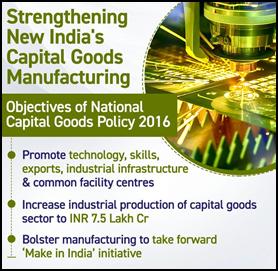
The major salient features of the policy are:

  1. To increase budgetary allocation and scope of the Scheme on Enhancement of Competitiveness in the Capital Goods Sector adding components i.e. skills, capacity building, advanced manufacturing and cluster development.
  2. To launch a Technology Development Fund under PPP model to fund technology acquisition/ transfer, purchase of IPRs/ designs and drawings/ commercialization.
  3. To set up regional State-of-the-Art Greenfield Centre of Excellence for skill development.
  4. To modernize existing CG manufacturing units, especially SMEs by replacing with the modern, computer controlled and energy efficient machineries across capital goods sub-sectors.
  5. To upgrade/ develop, testing and certification infrastructure.

The National Capital Goods Policy, 2016, inter alia, recommended increasing the budgetary allocation and scope of the Scheme on Enhancement of Competitiveness of Capital Goods which included setting up of Centers of Excellence, Common Engineering Facility Centers, Integrated Industrial Infrastructure Park and Technology Acquisition Fund Programme. These recommendations were incorporated in the Phase II of the scheme.

Scheme for Enhancement of Competitiveness in the Indian Capital Goods Sector Phase I

In order to address the skill gaps, infrastructure development and technology needs for the capital goods sector, Phase I of the capital goods scheme was rolled out in November 2014 which had the total outlay of Rs 995.96 crores. Phase I of the scheme fostered partnerships between academia and industry for engendering technology development with government support. The outcome of the Scheme has proved the efficacy of the strategies deployed for technology and industrial infrastructure development.

  • Centre of Excellence (CoE): 8 CoEs have been established wherein 30 niche indigenous technologies have been successfully developed in the fields of machine tools, additive manufacturing, textile machinery, welding robots and alloys design, earth moving machinery, and sensor technologies at national research institutes of eminence such as Indian Institute of Technology (IITs), Indian Institute of Sciences (IISc), Central Manufacturing Technology Institute (CMTI) etc.
  • Common Engineering Facility Centres (CEFC) - 15 CEFCs including four Industry 4.0 SAMARTH centres and six Web-Based Technology Innovation Platforms (TIPs) have been setup. Industry 4.0 SAMARTH centres are at Indian Institute of Sciences at Bengaluru, Centre for Industry 4.0 (C4i4) lab at Pune, Central Manufacturing Technology Institute (CMTI) at Bengaluru and Indian Institute of Technology (IIT) Delhi.
  • The six web-based open manufacturing technology innovation platforms are helping in bringing all India’s technical resources and the concerned Industry on to one platform to kick start and facilitate identification of technology problems faced by Indian Industry and crowd source solutions for the same in a systematic manner so as to facilitate start-ups and angel funding of India innovations.
  • Over 76,000 students, experts, institutes, industries and labs have already registered on these platforms so far.
  • Technology Acquisition Fund Programme (TAFP) – Following 5 technologies have been acquired from abroad under TAFP:
  1. Development & Commercialization of Titanium Casting with Ceramic Shelling Technology;
  2. Manufacturing of Heavy-Duty High Reliability Electrical Specialized Power Cables;
  3. Development of Turn Mill Centre;
  4. Development of Four Guideway CNC Lathe;
  5. Cutting Edge Robotic Laser Cladding Technology.
  • Integrated Machine Tools Park, Tumakuru: An exclusive industrial park for machine tool industry has been developed across 530 acres at Tumkuru, Karnataka. So far, out of 336 acres of allottable land, 145 acres of land has been allotted to the machine tool manufacturers.

Under Phase- I of the Scheme for Enhancement of Competitiveness in the Indian Capital Goods Sector, 33 projects with budgetary support of Rs. 583.312 crore were sanctioned. After launching of the Capital Goods Scheme Phase II, The Phase I of the Capital Goods Scheme has been merged with Phase II of the Scheme.

Scheme for Enhancement of Competitiveness in the Indian Capital Goods Sector Phase II

Ministry of Heavy Industries notified the Phase 2 of the Scheme on January 25, 2022, with an objective to expand and enlarge the impact created by Phase I of the capital goods scheme, thereby providing greater impetus through creation of a strong and globally competitive capital goods sector. The scheme has a financial outlay of Rs. 1207 crores with budgetary support of Rs. 975 crore and industry contribution of Rs. 232 crores. Under the Phase II, a total of 33 projects with project cost of Rs 1366.94 crores (due to higher contribution by Industry) and government contribution of Rs 963.19 crore have been sanctioned by August 2024. There are six components under the Phase II and the details of the projects sanctioned so far are:

  • Setting up of New Advanced Centres of Excellence and augmentation of Existing Centres of Excellence: To expedite R&D by utilizing academia of repute and private industry which is involved in research and development activities. A total of 9 projects with the budget of Rs. 478.87 have been sanctioned so far.
  • Setting up of Common Engineering Facility Centres (CEFCs) and augmentation of existing CEFCs: For creating demonstration & training, consultancy, hand holding and R & D services and awareness programmes to industrial units. A total of 5 projects with the budget of Rs. 357.07 have been sanctioned so far.
  • Promotion of skilling in Capital Goods Sector: Creation of Qualification packages for skill levels 6 and above- in association with Skill Councils for skills level 6 and above. A total of 3 projects with the budget of Rs. 7.59 have been sanctioned so far.
  • Augmentation of Existing Testing and Certification Centres: To address the needs of Capital Goods Sector & Auto sector for testing of machinery in terms of various properties relating to mechanical, electrical, chemical, structural, metallurgical, electronics aspects etc. A total of 7 projects with the budget of Rs. 195.99 have been sanctioned so far.
  • Setting up of Industry Accelerators for Technology Development: Aimed at development of targeted indigenous technologies, scaled to meet the requirements of selected industry segment, which till now has been dependent on imports. Selected Academic Institute/ Industry Body will act as an Accelerator for fostering the development of such technologies. A total of 8 projects with the budget of Rs. 325.32 have been sanctioned so far.
  • Identification of Technologies through Technology Innovation Portals: Six Web-based open manufacturing technology innovation platforms have been developed under CG Scheme Phase-I. These are being supported under CG Scheme Phase-II.

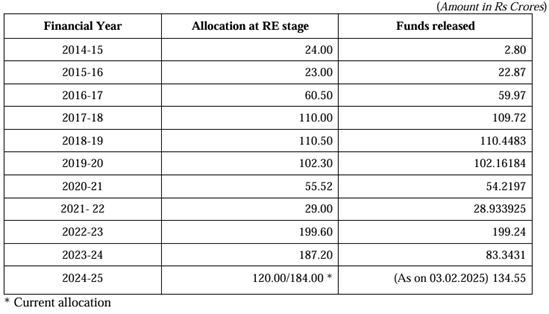
The details of the funds allocated and its utilization under the Scheme for Enhancement of Competitiveness in the Indian Capital Goods Sector Phase- I and II is as given in the table below:
Recent Achievements of the Capital Goods Scheme

  1. Sitarc, Coimbatore has indigenously developed a 6-inch BLDC submersible pump with a motor efficiency of 88% and a pump efficiency of 78% under the Capital Goods Scheme. This initiative promotes "Aatmanirbharta" by reducing the import of such pumps by 80%. This innovation was recognized as the best product in the pumps category by United Nations Industrial Development Organization (UNIDO).
  2. CMTI has developed a high-speed rapier loom machine capable of weaving yarns upto 450 RPM. This machine was launched at ITMA 2023 in Milan, Italy.
  3. Under the SAMARTH centre at CMTI, Industrial Internet of Things (IIOT) technology has been implemented in Toyota Engine Manufacturing line controlling 64 machines for preventive maintenance.
  4. A testing facilities for battery and Battery Management System (BMS) has been established at ARAI, Pune for the first time in India under the aegis of Ministry of Heavy Industries.
  5. 6 Smart Technologies, 5 Smart Tools, 14 solutions have been developed in digital twin, virtual reality, robotics, inspection, sustainability, additive manufacturing etc. by I-4.0 India @ IISc, Bengaluru;
  6. Under Industry Accelerator at ARAI-Advanced Mobility Transformation & Innovation Foundation (AMTIF) a high-voltage motor controller developed, which enabled the industry partner Raptee Energy Private Limited to launch a high-voltage motorcycle with electric car DNA.
  7. Under Industry Accelerator at ARAI-Advanced Mobility Transformation & Innovation Foundation (AMTIF) thermally stable sodium-ion batteries developed.

Bharat Heavy Electricals Limited (BHEL)

BHEL is a major contributor towards engineering and manufacturing capacity building for the Country. The company is carrying out following initiatives with support from Ministry of Heavy industries under the Capital Goods Scheme Phase II:

• BHEL has established a “Common Engineering Facility Centre (CEFC)” for skill development in Welding Technology at WRI Trichy along with its extension centers at Varanasi, Ranipet, Bhopal, Jhansi and Haridwar units of BHEL.

•  BHEL is establishing a testing facility comprising both Hardware in the Loop (HIL) and Software in the Loop (SIL) functionalities in the area of Industrial, Naval and Aircraft related processes at its Corporate R&D Unit at Hyderabad with support from Ministry of Heavy Industries.

Conclusion

The ‘Make in India’ initiative has had a transformative impact on the heavy industries and engineering sector. By fostering technological advancements, increasing domestic production, enhancing competitiveness, and generating employment, the initiative has played a pivotal role in strengthening India’s industrial base. With sustained policy support and continued investment, the sector is poised for further growth in the coming years.

References

https://www.investindia.gov.in/sector/capital-goods

https://pib.gov.in/PressReleseDetail.aspx?PRID=2098364

https://pib.gov.in/PressReleasePage.aspx?PRID=2085938

https://www.pib.gov.in/PressReleasePage.aspx?PRID=2042179

https://pib.gov.in/PressReleaseIframePage.aspx?PRID=2039020

https://www.indiabudget.gov.in/economicsurvey/doc/echapter.pdf

https://heavyindustries.gov.in/heavy-engineering-and-machine-tool

https://x.com/investindia/status/1302798627337723904?lang=ar-x-fm

https://heavyindustries.gov.in/sites/default/files/2023-07/Capital-Goods-Policy-Final.pdf

https://sansad.in/getFile/loksabhaquestions/annex/184/AU1227_CBVr5x.pdf?source=pqals

https://sansad.in/getFile/loksabhaquestions/annex/182/AU1375_e9YzYN.pdf?source=pqals

https://heavyindustries.gov.in/scheme-enhancement-competitiveness-indian-capital-goods-sector-phase-i

https://heavyindustries.gov.in/scheme-enhancement-competitiveness-indian-capital-goods-sector-phase-ii

https://heavyindustries.gov.in/sites/default/files/2025-02/heavy_annual_report_2024-25_final_27.02.2025_compressed.pdf

Topics

Acts Income Tax
