

Loading...

Top
Help
×

By creating an account you can:

Logo TaxTMI
Call Us / Help / Feedback

Contact Us At :

E-mail: [email protected]

Call / WhatsApp at: +91 99117 96707

For more information, Check Contact Us

FAQs :

To know Frequently Asked Questions, Check FAQs

Most Asked Video Tutorials :

For more tutorials, Check Video Tutorials

Submit Feedback/Suggestion :

Email :
Please provide your email address so we can follow up on your feedback.
Category :
Description :
Min 15 characters 0/2000
Make Most of Text Search
  1. Checkout this video tutorial: How to search effectively on TaxTMI.
  2. Put words in double quotes for exact word search, eg: "income tax"
  3. Avoid noise words such as : 'and, of, the, a'
  4. Sort by Relevance to get the most relevant document.
  5. Press Enter to add multiple terms/multiple phrases, and then click on Search to Search.
  6. Text Search
  7. The system will try to fetch results that contains ALL your words.
  8. Once you add keywords, you'll see a new 'Search In' filter that makes your results even more precise.
  9. Text Search
Add to...
You have not created any category. Kindly create one to bookmark this item!
Create New Category
Hide
Title :
Description :
❮❮ Hide
Default View
Expand ❯❯
Close ✕
🔎 News - Adv. Search
TEXT SEARCH:

Press 'Enter' to add multiple search terms. Rules for Better Search

Search In:
Main Text + AI Text
  • Main Text
  • Main Text + AI Text
  • AI Text
Category: ?
Categorized by AI
---- All Categories ----
  • ---- All Categories ----
  • Income Tax
  • GST
  • Customs, DGFT & SEZ
  • FEMA & RBI
  • Corp. Laws, SEBI & IBC
  • PMLA, Black Money & ED
  • Budget
  • News and Press Release
  • PTI News
Month:
---- All Months ----
  • ---- All Months ----
  • January
  • February
  • March
  • April
  • May
  • June
  • July
  • August
  • September
  • October
  • November
  • December
Year:
---- All Years ----
  • ---- All Years ----
  • 2026
  • 2025
  • 2024
  • 2023
  • 2022
  • 2021
  • 2020
  • 2019
  • 2018
  • 2017
  • 2016
  • 2015
  • 2014
  • 2013
  • 2012
  • 2011
Sort By: ?
In Sort By 'Default', exact matches for text search are shown at the top, followed by the remaining results in their regular order.
Relevance Default Date
    TMC calls ED searches political vendetta, bid to divert attention from Delhi building collapse
    Valmiki Corporation 'scam': ED questions ex-K'taka minister B Nagendra again
    Allahabad HC seeks Centre, UP response over learning licence issued in dead man's name
    Axis Bank sees religious tourism, defence, MSMEs as key growth areas in UP
    Rupee falls 13 paise to close at 94.56 against US dollar
    Vimal Elaichi makers move Delhi HC against Maharashtra FDA notice to 3 actors
    As world faced turmoil, India forged partnerships to maintain its economic growth: Shah
    Haryana govt, RBI review measures to tackle financial frauds
    Union law minister Meghwal inaugurates ITAT's new premises in Kolkata
    Enabling Filing of Appeals in Cases Involving NIL or Zero Demand Amount
    DGFT Introduces Open API Facility for Certificate of Origin on the Trade Connect e-Platform
    Amid global turmoil, India maintained momentum of its economic growth, says Amit Shah
    Zaggle Brings Cricket and Business Together in Hyderabad; Hosts Padma Bhushan Dr. Sunil Gavaskar
    AI may accelerate anti-competitive practices in digital markets: CCI chief
    Union Minister of Commerce and Industry Shri Piyush Goyal Calls for India to Emerge as a Global Medical and Healthcare Destination
    Union Minister of Commerce and Industry Shri Piyush Goyal Calls for Trained Caregivers and Wider Hospital Participation in Heal in India Gateway
    Rupee falls 7 paise to close at 94.50 against US dollar
    India Must Build Resilient, Globally Integrated Healthcare Supply Chains: Commerce and Industry Minister Shri Piyush Goyal at Bharat Health Global Exp...
    Rupee rises 4 paise to 94.39 against US dollar in early trade
    Jantar Mantar student stir, mass struggles could impact Assembly polls: MA Baby
❯❯
Maximize Maximize Maximize
0 / 200
Expand Note
Add to Folder

No Folders have been created

+

Are you sure you want to delete "My most important" ?

NOTE:

News
Showing Results for :
Reset Filters
Results Found:
Show All Summaries Hide All Summaries
September 7, 2026
Show AI Summary
Aadhaar-based learning licence authentication faces challenge over age verification, identity safeguards, and compliance with prescribed licensing formalities.
Aadhaar-based online processing of learning and driving licence applications is challenged on the ground that Aadhaar is not valid proof of age and that reliance on Aadhaar details may enable issue of licences to underage applicants. Allegations that licences were issued using a deceased person's Aadhaar number and despite an obscene uploaded photograph raise identity-verification and security concerns. The Union and State maintain that Aadhaar alone does not result in licence issuance because prescribed formalities must also be completed.
September 7, 2026
Show AI Summary
Digital payment transparency for religious institutions supports direct trust-account donations, reconciliation, and technology-led banking services.
Digital donation collection facilities for temples and religious establishments include kiosks, Bharat Bill Payment System payments and UPI QR-code payments. Donations may be credited directly to the relevant trust account, supported by transaction reconciliation and digital records to improve transparency and ease of transactions. Technology services also cover municipal dues payments and property-tax assessment, alongside banking support for defence-sector ecosystems, MSMEs, agriculture and priority-sector lending.
September 7, 2026
Show AI Summary
Rupee exchange-rate movement reflected crude oil pressures, domestic equity weakness, foreign inflows, and a softer dollar.
Foreign-exchange market conditions resulted in the rupee closing weaker against the US dollar after initial support from foreign currency deposit inflows. Rising crude oil prices and weakness in domestic equity markets weighed on sentiment and offset support from a softer dollar and foreign investor equity purchases. Future movement may remain influenced by foreign inflows, crude oil prices, domestic market conditions, geopolitical tensions and inflation data.
September 7, 2026
Show AI Summary
Surrogate advertising allegations challenge notices targeting brand ambassadors and raise jurisdiction and hearing concerns for product promoters.
Challenge to surrogate advertising allegations concerns notices requiring brand ambassadors promoting Vimal Elaichi to prove that it differs from prohibited pan masala, halt promotions, and remove digital materials. The product promoter contests the notices because they were addressed only to the actors, it was not heard, and the regulator allegedly lacked jurisdiction to stop the advertisements. Territorial jurisdiction to entertain the challenge is also contested.
September 7, 2026
Show AI Summary
Free trade agreements and cyber-fraud prevention feature in India's stated strategy for economic growth, security, and digital protection.
India's external economic strategy relies on diplomatic engagement, strategic partnerships and free trade agreements to sustain growth amid geopolitical uncertainty. Cooperation extends to defence, technology, energy, investment and trade, as well as digital public infrastructure, disaster relief and capacity building. Internal and border security are treated as conditions for national development, while police responsibilities include community safety, maritime protection and tourist safety. Growing cyber-fraud risks linked to the digital economy are addressed through coordination with states and the national cybercrime helpline.
September 7, 2026
Show AI Summary
Financial fraud prevention advances through accessible complaints, cyber awareness, intelligence-sharing, and AI-based detection of mule accounts.
Financial-fraud prevention measures rely on coordinated review of alleged fraud, unauthorised deposit collection, complaints, market intelligence, investor protection and cyber threats. The SACHET portal supports market intelligence and complaints concerning unregulated financial activities through multilingual and accessibility features. MuleHunter.ai uses artificial intelligence and machine learning to identify mule accounts used in fraudulent fund flows. Financial-literacy programmes and accessible educational initiatives promote safe banking, fraud awareness and coordinated responses to cyber-enabled financial crime.
September 7, 2026
Show AI Summary
Technology-driven tax dispute resolution supports faster tribunal processes, reduced litigation, and improved taxpayer services through digital filing and assessments.
The Kolkata Bench of the Income Tax Appellate Tribunal is intended to expedite tax-dispute resolution across 12 states, including seven northeastern states, while advancing impartial, accessible and swift justice. Its administrative role includes improving justice delivery, reducing pendency and pursuing AI-driven digital transformation. The Income Tax Department and the Tribunal seek reduced litigation and improved taxpayer services through technology-driven measures, including faceless assessment and electronic filing.
September 7, 2026
Show AI Summary
Appeals against NIL or Zero GST demand orders are enabled where taxpayers paid liabilities before issuance of the order.
GST Portal validation restricting appeals against demand orders showing NIL or Zero demand has been removed where a liability dispute exists and the taxpayer made payment before issuance of the demand order. Taxpayers may challenge such orders by filing an appeal in Form GST APL-01, and may raise a ticket with the GST Helpdesk if filing difficulties arise.
September 7, 2026
Show AI Summary
Certificate of origin API integration enables exporters to submit applications, receive certificates, verify issuance, and reduce repetitive data entry.
Open API integration for Certificates of Origin enables eligible exporters to connect ERP, accounting and other business software with the Trade Connect e-Platform for electronic application submission. The facility covers preferential and non-preferential certificates, provides authentication, file-submission and certificate-verification APIs, and maintains a transaction ledger for application tracking. Security measures include digital signatures, password hashing, IP whitelisting and time-limited access tokens. Relevant origin criteria, fields and validation rules are automatically applied according to the selected trade agreement or certification scheme.
September 7, 2026
Show AI Summary
Free trade agreements and strategic partnerships were identified as supporting India's trade engagement and economic growth amid geopolitical disruption.
India's international economic engagement through free trade agreements and strategic partnerships was identified as a means of sustaining economic growth amid geopolitical disruption. Economic cooperation was described as extending across defence, technology, energy, investment and trade. Nine free trade agreements were stated to have been concluded by 2026, with further trade arrangements proposed with other countries. Pursuit of free trade agreements was linked to increasing trade and to reported first-quarter GDP growth in the financial year 2026-27.
September 7, 2026
Show AI Summary
Leadership, talent recognition and legacy framed a discussion linking cricketing performance with entrepreneurship and organisational responsibility.
No FEMA or RBI regulatory measure, compliance obligation, legal interpretation, or adjudicatory determination is identified. The subject matter concerns leadership, performance and entrepreneurship, with emphasis on preparation, decision-making under pressure, teamwork, recognising potential and supporting talent. Corporate success is linked with creating opportunities, contributing to society and building a lasting legacy. Zaggle is described as providing enterprise spend management, card-based financial products through banking partnerships and software offerings for corporate customers.
September 7, 2026
Show AI Summary
AI-driven digital markets require competition scrutiny of autonomous pricing, self-preferencing, discriminatory pricing, tying, and market manipulation.
Artificial intelligence may accelerate anti-competitive conduct in digital markets through self-preferencing, discriminatory pricing, tying and market manipulation. Agentic AI may create particular concerns where it monitors competitors' prices and autonomously responds without direct human intervention. Competition law aims to prevent anti-competitive practices, promote competition, protect consumers and preserve freedom of trade, while allowing legitimate growth and innovation. Market dominance is not objectionable in itself; concern arises from abuse of dominance through exclusionary or exploitative practices.
September 7, 2026
Show AI Summary
Healthcare innovation and supply-chain self-reliance are prioritised through trade access, investment, research collaboration, testing infrastructure, and quality standards.
Healthcare-sector development priorities seek to expand medical devices, diagnostics, digital health, research, and pharmaceutical machinery through exports, import substitution, and services growth. Free trade agreements are presented as supporting preferential market access, services opportunities, and mobility. Sectoral growth is linked to startup incubation, intellectual-property capability, international research collaboration, technology transfer, and joint ventures. Healthcare self-reliance requires indigenous equipment, critical components, resilient supply chains, shared testing and certification infrastructure, and uncompromising quality standards.
September 7, 2026
Show AI Summary
Medical value tourism quality standards prioritise verified hospitals, ethical treatment, transparent pricing, and seamless international patient care.
Medical value tourism is proposed to expand through trained caregivers, transparent treatment packages, ethical hospital practices, seamless reimbursement and cashless-payment systems, telemedicine, and verified hospital participation. International patients are intended to receive care through accredited quality systems, supported by interpreters, global outreach, and coordinated healthcare networks. Expansion beyond metropolitan areas must maintain equivalent high-quality care for domestic and foreign patients without discrimination. Certification systems are expected to remain professionally independent and free from unethical influence.
September 7, 2026
Show AI Summary
Foreign exchange market pressures from rising crude oil and weak domestic equities constrained rupee support from foreign inflows.
Foreign exchange market conditions caused the rupee to depreciate against the US dollar despite support from FCNR dollar inflows and a softer dollar. Rising crude oil prices, weak domestic equities and global headwinds constrained gains. The outlook remained dependent on foreign inflows, dollar movements, crude prices, market sentiment and inflation data, with geopolitical tensions capable of increasing pressure on the currency.
September 7, 2026
Show AI Summary
Healthcare supply-chain resilience requires diversified sourcing, global investment, domestic innovation, and stronger medical-device production supported by enabling infrastructure.
Healthcare supply-chain resilience requires diversified sourcing, restoration of domestic capacity in Active Pharmaceutical Ingredients and Key Starting Materials, and continued imports where necessary through multiple suppliers and geographies. Pharmaceutical industry growth should move beyond generics towards research, development, patented products, new molecules, biosimilars and biotechnology. Regulatory convergence should support clinical trials, patenting and new-product introduction. Government support is contemplated for medical value travel, healthcare infrastructure, bulk drug parks, plug-and-play facilities, medical-device component production and scientific validation of Ayush products.
September 7, 2026
Show AI Summary
Foreign exchange market pressures offset rupee support from FCNR inflows amid higher crude oil and dollar demand.
The rupee gained marginally against the US dollar, supported by FCNR-related dollar inflows and robust liquidity. Elevated Brent crude prices, safe-haven dollar demand and geopolitical tensions constrained this support. Higher oil prices may enlarge India's import bill, increase dollar demand and pressure the rupee, although rising foreign-exchange reserves indicated external-sector strength.
September 6, 2026
Show AI Summary
Census data privacy and electoral integrity concerns emerge alongside calls to repeal insolvency law and protect political dissent.
CPI(M) called for repeal of the Insolvency and Bankruptcy Code, alleging that insolvency processes enabled diversion of public resources. It questioned economic growth figures against agricultural weakness, mining contraction, higher input costs, inflation, unemployment and malnutrition. The party also raised Census data privacy concerns over caste-data collection, potential linkage with government databases, and possible implications for citizenship, electoral rolls and future delimitation.

News

Back

All News

Showing Results for :
Reset Filters
No Records Found

News

Showing Results for : Reset Filters
Customs, DGFT & SEZ

Make in India and the Capital Goods Revolution

April 3, 2025

Contents
Summary
Note

Note

-

Bookmark

Print

Print

Catalyzing Domestic Production and Technological Innovation

Introduction

According to the Ministry of Heavy Industries, heavy engineering and machine tools sector comprises of capital goods industry. India's capital goods sector is experiencing significant attention due to its critical role in driving industrial growth and economic development. This sector encompasses industries such as electrical equipment, machinery, and construction, which are essential for the country's infrastructure development. According to the Indian Electrical and Electronics Manufacturers’ Association (IEEMA), the electrical equipment industry witnessed consistent double-digit growth in power equipment, particularly transmission equipment and transformers, driven by domestic demand and international market expansion.

India is the third-largest market for construction equipment. Government initiatives have been instrumental in bolstering the capital goods sector. The Ministry of Heavy Industries has launched several policies to boost domestic production and reduce reliance on imports. These initiatives are part of the broader Make in India campaign (launched in 2014), which seeks to increase the manufacturing sector's contribution to GDP, generate employment, and improve technological capabilities. The capital goods sector is crucial to India's economic strategy, supporting large-scale manufacturing and infrastructure projects. With rapid urbanization, extensive infrastructure development, and strong government support, the sector is poised to drive sustainable industrial growth and elevate India's position in the global market.

Overview of the Heavy Industries and Engineering Sector
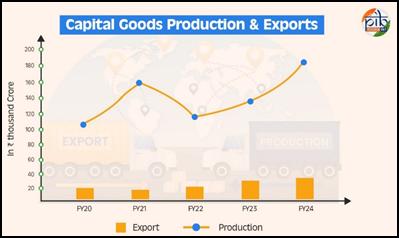
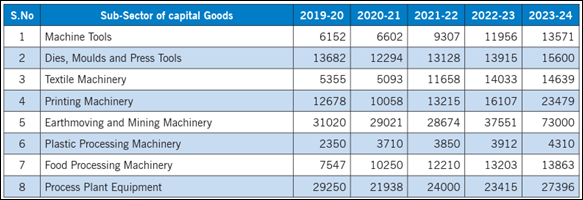
As per the present estimates, the Capital Goods industry contributes about 1.9% of GDP.  The Heavy Engineering and Machine Tool sector (capital goods industry) consists of the following major sub-sectors: Dies, Moulds and Press Tools; Plastic Machinery; Earthmoving and Mining Machinery; Metallurgical Machinery; Textile Machinery; Process Plant Equipment; Printing Machinery; and Food Processing Machinery. Due to catalytic effect of Ministry of Heavy Industries intervention, the production of capital goods sector has increased from Rs 2,29,533 crore in 2014-15 to Rs.4,29,001 crore in 2023-24. Production (in crores) by the sub-sectors of capital goods industry since 2019-20 are presented in the table below:
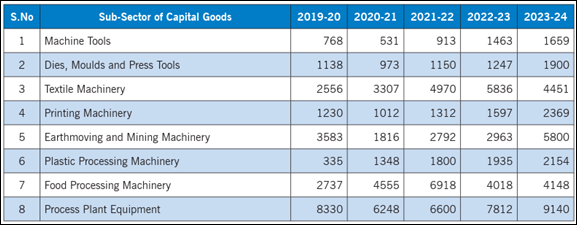
Exports (in crores) by the sub-sectors of capital goods industry since 2019-20 are presented in the table below:
The policy environment for the capital goods sector includes:

  • No industrial license is required for the sector.
  • FDI up to 100% permitted on automatic route (through RBI) except from the countries having land borders with India.
  • Quantum of payment for technology transfer, design and drawing, royalty, etc. to the foreign collaborator is not restricted.
  • There is no restriction on imports and exports.

The Union Budget 2025-26 proposes to add 35 additional capital goods for EV battery manufacturing, and 28 additional capital goods for mobile phone battery manufacturing to the list of exempted capital goods. This will boost domestic manufacture of lithium-ion battery, both for mobile phones and electric vehicles.

National Capital Goods Policy (2016)

The National Capital Goods Policy, formulated by the Ministry of Heavy Industries & Public Enterprises, is a comprehensive framework aims at boosting the capital goods sector in India. policy envisions increasing the sector's contribution to manufacturing activity from 12% (2016) to 20% by 2025. It seeks to make India one of the top capital goods producing nations, aiming to more than double production and increase exports to at least 40% of the total production. Furthermore, the policy aims to enhance the technology depth within the sector, moving from basic and intermediate levels to advanced levels.
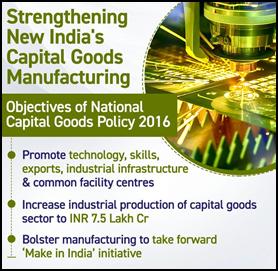
The major salient features of the policy are:

  1. To increase budgetary allocation and scope of the Scheme on Enhancement of Competitiveness in the Capital Goods Sector adding components i.e. skills, capacity building, advanced manufacturing and cluster development.
  2. To launch a Technology Development Fund under PPP model to fund technology acquisition/ transfer, purchase of IPRs/ designs and drawings/ commercialization.
  3. To set up regional State-of-the-Art Greenfield Centre of Excellence for skill development.
  4. To modernize existing CG manufacturing units, especially SMEs by replacing with the modern, computer controlled and energy efficient machineries across capital goods sub-sectors.
  5. To upgrade/ develop, testing and certification infrastructure.

The National Capital Goods Policy, 2016, inter alia, recommended increasing the budgetary allocation and scope of the Scheme on Enhancement of Competitiveness of Capital Goods which included setting up of Centers of Excellence, Common Engineering Facility Centers, Integrated Industrial Infrastructure Park and Technology Acquisition Fund Programme. These recommendations were incorporated in the Phase II of the scheme.

Scheme for Enhancement of Competitiveness in the Indian Capital Goods Sector Phase I

In order to address the skill gaps, infrastructure development and technology needs for the capital goods sector, Phase I of the capital goods scheme was rolled out in November 2014 which had the total outlay of Rs 995.96 crores. Phase I of the scheme fostered partnerships between academia and industry for engendering technology development with government support. The outcome of the Scheme has proved the efficacy of the strategies deployed for technology and industrial infrastructure development.

  • Centre of Excellence (CoE): 8 CoEs have been established wherein 30 niche indigenous technologies have been successfully developed in the fields of machine tools, additive manufacturing, textile machinery, welding robots and alloys design, earth moving machinery, and sensor technologies at national research institutes of eminence such as Indian Institute of Technology (IITs), Indian Institute of Sciences (IISc), Central Manufacturing Technology Institute (CMTI) etc.
  • Common Engineering Facility Centres (CEFC) - 15 CEFCs including four Industry 4.0 SAMARTH centres and six Web-Based Technology Innovation Platforms (TIPs) have been setup. Industry 4.0 SAMARTH centres are at Indian Institute of Sciences at Bengaluru, Centre for Industry 4.0 (C4i4) lab at Pune, Central Manufacturing Technology Institute (CMTI) at Bengaluru and Indian Institute of Technology (IIT) Delhi.
  • The six web-based open manufacturing technology innovation platforms are helping in bringing all India’s technical resources and the concerned Industry on to one platform to kick start and facilitate identification of technology problems faced by Indian Industry and crowd source solutions for the same in a systematic manner so as to facilitate start-ups and angel funding of India innovations.
  • Over 76,000 students, experts, institutes, industries and labs have already registered on these platforms so far.
  • Technology Acquisition Fund Programme (TAFP) – Following 5 technologies have been acquired from abroad under TAFP:
  1. Development & Commercialization of Titanium Casting with Ceramic Shelling Technology;
  2. Manufacturing of Heavy-Duty High Reliability Electrical Specialized Power Cables;
  3. Development of Turn Mill Centre;
  4. Development of Four Guideway CNC Lathe;
  5. Cutting Edge Robotic Laser Cladding Technology.
  • Integrated Machine Tools Park, Tumakuru: An exclusive industrial park for machine tool industry has been developed across 530 acres at Tumkuru, Karnataka. So far, out of 336 acres of allottable land, 145 acres of land has been allotted to the machine tool manufacturers.

Under Phase- I of the Scheme for Enhancement of Competitiveness in the Indian Capital Goods Sector, 33 projects with budgetary support of Rs. 583.312 crore were sanctioned. After launching of the Capital Goods Scheme Phase II, The Phase I of the Capital Goods Scheme has been merged with Phase II of the Scheme.

Scheme for Enhancement of Competitiveness in the Indian Capital Goods Sector Phase II

Ministry of Heavy Industries notified the Phase 2 of the Scheme on January 25, 2022, with an objective to expand and enlarge the impact created by Phase I of the capital goods scheme, thereby providing greater impetus through creation of a strong and globally competitive capital goods sector. The scheme has a financial outlay of Rs. 1207 crores with budgetary support of Rs. 975 crore and industry contribution of Rs. 232 crores. Under the Phase II, a total of 33 projects with project cost of Rs 1366.94 crores (due to higher contribution by Industry) and government contribution of Rs 963.19 crore have been sanctioned by August 2024. There are six components under the Phase II and the details of the projects sanctioned so far are:

  • Setting up of New Advanced Centres of Excellence and augmentation of Existing Centres of Excellence: To expedite R&D by utilizing academia of repute and private industry which is involved in research and development activities. A total of 9 projects with the budget of Rs. 478.87 have been sanctioned so far.
  • Setting up of Common Engineering Facility Centres (CEFCs) and augmentation of existing CEFCs: For creating demonstration & training, consultancy, hand holding and R & D services and awareness programmes to industrial units. A total of 5 projects with the budget of Rs. 357.07 have been sanctioned so far.
  • Promotion of skilling in Capital Goods Sector: Creation of Qualification packages for skill levels 6 and above- in association with Skill Councils for skills level 6 and above. A total of 3 projects with the budget of Rs. 7.59 have been sanctioned so far.
  • Augmentation of Existing Testing and Certification Centres: To address the needs of Capital Goods Sector & Auto sector for testing of machinery in terms of various properties relating to mechanical, electrical, chemical, structural, metallurgical, electronics aspects etc. A total of 7 projects with the budget of Rs. 195.99 have been sanctioned so far.
  • Setting up of Industry Accelerators for Technology Development: Aimed at development of targeted indigenous technologies, scaled to meet the requirements of selected industry segment, which till now has been dependent on imports. Selected Academic Institute/ Industry Body will act as an Accelerator for fostering the development of such technologies. A total of 8 projects with the budget of Rs. 325.32 have been sanctioned so far.
  • Identification of Technologies through Technology Innovation Portals: Six Web-based open manufacturing technology innovation platforms have been developed under CG Scheme Phase-I. These are being supported under CG Scheme Phase-II.

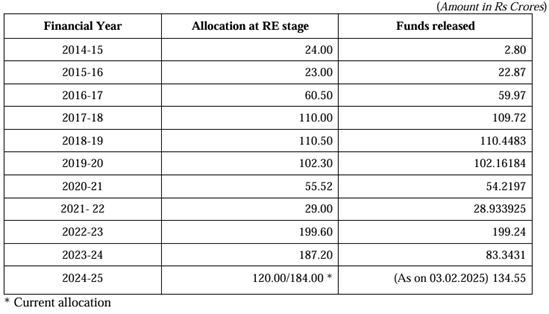
The details of the funds allocated and its utilization under the Scheme for Enhancement of Competitiveness in the Indian Capital Goods Sector Phase- I and II is as given in the table below:
Recent Achievements of the Capital Goods Scheme

  1. Sitarc, Coimbatore has indigenously developed a 6-inch BLDC submersible pump with a motor efficiency of 88% and a pump efficiency of 78% under the Capital Goods Scheme. This initiative promotes "Aatmanirbharta" by reducing the import of such pumps by 80%. This innovation was recognized as the best product in the pumps category by United Nations Industrial Development Organization (UNIDO).
  2. CMTI has developed a high-speed rapier loom machine capable of weaving yarns upto 450 RPM. This machine was launched at ITMA 2023 in Milan, Italy.
  3. Under the SAMARTH centre at CMTI, Industrial Internet of Things (IIOT) technology has been implemented in Toyota Engine Manufacturing line controlling 64 machines for preventive maintenance.
  4. A testing facilities for battery and Battery Management System (BMS) has been established at ARAI, Pune for the first time in India under the aegis of Ministry of Heavy Industries.
  5. 6 Smart Technologies, 5 Smart Tools, 14 solutions have been developed in digital twin, virtual reality, robotics, inspection, sustainability, additive manufacturing etc. by I-4.0 India @ IISc, Bengaluru;
  6. Under Industry Accelerator at ARAI-Advanced Mobility Transformation & Innovation Foundation (AMTIF) a high-voltage motor controller developed, which enabled the industry partner Raptee Energy Private Limited to launch a high-voltage motorcycle with electric car DNA.
  7. Under Industry Accelerator at ARAI-Advanced Mobility Transformation & Innovation Foundation (AMTIF) thermally stable sodium-ion batteries developed.

Bharat Heavy Electricals Limited (BHEL)

BHEL is a major contributor towards engineering and manufacturing capacity building for the Country. The company is carrying out following initiatives with support from Ministry of Heavy industries under the Capital Goods Scheme Phase II:

• BHEL has established a “Common Engineering Facility Centre (CEFC)” for skill development in Welding Technology at WRI Trichy along with its extension centers at Varanasi, Ranipet, Bhopal, Jhansi and Haridwar units of BHEL.

•  BHEL is establishing a testing facility comprising both Hardware in the Loop (HIL) and Software in the Loop (SIL) functionalities in the area of Industrial, Naval and Aircraft related processes at its Corporate R&D Unit at Hyderabad with support from Ministry of Heavy Industries.

Conclusion

The ‘Make in India’ initiative has had a transformative impact on the heavy industries and engineering sector. By fostering technological advancements, increasing domestic production, enhancing competitiveness, and generating employment, the initiative has played a pivotal role in strengthening India’s industrial base. With sustained policy support and continued investment, the sector is poised for further growth in the coming years.

References

https://www.investindia.gov.in/sector/capital-goods

https://pib.gov.in/PressReleseDetail.aspx?PRID=2098364

https://pib.gov.in/PressReleasePage.aspx?PRID=2085938

https://www.pib.gov.in/PressReleasePage.aspx?PRID=2042179

https://pib.gov.in/PressReleaseIframePage.aspx?PRID=2039020

https://www.indiabudget.gov.in/economicsurvey/doc/echapter.pdf

https://heavyindustries.gov.in/heavy-engineering-and-machine-tool

https://x.com/investindia/status/1302798627337723904?lang=ar-x-fm

https://heavyindustries.gov.in/sites/default/files/2023-07/Capital-Goods-Policy-Final.pdf

https://sansad.in/getFile/loksabhaquestions/annex/184/AU1227_CBVr5x.pdf?source=pqals

https://sansad.in/getFile/loksabhaquestions/annex/182/AU1375_e9YzYN.pdf?source=pqals

https://heavyindustries.gov.in/scheme-enhancement-competitiveness-indian-capital-goods-sector-phase-i

https://heavyindustries.gov.in/scheme-enhancement-competitiveness-indian-capital-goods-sector-phase-ii

https://heavyindustries.gov.in/sites/default/files/2025-02/heavy_annual_report_2024-25_final_27.02.2025_compressed.pdf

Topics

Acts Income Tax
