 TaxTMI
 Login
 TaxTMI
Login
Loading...
Press 'Enter' to add multiple search terms. Rules for Better Search

Press 'Enter' after typing page number.
Press 'Enter' after typing page number.


No Folders have been created
Are you sure you want to delete "My most important" ?
NOTE:
Press 'Enter' after typing page number.
Press 'Enter' after typing page number.

All News
Press 'Enter' after typing page number.
All News

Note

Bookmark

Share


A Push for Domestic and Global Competitiveness
Introduction
India’s manufacturing sector is undergoing a transformative shift, driven by visionary policies aimed at redefining its global standing. At the heart of this transformation is the Production Linked Incentive (PLI) Scheme, a cornerstone of the government’s strategy to establish India as a global manufacturing powerhouse while promoting innovation, efficiency, and competitiveness across key industries.
In a strong push to accelerate industrial growth, the Government has significantly increased budget allocations for key sectors under the PLI Scheme in 2025-26, reaffirming its commitment to strengthening domestic manufacturing. Several sectors have witnessed substantial hikes, with allocations for Electronics and IT Hardware soaring from ₹5,777 crore (revised estimate for 2024-25) to ₹9,000 crore, and Automobiles and Auto Components seeing a remarkable jump from ₹346.87 crore to ₹2,818.85 crore. The Textile sector has also received a major boost, with its allocation surging from ₹45 crore to ₹1,148 crore.
| PLI Schemes with the Highest Budget Allocation (2025-26) | ||
| Name of the Scheme | Revised Estimates 2024-25 (₹ Crores) | Budget Estimates 2025-26 (₹ Crores) |
| Production Linked Incentive (PLI) Scheme | 5777.00 | 9000.00 |
| PLI for Automobiles and Auto Components | 346.87 | 2818.85 |
| PLI for Pharmaceuticals | 2150.50 | 2444.93 |
| PLI for Textile | 45.00 | 1148.00 |
| PLI for White Goods (ACs and LED Lights) | 213.57 | 444.54 |
| PLI for Specialty Steel | 55.00 | 305.00 |
| PLI for National Programme on Advanced Chemistry Cell (ACC) Battery Storage | 15.42 | 155.76 |
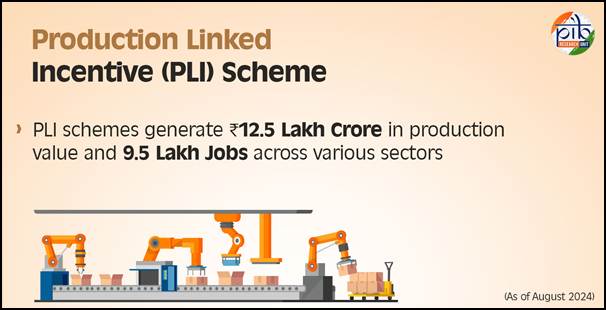
Launched in 2020, the PLI Scheme is more than just a policy; it is a strategic leap toward self-reliance. By targeting industries like electronics, textiles, pharmaceuticals, and automobiles, the initiative offers financial incentives tied directly to measurable outcomes such as higher production and incremental sales. This performance-driven approach not only attracts investments from domestic and global players but also encourages businesses to embrace cutting-edge technologies and achieve economies of scale.
Sectors Covered Under PLI Scheme
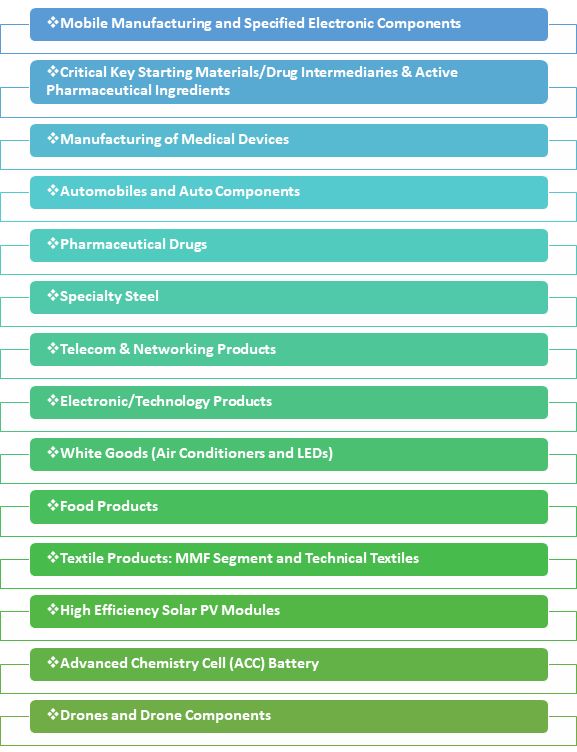
With an impressive outlay of ₹1.97 lakh crore (over US$26 billion), the PLI Schemes focus on 14 critical sectors, each strategically chosen to enhance the country’s manufacturing prowess, foster technological advancements, and elevate India’s position in global markets. These sectors are aligned with the government's goal of strengthening domestic production and expanding exports, contributing to the broader vision of Atmanirbhar Bharat.
The 14 sectors covered under the PLI Scheme include:
Achievements and Impact
The Production Linked Incentive (PLI) Schemes have made significant strides in transforming India’s manufacturing landscape. As of August 2024, actual investments totalling ₹1.46 lakh crore have been realized, with projections suggesting this figure will cross ₹2 lakh crore within the next year. These investments have already led to a remarkable boost in production and sales, amounting to ₹12.50 lakh crore, while directly and indirectly generating approximately 9.5 lakh jobs—this number is expected to rise to 12 lakhs in the near future.
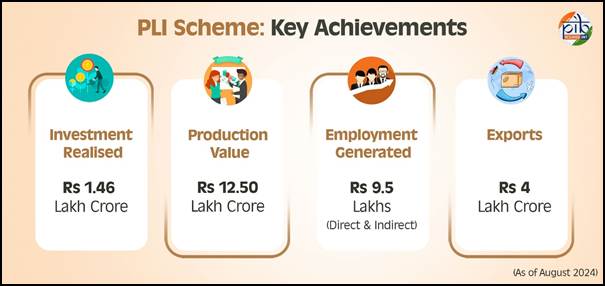
Exports have also seen a substantial uptick, surpassing ₹4 lakh crore, driven by key sectors such as electronics, pharmaceuticals, and food processing. The success of these schemes is evident in the accelerated growth of domestic industries, the increasing global competitiveness of Indian products, and the creation of millions of employment opportunities, all contributing to the nation’s broader economic goals.
FDI Reforms and their Impact
The PLI Scheme focuses on attracting investment in high-tech industries, strengthening domestic manufacturing capabilities, and enhancing India’s global competitiveness. By targeting key sectors, it aims to boost industrial growth and position India as a major manufacturing hub.
To support this objective, the Government of India has introduced a liberalized Foreign Direct Investment (FDI) policy to promote manufacturing and economic expansion. Most sectors, including manufacturing, allow 100% FDI under the automatic route, removing the need for prior government approval. Between 2019 and 2024, significant FDI reforms were implemented, such as permitting 100% FDI in coal and contract manufacturing (2019), increasing the FDI limit in insurance to 74% while bringing the telecom sector under the automatic route (2021), and liberalizing the space sector (2024). These measures aim to attract global investors, enhance industrial capabilities, and boost domestic production.
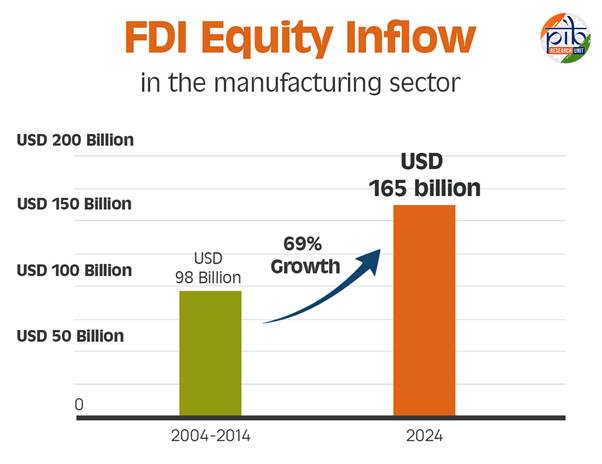
As a result of these reforms, FDI equity inflow in the manufacturing sector increased by 69%, rising from USD 98 billion (2004-2014) to USD 165 billion (2014-2024). With an investor-friendly approach and streamlined approval processes, the government continues to strengthen India's position as a leading global manufacturing destination.
Other sector specific achievements include:
Largescale Electronics Manufacturing (LSEM)
India’s electronics manufacturing sector has flourished under the PLI scheme, transforming from a net importer to a net exporter of mobile phones. Domestic production grew from 5.8 crore units in 2014-15 to 33 crore units in 2023-24, with imports dropping significantly. Exports reached 5 crore units, and Foreign Direct Investment increased by 254%, highlighting the scheme’s role in boosting manufacturing and investment.
Pharmaceuticals, Medical Devices, and Bulk Drugs
The PLI scheme has strengthened India’s position in the global pharmaceuticals market, making it the third-largest player by volume. Exports now account for 50% of production, and the country has reduced reliance on imports by manufacturing key bulk drugs like Penicillin G. Additionally, global companies have transferred advanced medical device technology, enabling India to produce critical equipment like CT scanners and MRI machines locally.
Automotive Industry
With an outlay of US$ 3.5 billion (₹20,750 crore), the automotive PLI scheme has driven significant investments and boosted production of high-tech automotive products. Over 115 companies applied, with 85 approved for incentives, attracting US$ 8.15 billion (₹67,690 crore) in investments, far exceeding the target. This success has strengthened India’s position in the global automotive sector.
Renewable Energy and Solar PV
The PLI scheme for solar PV modules has accelerated India’s renewable energy goals. The first phase, with an outlay of US$ 541.8 million (₹4,500 crore), established manufacturing capacity, while the second tranche aims to build 65 GW of capacity with US$ 2.35 billion (₹19,500 crore). The initiative is expected to create jobs, reduce imports, and drive solar innovation.
Telecom and Networking Products
India has achieved 60% import substitution in telecom products under the PLI scheme. Global tech companies have set up manufacturing units, turning India into a major exporter of 4G and 5G telecom equipment. This growth strengthens India’s telecom infrastructure and enhances its position in the global supply chain.
Drones and Drone Components
The drone sector has experienced rapid growth, with turnover increasing seven-fold under the PLI scheme. Driven by MSMEs and start-ups, this success has attracted significant investments and job creation, positioning India as a global leader in drone manufacturing.
Conclusion
The PLI Scheme stands as a cornerstone of India’s vision for Atmanirbhar Bharat and Make in India, driving self-reliance, innovation, and global competitiveness. With increased budget allocations, rising investments, and expanding exports, it is transforming key industries while reducing import dependence. By fostering a resilient and technologically advanced manufacturing ecosystem, the scheme is set to propel India toward sustained economic growth and leadership in global supply chains.
References:

