 TaxTMI
 Login
 TaxTMI
Login
Loading...
Press 'Enter' to add multiple search terms. Rules for Better Search
 of 3376
Press 'Enter' after typing page number.
of 3376 Press 'Enter' after typing page number.


No Folders have been created
Are you sure you want to delete "My most important" ?
NOTE:
of 3376 Press 'Enter' after typing page number.
of 3376 Press 'Enter' after typing page number.

All News
of 3376 Press 'Enter' after typing page number.
All News
 Join Channel
Note

Bookmark

Share


NO INCOME TAX ON AVERAGE MONTHLY INCOME OF UPTO RS 1 LAKH; TO BOOST MIDDLE CLASS HOUSEHOLD SAVINGS & CONSUMPTION
SALARIED CLASS TO PAY NIL INCOME TAX UPTO ₹ 12.75 LAKH PER ANNUM IN NEW TAX REGIME
UNION BUDGET RECOGNISES 4 ENGINES OF DEVELOPMENT – AGRICULTURE, MSME, INVESTMENT AND EXPORTS
BENEFITTING 1.7 CRORE FARMERS, ‘PRIME MINISTER DHAN-DHAANYA KRISHI YOJANA’ TO COVER 100 LOW AGRICULTURAL PRODUCTIVITY DISTRICTS
“MISSION FOR AATMANIRBHARTA IN PULSES” WITH A SPECIAL FOCUS ON TUR, URAD AND MASOOR TO BE LAUNCHED
LOANS UPTO Rs. 5 LAKHS THROUGH KCC UNDER MODIFIED INTEREST SUBVENTION SCHEME
FY-25 ESTIMATED TO END WITH FISCAL DEFICIT OF 4.8%, TARGET TO BRING IT DOWN TO 4.4% IN FY-26
SIGNIFICANT ENHANCEMENT OF CREDIT WITH GUARANTEE COVER TO MSMEs FROM ₹ 5 CR TO ₹ 10 CR
A NATIONAL MANUFACTURING MISSION COVERING SMALL, MEDIUM AND LARGE INDUSTRIES FOR FURTHERING “MAKE IN INDIA”
50,000 ATAL TINKERING LABS IN GOVERNMENT SCHOOLS IN NEXT 5 YEARS
CENTRE OF EXCELLENCE IN ARTIFICIAL INTELLIGENCE FOR EDUCATION, WITH A TOTAL OUTLAY OF ₹ 500 CRORE
PM SVANIDHI WITH ENHANCED LOANS FROM BANKS, AND UPI LINKED CREDIT CARDS WITH ₹ 30,000 LIMIT
GIG WORKERS TO GET IDENTITY CARDS, REGISTRATION ON E-SHRAM PORTAL & HEALTHCARE UNDER PM JAN AROGYA YOJANA
₹ 1 LAKH CRORE URBAN CHALLENGE FUND FOR ‘CITIES AS GROWTH HUBS’
NUCLEAR ENERGY MISSION FOR R&D OF SMALL MODULAR REACTORS WITH AN OUTLAY OF ₹ 20,000 CRORE
MODIFIED UDAN SCHEME TO ENHANCE REGIONAL CONNECTIVITY TO 120 NEW DESTINATIONS
₹ 15,000 CRORE SWAMIH FUND TO BE ESTABLISHED FOR EXPEDITIOUS COMPLETION OF ANOTHER 1 LAKH STRESSED HOUSING UNITS
₹ 20,000 CRORE ALLOCATED FOR PRIVATE SECTOR DRIVEN RESEARCH DEVELOPMENT AND INNOVATION INITIATIVES
GYAN BHARATAM MISSION FOR SURVEYAND CONSERVATION OF MANUSCRIPTS TO COVER MORE THAN ONE CRORE MANUSCRIPTS
FDI LIMIT ENHANCED FOR INSURANCE FROM 74 TO 100 PER CENT
JAN VISHWAS BILL 2.0 TO BE INTRODUCED FOR DECRIMINALISING MORE THAN 100 PROVISIONS IN VARIOUS LAWS
UPDATED INCOME TAX RETURNS TIME LIMIT INCREASED FROM TWO TO FOUR YEARS
DELAY IN TCS PAYMENT DECRIMINALISED
TDS ON RENT INCREASED FROM ₹ 2.4 LAKH TO ₹ 6 LAKH
BCD EXEMPTED ON 36 LIFESAVING DRUGS AND MEDICINES FOR TREATING CANCER, RARE AND CHRONIC DISEASES
BCD ON IFPD INCREASED TO 20% AND ON OPEN CELLS REDUCED TO 5%
BCD ON PARTS OF OPEN CELLS EXEMPTED TO PROMOTE DOMESTIC MANUFACTURING
TO BOOST BATTERY PRODUCTION, ADDITIONAL CAPITAL GOODS FOR EV AND MOBILE BATTERY MANUFACTURING EXEMPTED
BCD EXEMPTED FOR 10 YEARS ON RAW MATERIALS & COMPONENTS USED FOR SHIP BUILDING
BCD REDUCED FROM 30% TO 5% ON FROZEN FISH PASTE AND 15% TO 5% ON FISH HYDROLYSATE
Union Minister of Finance and Corporate Affairs Smt. Nirmala Sitharaman presented the Union Budget 2025-26 in Parliament today. Here is the summary of her budget speech;
PART A
Quoting Telugu poet and playwright Shri Gurajada Appa Rao’s famous saying, ‘A country is not just its soil; a country is its people.’ – the Finance Minister presented the Union Budget 2025-26 with the theme “Sabka Vikas” stimulating balanced growth of all regions.
In line with this theme, the Finance Minister outlined the broad Principles of Viksit Bharat to encompass the following:
a) Zero-poverty;
b) Hundred per cent good quality school education;
c) Access to high-quality, affordable, and comprehensive healthcare;
d) Hundred per cent skilled labour with meaningful employment;
e) Seventy per cent women in economic activities; and
f) Farmers making our country the ‘food basket of the world’.
The Union Budget 2025-2026 promises to continue Government’s efforts to accelerate growth, secure inclusive development, invigorate private sector investments, uplift household sentiments, and enhance spending power of India’s rising middle class. The Budget proposes development measures focusing on poor (Garib), Youth, farmer (Annadata) and women (Nari).
The Budget aims to initiate transformative reforms in Taxation, Power Sector, Urban Development, Mining, Financial Sector, and Regulatory Reforms to augment India’s growth potential and global competitiveness.
Union Budget highlights that Agriculture, MSME, Investment, and Exports are engines in the journey to Viksit Bharat using reforms as fuel, guided by the spirit of inclusivity.
1st Engine: Agriculture
Budget announced ‘Prime Minister Dhan-Dhaanya Krishi Yojana’ in partnership with states covering 100 districts to increase productivity, adopt crop diversification, augment post-harvest storage, improve irrigation facilities, and facilitate availability of long-term and short-term credit.
A comprehensive multi-sectoral ‘Rural Prosperity and Resilience’ programme will be launched in partnership with states to address underemployment in agriculture through skilling, investment, technology, and invigorating the rural economy. The goal is to generate ample opportunities in rural areas, with focus on rural women, young farmers, rural youth, marginal and small farmers, and landless families.
Union Finance Minister announced that Government will launch a 6-year “Mission for Aatmanirbharta in Pulses” with special focus on Tur, Urad and Masoor. Central agencies (NAFED and NCCF) will be ready to procure these 3 pulses, as much as offered during the next 4 years from farmers.
The Budget has outlined measures to Comprehensive Programme for Vegetables & Fruits, National Mission on High Yielding Seeds, and a five year Mission for Cotton Productivity amongst other measures to promote agriculture and allied activities in a major way.
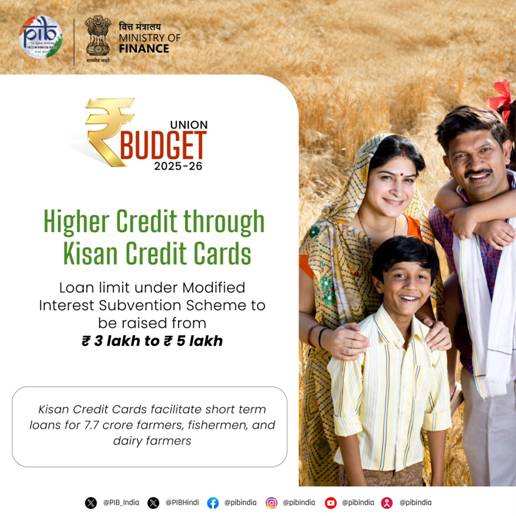
Smt. Sitharaman announced the increase in loan limits from Rs. 3 lakh to Rs. 5 lakh for loans taken through Kisan Credit Cards under modified interest subvention scheme.
2nd Engine: MSMEs
Finance Minister described MSMEs as the second power engine for development as they constitute for 45% of our exports. To help MSMEs achieve higher efficiencies of scale, technological upgradation and better access to capital, the investment and turnover limits for classification of all MSMEs enhanced to 2.5 and 2 times, respectively. Further, steps to enhance credit availability with guarantee cover have also been announced.
The Finance Minister also announced the launch of a new scheme for 5 lakh women, Scheduled Castes and Scheduled Tribes first-time entrepreneurs. This will provide term loans up to Rs. 2 crore during the next 5 years.
Smt. Sitharaman announced that the Government will also implement a scheme to make India a global hub for toys representing the 'Made in India' brand. She added that the Government will set up a National Manufacturing Mission covering small, medium and large industries for furthering “Make in India”.
3rd Engine: Investment
Defining Investment as the third engine of growth, the Union Minister prioritized investment in people, economy and innovation.
Under the investment in people, she announced that 50,000 Atal Tinkering Labs will be set up in Government schools in next 5 years.
Smt. Nirmala Sitharaman announced that broadband connectivity will be provided to all Government secondary schools and primary health centres in rural areas under the Bharatnet project.
She said Bharatiya Bhasha Pustak Scheme will be implemented to provide digital-form Indian language books for school and higher education.
Five National Centres of Excellence for skilling will be set up with global expertise and partnerships to equip our youth with the skills required for “Make for India, Make for the World” manufacturing.
A Centre of Excellence in Artificial Intelligence for education will be set up with a total outlay of 500 crore.
Budget announced that Government will arrange for Gig workers’ identity cards, their registration on the e-Shram portal and healthcare under PM Jan Arogya Yojana.
Under the investment in Economy, Smt Sitharaman said Infrastructure-related ministries will come up with a 3-year pipeline of projects in PPP mode.
She added that an outlay of Rs 1.5 lakh crore was proposed for the 50-year interest free loans to states for capital expenditure and incentives for reforms.
She also announced the second Asset Monetization Plan 2025-30 to plough back capital of Rs 10 lakh crore in new projects.
The Jal Jeevan Mission was extended till 2028 with focus on the quality of infrastructure and Operation & Maintenance of rural piped water supply schemes through “Jan Bhagidhari”.
Government will set up an Urban Challenge Fund of Rs.1 lakh crore to implement the proposals for ‘Cities as Growth Hubs’, ‘Creative Redevelopment of Cities’ and ‘Water and Sanitation’.
Under the investment in Innovation, an allocation of ₹20,000 crore is announced to implement private sector driven Research, Development and Innovation initiative.
Finance Minister proposed National Geospatial Mission to develop foundational geospatial infrastructure and data which will benefit urban planning.
Budget proposes Gyan Bharatam Mission, for survey, documentation and conservation of more than 1 crore manuscripts with academic institutions, museums, libraries and private collectors. A National Digital Repository of Indian knowledge systems for knowledge sharing is also proposed.
4th Engine: Exports
Smt. Sitharaman defined Exports as the fourth engine of growth and said that jointly driven by the Ministries of Commerce, MSME, and Finance; Export Promotion Mission will help MSMEs tap into the export market. She added that a digital public infrastructure, ‘BharatTradeNet’ (BTN) for international trade was proposed as a unified platform for trade documentation and financing solutions.
The Finance Minister mentioned that support will be provided to develop domestic manufacturing capacities for our economy’s integration with global supply chains. She also announced that government will support the domestic electronic equipment industry for leveraging the opportunities related to Industry 4.0. A National Framework has also been proposed for promoting Global Capability Centres in emerging tier 2 cities.
The government will facilitate upgradation of infrastructure and warehousing for air cargo including high value perishable horticulture produce.
Reforms as the Fuel
Defining Reforms as the fuel to the engine, Smt. Sitharaman said that over the past 10 years, the Government had implemented several reforms for convenience of tax payers, such as faceless assessment, tax payers charter, faster returns, almost 99 per cent returns being on self-assessment, and Vivad se Vishwas scheme. Continuing with these efforts, she reaffirmed the commitment of the tax department to “trust first, scrutinize later”.
Financial Sector Reforms and Development
In a demonstrated steadfast commitment of the Government towards ‘Ease of Doing Business’, the Union Finance Minister proposed changes across the length and breadth of the financial landscape in India to ease compliance, expand services, build strong regulatory environment, promote international and domestic investment, and decriminalisation of archaic legal provisions.
The Union Finance Minister proposed to raise the Foreign Direct Investment (FDI) limit for the insurance from 74 to 100 per cent, to be available for those companies that invest the entire premium in India.
Smt. Sitharaman proposed a light-touch regulatory framework based on principles and trust to unleash productivity and employment. She proposed four specific measures to develop this modern, flexible, people-friendly, and trust-based regulatory framework for the 21st first century, viz.:
Fiscal Consolidation
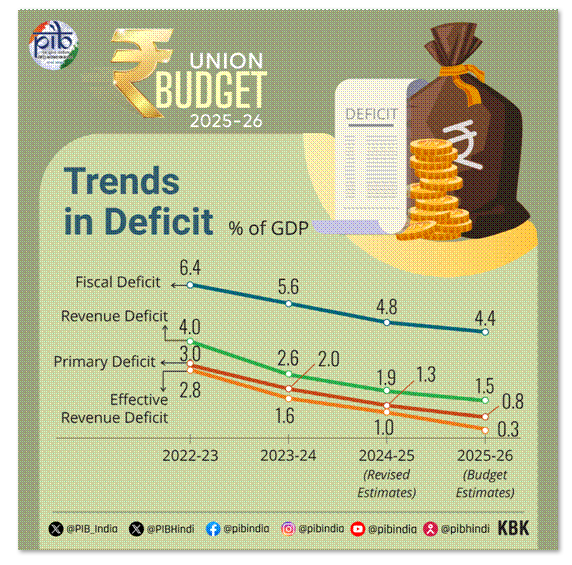
Reiterating the commitment to stay the course for fiscal consolidation, the Union Finance Minister stated that the Government endeavours to keep the fiscal deficit each year such that the Central Government debt remains on a declining path as a percentage of the GDP and the detailed roadmap for the next 6 years has been detailed in the FRBM statement. Smt. Sitharaman stated that the Revised Estimate 2024-25 of fiscal deficit is 4.8 per cent of GDP, while the Budget Estimates 2025-26 is estimated to be 4.4 per cent of GDP.
Revised Estimates 2024-25
The Minister said that the Revised Estimate of the total receipts other than borrowings is ₹31.47 lakh crore, of which the net tax receipts are ₹25.57 lakh crore. She added that the Revised Estimate of the total expenditure is ₹47.16 lakh crore, of which the capital expenditure is about ₹10.18 lakh crore.
Budget Estimates 2025-26
For FY 2025-26, the Union Finance Minister stated that the total receipts other than borrowings and the total expenditure are estimated at ₹34.96 lakh crore and ₹50.65 lakh crore respectively. The net tax receipts are estimated at ₹28.37 lakh crore.

PART B
Reposing faith on middle class in nation building, the Union Budget 2025-26 proposes new direct tax slabs and rates under the new income tax regime so that no income tax is needed to be paid for total income upto ₹ 12 Lakh per annum, i.e. average income of Rs 1 Lakh per month, other than special rate income such as Capital Gain. Salaried individuals earning upto ₹ 12.75 Lakh per annum will pay NIL tax, due to standard deduction of ₹ 75,000. Towards the new tax structure and other direct tax proposals, Government is set to lose revenue of about ₹ 1 lakh crore.
Under the guidance of Prime Minister Shri Narendra Modi, the Government has taken steps to understand the needs voiced by the people. The direct tax proposals include personal income tax reform with special focus on middle class, TDS/TCS rationalization, encouragement to voluntary compliances along with reduction of compliance burden, ease of doing business and incentivizing employment and investment.
The Budget proposes revised tax rate structure under the new tax regime as follows;
| Total Income per annum | Rate of Tax |
| ₹ 0 – 4 Lakh | NIL |
| ₹ 4 – 8 Lakh | 5% |
| ₹ 8 – 12 Lakh | 10% |
| ₹ 12 – 16 Lakh | 15% |
| ₹ 16 – 20 Lakh | 20% |
| ₹ 20 – 24 Lakh | 25% |
| Above ₹ 24 Lakh | 30% |
To rationalize TDS/TCS, Budget doubles limit for tax deduction on interest earned by senior citizens from the present ₹ 50,000 to ₹ 1 Lakh. Further, TDS threshold on rent has been increased to ₹ 6 Lakh from ₹ 2.4 Lakh per annum. Other measures include, increasing of threshold to collect TCS to ₹ 10 Lakh and continuing with higher TDS deductions only in non-PAN cases. After the decriminalization of delay in payment of TDS, delay in TCS payments has now been decriminalized.
Encouraging voluntary compliance, Budget extends time-limit to file updated returns for any assessment year, from the current limit of two years, to four years. Over 90 Lakh taxpayers paid additional tax to update their income. Small charitable trusts/institutions have been given the benefit by increasing their period of registration from 5 to 10 years, reducing compliance burden. Further, tax payers can now claim annual value of two self-occupied properties as NIL, without any condition. Last budget’s Vivad Se Vishwas Scheme has received a great response, with nearly 33,000 tax payers having availed the scheme to settle their disputes. Giving benefits to senior and very senior citizens, withdrawals made from National Savings Scheme Accounts on or after 29th of August, 2024 have been exempted. NPS Vatsalya accounts also to get similar benefits.
For ease of doing business, Budget introduces a scheme for determining arm's length price of international transaction for a block period of three years. This is in line with global best practices. Further, self harbor rules are being expanded to provide certainty in international taxation.
To promote employment and investment, a presumptive taxation regime is envisaged for non-residents who provide services to a resident company that is establishing or operating an electronics manufacturing facility. Further, benefits of existing tonnage tax scheme are proposed to be extended to inland vessels. To promote start-up ecosystem, period of incorporation has been extended for a period of 5 years. To promote investment in the infrastructure sector, Budget extends the date of making investment in Sovereign Wealth Funds and Pension Funds by five more years, to 31st March, 2030.
As part of rationalization of Customs tariffs of industrial goods, Budget proposes to; (i) Remove seven tariffs, (ii) apply appropriate cess to maintain effective duty incidence, and (iii) levy not more than one cess or surcharge.
As relief on import of Drugs/Medicines, 36 lifesaving drugs and medicines for treating cancer, rare diseases and chronic diseases have been fully exempted from Basic Customs Duty (BCD). Further, 37 medicines along with 13 new drugs and medicines under Patient Assistance Programmes have been exempted from Basic Customs Duty (BCD), if supplied free to patients.
To support Domestic Manufacturing and Value Addition, BCD on 25 critical minerals, that were not domestically available, were exempted in July 2024. The Budget 2025-26 fully exempts cobalt powder and waste, scrap of lithium-ion battery, Lead, Zinc and 12 more critical minerals. To promote domestic textile production, two more types of shuttle-less looms added to fully exempted textile machinery. Further, BCD on knitted fabrics covering nine tariff lines from “10% to 20%” revised to “20% or ₹ 115 kg, whichever is higher”.
To rectify inverted duty structure and promote “Make in India”, BCD on Interactive Flat Panel Display (IFPD) increased to 20% and on Open cells reduced to 5%. Further to promote manufacture of Open cells, BCD on parts of Open Cells stands exempted.
To boost manufacturing of Lithion-ion battery in the country, 35 additional capital goods for EV battery manufacturing, and 28 additional capital goods for mobile phone battery manufacturing added to the list of exempted capital goods. Union Budget 2025-26 also continues exemption on BCD on raw materials, components, consumables or parts for ship building for another ten years. Budget also reduced BCD from 20% to 10% on Carrier Grade ethernet switches to make it at par with Non-Carrier Grade ethernet switches.
For export promotion, Budget 2025-26 facilitates exports of handicrafts, fully exempts BCD on Wet Blue leather for value addition and employment, reduce BCD from 30% to 5% on Frozen Fish Paste and reduce BCD from 15% to 5% on fish hydrolysate for manufacture of fish and shrimp feeds.
Union Minister of Finance and Corporate Affairs Smt. Nirmala Sitharaman said that Democracy, Demography and Demand are key pillars of Viksit Bharat journey. She said that the middle class gives strength of India’s growth and the Government has periodically hiked the ‘Nil tax’ slab in recognition to their contribution. She said the proposed new tax structure will substantially boost consumption, savings and investment, by putting more money in the hands of the middle class.
