

Just a moment...

Top
Help
Upgrade to AI Tools

We've upgraded AI Tools on TaxTMI with two powerful modes:

1. Basic
Quick overview summary answering your query with referencesCategory-wise results to explore all relevant documents on TaxTMI

2. Advanced
• Includes everything in Basic
Detailed report covering:
     -   Overview Summary
     -   Governing Provisions [Acts, Notifications, Circulars]
     -   Relevant Case Laws
     -   Tariff / Classification / HSN
     -   Expert views from TaxTMI
     -   Practical Guidance with immediate steps and dispute strategy

• Also highlights how each document is relevant to your query, helping you quickly understand key insights without reading the full text.Help Us Improve - by giving the rating with each AI Result:

Explore AI Tools

Powered by Weblekha - Building Scalable Websites

×

By creating an account you can:

Logo TaxTMI
>
Call Us / Help / Feedback

Contact Us At :

E-mail: [email protected]

Call / WhatsApp at: +91 99117 96707

For more information, Check Contact Us

FAQs :

To know Frequently Asked Questions, Check FAQs

Most Asked Video Tutorials :

For more tutorials, Check Video Tutorials

Submit Feedback/Suggestion :

Email :
Please provide your email address so we can follow up on your feedback.
Category :
Description :
Min 15 characters0/2000
Make Most of Text Search
  1. Checkout this video tutorial: How to search effectively on TaxTMI.
  2. Put words in double quotes for exact word search, eg: "income tax"
  3. Avoid noise words such as : 'and, of, the, a'
  4. Sort by Relevance to get the most relevant document.
  5. Press Enter to add multiple terms/multiple phrases, and then click on Search to Search.
  6. Text Search
  7. The system will try to fetch results that contains ALL your words.
  8. Once you add keywords, you'll see a new 'Search In' filter that makes your results even more precise.
  9. Text Search
Add to...
You have not created any category. Kindly create one to bookmark this item!
Create New Category
Hide
Title :
Description :
❮❮ Hide
Default View
Expand ❯❯
Close ✕
🔎 News - Adv. Search
TEXT SEARCH:

Press 'Enter' to add multiple search terms. Rules for Better Search

Search In:
Main Text + AI Text
  • Main Text
  • Main Text + AI Text
  • AI Text
Category: ?
Categorized by AI
---- All Categories ----
  • ---- All Categories ----
  • Income Tax
  • GST
  • Customs, DGFT & SEZ
  • FEMA & RBI
  • Corp. Laws, SEBI & IBC
  • PMLA, Black Money & ED
  • Budget
  • News and Press Release
  • PTI News
Month:
---- All Months ----
  • ---- All Months ----
  • January
  • February
  • March
  • April
  • May
  • June
  • July
  • August
  • September
  • October
  • November
  • December
Year:
---- All Years ----
  • ---- All Years ----
  • 2026
  • 2025
  • 2024
  • 2023
  • 2022
  • 2021
  • 2020
  • 2019
  • 2018
  • 2017
  • 2016
  • 2015
  • 2014
  • 2013
  • 2012
  • 2011
Sort By: ?
In Sort By 'Default', exact matches for text search are shown at the top, followed by the remaining results in their regular order.
RelevanceDefaultDate
    No Records Found
    ❯❯
    MaximizeMaximizeMaximize
    0 / 200
    Expand Note
    Add to Folder

    No Folders have been created

      +

      Are you sure you want to delete "My most important" ?

      NOTE:

      News
      Showing Results for :
      Reset Filters
      Results Found:
      AI TextQuick Glance by AIHeadnote
      Show All SummariesHide All Summaries
      No Records Found

      News

      Back

      All News

      Showing Results for :
      Reset Filters
      Showing
      Records
      ExpandCollapse
        No Records Found

        News

        Back

        All News

        Showing Results for : Reset Filters
        Case ID :

        GOVERNMENT WELFARE SCHEMES SPUR CONSUMPTION AND INCOME GENERATING ACTIVITY IN LOW-INCOME HOUSEHOLDS, FAVOURABLY IMPACT STANDARD OF LIVING BY REDUCING INEQUALITY: ECONOMIC SURVEY 2024-25

        January 31, 2025

        📋
        Contents
        Note

        Note

        -

        Bookmark

        print

        Print

        Login to TaxTMI
        Verification Pending

        The Email Id has not been verified. Click on the link we have sent on

        Didn't receive the mail? Resend Mail

        Don't have an account? Register Here

        GOVERNMENT’S SOCIAL SERVICES EXPENDITURE (SSE) RISES IN TOTAL EXPENDITURE (TE), FROM 23.3% IN FY21 TO 26.2% IN FY25 (BE)

        URBAN-RURAL GAP IN CONSUMPTION EXPENDITURE DECLINES TO 70% IN 2023-24 FROM 84% IN 2011-12

        Government’s focus on empowering citizens through education, healthcare, skill development, and social infrastructure development have seen significant progress, states Economic Survey 2024-25. The document was tabled in Parliament today by Union Minister for Finance and Corporate Affairs, Smt. Nirmala Sitharaman.

        Trends in Social Service Expenditure

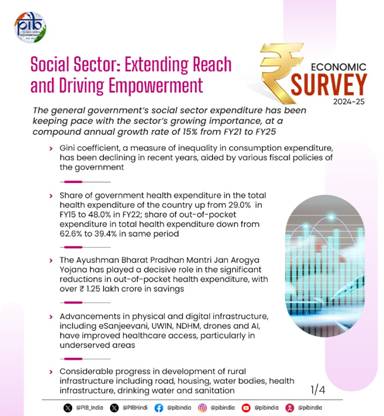
        Highlighting an increase from 23.3% in FY21 to 26.2% per cent in FY25 (BE) or a CAGR of 15%, the Economic Survey notes a rising trend in Government’s social services expenditure (SSE), as a percentage of total expenditure (TE). While the SSE outlay of the Centre and State governments was Rs. 14.8 lakh crore in FY21, it has increased steadily to stand at ₹25.7 lakh crore in FY25 (BE).

        On Education, the Survey notes that the expenditure in the sector has grown at a CAGR of 12%, from Rs. 5.8 lakh crore in FY21 to Rs. 9.2 lakh crore in FY25 (BE). On the other hand, the Survey noted a growing trend in Health sector expenditure at CAGR of 18 per cent, from Rs.  3.2 lakh crore in FY21 to Rs. 6.1 lakh crore in FY25 (BE). In the total health expenditure of the country between FY15 and FY22, the share of government health expenditure has increased from 29.0 per cent to 48.0 per cent, the Survey noted.
        Consumption Expenditure

        Evidence shows that government schemes have spurred consumption and income generating activity in low-income households, observes the Economic Survey. Various government welfare schemes such as free or subsidized food grains, subsidized cooking fuel, insurance cover, Direct Benefit Transfers under various schemes are lifting household incomes. These fiscal transfers help to provide additional resources to the financially deprived sections and, thus, favourably impact people's standard of living.

        Social sector initiatives have reduced inequality and increased consumption spending, as reflected in the Survey. The Gini coefficient, a measure of inequality in consumption expenditure, has been declining in recent years. For rural areas, it declined to 0.237 in 2023-24 from 0.266 in 2022-23, and, in urban areas it fell to 0.284 in 2023-24 from 0.314 in 2022-23.

        The Survey document highlights the results of the Household Consumption Expenditure Survey (HCES) 2023-24, which observes that the urban-rural gap in consumption expenditure is narrowing. The largest growth in average Monthly Per Capita Expenditure (MPCE) between FY 2022-23 and FY 2023-24 occurred among the bottom 5-10% of the population in both rural and urban areas. The urban-rural gap in average MPCE has declined to 71% in 2022-23 from 84% in 2011-12. It has further come down to 70% in 2023-24, which confirms the sustained momentum of consumption growth in rural areas.

        The Economic Survey notes that various fiscal policies of the government are reshaping income distribution. Food subsidies constitute the largest fiscal outlay in the government’s diverse set of social schemes. In 2022-23, Union government spent 6.5% of its budget on the PM Pradhan Mantri Garib Kalyan Anna Yojana (PMGKAY) to provide free and subsidized food rations.

        The concentration of larger benefits among lower consumption groups suggests that the PDS/PMGKAY policies support the low income and protect other vulnerable households against income fluctuations and impoverishment. On an average in 2022-23, the value of the subsidy accounted for 7% of household consumption among the rural bottom 20%, but only for 2% among the top 20%. A similar progressive pattern is observed in urban areas.

        The survey also provides insights into the allocation of these benefits across different segments of the population. In 2022-23, 84% of the population had access to a ration card, including 59% who reported holding a Below Poverty Line (BPL), Antyodaya Anna Yojana (AAY) or Priority Household (PHH) card in their household.

        Government welfare schemes boost low income household consumption and narrow consumption inequality through targeted fiscal transfers. Government welfare schemes, delivered through fiscal transfers such as food subsidies, subsidized fuel, insurance and Direct Benefit Transfers, have increased resources for low-income households and disproportionately benefited lower consumption groups, thereby stimulating consumption and income-generating activity. The Economic Survey 2024-25 links rising social services expenditure, growth in education and health outlays, widespread ration-card coverage, and progressive subsidy incidence to declining Gini coefficients and a narrowing urban-rural consumption gap, with the largest MPCE gains recorded among the poorest percentiles.
                          Cases where this provision is explicitly mentioned in the judgment/order text; may not be exhaustive. To view the complete list of cases mentioning this section, Click here.
                            Provisions expressly mentioned in the judgment/order text.

                                Government welfare schemes boost low income household consumption and narrow consumption inequality through targeted fiscal transfers.

                                Government welfare schemes, delivered through fiscal transfers such as food subsidies, subsidized fuel, insurance and Direct Benefit Transfers, have increased resources for low-income households and disproportionately benefited lower consumption groups, thereby stimulating consumption and income-generating activity. The Economic Survey 2024-25 links rising social services expenditure, growth in education and health outlays, widespread ration-card coverage, and progressive subsidy incidence to declining Gini coefficients and a narrowing urban-rural consumption gap, with the largest MPCE gains recorded among the poorest percentiles.


                                Note: It is a system-generated summary and is for quick reference only.

                                Topics

                                ActsIncome Tax
                                No Records Found