
Just a moment...

Top
Help
×

By creating an account you can:

Logo TaxTMI
>
Call Us / Help / Feedback

Contact Us At :

E-mail: [email protected]

Call / WhatsApp at: +91 99117 96707

For more information, Check Contact Us

FAQs :

To know Frequently Asked Questions, Check FAQs

Most Asked Video Tutorials :

For more tutorials, Check Video Tutorials

Submit Feedback/Suggestion :

Email :
Please provide your email address so we can follow up on your feedback.
Category :
Description :
Min 15 characters0/2000
Add to...
You have not created any category. Kindly create one to bookmark this item!
Create New Category
Hide
Title :
Description :
❮❮ Hide
Default View
Expand ❯❯
Close ✕
🔎 News - Adv. Search
TEXT SEARCH:

Press 'Enter' to add multiple search terms. Rules for Better Search

Search In:
Main Text + AI Text
  • Main Text
  • Main Text + AI Text
  • AI Text
Category: ?
Categorized by AI
---- All Categories ----
  • ---- All Categories ----
  • Income Tax
  • GST
  • Customs, DGFT & SEZ
  • FEMA & RBI
  • Corp. Laws, SEBI & IBC
  • PMLA, Black Money & ED
  • Budget
  • News and Press Release
  • PTI News
Month:
---- All Months ----
  • ---- All Months ----
  • January
  • February
  • March
  • April
  • May
  • June
  • July
  • August
  • September
  • October
  • November
  • December
Year:
---- All Years ----
  • ---- All Years ----
  • 2026
  • 2025
  • 2024
  • 2023
  • 2022
  • 2021
  • 2020
  • 2019
  • 2018
  • 2017
  • 2016
  • 2015
  • 2014
  • 2013
  • 2012
  • 2011
Sort By: ?
In Sort By 'Default', exact matches for text search are shown at the top, followed by the remaining results in their regular order.
RelevanceDefaultDate
    Rajya Sabha passes bill to tackle payment delays faced by MSMEs amid Opposition protests
    MPC's 3-day meeting begins amid expectations of status quo on interest rates
    Trane Technologies Reports Strong Second Quarter Results; Raises Full-Year Revenue and EPS Guidance
    CBN dismantles inter-state counterfeit drug network in Bihar under Operation Vajra; mastermind arrested
    DRI seizes quantities of gold; drugs, e-cigarettes and other contraband in pan-India Ops; 20 persons, including 5 foreign nationals, arrested
    Union Government releases tax devolution of ₹1,09,019 crore to State Governments, as one advance instalment to accelerate their capital and deve...
    Raymond Lifestyle Limited Delivered a stable Q1 FY27 Performance
    Rupee rises 31 paise to 95.12 against US dollar in early trade
    Customs seizes 8 kg gold worth over Rs 11 cr at Kerala airports in one week
    Drill, Baby, Drill: India to fund Rs 650 cr per well for 60 deepsea wells to break its oil import habit
    Punjab GST revenue rises 20 pc to Rs 10,447 crore in April-July: Cheema
    India-China trade through Shipli La resumes after six years
    Odisha's export can reach USD 50 billion by FY 2029-30: Study
    Andhra records 21 per cent growth in net GST collections till July
    J&K crime branch chargesheets accused in separate bank, insurance fraud cases
    MCD-facilitated PM Vishwakarma Scheme enrols over 41,000 artisans in Delhi
    Gross GST mop-up grows 15.4 pc to over Rs 2.11 lakh cr in July on higher imports, sales
    Gross and Net GST revenue collections for the month of July, 2026
    India and Rwanda Hold First Joint Trade Committee Meeting to Deepen Bilateral Trade and Investment Cooperation
    West Bengal GST collection rises 2 pc in July to Rs 5,564 crore
❯❯
MaximizeMaximizeMaximize
0 / 200
Expand Note
Add to Folder

No Folders have been created

    +

    Are you sure you want to delete "My most important" ?

    NOTE:

    News
    Showing Results for :
    Reset Filters
    Results Found:
    Show All SummariesHide All Summaries
    August 3, 2026
    Show AI Summary
    MSME delayed-payment reforms strengthen award recovery, faster dispute adjudication, invoice discounting, and interim supplier payment protection.
    MSME delayed-payment reforms seek faster adjudication, strengthened recovery and improved liquidity for enterprise suppliers. Courts may direct payment of at least half of an awarded amount where a setting-aside application remains pending beyond six months. Mediated settlements and arbitral awards may be recovered as arrears of land revenue and recognised as legally enforceable debts under the insolvency framework. The measures also provide graded penalties, voluntary digital registration, invoice settlement through the Trade Receivables Discounting System, and additional Facilitation Councils.
    August 3, 2026
    Show AI Summary
    Monetary policy rate setting remains cautious as inflation, liquidity, growth and global uncertainty shape the policy stance.
    Monetary policy rate setting is expected to remain cautious amid global uncertainty, rising inflation risks and steady domestic growth. The inflation outlook is affected by energy-price pass-through, higher input costs, and seasonal and monsoon-related food-price pressures. Policy decisions are expected to remain data-dependent, guided primarily by domestic inflation, liquidity conditions and economic growth. A cautious or neutral stance is identified as preferable while external risks and inflation developments persist.
    August 3, 2026
    Show AI Summary
    Forward-looking financial disclosure raises revenue and earnings guidance while describing non-GAAP measures, capital allocation, and material business risks.
    Financial performance reporting identifies increased bookings, revenue growth, continuing earnings, and backlog, with segment-level operating and margin measures. The release addresses cash flow, capital allocation through dividends, acquisitions and share repurchases, and increased full-year revenue and earnings guidance. Forward-looking statements concerning financial performance, operations, demand, liquidity and capital deployment are subject to identified risks and uncertainties. Non-GAAP measures are presented as supplemental to GAAP measures, with definitions and reconciliations stated to be available in accompanying materials.
    August 3, 2026
    Show AI Summary
    Counterfeit drug enforcement targets illicit manufacture, storage and trafficking networks, with coordinated seizures and referral of non-narcotic stock.
    Counterfeit-drug enforcement under Operation Vajra addressed an inter-state network involved in the illicit manufacture, storage and distribution of narcotic drugs, psychotropic substances and spurious pharmaceutical products. Searches of unregistered godowns recovered narcotic products, unauthorisedly manufactured Buprenorphine injection ampoules, and counterfeit non-NDPS medicines. A farmhouse-based illicit manufacturing facility was dismantled, with machinery, chemicals and related materials seized under the NDPS Act, 1985.
    August 3, 2026
    Show AI Summary
    Anti-smuggling enforcement targets concealed gold, narcotics, protected products, prohibited e-cigarettes and restricted imports through coordinated intelligence operations.
    Intelligence-led anti-smuggling operations resulted in seizures of foreign-origin gold, narcotic drugs, hydroponic weed, protected wildlife and forest products, prohibited electronic cigarettes, and restricted poppy seeds and areca nuts. The operations identified concealment through fabricated baggage cavities, false cargo declarations, misdeclaration of origin, forged documentation, and concealment in transport vehicles. Poppy seeds are restricted under the Foreign Trade Policy and may be imported only subject to conditions concerning legally cultivated produce from designated countries and registration of import contracts with the Narcotics Commissioner.
    August 3, 2026
    Show AI Summary
    Tax devolution advance instalment strengthens State finances for accelerated capital and developmental expenditure through distribution of Union tax proceeds.
    Tax devolution was released to State Governments as an additional advance instalment alongside the normal monthly devolution schedule. The fiscal transfer shares net proceeds of Union taxes and duties with States, with the stated purpose of strengthening State finances and supporting accelerated capital and developmental expenditure. The release includes a State-wise distribution of tax-devolution proceeds.
    August 3, 2026
    Show AI Summary
    Financial performance reporting highlights revenue and EBITDA growth, garmenting recovery, retail optimisation, ESG commitments, and forward-looking risk disclosures.
    Financial performance reflects growth in total income and EBITDA, with improved margin, reduced net working-capital days, and a net-cash position. Branded textiles and high-value cotton shirting reported lower revenue due to the prior-year base effect, while branded apparel grew but faced lower margin from channel mix. Garmenting improved through order-book execution, tariff rationalisation, and new global clients. ESG priorities include female representation, waste-management initiatives, renewable energy, emissions reduction, and workplace safety. Forward-looking statements remain subject to regulatory, political, economic, and technological risks.
    August 3, 2026
    Show AI Summary
    Foreign exchange market support strengthens the rupee as lower crude prices, portfolio inflows and reserve growth improve sentiment.
    Foreign exchange market conditions supported an early appreciation of the rupee against the US dollar, attributed to lower global crude oil prices, a weaker dollar, sustained foreign portfolio inflows, higher foreign exchange reserves, and Reserve Bank of India presence in the foreign exchange market. Domestic equity market gains and net foreign institutional equity purchases were also identified as supporting factors.
    August 2, 2026
    Show AI Summary
    Gold smuggling detection targets sophisticated concealment methods through strengthened passenger profiling, intelligence gathering and coordinated investigations into organised networks.
    Gold smuggling detection at Kerala airports led to multiple seizures, registration of cases and arrests in alleged smuggling attempts. Organised networks reportedly use gold in paste or compound forms concealed in clothing, body cavities, aircraft seats and other unconventional locations. Enforcement measures include strengthened passenger profiling, intelligence gathering and inter-agency coordination, while investigations continue to identify associated syndicates and financiers.
    August 2, 2026
    Show AI Summary
    Offshore exploration funding supports deepwater drilling, shared infrastructure and seismic data to strengthen domestic hydrocarbon production potential.
    The Samudra Manthan National Offshore Exploration Scheme provides direct budgetary support for high-risk deepwater and ultra-deepwater exploratory drilling, subject to cost-sharing and per-well limits. Support is available to eligible operators holding or securing exploration acreage. The scheme also funds offshore data acquisition and shared subsea, receipt and processing infrastructure through a Common Hub Infrastructure model. It is intended to promote risk exploration, improve commercialisation of offshore discoveries and strengthen domestic hydrocarbon production potential within the existing exploration and licensing framework.
    August 1, 2026
    Show AI Summary
    GST compliance enforcement combines taxpayer refunds, analytics-based fraud detection, cancellation of fake registrations, and recovery of outstanding VAT arrears.
    Punjab attributed increased GST collections to voluntary compliance, intelligence-based enforcement and technology-driven tax administration, while facilitating compliant taxpayers through timely GST refunds. Data analytics, risk profiling and field verification were used to identify tax evasion, bogus billing, fake input tax credit networks and misuse of the GST registration framework. Measures included penalties, cancellation of fraudulent registrations and recovery of long-pending VAT arrears through attachment and auction of defaulters' properties.
    August 1, 2026
    Show AI Summary
    Cross-border barter trade resumes through Shipki La, subject to permitted goods, time limits, and import-export compliance requirements.
    Cross-border barter trade through Shipki La between India and Tibet resumed after a six-year interruption. Traders may exchange specified goods under a barter arrangement and must return within 72 hours. Traders are required to comply strictly with import-export regulations prescribed by the Union Ministry of Commerce, emphasising transparency and regulatory compliance. Expansion of permitted goods may be pursued through prescribed governmental and external-affairs channels.
    August 1, 2026
    Show AI Summary
    Export growth projections outline pathways for Odisha to expand merchandise trade through export diversification, MSME support and financing initiatives.
    Export growth projections for Odisha set out base, optimistic and ambitious scenarios through FY 2029-30, based respectively on historical growth, envisaged national export growth, and a larger share of national exports. Odisha's export basket remains concentrated in metals and minerals, led by aluminium products, with China as the principal export destination. Odisha Vision 2047 identifies exports, including MSME contributions, as an economic transformation driver, while export-financing and risk-mitigation initiatives aim to address financing gaps for exporters and MSMEs.
    August 1, 2026
    Show AI Summary
    GST compliance enforcement through AI analytics supported sustained net GST collection growth despite rate rationalisation reforms and reduced compliance costs.
    GST revenue mobilisation in Andhra Pradesh showed year-on-year growth in net GST and total commercial tax collections through July 2026, despite rate-rationalisation reforms. Revenue growth was attributed to AI-based scrutiny and analytics, machine-learning risk scoring, AI-driven IGST reversals, UPI-based enforcement analytics, data sharing, predictive analytics, registration verification, and Aadhaar-integrated expansion of the professional-tax base. These measures were stated to strengthen compliance, curb wrongful input tax credit claims, broaden taxpayer coverage, and improve revenue mobilisation.
    August 1, 2026
    Show AI Summary
    Economic-offences fraud chargesheets address alleged fictitious loans, forged insurance surrender papers, and diversion of bank and policy funds.
    Economic-offences chargesheets were filed in separate alleged bank and insurance fraud matters. The bank investigation alleged fictitious loan sanctions and overdrafts beyond delegated authority, involving cheating, forgery, use of forged documents and criminal conspiracy. The insurance investigation alleged that duplicate policy records and forged surrender documents were used to open a fraudulent account in a policyholder's name and divert policy proceeds. Records, witness statements, documentary evidence and forensic examination were cited in support of the allegations.
    August 1, 2026
    Show AI Summary
    PM Vishwakarma Scheme implementation expands artisan enrolment, skills, credit, e-commerce access and export facilitation while addressing documentation barriers.
    PM Vishwakarma Scheme implementation in Delhi facilitated artisan enrolment, application processing, skill training, toolkit distribution, loan access, e-commerce onboarding and export-related support. Awareness workshops and tele-calling campaigns were used to promote participation and follow up on benefits. Key implementation challenges concerned outreach to informal clusters, digital literacy, delays in Aadhaar and IEC documentation, and additional support for Divyang artisans. Planned action includes expanding workshops, scaling e-commerce onboarding, strengthening export facilitation and coordination with implementing agencies.
    August 1, 2026
    Show AI Summary
    Goods and Services Tax collections rise on domestic consumption and imports, while elevated import revenue prompts assessment of underlying drivers.
    Goods and Services Tax collections for July increased over the corresponding prior-year period, supported by domestic sales and imports. Gross receipts included Central GST, State GST and Integrated GST, with net GST revenue calculated after adjusting refunds. For the April-July period, gross and net collections also increased. Commentary linked domestic GST growth to consumption, formalisation and industrial activity, while identifying elevated import GST collections as an area requiring assessment of import composition, currency effects and volumes.
    August 1, 2026
    Show AI Summary
    GST revenue collections show provisional gross, refund and net revenue trends, with State-wise settlement and domestic collection data.
    GST revenue collections for July 2026 are reported provisionally through gross domestic and import revenue, domestic and export-related refunds, and net GST revenue after refunds. The data also sets out SGST collections and the SGST share of IGST settled to States and Union Territories, both monthly and cumulatively. State-wise domestic GST growth excludes GST on imported goods, while jurisdiction-wise data allocates collections between central and State formations and identifies CGST, SGST and IGST components.
    August 1, 2026
    Show AI Summary
    Bilateral trade cooperation expands through a Joint Trade Committee covering investment, critical minerals, healthcare, digital technologies and market access.
    Bilateral trade and investment cooperation between India and Rwanda is to be advanced through a structured Joint Trade Committee mechanism for reviewing commerce, diversifying trade, promoting investment, facilitating business engagement and addressing market-access and logistical issues. Priority cooperation includes critical minerals, pharmaceuticals and healthcare, agriculture and agro-processing, standards harmonisation, digital public infrastructure, fintech, cybersecurity, green mobility and renewable energy. Investment focal points will support engagement, while capacity-building assistance and close monitoring of the Agreed Minutes are intended to support time-bound implementation.
    August 1, 2026
    Show AI Summary
    GST collection growth in West Bengal continued year-on-year in July but remained below the national growth trend.
    West Bengal's July GST collection increased year-on-year and over the preceding month, marking a second consecutive month of annual growth. Official data also indicated that the State's annual growth rate was below the national trend, while gross domestic GST revenue excluding imports and overall gross GST collections including import-related taxes rose nationally during July.

    News

    Back

    All News

    Showing Results for :
    Reset Filters
      No Records Found

      News

      Back

      All News

      whatsappJoin Channel
      Showing Results for : Reset Filters

      INDIA’S AGRICULTURE SECTOR DEMONSTRATES RESILIENCE, AVERAGE GROWTH RATE OF 5 PER CENT DURING FY17 TO FY23: ECONOMIC SURVEY

      January 31, 2025

      Contents
      Plus +
      Summary
      Note

      Note

      -

      Bookmark

      Print

      Print

      AGRICULTURAL INCOME INCREASES 5.23 PER CENT ANNUALLY OVER THE PAST DECADE

      ALLIED SECTORS HAVE BECOME KEY DRIVERS OF AGRICULTURE GROWTH: ECONOMIC SURVEY

      KHARIF FOODGRAIN PRODUCTION TO REACH 1647.05 LMT IN 2024

      INDIA’S FOOD EXPORTS CONSTITUTE 11.7 PER CENT OF INDIA’S TOTAL EXPORTS, SEAFOOD EXPORTS GROW TO 29.70 PER CENT FROM FY-20 TO FY24

      GOVERNMENT RAISED MSP SUPPORT FOR NUTRI CEREALS (SHREE ANNA), PULSES, OILSEEDS, ARHAR, BAJRA, MASUR AND RAPESEED

      PLI SCHEME FOR FOOD PROCESSING: BENEFICIARIES INVEST ₹8,910 CRORE, RECEIVE ₹1,084.01 CRORE IN INCENTIVES BY OCTOBER, 2024

      GOVERNMENT FULLY COMMITTED TO ACHIEVE 100 PER CENT e-KYC COMPLIANCE NATIONWIDE FOR PUBLIC DISTRIBUTION SYSTEM

      India’s agricultural sector has demonstrated remarkable resilience in recent years, marked by consistent growth rates, which can be largely attributed to various government initiatives to enhance productivity, promote crop diversification, and increase farmers' income, states the Economic Survey 2024-25, tabled by Union Minister of Finance and Corporate Affairs, Smt. Nirmala Sitharaman in the Parliament today.

      The Economic Survey highlights that the ‘Agriculture and Allied Activities’ sector has long been the backbone of the Indian economy, playing a vital role in national income and employment. In recent years, the agriculture sector in India has shown robust growth, averaging 5 per cent annually from FY17 to FY23, demonstrating resilience despite challenges. In the second quarter of the 2024-25 fiscal year, the agriculture sector recorded a growth rate of 3.5 per cent. The Gross Value Added (GVA) of agriculture and related sectors, have improved from 24.38 per cent in the fiscal year FY15 to an impressive 30.23 per cent by FY23. Consistent and stable growth of agriculture at around 5 per cent, with a 20 per cent share of overall GVA in the economy, will contribute 1 per cent growth to GVA.

      Chapter 9-01.jpg

      The Economic Survey notes that the kharif foodgrain production in 2024 is projected to reach 1647.05 Lakh Metric Tonnes (LMT), which is an increase of 89.37 LMT compared to the previous year. Agricultural income has increased at 5.23 per cent annually over the past decade, the survey adds.
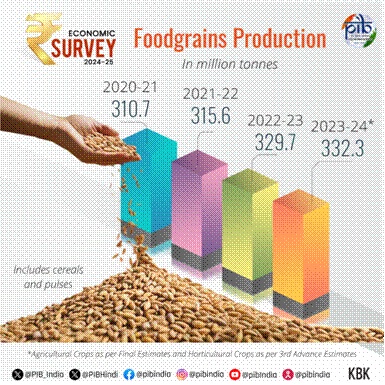
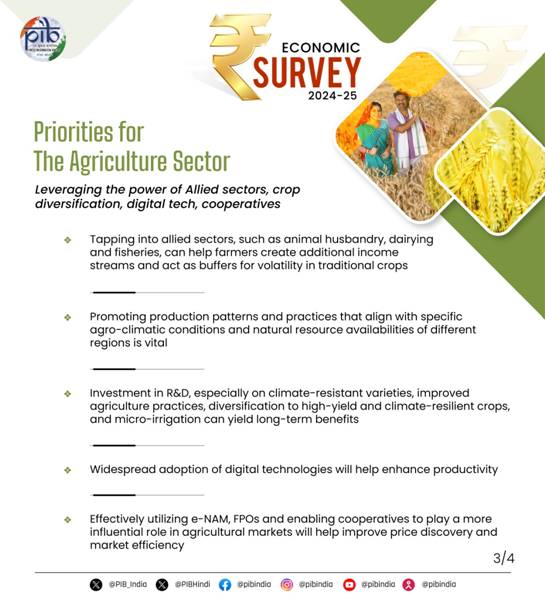
      The Economic Survey states that the government is implementing a range of initiatives aimed at enhancing agricultural productivity and increasing farmers' incomes, in alignment with the recommendations put forth in the Doubling Farmers' Income (DFI) Report 2016. This report highlighted essential strategies for improving crop and livestock productivity, boosting cropping intensity, and diversifying into high-value crops. The government is pursuing initiatives such as Per Drop More Crop (PDMC) and various actions under the National Mission on Sustainable Agriculture (NMSA). These measures include using alternative and organic fertilisers to enhance productivity and sustainability. Furthermore, digital initiatives like the Digital Agriculture Mission and the e-National Agriculture Market (e-NAM) have been launched to encourage the adoption of innovative agricultural technologies and improve price discovery mechanisms. Additionally, the government provides income support to farmers through assured remunerative prices for their produce, alongside programs such as the Pradhan Mantri Kisan Samman Nidhi (PM-KISAN).

      MINIMUM SUPPORT PRICE

      The Economic Survey states that in the Union Budget of 2018-19, the government decided the principle of fixing MSP at a level of at least 1.5 times the weighted average cost of production for these crops. The government has raised the MSP for nutri cereals (Shree Anna), pulses, and oilseeds as part of these initiatives. For the fiscal year FY25, the MSP for arhar and bajra has been increased by 59 per cent and 77 per cent over the weighted average cost of production, respectively. Moreover, the MSP for Masur has risen by 89 per cent, while rapeseed has seen an impressive increase of 98 per cent.

      IRRIGATION DEVELOPMENT

      The Economic Survey states that the government has prioritised irrigation development and water conservation practices to enhance access to irrigation facilities. Since the FY16 fiscal year, the government has been implementing the Per Drop More Crop (PDMC) initiative, a component of the Pradhan Mantri Krishi Sinchayee Yojana (PMKSY), to promote water efficiency. Financial assistance is provided at 55 per cent of the total project cost for small and marginal farmers, and 45 per cent for other farmers for installation of micro irrigation under PDMC. From FY16 to FY25 (end of Dec. 2024), ₹ 21968.75 crore was released to states for implementation of PDMC Scheme and an area of 95.58 lakh ha has been covered under which is about 104.67 per cent higher as compared to the Pre-PDMC period. The micro irrigation Fund (MIF) supports innovatiove projects through 2 per cent interest subvention to states on loans availed under MIF. Loans amounting to ₹4709 crore has been approved of which ₹3640 crore has been disbursed so far.

      LIVESTOCK

      The Economic Survey states that Allied Sectors have become key drivers of agriculture growth. The livestock sector alone represented 5.5 per cent of the total GVA, reflecting its dynamic growth trajectory, with a robust Compound Annual Growth Rate (CAGR) of 12.99 per cent. The economic significance of this sector is clearly illustrated by its escalating output value, which reached an astounding 17.25 lakh crore rupees (equivalent to US$205.81 billion) in FY23. Among the various branches of livestock production, the milk industry stands out, generating over ₹11.16 lakh crore (US$133.16 billion) in revenue. Government has supported the sector through interventions which include the Rashtriya Gokul Mission for the development and conservation of indigenous bovine breeds, the Livestock Health and Disease Control Program to enhance the well-being of livestock, Multipurpose AI Technicians in Rural India (MAITRIs) to deliver breeding inputs to farmers’ doorstep. In the last 4 years, 38736 MAITRIs have been inducted under Rashtriya Gokul Mission.

      FISHERIES

      The Economic Survey conveys that the government has implemented several initiatives to enhance the fisheries sector's production which include Pradhan Mantri Matsya Sampada Yojana (PMMSY) to boost aquaculture productivity and improve fisheries management, Fisheries and Aquaculture Infrastructure Development Fund (FIDF) to provide financial support for developing infrastructure in both marine and inland fisheries. Other initiatives include the establishment of fishing harbours and fish landing centres, the adoption of innovative production technologies such as cages, Recirculating Aquaculture Systems (RAS), bio flocs, pens, and raceways. Due to these initiatives, total fish production (both inland and marine) has surged to 184.02 lakh tonnes in FY 23, up from 95.79 lakh tonnes in FY14. Furthermore, India's seafood exports have risen from ₹46,662.85 crore in FY-20 to ₹60523.89 crore in 2023-24, reflecting a growth of 29.70 per cent. Under the Pradhan Mantri Matsya Kisan Samridhi Sah-Yojana (PM-MKSSY), the National Fisheries Digital Platform (NFDP) successfully mobilized and registered 16.35 lakh fish producers, workers, vendors, and processors within a short timeframe of just four months.
      Chapter 9-03.jpg

      FLORICULTURE

      India's floriculture industry has grown into a high-performing sector, earning its status as a "sunrise industry" with a 100 per cent export orientation. With subsidy support and crop loan financing, it is a promising venture for marginal and small landholdings, which constitute more than 96 per cent of the total landholdings with 90.9 per cent of marginal landholdings and 63 per cent of the area of cultivation under floriculture. The exports increased by 14.55 per cent in April-October FY25 over April-October FY24. In FY24, approximately 297 thousand hectares were dedicated to floriculture, yielding an estimated 2,284 thousand tonnes of loose flowers and 947 thousand tonnes of cut flowers. During the same period, India exported 19,678 metric tonnes of floriculture products, earning ₹717.83 crore (USD 86.63 million).

      HORTICULTURE

      Economic Survey states that India is a leading exporter, shipping 343,982.34 MT of fresh grapes worth ₹3,460.70 crore (USD 417.07 million) globally in 2023-24. Key grape-growing states are Maharashtra, Karnataka, Tamil Nadu, and Mizoram. Maharashtra leads in production, contributing over 67 per cent of total output with the highest productivity in 2023-24. Grape cultivation has significantly improved the livelihoods of Nashik farmers where export-quality grapes fetch higher prices (₹65-70/kg) than domestic markets. Farmers have adopted advanced technologies like real-time monitoring systems to ensure optimal grape quality.  

      FOOD PROCESSING

      The Economic Survey highlights that in the fiscal year FY24, the value of agri-food exports, which includes processed food exports, reached USD 46.44 billion, constituting roughly 11.7 per cent of India’s total exports. Notably, the share of processed food exports within agri-food exports has risen from 14.9 per cent in FY18 to 23.4 per cent in FY24. Pradhan Mantri Kisan Sampada Yojana (PMKSY) aims to promote the overall advancement of the food processing industry. As of 31 October 2024, 1,079 PMKSY projects have been completed. Under Production Linked Incentive Scheme for Food Processing (PLISFPI), by 31 October 2024, 171 applications had been approved, with beneficiaries investing ₹8,910 crore and receiving ₹1,084.01 crore in incentives. Pradhan Mantri Formalisation of Micro Food Processing Enterprises (PMFME) scheme has received 407,819 applications, with loans totaling ₹8.63 thousand crore sanctioned to 108,580 applicants, as of 31 October 2024. Additionally, the programme has successfully trained 672 Master Trainers, 1,120 District Level Trainers, and 87,477 beneficiaries across 36 states and union territories.

      FOOD MANAGEMENT:

      To enhance the efficiency of the Public Distribution System (PDS), the government is fully committed to achieving 100 per cent e-KYC compliance nationwide. This aligns with the One Nation, One Ration Card (ONORC) scheme, allowing beneficiaries to complete electronic know your customer e-KYC anywhere, regardless of their home state. Beneficiaries can authenticate their Aadhaar biometrics at any Fair Price Shop (FPS). To facilitate post-harvest lending for farmers, especially small and marginal farmers, the government has approved the Credit Guarantee Scheme for electronic-negotiable warehouse receipt (e-NWR)-based Pledge Financing (CGS-NPF). Under this scheme, farmers can obtain loans against e-NWRs issued for agricultural and horticultural commodities stored in accredited warehouses. The scheme covers the loss incurred by the bank due to credit and warehouseman risk. The scheme will help in increasing postharvest lending against e-NWRs and thereby play a role in improving farmers’ income.

      Topics

      ActsIncome Tax
