
Just a moment...

Top
Help
×

By creating an account you can:

Logo TaxTMI
>
Call Us / Help / Feedback

Contact Us At :

E-mail: [email protected]

Call / WhatsApp at: +91 99117 96707

For more information, Check Contact Us

FAQs :

To know Frequently Asked Questions, Check FAQs

Most Asked Video Tutorials :

For more tutorials, Check Video Tutorials

Submit Feedback/Suggestion :

Email :
Please provide your email address so we can follow up on your feedback.
Category :
Description :
Min 15 characters0/2000
Add to...
You have not created any category. Kindly create one to bookmark this item!
Create New Category
Hide
Title :
Description :
❮❮ Hide
Default View
Expand ❯❯
Close ✕
🔎 News - Adv. Search
TEXT SEARCH:

Press 'Enter' to add multiple search terms. Rules for Better Search

Search In:
Main Text + AI Text
  • Main Text
  • Main Text + AI Text
  • AI Text
Category: ?
Categorized by AI
---- All Categories ----
  • ---- All Categories ----
  • Income Tax
  • GST
  • Customs, DGFT & SEZ
  • FEMA & RBI
  • Corp. Laws, SEBI & IBC
  • PMLA, Black Money & ED
  • Budget
  • News and Press Release
  • PTI News
Month:
---- All Months ----
  • ---- All Months ----
  • January
  • February
  • March
  • April
  • May
  • June
  • July
  • August
  • September
  • October
  • November
  • December
Year:
---- All Years ----
  • ---- All Years ----
  • 2026
  • 2025
  • 2024
  • 2023
  • 2022
  • 2021
  • 2020
  • 2019
  • 2018
  • 2017
  • 2016
  • 2015
  • 2014
  • 2013
  • 2012
  • 2011
Sort By: ?
In Sort By 'Default', exact matches for text search are shown at the top, followed by the remaining results in their regular order.
RelevanceDefaultDate
    Vijayan slams Kerala govt's move to end doorstep pension delivery through cooperative banks
    Kerala to stop welfare pension delivery through cooperative banks, shifts to DBT
    China's exports slow slightly in July despite robust demand for high-tech products
    India successfully concludes the Tenth BRICS Industry Ministers' Meeting in Jaipur under its BRICS Chairship 2026
    APEDA Organises BIOFACH INDIA 2026 to Promote India's Certified Organic Products and Expand Global Market Access
    RBI bars banks from disabling mobile devices of defaulting borrowers
    Par panel for early conclusion of India-US trade pact, tariff exemptions on key goods
    No commitments relating to ethanol import from US for fuel blending under FTA talks: Govt
    No concession or commitment on import of Ethanol for fuel blending from the United States
    Office of the Controller General of Patents, Designs and Trade Marks Announces Tentative Schedule for Patent and Trade Marks Agent Examinations 2027 a...
    RBI invites comments on the draft “Reserve Bank of India (Non-Banking Financial Companies – Credit Facilities) Amendment Directions, 2026”
    West Bengal seeks 100pc foodgrain, 40pc sugar jute packaging quota at SAC meeting
    RBI clasifies Tata Sons, 16 others as large NBFCs
    Sensex climbs 374 points on buying in Reliance, ICICI Bank; Nifty ends flat
    Insurance Division, DFS Secures 3rd Rank in Group A Category of Grievance Redressal Assessment & Index (GRAI) for June 2026
    VKDL Group’s NPA Bazaar Strengthens India’s Distressed Asset Resolution Ecosystem Under the Leadership of V K Dubey
    Lok Sabha passes bill to authorise govt to permit banks to levy charges on UPI transactions
    Monetary Policy Statement, 2026-27 Resolution of the Monetary Policy Committee August 3 to 5, 2026
    Stock markets edged higher in early trade amid lower crude oil prices, buying in Reliance Industries
    Monthly review of accounts of Government of India upto June 2026 (FY 2026-27)
❯❯
MaximizeMaximizeMaximize
0 / 200
Expand Note
Add to Folder

No Folders have been created

    +

    Are you sure you want to delete "My most important" ?

    NOTE:

    News
    Showing Results for :
    Reset Filters
    Results Found:
    Show All SummariesHide All Summaries
    August 7, 2026
    Show AI Summary
    Direct benefit transfer for welfare pensions replaces cooperative-bank doorstep delivery, while retaining limited home service for excluded beneficiaries.
    Direct Benefit Transfer for social security and welfare pensions is to be made through Aadhaar-linked bank accounts, replacing cooperative-bank doorstep delivery. Home delivery remains available for bedridden persons and others who cannot be excluded. The change is associated with delays in remitting undistributed amounts, record-update failures, reconciliation issues, duplicate payments, and incomplete Aadhaar-based payment implementation. Concerns have been raised that mandatory bank-account credit may disadvantage beneficiaries dependent on doorstep delivery.
    August 7, 2026
    Show AI Summary
    Direct Benefit Transfer for welfare pensions replaces doorstep cooperative-bank delivery, while home delivery remains for bedridden beneficiaries.
    Direct Benefit Transfer of social security and welfare pensions is to be made mandatory through Aadhaar-linked bank accounts, replacing cooperative-bank doorstep distribution. Home delivery continues for completely bedridden beneficiaries and others who cannot be excluded. The change addresses delays in remitting undistributed amounts, record-update and reconciliation deficiencies, duplicate payments linked to incomplete Aadhaar-based payments, delivery incentive costs, and the need to comply with Direct Benefit Transfer norms to avoid loss of central financial assistance.
    August 7, 2026
    Show AI Summary
    Customs trade data show moderating July growth while high-technology exports, vehicles and advanced manufacturing supplies remain strongly supported.
    Customs and trade data showed that China's July export and import growth moderated and its trade surplus narrowed from the preceding month. Typhoon-related port disruptions affected trade flows, but demand for electronics and green technology products supported elevated values. High-technology items, vehicles, electronics and machinery recorded strong January-July export growth, while trade performance varied among the United States, the European Union and Southeast Asia.
    August 7, 2026
    Show AI Summary
    BRICS industrial cooperation advances MSME, photovoltaic, startup and logistics frameworks alongside resilient trade and digital services collaboration.
    BRICS industrial cooperation under PartNIR was strengthened through a Joint Declaration and institutional measures addressing MSMEs, photovoltaics, startup-led innovation, and resilient transport and logistics. The measures include an SME cooperation framework, Terms of Reference and an Action Plan for photovoltaic industry cooperation, and a startup innovation action plan. Trade discussions focused on the multilateral trading system, MSME participation in international trade, resilient global value chains, and cross-border digitally delivered services within a rules-based trading framework.
    August 7, 2026
    Show AI Summary
    Certified organic export promotion: BIOFACH INDIA facilitates buyer-seller engagement, certification awareness, traceability discussions and international market access.
    BIOFACH INDIA 2026 promotes certified organic exports by providing a platform for Indian organic enterprises to showcase diverse certified products and engage with overseas buyers through structured Buyer-Seller Meets. Technical sessions address organic certification, traceability, sustainability, quality standards, international regulatory requirements and export-market expectations. The initiative supports quality assurance, international market access, export linkages and sustainable agricultural practices across the organic value chain.
    August 6, 2026
    Show AI Summary
    Device-based loan recovery restrictions protect essential mobile functions while permitting gradual locking only for lender-financed devices.
    Technology-based recovery mechanisms cannot restrict or disable a borrower's mobile device unless the bank financed acquisition of that device. Where permitted, banks must adopt a gradual approach and preserve essential functions, including incoming calls, SMS access, and emergency SOS features. Regulated entities and service providers must obtain manufacturer or operating-system certification for device-locking technology. Disclosure of borrower or guarantor information to recovery personnel must be limited to what is necessary for loan-recovery duties.
    August 6, 2026
    Show AI Summary
    Bilateral trade agreement negotiations should secure tariff certainty, protect key exports, strengthen supply chains, and support vulnerable small industries.
    An early Bilateral Trade Agreement is proposed to protect Indian interests, secure tariff exemptions for key exports, reduce barriers affecting industrial products, and create predictable trade conditions. Recommended measures include financial and export-credit support for small industries, real-time monitoring of customs requirements, documentation assistance, and timely policy support against tariff and non-tariff barriers. Export strategy should develop knowledge services and critical supply-chain integration, while a National Fund should assist suppliers with redesign, tooling, certification and entry into new global supply chains.
    August 6, 2026
    Show AI Summary
    Ethanol imports for fuel blending remain excluded from trade commitments, with domestic producers continuing to supply the blending programme.
    Ethanol imports for fuel blending remain outside concessions or commitments in India-US trade discussions. Under the Ethanol Blended with Petrol Programme, ethanol procurement is governed solely by domestic policy requirements and is sourced entirely from domestic producers. Claims of existing or intended large-scale ethanol imports from the United States for fuel blending, or of a policy change permitting them, are stated to be baseless.
    August 6, 2026
    Show AI Summary
    Domestic ethanol sourcing for fuel blending continues unchanged, with no import commitments or concessions involving United States ethanol.
    Ethanol used for fuel blending under the Ethanol Blended with Petrol Programme is sourced entirely from domestic producers, with no imports from the United States for that purpose. No concessions or commitments on importing United States ethanol for fuel blending have been made in trade discussions. Fuel blending and ethanol procurement continue to be governed solely by domestic policy requirements, and claims of a policy change allowing large-scale imports are incorrect.
    August 6, 2026
    Show AI Summary
    Patent and trade marks agent qualification examinations require written-paper minimums, aggregate passing scores, and viva voce assessment for registration.
    Patent and trade marks agent examinations comprise an objective Paper I, a descriptive Paper II and a viva voce assessing suitability to practise before the Intellectual Property Office. Candidates must secure the stipulated minimum marks in each written paper and the required aggregate score to pass. Registration in the relevant Register of Patent Agents or Register of Trade Marks Agents is available only to candidates who satisfy all prescribed eligibility conditions and qualify the examination.
    August 6, 2026
    Show AI Summary
    Draft NBFC credit-facilities amendments open for stakeholder consultation through designated online and email feedback channels.
    Draft amendments to the Non-Banking Financial Companies credit-facilities framework have been released for public consultation. Regulated entities and other interested stakeholders may submit comments or feedback through the 'Connect 2 Regulate' platform or by email using the specified subject line.
    August 6, 2026
    Show AI Summary
    Mandatory jute packaging reservations were urged to protect cultivators, mill workers, crop absorption, and environmentally sustainable packaging.
    Mandatory jute packaging reservations were sought to be retained at full coverage for foodgrains and increased for sugar packaging for the forthcoming Jute Year. The submission before the Standing Advisory Committee emphasised absorption of bumper jute output, remunerative prices for cultivators, uninterrupted mill operations, and protection of farm and worker livelihoods. It also stressed that biodegradable jute bags offer an environmentally friendly alternative to HDPE and polypropylene woven sacks, and that dilution of compulsory packaging could undermine plastic-pollution reduction efforts.
    August 6, 2026
    Show AI Summary
    NBFC Upper Layer classification imposes enhanced regulation and listing obligations, while de-registration applications remain under examination.
    NBFC Upper Layer classification subjects identified large non-banking financial companies to enhanced regulatory requirements for at least five years and requires stock-exchange listing within three years of identification. The framework divides NBFCs into Base, Middle, Upper and Top Layers. Seventeen large NBFCs were included in the Upper Layer list, while Tata Sons' classification remains subject to the pending examination of its de-registration application.
    August 6, 2026
    Show AI Summary
    Closing auction price discovery may affect benchmark levels differently based on constituent liquidity and concentrated institutional order flow.
    The Closing Auction Session in the equity cash segment uses an auction-based method to determine closing prices of eligible shares with futures and options contracts, aiming to strengthen transparent and robust price discovery. Its effect on benchmark closing levels may differ according to constituent liquidity and institutional order flow. The Reserve Bank of India retained the policy repo rate and neutral stance, indicating that future policy decisions will be data-dependent and influenced by assessment of energy-cost effects on inflation.
    August 6, 2026
    Show AI Summary
    Public grievance redressal strengthens through monitoring, senior review, workshops, stakeholder coordination, and customer-centric service delivery improvements.
    Public grievance redressal is assessed through the Grievance Redressal Assessment and Index, which analyses grievance categories and disposal. The Department of Financial Services' Insurance and Banking Divisions received third and sixth ranks respectively in the June 2026 assessment. Its framework includes disposal of grievances, random reviews by senior officials, and workshops on effective grievance redressal, supporting best practices, stakeholder coordination, technology use, customer-centric service, and accountable public service delivery.
    August 6, 2026
    Show AI Summary
    Distressed asset resolution integrates restructuring, insolvency advisory, funding facilitation and digital marketplaces for transparent financial recovery transactions.
    The platform provides integrated advisory, management and transaction-facilitation services for Non-Performing Assets, stressed assets and distressed assets. Its services include NPA resolution, debt restructuring, One-Time Settlements, funding assistance, insolvency and bankruptcy advisory, asset reconstruction, financial restructuring and capital raising. Digital and offline marketplaces facilitate transactions involving distressed assets, receivables and related movable or immovable properties, supported by collaborations with banks, Non-Banking Financial Companies, Asset Reconstruction Companies, corporates and investors.
    August 6, 2026
    Show AI Summary
    Merchant discount rate framework may permit charges on notified UPI and digital payments through a government notification mechanism.
    The proposed amendment to Section 10A of the Payment and Settlement Systems Act, 2007 replaces the existing income-tax-linked reference with a Central Government notification-based mechanism for electronic payment modes. It removes the current statutory restriction preventing banks and payment service providers from charging Merchant Discount Rate on notified modes, enabling the Government to permit charges for UPI and other digital payments. The policy rationale is to support funding for payment infrastructure and a sustainable revenue model for service providers.
    August 6, 2026
    Show AI Summary
    Neutral monetary policy stance continues as resilient growth and food-fuel inflation risks require close macroeconomic monitoring.
    The Monetary Policy Committee retained the policy repo rate and continued the neutral monetary policy stance, citing the need to assess evolving growth-inflation conditions. Domestic activity was assessed as resilient, supported by consumption, investment, credit, manufacturing, services and exports, although global uncertainty, energy prices, supply-chain pressures, geopolitical developments and monsoon conditions remain risks. CPI inflation increased mainly because of food and fuel pressures, while underlying inflation remained moderate. The Committee considered that price pressures were not yet generalised and reaffirmed its commitment to align inflation with the target.
    August 6, 2026
    Show AI Summary
    Closing auction price discovery and a neutral monetary policy stance shaped equity market conditions amid lower crude prices.
    The Closing Auction Session in the equity cash segment introduced an auction-based mechanism for determining closing prices of eligible shares with futures and options contracts, intended to make price discovery more transparent and robust. The Reserve Bank of India retained its neutral stance and left the benchmark policy rate unchanged, pending greater clarity on the inflationary effects of higher energy costs. Future policy decisions were stated to be data dependent.
    August 6, 2026
    Show AI Summary
    Monthly public accounts review records receipts, expenditure, tax devolution, interest payments, subsidies, and capital spending through June.
    Consolidated monthly accounts up to June 2026 report total receipts of Rs.10,49,243 crore, comprising net tax revenue, non-tax revenue and non-debt capital receipts. Tax devolution transfers to State Governments total Rs.2,63,336 crore. Total expenditure is Rs.13,57,076 crore, including revenue expenditure of Rs.10,16,818 crore and capital expenditure of Rs.3,40,258 crore. Revenue expenditure includes interest payments and major subsidies.

    News

    Back

    All News

    Showing Results for :
    Reset Filters
      No Records Found

      News

      Back

      All News

      whatsappJoin Channel
      Showing Results for : Reset Filters

      INDIA’S AGRICULTURE SECTOR DEMONSTRATES RESILIENCE, AVERAGE GROWTH RATE OF 5 PER CENT DURING FY17 TO FY23: ECONOMIC SURVEY

      January 31, 2025

      Contents
      Plus +
      Summary
      Note

      Note

      -

      Bookmark

      Print

      Print

      AGRICULTURAL INCOME INCREASES 5.23 PER CENT ANNUALLY OVER THE PAST DECADE

      ALLIED SECTORS HAVE BECOME KEY DRIVERS OF AGRICULTURE GROWTH: ECONOMIC SURVEY

      KHARIF FOODGRAIN PRODUCTION TO REACH 1647.05 LMT IN 2024

      INDIA’S FOOD EXPORTS CONSTITUTE 11.7 PER CENT OF INDIA’S TOTAL EXPORTS, SEAFOOD EXPORTS GROW TO 29.70 PER CENT FROM FY-20 TO FY24

      GOVERNMENT RAISED MSP SUPPORT FOR NUTRI CEREALS (SHREE ANNA), PULSES, OILSEEDS, ARHAR, BAJRA, MASUR AND RAPESEED

      PLI SCHEME FOR FOOD PROCESSING: BENEFICIARIES INVEST ₹8,910 CRORE, RECEIVE ₹1,084.01 CRORE IN INCENTIVES BY OCTOBER, 2024

      GOVERNMENT FULLY COMMITTED TO ACHIEVE 100 PER CENT e-KYC COMPLIANCE NATIONWIDE FOR PUBLIC DISTRIBUTION SYSTEM

      India’s agricultural sector has demonstrated remarkable resilience in recent years, marked by consistent growth rates, which can be largely attributed to various government initiatives to enhance productivity, promote crop diversification, and increase farmers' income, states the Economic Survey 2024-25, tabled by Union Minister of Finance and Corporate Affairs, Smt. Nirmala Sitharaman in the Parliament today.

      The Economic Survey highlights that the ‘Agriculture and Allied Activities’ sector has long been the backbone of the Indian economy, playing a vital role in national income and employment. In recent years, the agriculture sector in India has shown robust growth, averaging 5 per cent annually from FY17 to FY23, demonstrating resilience despite challenges. In the second quarter of the 2024-25 fiscal year, the agriculture sector recorded a growth rate of 3.5 per cent. The Gross Value Added (GVA) of agriculture and related sectors, have improved from 24.38 per cent in the fiscal year FY15 to an impressive 30.23 per cent by FY23. Consistent and stable growth of agriculture at around 5 per cent, with a 20 per cent share of overall GVA in the economy, will contribute 1 per cent growth to GVA.

      Chapter 9-01.jpg

      The Economic Survey notes that the kharif foodgrain production in 2024 is projected to reach 1647.05 Lakh Metric Tonnes (LMT), which is an increase of 89.37 LMT compared to the previous year. Agricultural income has increased at 5.23 per cent annually over the past decade, the survey adds.
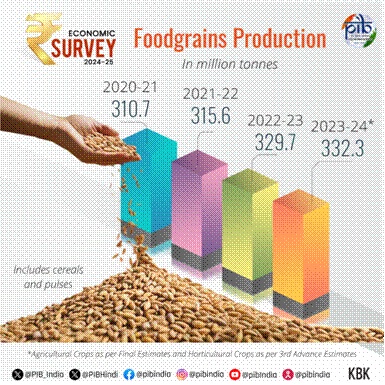
      The Economic Survey states that the government is implementing a range of initiatives aimed at enhancing agricultural productivity and increasing farmers' incomes, in alignment with the recommendations put forth in the Doubling Farmers' Income (DFI) Report 2016. This report highlighted essential strategies for improving crop and livestock productivity, boosting cropping intensity, and diversifying into high-value crops. The government is pursuing initiatives such as Per Drop More Crop (PDMC) and various actions under the National Mission on Sustainable Agriculture (NMSA). These measures include using alternative and organic fertilisers to enhance productivity and sustainability. Furthermore, digital initiatives like the Digital Agriculture Mission and the e-National Agriculture Market (e-NAM) have been launched to encourage the adoption of innovative agricultural technologies and improve price discovery mechanisms. Additionally, the government provides income support to farmers through assured remunerative prices for their produce, alongside programs such as the Pradhan Mantri Kisan Samman Nidhi (PM-KISAN).

      MINIMUM SUPPORT PRICE

      The Economic Survey states that in the Union Budget of 2018-19, the government decided the principle of fixing MSP at a level of at least 1.5 times the weighted average cost of production for these crops. The government has raised the MSP for nutri cereals (Shree Anna), pulses, and oilseeds as part of these initiatives. For the fiscal year FY25, the MSP for arhar and bajra has been increased by 59 per cent and 77 per cent over the weighted average cost of production, respectively. Moreover, the MSP for Masur has risen by 89 per cent, while rapeseed has seen an impressive increase of 98 per cent.

      IRRIGATION DEVELOPMENT

      The Economic Survey states that the government has prioritised irrigation development and water conservation practices to enhance access to irrigation facilities. Since the FY16 fiscal year, the government has been implementing the Per Drop More Crop (PDMC) initiative, a component of the Pradhan Mantri Krishi Sinchayee Yojana (PMKSY), to promote water efficiency. Financial assistance is provided at 55 per cent of the total project cost for small and marginal farmers, and 45 per cent for other farmers for installation of micro irrigation under PDMC. From FY16 to FY25 (end of Dec. 2024), ₹ 21968.75 crore was released to states for implementation of PDMC Scheme and an area of 95.58 lakh ha has been covered under which is about 104.67 per cent higher as compared to the Pre-PDMC period. The micro irrigation Fund (MIF) supports innovatiove projects through 2 per cent interest subvention to states on loans availed under MIF. Loans amounting to ₹4709 crore has been approved of which ₹3640 crore has been disbursed so far.

      LIVESTOCK

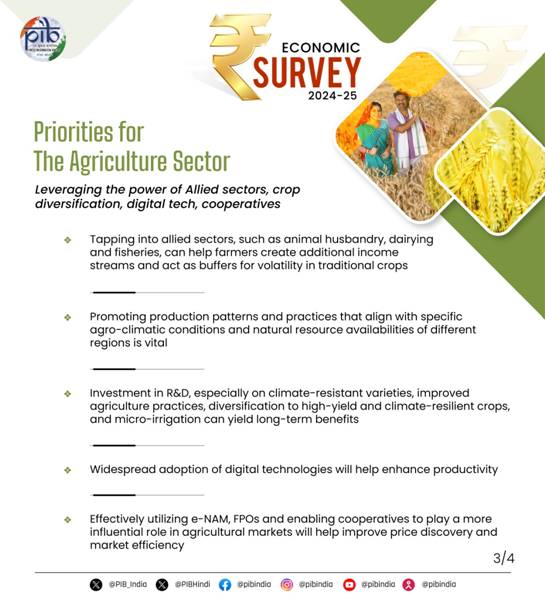
      The Economic Survey states that Allied Sectors have become key drivers of agriculture growth. The livestock sector alone represented 5.5 per cent of the total GVA, reflecting its dynamic growth trajectory, with a robust Compound Annual Growth Rate (CAGR) of 12.99 per cent. The economic significance of this sector is clearly illustrated by its escalating output value, which reached an astounding 17.25 lakh crore rupees (equivalent to US$205.81 billion) in FY23. Among the various branches of livestock production, the milk industry stands out, generating over ₹11.16 lakh crore (US$133.16 billion) in revenue. Government has supported the sector through interventions which include the Rashtriya Gokul Mission for the development and conservation of indigenous bovine breeds, the Livestock Health and Disease Control Program to enhance the well-being of livestock, Multipurpose AI Technicians in Rural India (MAITRIs) to deliver breeding inputs to farmers’ doorstep. In the last 4 years, 38736 MAITRIs have been inducted under Rashtriya Gokul Mission.

      FISHERIES

      The Economic Survey conveys that the government has implemented several initiatives to enhance the fisheries sector's production which include Pradhan Mantri Matsya Sampada Yojana (PMMSY) to boost aquaculture productivity and improve fisheries management, Fisheries and Aquaculture Infrastructure Development Fund (FIDF) to provide financial support for developing infrastructure in both marine and inland fisheries. Other initiatives include the establishment of fishing harbours and fish landing centres, the adoption of innovative production technologies such as cages, Recirculating Aquaculture Systems (RAS), bio flocs, pens, and raceways. Due to these initiatives, total fish production (both inland and marine) has surged to 184.02 lakh tonnes in FY 23, up from 95.79 lakh tonnes in FY14. Furthermore, India's seafood exports have risen from ₹46,662.85 crore in FY-20 to ₹60523.89 crore in 2023-24, reflecting a growth of 29.70 per cent. Under the Pradhan Mantri Matsya Kisan Samridhi Sah-Yojana (PM-MKSSY), the National Fisheries Digital Platform (NFDP) successfully mobilized and registered 16.35 lakh fish producers, workers, vendors, and processors within a short timeframe of just four months.
      Chapter 9-03.jpg

      FLORICULTURE

      India's floriculture industry has grown into a high-performing sector, earning its status as a "sunrise industry" with a 100 per cent export orientation. With subsidy support and crop loan financing, it is a promising venture for marginal and small landholdings, which constitute more than 96 per cent of the total landholdings with 90.9 per cent of marginal landholdings and 63 per cent of the area of cultivation under floriculture. The exports increased by 14.55 per cent in April-October FY25 over April-October FY24. In FY24, approximately 297 thousand hectares were dedicated to floriculture, yielding an estimated 2,284 thousand tonnes of loose flowers and 947 thousand tonnes of cut flowers. During the same period, India exported 19,678 metric tonnes of floriculture products, earning ₹717.83 crore (USD 86.63 million).

      HORTICULTURE

      Economic Survey states that India is a leading exporter, shipping 343,982.34 MT of fresh grapes worth ₹3,460.70 crore (USD 417.07 million) globally in 2023-24. Key grape-growing states are Maharashtra, Karnataka, Tamil Nadu, and Mizoram. Maharashtra leads in production, contributing over 67 per cent of total output with the highest productivity in 2023-24. Grape cultivation has significantly improved the livelihoods of Nashik farmers where export-quality grapes fetch higher prices (₹65-70/kg) than domestic markets. Farmers have adopted advanced technologies like real-time monitoring systems to ensure optimal grape quality.  

      FOOD PROCESSING

      The Economic Survey highlights that in the fiscal year FY24, the value of agri-food exports, which includes processed food exports, reached USD 46.44 billion, constituting roughly 11.7 per cent of India’s total exports. Notably, the share of processed food exports within agri-food exports has risen from 14.9 per cent in FY18 to 23.4 per cent in FY24. Pradhan Mantri Kisan Sampada Yojana (PMKSY) aims to promote the overall advancement of the food processing industry. As of 31 October 2024, 1,079 PMKSY projects have been completed. Under Production Linked Incentive Scheme for Food Processing (PLISFPI), by 31 October 2024, 171 applications had been approved, with beneficiaries investing ₹8,910 crore and receiving ₹1,084.01 crore in incentives. Pradhan Mantri Formalisation of Micro Food Processing Enterprises (PMFME) scheme has received 407,819 applications, with loans totaling ₹8.63 thousand crore sanctioned to 108,580 applicants, as of 31 October 2024. Additionally, the programme has successfully trained 672 Master Trainers, 1,120 District Level Trainers, and 87,477 beneficiaries across 36 states and union territories.

      FOOD MANAGEMENT:

      To enhance the efficiency of the Public Distribution System (PDS), the government is fully committed to achieving 100 per cent e-KYC compliance nationwide. This aligns with the One Nation, One Ration Card (ONORC) scheme, allowing beneficiaries to complete electronic know your customer e-KYC anywhere, regardless of their home state. Beneficiaries can authenticate their Aadhaar biometrics at any Fair Price Shop (FPS). To facilitate post-harvest lending for farmers, especially small and marginal farmers, the government has approved the Credit Guarantee Scheme for electronic-negotiable warehouse receipt (e-NWR)-based Pledge Financing (CGS-NPF). Under this scheme, farmers can obtain loans against e-NWRs issued for agricultural and horticultural commodities stored in accredited warehouses. The scheme covers the loss incurred by the bank due to credit and warehouseman risk. The scheme will help in increasing postharvest lending against e-NWRs and thereby play a role in improving farmers’ income.

      Topics

      ActsIncome Tax
