 TaxTMI
 Login
 TaxTMI
Login
Loading...
Press 'Enter' to add multiple search terms. Rules for Better Search

Press 'Enter' after typing page number.
Press 'Enter' after typing page number.


No Folders have been created
Are you sure you want to delete "My most important" ?
NOTE:
Press 'Enter' after typing page number.
Press 'Enter' after typing page number.

All News
Press 'Enter' after typing page number.
All News

Note

Bookmark

Share


CORE INFLATION DECREASED BY 0.9 PERCENTAGE POINTS BETWEEN FY24 AND FY25
STRENGTHENING OF BUFFER STOCKS AND PERIODIC OPEN MARKET OPERATIONS HAVE BEEN CRUCIAL IN STABILIZING INFLATION
EXTREME WEATHER AND SUPPLY SIDE CONSTRAINTS IMPACT FOOD INFLATION IN INDIA
INDIA'S CONSUMER PRICE INFLATION WILL ALIGN TOWARDS THE INFLATION TARGET OF 4 % IN FY26
RESEARCH IN AGRICULTURE AND TRAINING OF FARMERS ESSENTIAL TO INCREASE PRODUCTION
Retail inflation in India has reduced from 5.4 per cent in FY24 to 4.9 per cent in FY25 (April-December), aided by various government initiatives and monetary policy measures. This has been stated by Economic Survey 24 -25 tabled in Parliament today by the Union Minister of Finance and Corporate Affairs Smt. Nirmala Sitharaman.
Decline in retail inflation is primarily due to decrease in core inflation by 0.9 percentage points between FY24 and FY25 (April-December), largely driven by core services inflation and decrease in fuel price inflation, Survey adds.
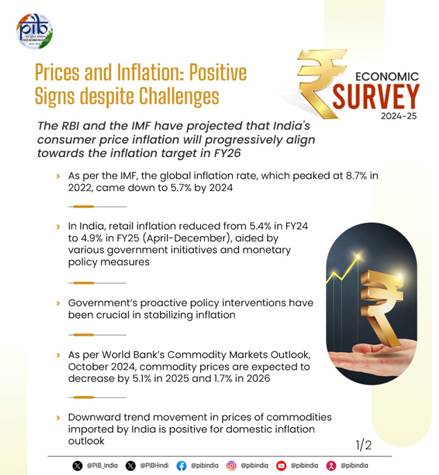
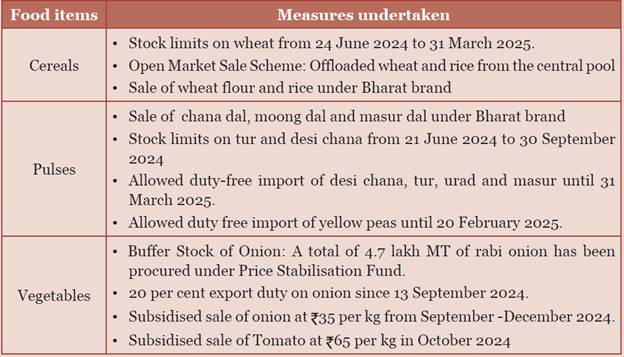
Economic Survey highlights that government’s administrative measures such as strengthening of buffer stocks for essential food items, open market releases and efforts to ease imports during supply shortage have been crucial in stabilizing inflation.
Administrative measures to control food inflation
Survey says that India's food inflation rate has remained firm, driven by a few food items such as vegetables and pulses. Contribution of vegetables and pulses to the overall inflation stood at 32.3 per cent in FY25 (April to December). When these items are excluded, the average food inflation rate for FY25 (April-December) was 4.3 per cent, which is 4.1 per cent lower than the overall food inflation, Survey adds.
Survey underlines that extreme weather conditions such as cyclones, heavy rains, floods, thunderstorms, hailstorms, and droughts impact vegetable production and prices. These adverse weather conditions also present significant challenges to storage and transportation, resulting in temporary disruptions to the supply chain and causing an increase in vegetable prices, Survey adds.
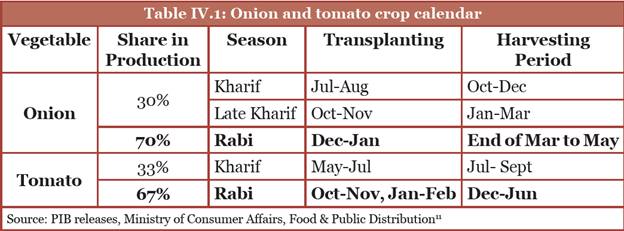
Survey states that the inflationary pressures in onion remained firm in FY24 and the current year, despite prompt measures by the government to contain prices due to constrained supply resulting from reduced production. Survey says that the lower production in 2022-23 and 2023-24 has consequently led to inflationary pressures in onions for FY24 and FY25 (April-December). The price pressures in tomatoes remained intermittently high since FY23 due to constrained supply. Despite earnest efforts by the government, tomato prices remained high due to its highly perishable nature and production concentrated in few states, Survey mentions.
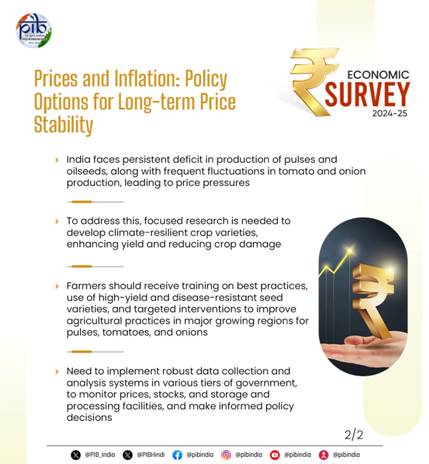
To increase the production of pulses, oilseeds, tomato and onion, focused research is needed to develop climate-resilient crop varieties, enhancing yield and reducing crop damage, Survey suggests. Training of the farmers on best practices and high-frequency price monitoring data for essential food items to monitor price are other measures that Survey suggests.
Survey says that the deficient production of tur in 2022-23 and 2023-24 has indeed led to high price pressures in tur dal during FY24 and FY25 (April-December). To ensure adequate supply, government periodically imposes stock limits for tur and actively monitors through the stock disclosure portal, Survey adds. Further, India imported 7.7 lakh tonnes of tur in FY24, Survey states.
Despite challenges, RBI and the IMF project that India's consumer price inflation will progressively align towards the inflation target of around 4 per cent in FY26, Survey notes. RBI expects headline inflation to be 4.2 per cent in FY26. IMF has projected an inflation rate of 4.4 per cent in FY25 and 4.1 per cent in FY26 for India.
Survey says that global economy has been resilient despite tightening of monetary policy across countries. This resilience is reflected in the decline of the headline and core inflation rate in most countries during FY24 and the current year, Survey adds. Global food inflation eases with divergence in some emerging economies such as Brazil, India, and China, Survey points out.
Survey mentions that as per World Bank’s Commodity Markets Outlook, October 2024, commodity prices are expected to decrease by 5.1 per cent in 2025 and 1.7 per cent in 2026. The projected declines are led by oil prices but tempered by price increases for natural gas and a stable outlook for agricultural raw materials. The downward trend movement in the prices of commodities imported by India is a positive for the domestic inflation outlook, Survey underscores.

