 TaxTMI
 Login
 TaxTMI
Login
Loading...
Press 'Enter' to add multiple search terms. Rules for Better Search

Press 'Enter' after typing page number.
Press 'Enter' after typing page number.


No Folders have been created
Are you sure you want to delete "My most important" ?
NOTE:
Press 'Enter' after typing page number.
Press 'Enter' after typing page number.

All News
Press 'Enter' after typing page number.
All News

Note

Bookmark

Share


DESPITE MODEL CODE OF CONDUCT AND ERRATIC MONSOON, THE PACE OF INFRASTRUCTRE DEVELOPMENT WAS ON TRACK IN FY25: ECONOMIC SURVEY
FINANCIAL MARKET REGULATORS HAVE INTRODUCED REFORMS TO ENCOURAGE PRIVATE PARTICIPATION
India needs a continued step-up of infrastructure investment over the next two decades to sustain a high rate of growth, states the Economic Survey 2024-25, presented by Union Minister of Finance and Corporate Affairs Smt. Nirmala Sitharaman in the Parliament today.
The Economic Survey states that building infrastructure – physical, digital and social - has been a central focus area for the Government in the last five years. This has had various dimensions – increase in public spending on infrastructure, creation of institutions to de-bottleneck approvals and execution and innovative modes of resource mobilization. It states that public capital alone cannot meet the demands of upgrading the country’s infrastructure commensurate with the requirements of Viksit Bharat@2047.
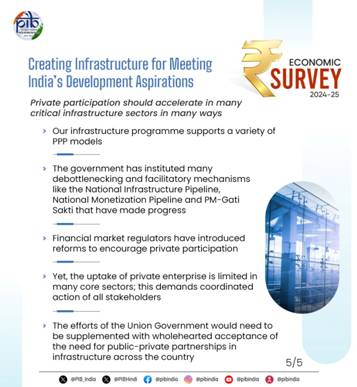
We need to ensure increasing private participation in infrastructure by improving their capacity to conceptualize projects and their confidence in risk and revenue-sharing mechanisms, contract management, conflict resolution and project closure. The efforts of the Union Government would need to be supplemented with wholehearted acceptance of the need for public-private partnerships in infrastructure across the country, states the Survey. Equally important, the private sector must reciprocate too, adds the survey.
The strategy to step up private participation needs coordinated action of all stakeholders involved - governments at different tiers, financial market players, project management experts and planners, and the private sector. Capacities to conceptualise projects, develop sector-specific innovative strategies for execution and develop high-expertise areas such as risk and revenue sharing, contract management, conflict resolution and project closure need to improve substantially.
The pace of the Union Government’s capital expenditure in major infrastructure sectors was affected during Q1FY25, largely due to the model code of conduct during the general elections. The unusual patterns of the last monsoon season also slowed down the progress of work. Hence, a year-over-year comparison may not be appropriate for Q1FY25. As the electoral process settled, capital expenditure saw an uptick in July November 2024. CapEx in infrastructure sectors is expected to gain further momentum in the remaining months of the current fiscal. On an average, ministries related to infrastructure sectors utilised 60 per cent of the budgeted capex during April to November 2024. This compares favourably with the progress achieved in the same period in FY20 when the 17th Lok Sabha elections were held.
The government has instituted many de-bottlenecking and facilitatory mechanisms like the National Infrastructure Pipeline, National Monetisation Pipeline and PM-Gati Sakti that have made progress. Financial market regulators have introduced reforms to encourage private participation. Yet, the uptake of private enterprise is limited in many core sectors, points out the Economic Survey.

