 TaxTMI
 Login
 TaxTMI
Login
Loading...
Press 'Enter' to add multiple search terms. Rules for Better Search

Press 'Enter' after typing page number.
Press 'Enter' after typing page number.


No Folders have been created
Are you sure you want to delete "My most important" ?
NOTE:
Press 'Enter' after typing page number.
Press 'Enter' after typing page number.

All News
Press 'Enter' after typing page number.
All News

Note

Bookmark

Share


ECONOMIC SURVEY URGES STATES TO FOCUS ON BUSINESS REFORMS ON A PRIORITY BASIS
NEED TO FOCUS ON INDUSTRIAL STRATEGIES APPROPRIATE TO UNIQUE GEOGRAPHIES
The degree of industrialization varies across states, with some being better positioned to leverage their industrial sectors to generate higher income levels for their populations, says the Economic Survey 2024-25 tabled in Parliament by Union Minister of Finance and Corporate Affairs, Smt. Nirmala Sitharaman today. The Survey mentions that there are clear patterns in the degree of industrialisation with few States like Gujarat, Uttarakhand and Himachal Pradesh are able to cash on their high level of dependence on industrial sector to generate reasonable levels of incomes for their people.
The Survey specifies that four states—the western states of Gujarat and Maharashtra and the southern states of Karnataka and Tamil Nadu— account for about 43 per cent of the total industrial GSVA. In contrast, the Survey mentions, six states of the Northeast (excluding Sikkim and Assam), account for only 0.7 per cent of the industrial GVA. There is a need for focus on industrial strategies appropriate to unique geographies like the North East, the Survey adds.
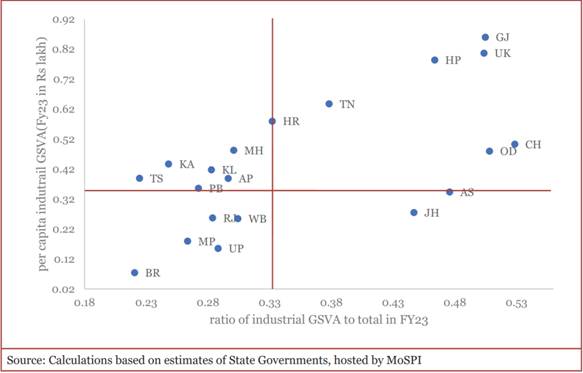
Figure 1: Vast inter-State differences in the levels of industrialization
The Survey also points that construction activity, closely linked with infrastructure development, urbanization and real estate trends, also shows inter-state differences. In this context, the Survey indicates, Kerala is comparatively less industrial than many other States but it is a positive outlier in construction activity, with construction contributing about half of its industrial GVA.
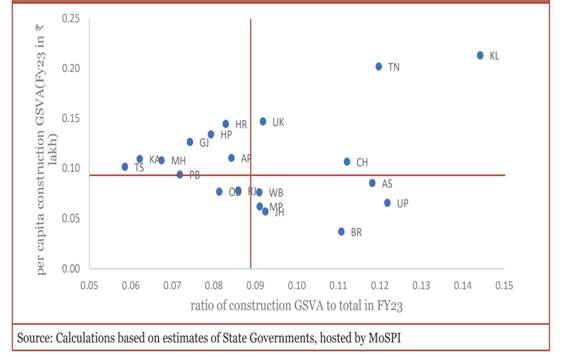
Figure 2: Pattern of construction activity variant from general pattern of industrial activity
The Survey additionally analyses that the mining sector contributes about 8 per cent to the total industrial output. It specifies, mining activity is highly concentrated with top five states that is Assam, Chhattisgarh, Gujarat, Maharashtra and Odisha, accounting for about 60 per cent of the all-State mining GSVA.The Economic Survey quoting varied Research papers, highlights state-level policies play a crucial role in shaping the economic growth patterns across Indian states. It further emphasizes that factors like regulatory environment, infrastructure development, and state-level reforms are shown to significantly influence industrial growth patterns.
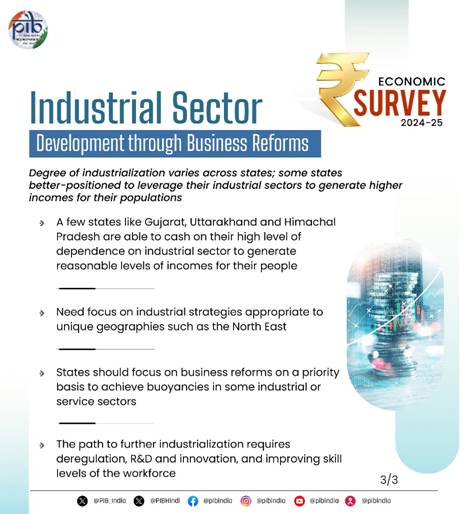
Pertinently, the Survey points to the quintessential aspect that States should focus on business reforms on a priority basis to achieve buoyancies in some industrial or service sectors. The Survey asserts that States should make it easier for businesses to commence operations and to grow; thereby, resulting in faster convergence of living standards and per capita incomes.

