
Just a moment...

Top
Help
×

By creating an account you can:

Logo TaxTMI
>
Call Us / Help / Feedback

Contact Us At :

E-mail: [email protected]

Call / WhatsApp at: +91 99117 96707

For more information, Check Contact Us

FAQs :

To know Frequently Asked Questions, Check FAQs

Most Asked Video Tutorials :

For more tutorials, Check Video Tutorials

Submit Feedback/Suggestion :

Email :
Please provide your email address so we can follow up on your feedback.
Category :
Description :
Min 15 characters0/2000
Add to...
You have not created any category. Kindly create one to bookmark this item!
Create New Category
Hide
Title :
Description :
❮❮ Hide
Default View
Expand ❯❯
Close ✕
🔎 News - Adv. Search
TEXT SEARCH:

Press 'Enter' to add multiple search terms. Rules for Better Search

Search In:
Main Text + AI Text
  • Main Text
  • Main Text + AI Text
  • AI Text
Category: ?
Categorized by AI
---- All Categories ----
  • ---- All Categories ----
  • Income Tax
  • GST
  • Customs, DGFT & SEZ
  • FEMA & RBI
  • Corp. Laws, SEBI & IBC
  • PMLA, Black Money & ED
  • Budget
  • News and Press Release
  • PTI News
Month:
---- All Months ----
  • ---- All Months ----
  • January
  • February
  • March
  • April
  • May
  • June
  • July
  • August
  • September
  • October
  • November
  • December
Year:
---- All Years ----
  • ---- All Years ----
  • 2026
  • 2025
  • 2024
  • 2023
  • 2022
  • 2021
  • 2020
  • 2019
  • 2018
  • 2017
  • 2016
  • 2015
  • 2014
  • 2013
  • 2012
  • 2011
Sort By: ?
In Sort By 'Default', exact matches for text search are shown at the top, followed by the remaining results in their regular order.
RelevanceDefaultDate
    DRI busts illegal drug manufacturing unit in Satara district in Maharashtra; two arrested
    CCI approves proposed combination inter alia involving share acquisition(s) and merger of certain entities e.g. AAPC India, Triguna, Caddie, SMPL, Tec...
    Rupee gains 20 paise to close at 95.08 against US dollar post-RBI policy decision
    TN Budget: Revenue deficit at Rs 55,775 crore, fiscal deficit estimated at Rs 1,21,819 crore
    Tatkare slams ‘gungi gudiya’ jibe against Sunetra; Cong says row being exploited for political gains
    RBI invites public comments on Draft Guidelines for ‘on tap’ Licensing of Urban Co-operative Banks
    Pakistan-origin dry dates, routed through UAE, seized at Kandla port
    RBI keeps rates unchanged, retains neutral stance; outlook uncertain on El Nino, geopolitical risks
    Government Notifies Inventory-based Cross-border E-Commerce Export Framework under Foreign Trade Policy 2023
    Customs official among 5 held for smuggling gold of Rs 1.44 crore at Indore airport
    Lok Sabha passes Bankers' Books Evidence Bill to replace colonial-era law
    Sensex gains 152 pts in volatile session as RBI keeps policy rates unchanged
    DRI seizes 364 metric tonne (MT) banned Pakistan-origin dry dates imports worth Rs. 3 crore
    Rupee gains 13 paise to close at 95.15 against US dollar post-RBI policy decision
    ED raids premises linked to ex-Andhra MLA Malla Vijaya Prasad in chit fund scam
    'Gungi gudiya' remark against Sunetra shows Cong's 'ideological bankruptcy': NCP leader Tatkare
    RBI holds interest rates for fourth straight meeting, awaits clearer inflation outlook
    Highlights of RBI's August monetary policy
    RBI targeting polymer currency notes launch in early FY28: Guv Malhotra
    Two women held at Delhi airport with 1 kg gold concealed as silver-coated armlet
❯❯
MaximizeMaximizeMaximize
0 / 200
Expand Note
Add to Folder

No Folders have been created

    +

    Are you sure you want to delete "My most important" ?

    NOTE:

    News
    Showing Results for :
    Reset Filters
    Results Found:
    Show All SummariesHide All Summaries
    August 6, 2026
    Show AI Summary
    Illicit psychotropic drug manufacture triggered seizure, apprehensions, and investigation into planned trafficking under narcotics control law.
    Illicit manufacture and trafficking of Alprazolam and Diazepam, psychotropic substances regulated under the Narcotic Drugs and Psychotropic Substances Act, 1985, were detected at a clandestine facility. Searches recovered finished and intermediary substances, together with raw materials and reaction mixtures used in manufacture, and the goods were seized under the Act. The manufacturer and an intended buyer were apprehended, with material indicating a proposed transaction for further illicit trafficking. Preliminary investigation indicated prior involvement in illegal drug production and trafficking.
    August 6, 2026
    Show AI Summary
    Competition approval for hotel-sector consolidation covers share acquisitions and merger of Accor-branded hotel entities into InterGlobe Hotels.
    Competition approval was granted for related share acquisitions and the merger of AAPC India, Caddie, Triguna, Srilanand Mansions, Techpark and Accent into InterGlobe Hotels. The combination involves entities jointly controlled by the Bhatia Family Group and the Accor Group, including hotel-owning and developing entities, hotel management and franchising operations, leasing activities, and captive consultancy and support services relating to Accor-branded hotels in India.
    August 5, 2026
    Show AI Summary
    Rupee appreciation followed unchanged monetary policy, lower crude prices, weaker dollar and expectations of orderly exchange-rate management.
    The rupee strengthened after the central bank maintained its policy rate and neutral monetary-policy stance. Lower crude oil prices, a weaker US dollar and declining US Treasury yields supported investor sentiment. Earlier measures to attract capital inflows remained part of the framework supporting the rupee, while the central bank stressed its endeavour to preserve an orderly currency trajectory. Future movement was linked to geopolitical de-escalation, global risk sentiment and US economic data.
    August 5, 2026
    Show AI Summary
    Fiscal consolidation through revenue mobilisation and leakage control aims to reduce deficits while expanding capital expenditure capacity.
    Tamil Nadu's Revised Budget Estimates for 2026-27 project a revenue deficit and fiscal deficit, with outstanding liabilities comprising public debt and public-account liabilities. Revenue mobilisation is proposed through improved tax administration, collection efficiency, closure of leakages, liquor-manufacturer privilege fees, and eligible Union grants. The strategy projects gradual deficit reduction to create room for capital expenditure, supported by expenditure reforms aimed at eliminating leakages, optimising expenditure, and improving service delivery.
    August 5, 2026
    Show AI Summary
    Political criticism of public office-holders raises debate over media accountability, personal remarks, and acceptable public discourse.
    Political criticism followed a social-media post describing Maharashtra Deputy Chief Minister Sunetra Pawar as "gungi gudiya" in connection with a press interaction on law-and-order issues in Beed district. Congress representatives stated that the post was not a personal insult, had been deleted after adverse reactions, and was followed by an expression of regret. NCP representatives termed the expression inappropriate and stressed that the principal dignitary should conduct media interactions. Shiv Sena (UBT) representatives described the phrase as not unparliamentary and linked it to criticism of a guardian minister's public responsibilities.
    August 5, 2026
    Show AI Summary
    On-tap licensing for Urban Co-operative Banks enters public consultation through draft guidelines inviting stakeholder feedback.
    Draft guidelines for 'on tap' licensing of Urban Co-operative Banks have been issued for public and stakeholder consultation. Comments and feedback may be submitted until September 05, 2026, through the designated online consultation facility or by written or email submission to the specified regulatory department.
    August 5, 2026
    Show AI Summary
    Prohibition on indirect Pakistan-origin imports targets alleged origin misdeclaration and UAE routing used to circumvent trade restrictions.
    Import prohibition on goods originating in Pakistan applies to direct and indirect imports under the Foreign Trade Policy, 2023. Pakistan-origin dry dates routed through the UAE were allegedly declared as UAE-origin goods for import, and were intercepted under the Customs Act, 1962. Investigation indicated that the goods were first sent from Pakistan to Dubai, re-containerised, and then exported to India. A separate interception involved Pakistan-origin guggul resin allegedly declared as Somali natural resin and routed through Dubai.
    August 5, 2026
    Show AI Summary
    Neutral monetary policy stance keeps benchmark rates unchanged while inflation risks, liquidity management and consumer-protection reforms remain under review.
    Monetary policy maintains the benchmark policy rate unchanged and retains a neutral stance, with future decisions guided by incoming data. The central bank remains committed to aligning headline inflation with its medium-term target while monitoring food, fuel and other input-cost risks. Surplus liquidity will be managed through two-way operations, and the regulatory framework for interest rates on advances is proposed to be harmonised and standardised across regulated entities to improve transparency and consumer protection.
    August 5, 2026
    Show AI Summary
    Export-only e-commerce inventory framework enables seller exports through registered exporters while requiring traceability, timely payments and domestic-diversion controls.
    The export-only inventory framework permits eligible e-commerce entities to export through a registered Exporter-on-Record, which procures goods from Indian Sellers-on-Record against confirmed overseas orders and assumes export and destination-country compliance responsibilities. Inventory must be segregated, digitally traceable and cannot be diverted to domestic sale. The framework requires timely seller payments, visibility of overseas sales and shipment information, proportional pass-through of export rebates and refunds, annual compliance certification and digital records.
    August 5, 2026
    Show AI Summary
    Gold smuggling enforcement targets concealed foreign-origin gold, airport control evasion, and illicit railway transport under customs law.
    Gold smuggling enforcement operations under the Customs Act, 1962 involved alleged concealment and unlawful movement of foreign-origin gold. At an international airport, an alleged syndicate used an airline employee to transfer gold received from arriving passengers outside Customs and immigration controls, with gold disguised as silver-coloured bracelets. A separate railway operation concerned gold concealed in a specially made cloth waist belt and intended for delivery to a jeweller. The actions addressed concealment, evasion of Customs controls, and illicit transport of foreign-origin gold.
    August 5, 2026
    Show AI Summary
    Digital bank-record evidence gains a technology-neutral framework through expanded admissibility, certified authentication, and regulated production of bankers' books.
    The Bankers' Books Evidence Bill, 2026, modernises the evidentiary treatment of banking records by extending "bankers' books" to physical, electronic, digital, virtual and cloud-based records. It recognises electronic bank records as admissible evidence, allows production in physical or electronic form, and provides for standardised certificates authenticated by manual, digital or electronic signatures. The Bill also defines "special cause" for compelling bank officers to produce records or testify where the bank is not a party, and permits extension to specified financial-sector entities subject to conditions.
    August 5, 2026
    Show AI Summary
    Closing auction price discovery and unchanged policy rates shaped volatile equity trading amid inflation and geopolitical uncertainty.
    The Monetary Policy Committee retained the policy repo rate and neutral policy stance while seeking greater clarity on inflation risks from higher energy costs. Stock exchanges introduced the Closing Auction Session for eligible futures and options shares in the equity cash segment to determine closing prices through a more transparent and robust auction-based price-discovery mechanism. Equity markets showed volatile, limited gains amid geopolitical uncertainty, energy-price concerns, profit booking and the new mechanism's introduction.
    August 5, 2026
    Show AI Summary
    Pakistan-origin import prohibition covers third-country routing, false origin declarations, forged documents, and trans-shipment arrangements used to evade restrictions.
    The prohibition on direct or indirect import or transit of goods originating in or exported from Pakistan extends to goods routed through third countries and falsely declared as having another origin. Misdeclaration of country of origin, false descriptions, forged documentation, and trans-shipment arrangements may contravene that prohibition and invite action under the Customs Act, 1962. Dry dates declared as UAE-origin and Guggul resin declared as Somalia-origin were investigated as goods of Pakistan origin routed through Dubai.
    August 5, 2026
    Show AI Summary
    Foreign exchange stability measures support the rupee as policy continuity, capital inflows and global risk sentiment shape currency expectations.
    Foreign exchange market movement reflected a rupee appreciation against the US dollar following the monetary policy decision to retain the repo rate and neutral stance. Market sentiment was supported by softer crude oil prices, weakness in the US dollar, lower US Treasury yields and foreign equity inflows. The monetary policy framework sought to support capital inflows and maintain an orderly rupee trajectory, with geopolitical developments and US economic data remaining relevant to near-term exchange-rate expectations.
    August 5, 2026
    Show AI Summary
    Money-laundering investigation examines alleged proceeds from chit fund operations following searches linked to a former company managing director.
    A money-laundering investigation concerns alleged proceeds of crime arising from a multi-state chit fund operation associated with Welfare Building and Estates Pvt Ltd. The company is alleged to have collected investor deposits through investment schemes promising high returns before defaulting. Searches at premises linked to its former managing director form part of the inquiry into alleged laundering. The underlying alleged fraud had previously resulted in a CBI case and multiple police FIRs.
    August 5, 2026
    Show AI Summary
    Political restraint in public communications was urged, alongside adherence to principal-speaker protocol during press conferences and media interactions.
    Political restraint in public communications was urged after a social-media remark directed at Sunetra Pawar was criticised as ideologically irresponsible. It was stated that regret alone was insufficient and that leaders should exercise care in public comments. Press-conference protocol was also emphasised: the principal dignitary should respond to media questions, and those seated alongside should not participate in the interaction. Party colleagues were expected to act more responsibly in future media engagements.
    August 5, 2026
    Show AI Summary
    Neutral monetary policy stance continues as inflation clarity is awaited, alongside cooperative banking and lending-rate transparency measures.
    Monetary policy maintained the benchmark policy repo rate and a neutral stance pending clearer evidence that energy-cost pressures will generate broad-based inflation. Inflation is expected to rise temporarily due principally to food and fuel prices before moderating, while core inflation remains benign. The approach remains data-dependent, supported by two-way liquidity operations. Proposed measures include resuming urban cooperative bank licensing, revising rural cooperative bank credit-monitoring directions, and harmonising interest-rate regulation on advances across regulated entities to improve transparency and consumer protection.
    August 5, 2026
    Show AI Summary
    Repo rate stability preserves the policy stance amid lower inflation projections, stronger growth expectations and external-sector resilience.
    Monetary policy maintained the repo rate at 5.25 per cent following a unanimous policy committee decision. The growth forecast for FY27 was marginally increased, while the inflation projection was lowered. Inflation conditions remain uncertain because of monsoon, El Nino and geopolitical developments. Liquidity remained in surplus, and external-sector indicators reflected a current-account surplus, buoyant foreign direct investment inflows, renewed foreign portfolio investment inflows, and adequate foreign-exchange reserves.
    August 5, 2026
    Show AI Summary
    Polymer currency notes target improved durability as monetary policy remains data-dependent and rupee management pursues an orderly trajectory.
    Polymer currency notes are targeted for circulation at the beginning of the next financial year, subject to implementation proceeding as planned. They are intended to improve durability, especially for lower-denomination notes with high circulation velocity. Monetary policy decisions will remain data-dependent and focused on aligning headline inflation with its medium-term target. Foreign Currency Non-Resident (Bank) scheme inflows are expected to remain healthy until closure, with no proposal for premature termination. Rupee management aims to maintain an orderly exchange-rate trajectory.
    August 5, 2026
    Show AI Summary
    Customs anti-smuggling enforcement targets gold concealed as silver-coated armlets following passenger profiling and personal search at airport.
    Customs officers intercepted two passengers arriving from Istanbul after Advance Passenger Information System profiling and their activation of the Door Frame Metal Detector. A personal search recovered approximately one kilogram of gold, silver-coated and concealed as traditional armlets worn on the upper arms. The gold was seized under the Customs Act, a smuggling case was registered, and investigation was initiated into the source and any wider smuggling network.

    News

    Back

    All News

    Showing Results for :
    Reset Filters
      No Records Found

      News

      Back

      All News

      whatsappJoin Channel
      Showing Results for : Reset Filters

      SUMMARY OF ECONOMIC SURVEY 2024-25

      January 31, 2025

      Contents
      Plus +
      Summary
      Note

      Note

      -

      Bookmark

      Print

      Print

      INDIA’S GDP EXPECTED TO GROW BETWEEN 6.3 & 6.8 PER CENT IN FY26

      REAL GDP ESTIMATED AT 6.4 PER CENT IN FY25, CLOSE TO ITS DECADAL AVERAGE

      REAL GVA ESTIMATED TO GROW BY 6.4 PER CENT IN FY25

      CAPEX GROWS AT 8.2 PER CENT IN JULY – NOVEMBER 2024 AND EXPECTED TO PICK UP FURTHER PACE

      RETAIL HEADLINE INFLATION SOFTENED TO 4.9 PER CENT IN APRIL-DECEMBER 2024

      INDIA’S CONSUMER PRICE INFLATION TO ALIGN WITH THE TARGET OF AROUND 4 PER CENT IN FY26

      OVERALL EXPORTS GROW 6.0 PER CENT (YOY) DURING APRIL-DECEMBER 2024

      INDIA’S SERVICES EXPORT GROWTH SURGED TO 12.8 PER CENT DURING APRIL–NOVEMBER FY25, UP FROM 5.7 PER CENT IN FY24

      GROSS FDI INFLOWS INCREASE FROM USD 47.2 BILLION IN FIRST EIGHT MONTHS OF FY24 TO USD 55.6 BILLION IN THE SAME PERIOD OF FY25, A YOY GROWTH OF 17.9 PER CENT

      FOREX AT USD 640.3 BILLION AS OF END OF DECEMBER 2024, SUFFICIENT TO COVER 10.9 MONTHS OF IMPORTS AND APPROXIMATELY 90 PER CENT OF EXTERNAL DEBT

      CAPACITY ADDITION IN SOLAR AND WIND POWER INCREASES 15.8 PER CENT YEAR-ON-YEAR IN DECEMBER 2024

      BSE STOCK MARKET CAPITALISATION TO GDP RATIO AT 136 PER CENT AT THE END OF DECEMBER 2024, FAR HIGHER THAN CHINA (65 PER CENT) AND BRAZIL (37 PER CENT)

      ECONOMIC SURVEY ADVOCATES DEREGULATION TO ACCELERATE AND SUSTAIN ECONOMIC GROWTH

      CONTINUED STEP-UP OF INFRASTRUCTURE INVESTMENT OVER NEXT TWO DECADES NEEDED TO SUSTAIN A HIGH GROWTH

      ₹50,000 CRORE SELF-RELIANT INDIA FUND LAUNCHED TO PROVIDE EQUITY FUNDING TO MSMES

      AGRICULTURE EXPECTED TO GROW AT 3.8 PER CENT IN FY25

      KHARIF FOODGRAIN PRODUCTION FOR 2024 IS EXPECTED TO REACH 1647.05 LMT, AN INCREASE OF 89.37 LMT OVER PREVIOUS YEAR

      KEY DRIVERS OF AGRICULTURAL GROWTH ARE HORTICULTURE, LIVESTOCK & FISHERIES

      INDUSTRIAL SECTOR ESTIMATED TO GROW BY 6.2 PER CENT IN FY25

      SOCIAL SERVICES EXPENDITURE REGISTERS AN ANNUAL GROWTH RATE OF 15 PER CENT BETWEEN FY 21 AND FY 25

      GOVERNMENT HEALTH EXPENDITURE INCREASES FROM 29.0 PER CENT TO 48.0 PER CENT; SHARE OF OUT OF POCKET EXPENDITURE IN TOTAL HEALTH EXPENDITURE DECLINES FROM 62.6 PER CENT TO 39.4 PER CENT BETWEEN FY15 AND FY22

      UNEMPLOYMENT RATE DECLINES TO 3.2 PER CENT IN 2023-24 (JULY-JUNE) FROM 6.0 PER CENT IN 2017-18 (JULY-JUNE)

      COLLABORATIVE EFFORT BETWEEN GOVERNMENT, PRIVATE SECTOR, AND ACADEMIA ESSENTIAL TO MINIMISE ADVERSE AI SOCIETAL EFFECTS

      “The global economy grew by 3.3 per cent in 2023. The International Monetary Fund (IMF) projects global growth to average around 3.2 per cent over the next five years, which is modest by historical standards”, says the Economic Survey 2024-25 tabled by Union Minister of Finance and Corporate Affairs Smt. Nirmala Sitharaman, in the Parliament today.
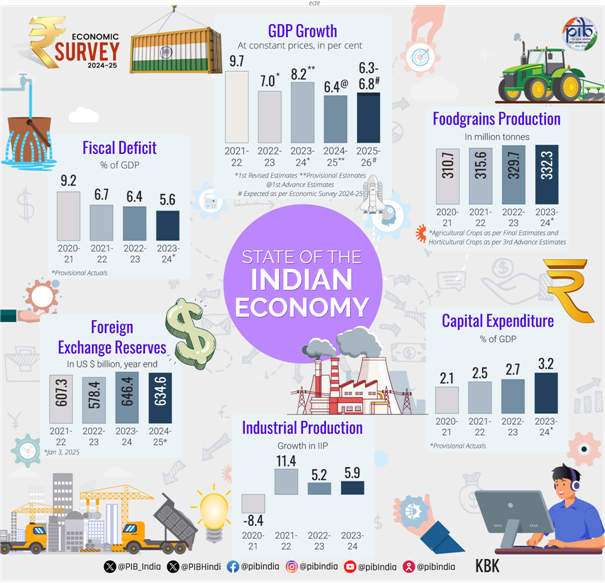
      As per the Survey, the global economy exhibited steady yet uneven growth across regions in 2024. A notable trend was the slowdown in global manufacturing, especially in Europe and parts of Asia, due to supply chain disruptions and weak external demand. In contrast, the services sector performed better, supporting growth in many economies. Inflationary pressures eased in most economies. However, services inflation has remained persistent, notes the Survey.
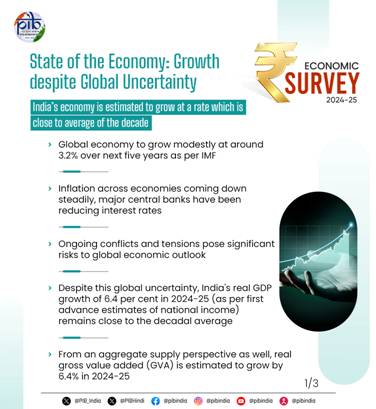
      The Survey highlights that, despite global uncertainty, India has displayed steady economic growth. India's real GDP growth of 6.4 per cent in FY25 remains close to the decadal average.

      From an aggregate demand perspective, private final consumption expenditure at constant prices is estimated to grow by 7.3 per cent, driven by a rebound in rural demand.

      On the supply side, the real gross value added (GVA) is estimated to grow by 6.4 per cent. The agriculture sector is expected to rebound to a growth of 3.8 per cent in FY25. The industrial sector is estimated to grow by 6.2 per cent in FY25. Strong growth rates in construction activities and electricity, gas, water supply and other utility services are expected to support industrial expansion. Growth in the services sector is expected to remain robust at 7.2 per cent, driven by healthy activity in financial, real estate, professional services, public administration, defence, and other services.
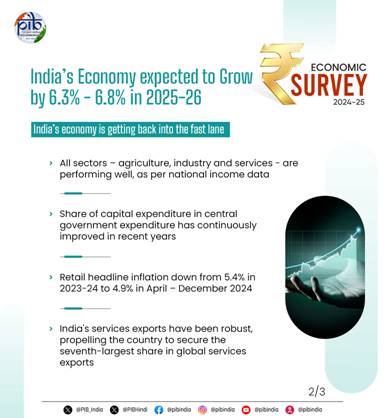
      Keeping in mind the upsides and downsides to growth, the Survey expects the real GDP growth in FY26 to be between 6.3 and 6.8 per cent.

      The Chapter on the Medium-Term Outlook elaborates on the global factors and the importance of strengthening the levers of domestic growth in the context of heightened risks due to global concerns about economic policies and trade policy uncertainties.

      To realize the aspirations of Viksit Bharat by 2047, it is important that the medium-term growth outlook of India be assessed in the context of emerging global realities of Geo-Economic Fragmentation (GEF), Chinese manufacturing prowess, and global dependency on China for energy transition efforts. The Survey puts forth a way forward to reinvigorate the internal engines and domestic levers of growth by focusing on one central element of systemic deregulation, which will enable a paradigm of economic freedom to businesses of individuals and organizations to pursue legitimate economic activity with ease. The Survey stresses that the reforms and economic policy must now be on systematic deregulation under Ease of Doing Business 2.0 so that it encourages creation of a viable Mittelstand, i.e. India’s SME sector.

      The Economic Survey 2024-25 notes that agriculture growth remained steady in first half of FY25, with Q2 recording a growth rate of 3.5 per cent, marking an improvement over the previous four quarters. Healthy Kharif production, above-normal monsoons, and an adequate reservoir level supported agricultural growth. The total Kharif food grain production is estimated at a record 1647.05 lakh metric tonnes (LMT) in 2024-25, higher by 5.7 per cent compared to 2023-24 and 8.2 per cent higher than the average food grain production in the past five years.

      The industrial sector grew by 6 per cent in first half of FY25, and is estimated to grow by 6.2 per cent in FY25. Q1 saw a strong growth of 8.3 per cent, but growth moderated in Q2 due to three key factors. First, manufacturing exports slowed significantly due to weak demand from destination countries, and aggressive trade and industrial policies in major trading nations. Second, the above average monsoon had mixed effects - while it replenished reservoirs and supported agriculture, it also disrupted sectors like mining, construction, and, to some extent, manufacturing. Third, the variation in the timing of festivities between September and October in the previous and current years led to a modest growth slowdown in Q2 FY25.

      Despite various challenges, India continues to register the fastest growth in manufacturing PMI, stated the Survey. The latest Manufacturing PMI for December 2024 remained well within the expansionary zone, driven by new business gains, robust demand, and advertising efforts.

      The services sector continues to perform well in FY25, emphasizes the Survey. A notable growth in Q1 and Q2 resulted in 7.1 per cent growth in first half of FY25. Across sub-categories, all the sub-sectors have performed well. India’s services export growth surged to 12.8 per cent during April–November FY25, up from 5.7 per cent in FY24.

      The Economic Survey states that growth process has been ably supported by stability on fronts such as inflation, fiscal health, and external sector balance. On inflation, the Survey states that retail headline inflation has softened from 5.4 per cent in FY24 to 4.9 per cent in April – December 2024. Food inflation, measured by the Consumer Food Price Index (CFPI), has increased from 7.5 per cent in FY24 to 8.4 per cent in FY25 (April-December), primarily driven by a few food items such as vegetables and pulses. India’s consumer price inflation will gradually align with the target of around 4 per cent in FY26 as per RBI and IMF.
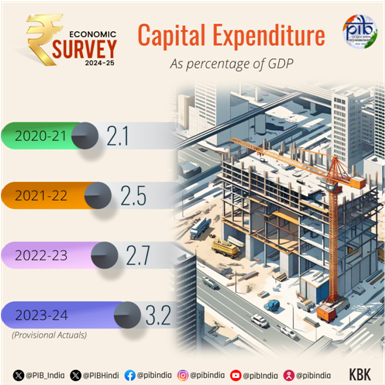
      Capital expenditure (capex), as a per cent of the total expenditure of the union, has continuously improved from FY21 to FY24. After the general elections, union government capex has grown by 8.2 per cent during July – November 2024 YoY, the Survey says.

      Despite the gross tax revenue (GTR) increasing by 10.7 per cent YoY during April-November 2024, the tax revenue retained by the Union, net of devolution to the states, hardly increased, says the Survey. As of November, the deficit indicators of the union were comfortably placed, leaving ample room for developmental and capital expenditure in the rest of the year.
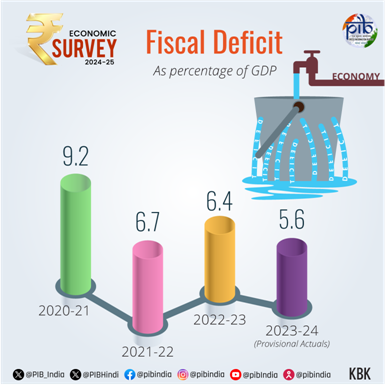
      According to the Survey, the GTR of the union and own tax revenue (OTR) of the states have increased at comparable pace during the period April - November 2024. The revenue expenditure of the states grew at 12 per cent (YoY) during April to November 2024, with subsidies and committed liabilities registering a growth of 25.7 per cent and 10.4 per cent, respectively.

      The Survey observes that stability in the banking sector is underscored by declining asset impairments, robust capital buffers, and strong operational performance. The gross non-performing assets (NPAs) in the banking system have declined to a 12-year low of 2.6 per cent of gross loans and advances. The capital-to-risk-weighted assets ratio (CRAR) for Schedule Commercial Banks stands at 16.7 per cent as of September 2024, well above the norm, says the Survey.

      Emphasizing that the external sector stability is safeguarded by services trade and record remittances, the Economic Survey quotes that India’s merchandise exports grew by 1.6 per cent YoY in April – December 2024. Merchandise imports rose by 5.2 per cent. India's robust services exports have propelled the country to secure the seventh-largest share in global services exports, underscoring its competitiveness.

      In addition to the services trade surplus, remittances from abroad led to a healthy net inflow of private transfers. India was the top recipient of remittances in the world, driven by an uptick in job creation in OECD economies. These two factors combined to ensure that India’s current account deficit (CAD) remains relatively contained at 1.2 per cent of GDP in Q2 FY25, as per the Survey.

      Gross Foreign Direct Investment inflows recorded a revival in FY25, increasing from USD 47.2 billion in the first eight months of FY24 to USD 55.6 billion in the same period of FY25, a YoY growth of 17.9 per cent, says the Survey. Foreign portfolio investment (FPI) flows have been volatile in the second half of 2024, primarily on account of global geopolitical and monetary policy developments.

      The Economic Survey states that as a result of stable capital flows, India’s foreign exchange reserves increased from USD 616.7 billion at the end of January 2024 to USD 704.9 billion in September 2024 before moderating to USD 634.6 billion as on 3 January 2025. India’s forex reserves are sufficient to cover 90 per cent of external debt and provide an import cover of more than ten months, thereby safeguarding against external vulnerabilities.

      The Economic Survey highlights continued good performance on the employment front. It states that India's labour market growth in recent years has been supported by post-pandemic recovery and increased formalisation. The unemployment rate for individuals aged 15 years and above has steadily declined from 6 per cent in 2017-18 to 3.2 per cent in 2023-24. The labour force participation rate (LFPR) and the worker-to-population ratio (WPR) have also increased.

      The Survey also mentions that for India, a services-driven economy with a youthful and adaptable workforce, the adoption of AI offers the potential to support economic growth and improve labour market outcomes. Prioritising education and skill development will be crucial to equipping workers with the competencies needed to thrive in an AI-augmented landscape. The Survey brings out the fact that there are at present barriers to large-scale AI adoption, leading to a window for policymakers to act. The Economic Survey calls upon for collaborative effort between government, private sector, and academia to minimise the adverse societal effects of AI-driven transformation in the labour sector.

      On infrastructure front, the Economic Survey highlights the need for continued step-up of infrastructure investment over next two decades to sustain a high growth. Under railway connectivity, 2031 km of railway network was commissioned between April and November, 2024, and 17 new pairs of Vande Bharat trains were introduced between April and October 2024. Port capacity improved significantly in FY25, leading to improvements in operational efficiency and reduction in average container turnaround time in major ports from 48.1 hours in FY24 to 30.4 hours during FY25 (Apr-Nov).

      The Economic Survey underscores the government of India’s efforts to boost renewable energy in the country and green investments through schemes, policies, financial incentives and regulatory measures such as PM - Surya Ghar: Muft Bijli Yojana, National Bioenergy Programme, National Green Hydrogen Mission and PM-KUSUM. The capacity addition in solar and wind power has lead to a 15.8 per cent year-on-year increase in renewable energy capacity by December 2024.

      The Government social services expenditure has witnessed an increase of compounded annual growth rate of 15% (combined for centre and states) from FY 21 to FY 25. The Gini coefficient, which is a measure of inequality in consumption expenditure, has been declining in recent years (For rural areas it declined to 0.237 in 2023-24 from 0.266 in 2022-23 and for urban areas, it fell to 0.284 in 2023-24 from 0.314 in 2022-23), reflecting positive impact of Government’s initiatives in reshaping income distribution. On the school education front, the government is working toward meeting the objectives of National Education Policy 2020 through a range of programmes and schemes. These interalia include the Samagra Shiksha Abhiyan, DIKSHA, STARS, PARAKH, PM SHRI, ULLAS, PM POSHAN, etc, as per the Survey.

      In the total health expenditure of the country between FY15 and FY22, the Survey quotes the share of government health expenditure has increased from 29.0 per cent to 48.0 per cent. During the same period, the share of out-of-pocket expenditure in total health expenditure declined from 62.6 per cent to 39.4 per cent.

      Micro, Small and Medium Enterprises (MSME) sector has emerged as a highly vibrant sector of the Indian economy, noted the Survey. To provide equity funding to MSMEs with the potential to scale up, the government launched the Self-Reliant India Fund with a corpus of ₹50,000 crore.

      The Survey, says that reducing excessive regulatory burdens, governments can help businesses become more efficient, reduce costs, and unlock new growth opportunities. Regulations increase the cost of all operational decisions in firms, the Economic Survey adds. It has outlined a three-step process for states to systematically review regulations for their cost-effectiveness. The steps include identifying areas for deregulation, thoughtfully comparing the regulations with other states and countries and estimating the cost of each of these regulations on individual enterprises. The Survey highlights that Ease of Doing Business (EoDB) 2.0 should be a state government-led initiative focused on fixing the root causes behind the unease of doing business. It mentions that in the next phase for EoDB, states must break new ground on liberalizing standards and controls, setting legal safeguards for enforcement, reducing tariffs and fees, and applying risk-based regulation. 

      As the Survey underscores, looking ahead, India’s economic prospects for FY26 are balanced. Headwinds to growth include elevated geopolitical and trade uncertainties and possible commodity price shocks. Domestically, the translation of order books of private capital goods sector into sustained investment pick-up, improvements in consumer confidence, and corporate wage pick-up will be key to promoting growth. Rural demand backed by a rebound in agricultural production, an anticipated easing of food inflation and a stable macro-economic environment provides an upside to near-term growth. Overall, India will need to improve its global competitiveness through grassroots-level structural reforms and deregulation to reinforce its medium-term growth potential.

      Topics

      ActsIncome Tax
