
Just a moment...

Top
Help
×

By creating an account you can:

Logo TaxTMI
Call Us / Help / Feedback

Contact Us At :

E-mail: [email protected]

Call / WhatsApp at: +91 99117 96707

For more information, Check Contact Us

FAQs :

To know Frequently Asked Questions, Check FAQs

Most Asked Video Tutorials :

For more tutorials, Check Video Tutorials

Submit Feedback/Suggestion :

Email :
Please provide your email address so we can follow up on your feedback.
Category :
Description :
Min 15 characters0/2000
Make Most of Text Search
  1. Checkout this video tutorial: How to search effectively on TaxTMI.
  2. Put words in double quotes for exact word search, eg: "income tax"
  3. Avoid noise words such as : 'and, of, the, a'
  4. Sort by Relevance to get the most relevant document.
  5. Press Enter to add multiple terms/multiple phrases, and then click on Search to Search.
  6. Text Search
  7. The system will try to fetch results that contains ALL your words.
  8. Once you add keywords, you'll see a new 'Search In' filter that makes your results even more precise.
  9. Text Search
Add to...
You have not created any category. Kindly create one to bookmark this item!
Create New Category
Hide
Title :
Description :
❮❮ Hide
Default View
Expand ❯❯
Close ✕
🔎 News - Adv. Search
TEXT SEARCH:

Press 'Enter' to add multiple search terms. Rules for Better Search

Search In:
Main Text + AI Text
  • Main Text
  • Main Text + AI Text
  • AI Text
Category: ?
Categorized by AI
---- All Categories ----
  • ---- All Categories ----
  • Income Tax
  • GST
  • Customs, DGFT & SEZ
  • FEMA & RBI
  • Corp. Laws, SEBI & IBC
  • PMLA, Black Money & ED
  • Budget
  • News and Press Release
  • PTI News
Month:
---- All Months ----
  • ---- All Months ----
  • January
  • February
  • March
  • April
  • May
  • June
  • July
  • August
  • September
  • October
  • November
  • December
Year:
---- All Years ----
  • ---- All Years ----
  • 2026
  • 2025
  • 2024
  • 2023
  • 2022
  • 2021
  • 2020
  • 2019
  • 2018
  • 2017
  • 2016
  • 2015
  • 2014
  • 2013
  • 2012
  • 2011
Sort By: ?
In Sort By 'Default', exact matches for text search are shown at the top, followed by the remaining results in their regular order.
RelevanceDefaultDate
    30-member Indian commerce chamber delegation to visit Sri Lanka
    Rupee rises 22 paise to 96.51 against US dollar in early trade
    ED conducts raids in UP, Delhi and Punjab in Rs 450-crore bank loan 'fraud'
    US slaps 10 per cent tariff on goods imported from India over forced labour concerns
    NICDC Organises Cross-Learning Site Visit to AURIC Smart City to Strengthen Industrial Corridor Development
    India Concludes Eighth Trade Policy Review at WTO in Geneva
    US' temporary 10 pc tariff set to expire on Friday unless extended or new duties announced
    PNB to establish Quantum Finance Innovation Hub in Amaravati
    Infosys veteran Ashiss Kumar Dash to succeed Salil Parekh as new CEO in 2027
    Gold falls Rs 400 per 10 grams amid surging oil prices
    PNB and Andhra Pradesh sign MoU to establish India's first Bank-led Quantum Finance Hub at Amaravati
    Govt allows FDI in inventory-based e-commerce model only for export purposes
    Joint home loans in India - interest rates start at 7.25%* p.a. for salaried applicants
    6Wresearch: India Export Attractiveness Tracker 2026
    Govt allows FDI in inventory-based model of e-commerce only for export purposes
    CRIF India Launches Chennai Chapter of 'Credit Goes to HER' to Strengthen Women's Leadership in the Credit Ecosystem
    Loan Fest 2026: Apply for a Bajaj Finance Personal Loan Online with Attractive Offers
    Rupee slips 4 paise to settle at 96.57 against US dollar
    Supertech twin towers: SC defers hearing on plea seeking refund for homebuyers
    Invest Manchester: UK-India Free Trade Agreement Opens New Doors for APAC Manufacturers
❯❯
MaximizeMaximizeMaximize
0 / 200
Expand Note
Add to Folder

No Folders have been created

    +

    Are you sure you want to delete "My most important" ?

    NOTE:

    News
    Showing Results for :
    Reset Filters
    Results Found:
    Show All SummariesHide All Summaries
    July 24, 2026
    Show AI Summary
    Cross-border commercial engagement supports Indian and Sri Lankan businesses in identifying partnerships and strengthening trade and investment relationships.
    Cross-border trade and investment engagement between India and Sri Lanka is proposed through a commerce chamber delegation representing diverse Indian industry sectors. A networking session is intended to enable direct interactions between businesses, identify partnership opportunities, discuss commercial collaboration and develop new business connections. The engagement seeks to strengthen commercial relationships across participating industries within the established bilateral trade and investment relationship.
    July 24, 2026
    Show AI Summary
    Foreign exchange market intervention limited rupee depreciation amid elevated oil prices, importer dollar demand, capital outflows and equity market weakness.
    Foreign exchange market conditions reflected an early appreciation of the rupee against the US dollar, with likely central bank intervention through state-owned banks reported as limiting sharper depreciation. Softer dollar conditions provided limited support, while elevated crude oil prices increased dollar demand from oil marketing companies and sustained importer buying pressure. Foreign institutional investor equity outflows, domestic equity weakness, and West Asia tensions affecting oil prices also influenced the rupee.
    July 24, 2026
    Show AI Summary
    Money-laundering investigation examines alleged bank-loan fund diversion through shell entities, accommodation entries, fake invoices and circular transactions.
    A money-laundering investigation under the Prevention of Money Laundering Act concerns alleged bank-loan fraud involving Santosh Overseas Ltd., its promoters and linked entities. Searches were conducted at premises in Uttar Pradesh, Delhi and Punjab. The investigation, arising from a Central Bureau of Investigation case, alleges diversion and layering of loan funds through shell entities, accommodation-entry operators and related companies by means of purportedly fake invoices and circular financial transactions.
    July 24, 2026
    Show AI Summary
    Forced-labour import prohibitions shape tariff treatment as India's policy amendment secures a lower rate for imported goods.
    Forced-labour import prohibitions are linked to tariff treatment under Section 301 of the Trade Act of 1974. Goods imported from India receive a lower tariff rate after India amended its foreign trade policy to prohibit imports of goods produced using forced labour. The framework excludes certain raw materials, goods causing economy-wide disruption, and products unavailable in sufficient domestic quantities. India has contested the underlying investigations and proposes that the issues be addressed through a bilateral trade agreement.
    July 24, 2026
    Show AI Summary
    Integrated industrial city development promotes cross-learning on digital governance, investor facilitation, infrastructure planning and plug-and-play industrial parks.
    Industrial corridor development is being supported through cross-learning on AURIC Smart City's integrated planning, infrastructure and governance practices. The programme addresses master planning, utility systems, digital monitoring, land utilisation, investor facilitation, project implementation and coordination among implementing agencies. It also considers application of these practices to the Bharat Audyogik Vikas Yojana for plug-and-play industrial parks, with emphasis on integrated utilities, digital land management, investor-friendly approvals, sustainable infrastructure and multimodal connectivity.
    July 24, 2026
    Show AI Summary
    WTO trade policy review highlights India's commitment to transparent trade rules, development policy space and multilateral engagement.
    India reaffirmed an open, transparent, predictable and WTO-consistent trade and investment regime through tariff reform, customs simplification and free trade agreement initiatives. Its trade policy was presented as balancing developmental needs with WTO principles: agricultural tariffs protect vulnerable farmers, while industrial tariffs support supply-chain resilience and domestic manufacturing. India also committed to transparent, consultative and rules-compliant sanitary measures, technical regulations and trade remedies, with investigations based on objective evidence, due process and judicial oversight, including continued application of the Lesser Duty Rule in anti-dumping matters.
    July 23, 2026
    Show AI Summary
    Temporary Section 122 surcharge expiry may restore MFN treatment for Indian exports, while Section 301 tariff uncertainty continues.
    The US temporary Section 122 import surcharge on Indian goods is scheduled to expire unless extended or replaced, restoring affected imports to normal US MFN tariff treatment. Liability depends on entry for consumption or warehouse withdrawal. Section 232 national-security tariffs remain unchanged. Indian exports may still face fresh measures under Section 301 investigations into forced labour and excess manufacturing capacity, alongside potential country-specific or sectoral tariffs. The expiry may improve export competitiveness and market access, particularly for labour-intensive and MSME-driven sectors.
    July 23, 2026
    Show AI Summary
    Quantum finance innovation will advance secure digital banking through cybersecurity, fraud detection, collaborative research, workforce development and digital literacy.
    A Quantum Finance Innovation Hub is proposed to apply quantum technologies to banking through stronger cybersecurity, proactive financial-fraud detection and secure digital financial ecosystems. The initiative will bring together industry, academia, startups, research organisations and government agencies to promote innovation in quantum computing, artificial intelligence and related technologies. It also focuses on workforce development, digital literacy, public confidence in digital financial services, and technology-enabled responses to cybercrime and digital-arrest scams.
    July 23, 2026
    Show AI Summary
    Chief executive succession plan appoints a CEO designate, subject to shareholder approval, for an AI-led corporate leadership transition.
    Corporate leadership succession at Infosys is proposed through the appointment of Ashiss Kumar Dash as Managing Director and Chief Executive Officer designate from 1 April 2027. The five-year appointment is subject to shareholder approval and follows a recommendation of the Board's Nomination and Remuneration Committee. The incumbent will remain in office until the transition date and support an orderly transfer of responsibilities. The succession plan identifies the CEO designate's business, technology-delivery, client and global operations experience as relevant to AI-led transformation.
    July 23, 2026
    Show AI Summary
    Bullion market pressure intensified as rising oil prices, inflation concerns and restrictive monetary policy expectations weakened gold and silver sentiment.
    Gold and silver prices declined amid weaker global bullion trends, profit-booking, and higher crude oil prices linked to Middle East tensions. Market commentary associated the decline with inflation concerns and expectations that major central banks may sustain restrictive monetary policy for longer. Gold was described as facing near-term pressure from higher interest-rate expectations, inflation risks, and geopolitical uncertainty.
    July 23, 2026
    Show AI Summary
    Quantum finance innovation will develop secure, AI-enabled banking solutions through collaborative research, startup incubation, cybersecurity enhancement and workforce development.
    Quantum finance innovation is to be advanced through a memorandum of understanding for establishing the PNB Quantum Finance Hub at Amaravati Quantum Valley. The hub will develop, test and support adoption of secure, intelligent and future-ready banking solutions using Quantum Computing and Artificial Intelligence. It will bring together industry, academia, startups and government agencies for research, innovation, incubation and acceleration of financial technologies, focusing on cybersecurity, fraud detection, operational efficiency, risk management and customer experience.
    July 23, 2026
    Show AI Summary
    Foreign investment in inventory-based e-commerce is allowed only for exports of Indian-made goods, while domestic retail remains prohibited.
    Foreign direct investment in inventory-based e-commerce is permitted exclusively for exports of goods or products manufactured or produced in India. Restrictions on business-to-consumer and inventory-based e-commerce do not apply to these exports, subject to the Foreign Trade Policy 2023 and export regulations. Foreign direct investment in inventory-based e-commerce retailing for domestic sales remains prohibited, with the revised position taking effect upon the relevant foreign exchange notification.
    July 23, 2026
    Show AI Summary
    Joint Home Loan Eligibility and Shared Repayment Liability Shape Borrowing Capacity, Tax Claims, Documentation, and Exit Planning.
    Joint home loans allow eligible applicants to combine income for a single housing loan, while making every co-applicant fully responsible for repayment. Eligibility depends on each applicant's income, financial obligations, credit history, age, repayment capacity and property criteria. Applicants should agree on EMI sharing, ownership proportions and exit arrangements before applying, as removal of a co-applicant requires lender approval and reassessment. Co-owner borrowers may claim applicable interest and principal repayment deductions subject to ownership, contribution and income-tax requirements. Each applicant must provide separate identity, income and banking documentation.
    July 23, 2026
    Show AI Summary
    Export competitiveness increasingly depends on regulatory compliance, preferential trade access and diversification into smartphones, medicines, petroleum products and semiconductors.
    India's export potential to 2031 is centred on smartphones, polished diamonds, petroleum products and medicines, with the United States, Hong Kong, Japan, China, Singapore and the United Arab Emirates as important markets. New product opportunities include iron ore concentrates, gasoline vehicles and light petroleum oils. Although selected destinations offer duty-free or preferential access, market entry in mature markets increasingly depends on compliance with non-tariff measures, including registration, quality certification, safety documentation and product standards. Semiconductor-related manufacturing is identified as a long-term opportunity supported by expanding electronics capacity, supply-chain diversification and domestic incentives.
    July 23, 2026
    Show AI Summary
    Foreign investment in inventory-based e-commerce is permitted exclusively for exports of Indian-manufactured or produced goods under export compliance rules.
    Foreign direct investment in inventory-based e-commerce is permitted exclusively for exports of goods or products manufactured or produced in India. Foreign direct investment remains permitted in business-to-business e-commerce and the marketplace model, while business-to-consumer and inventory-based direct sales to consumers remain prohibited except for the specified export activity. Export-oriented inventory-based operations must comply with the applicable Foreign Trade Policy and foreign exchange regulations governing exports.
    July 23, 2026
    Show AI Summary
    Women's leadership in credit expands through a Chennai community platform supporting mentorship, inclusive lending practices, and financial ecosystem collaboration.
    The Chennai chapter of the 'Credit Goes to HER' initiative provides a platform for women professionals in banking, NBFCs, fintech, housing finance, academia and policy to share knowledge, obtain mentorship and collaborate on inclusive credit practices. It seeks to strengthen women's leadership and participation in the credit ecosystem while supporting responsible lending, financial inclusion, transparency and data-driven decision-making.
    July 23, 2026
    Show AI Summary
    Digital personal-loan campaign combines online collateral-free borrowing, eligibility-based assessment, flexible repayment options and conditional lifestyle rewards for successful disbursals.
    Digital personal-loan campaign permits eligible customers to apply online for collateral-free borrowing and receive specified lifestyle rewards upon successful disbursal, subject to campaign terms. Applicants may check an offer, provide personal, financial and employment information, review loan terms, complete know-your-customer and bank-account verification, and undergo assessment. Interest rates, loan amounts and repayment tenures depend on eligibility, credit profile, income and internal assessment. An EMI calculator supports comparison of repayment options and estimation of monthly instalments before application.
    July 23, 2026
    Show AI Summary
    Foreign-exchange market pressure weakened the rupee as elevated crude prices and risk sentiment drove trading conditions.
    Foreign-exchange market movement saw the rupee depreciate against the US dollar amid elevated crude oil prices linked to heightened West Asia hostilities. Weak domestic equity markets and foreign investor equity outflows contributed to negative sentiment. Market commentary indicated that prospective Reserve Bank of India intervention supported the rupee and could limit sharper depreciation, while shipping-security concerns contributed to elevated oil prices.
    July 23, 2026
    Show AI Summary
    Homebuyer refund claims in developer insolvency proceed through pro-rata distribution of funds deposited for eligible buyers.
    Homebuyer refund claims connected with demolished residential towers are being considered within the developer's insolvency proceedings. Buyers who have not opted for alternative allotment seek repayment. Eligible refunds are contemplated on a pro-rata basis from funds deposited by the Interim Resolution Professional, subject to the claims process and the availability of deposited funds.
    July 23, 2026
    Show AI Summary
    Free trade agreement tariff reductions create investment opportunities for Asia-Pacific manufacturers seeking UK and European market access.
    The UK-India Free Trade Agreement is presented as reducing tariffs on advanced machinery and manufacturing-related goods and creating trade and investment opportunities for Asia-Pacific manufacturers seeking UK and European market access. Manchester is promoted as an investment location through its advanced manufacturing cluster, skilled workforce, innovation infrastructure, international links, and available manufacturing and research space. Invest Manchester provides investor support and undertakes international engagement to develop trade, investment and innovation partnerships.

    News

    Back

    All News

    Showing Results for :
    Reset Filters
      No Records Found

      News

      Back

      All News

      whatsappJoin Channel
      Showing Results for : Reset Filters

      SUMMARY OF ECONOMIC SURVEY 2024-25

      January 31, 2025

      Contents
      Plus +
      Summary
      Note

      Note

      -

      Bookmark

      Print

      Print

      INDIA’S GDP EXPECTED TO GROW BETWEEN 6.3 & 6.8 PER CENT IN FY26

      REAL GDP ESTIMATED AT 6.4 PER CENT IN FY25, CLOSE TO ITS DECADAL AVERAGE

      REAL GVA ESTIMATED TO GROW BY 6.4 PER CENT IN FY25

      CAPEX GROWS AT 8.2 PER CENT IN JULY – NOVEMBER 2024 AND EXPECTED TO PICK UP FURTHER PACE

      RETAIL HEADLINE INFLATION SOFTENED TO 4.9 PER CENT IN APRIL-DECEMBER 2024

      INDIA’S CONSUMER PRICE INFLATION TO ALIGN WITH THE TARGET OF AROUND 4 PER CENT IN FY26

      OVERALL EXPORTS GROW 6.0 PER CENT (YOY) DURING APRIL-DECEMBER 2024

      INDIA’S SERVICES EXPORT GROWTH SURGED TO 12.8 PER CENT DURING APRIL–NOVEMBER FY25, UP FROM 5.7 PER CENT IN FY24

      GROSS FDI INFLOWS INCREASE FROM USD 47.2 BILLION IN FIRST EIGHT MONTHS OF FY24 TO USD 55.6 BILLION IN THE SAME PERIOD OF FY25, A YOY GROWTH OF 17.9 PER CENT

      FOREX AT USD 640.3 BILLION AS OF END OF DECEMBER 2024, SUFFICIENT TO COVER 10.9 MONTHS OF IMPORTS AND APPROXIMATELY 90 PER CENT OF EXTERNAL DEBT

      CAPACITY ADDITION IN SOLAR AND WIND POWER INCREASES 15.8 PER CENT YEAR-ON-YEAR IN DECEMBER 2024

      BSE STOCK MARKET CAPITALISATION TO GDP RATIO AT 136 PER CENT AT THE END OF DECEMBER 2024, FAR HIGHER THAN CHINA (65 PER CENT) AND BRAZIL (37 PER CENT)

      ECONOMIC SURVEY ADVOCATES DEREGULATION TO ACCELERATE AND SUSTAIN ECONOMIC GROWTH

      CONTINUED STEP-UP OF INFRASTRUCTURE INVESTMENT OVER NEXT TWO DECADES NEEDED TO SUSTAIN A HIGH GROWTH

      ₹50,000 CRORE SELF-RELIANT INDIA FUND LAUNCHED TO PROVIDE EQUITY FUNDING TO MSMES

      AGRICULTURE EXPECTED TO GROW AT 3.8 PER CENT IN FY25

      KHARIF FOODGRAIN PRODUCTION FOR 2024 IS EXPECTED TO REACH 1647.05 LMT, AN INCREASE OF 89.37 LMT OVER PREVIOUS YEAR

      KEY DRIVERS OF AGRICULTURAL GROWTH ARE HORTICULTURE, LIVESTOCK & FISHERIES

      INDUSTRIAL SECTOR ESTIMATED TO GROW BY 6.2 PER CENT IN FY25

      SOCIAL SERVICES EXPENDITURE REGISTERS AN ANNUAL GROWTH RATE OF 15 PER CENT BETWEEN FY 21 AND FY 25

      GOVERNMENT HEALTH EXPENDITURE INCREASES FROM 29.0 PER CENT TO 48.0 PER CENT; SHARE OF OUT OF POCKET EXPENDITURE IN TOTAL HEALTH EXPENDITURE DECLINES FROM 62.6 PER CENT TO 39.4 PER CENT BETWEEN FY15 AND FY22

      UNEMPLOYMENT RATE DECLINES TO 3.2 PER CENT IN 2023-24 (JULY-JUNE) FROM 6.0 PER CENT IN 2017-18 (JULY-JUNE)

      COLLABORATIVE EFFORT BETWEEN GOVERNMENT, PRIVATE SECTOR, AND ACADEMIA ESSENTIAL TO MINIMISE ADVERSE AI SOCIETAL EFFECTS

      “The global economy grew by 3.3 per cent in 2023. The International Monetary Fund (IMF) projects global growth to average around 3.2 per cent over the next five years, which is modest by historical standards”, says the Economic Survey 2024-25 tabled by Union Minister of Finance and Corporate Affairs Smt. Nirmala Sitharaman, in the Parliament today.
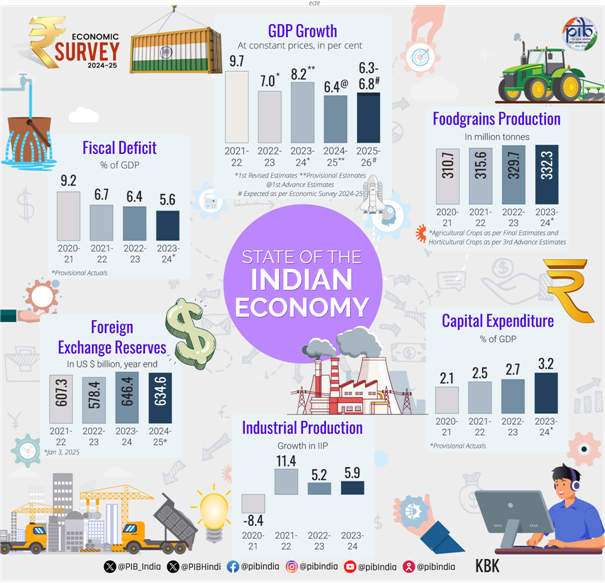
      As per the Survey, the global economy exhibited steady yet uneven growth across regions in 2024. A notable trend was the slowdown in global manufacturing, especially in Europe and parts of Asia, due to supply chain disruptions and weak external demand. In contrast, the services sector performed better, supporting growth in many economies. Inflationary pressures eased in most economies. However, services inflation has remained persistent, notes the Survey.
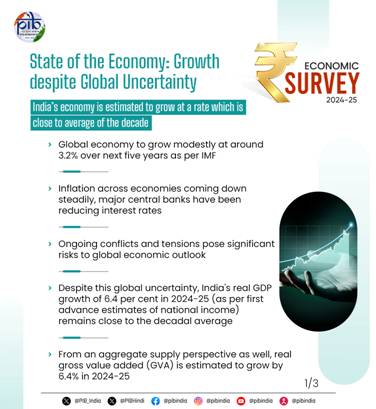
      The Survey highlights that, despite global uncertainty, India has displayed steady economic growth. India's real GDP growth of 6.4 per cent in FY25 remains close to the decadal average.

      From an aggregate demand perspective, private final consumption expenditure at constant prices is estimated to grow by 7.3 per cent, driven by a rebound in rural demand.

      On the supply side, the real gross value added (GVA) is estimated to grow by 6.4 per cent. The agriculture sector is expected to rebound to a growth of 3.8 per cent in FY25. The industrial sector is estimated to grow by 6.2 per cent in FY25. Strong growth rates in construction activities and electricity, gas, water supply and other utility services are expected to support industrial expansion. Growth in the services sector is expected to remain robust at 7.2 per cent, driven by healthy activity in financial, real estate, professional services, public administration, defence, and other services.
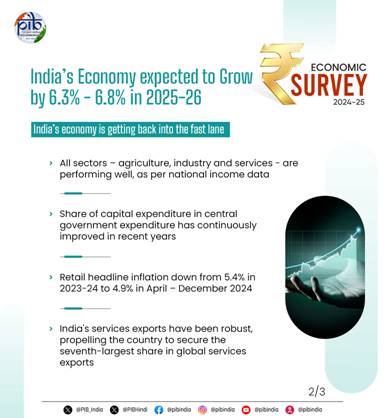
      Keeping in mind the upsides and downsides to growth, the Survey expects the real GDP growth in FY26 to be between 6.3 and 6.8 per cent.

      The Chapter on the Medium-Term Outlook elaborates on the global factors and the importance of strengthening the levers of domestic growth in the context of heightened risks due to global concerns about economic policies and trade policy uncertainties.

      To realize the aspirations of Viksit Bharat by 2047, it is important that the medium-term growth outlook of India be assessed in the context of emerging global realities of Geo-Economic Fragmentation (GEF), Chinese manufacturing prowess, and global dependency on China for energy transition efforts. The Survey puts forth a way forward to reinvigorate the internal engines and domestic levers of growth by focusing on one central element of systemic deregulation, which will enable a paradigm of economic freedom to businesses of individuals and organizations to pursue legitimate economic activity with ease. The Survey stresses that the reforms and economic policy must now be on systematic deregulation under Ease of Doing Business 2.0 so that it encourages creation of a viable Mittelstand, i.e. India’s SME sector.

      The Economic Survey 2024-25 notes that agriculture growth remained steady in first half of FY25, with Q2 recording a growth rate of 3.5 per cent, marking an improvement over the previous four quarters. Healthy Kharif production, above-normal monsoons, and an adequate reservoir level supported agricultural growth. The total Kharif food grain production is estimated at a record 1647.05 lakh metric tonnes (LMT) in 2024-25, higher by 5.7 per cent compared to 2023-24 and 8.2 per cent higher than the average food grain production in the past five years.

      The industrial sector grew by 6 per cent in first half of FY25, and is estimated to grow by 6.2 per cent in FY25. Q1 saw a strong growth of 8.3 per cent, but growth moderated in Q2 due to three key factors. First, manufacturing exports slowed significantly due to weak demand from destination countries, and aggressive trade and industrial policies in major trading nations. Second, the above average monsoon had mixed effects - while it replenished reservoirs and supported agriculture, it also disrupted sectors like mining, construction, and, to some extent, manufacturing. Third, the variation in the timing of festivities between September and October in the previous and current years led to a modest growth slowdown in Q2 FY25.

      Despite various challenges, India continues to register the fastest growth in manufacturing PMI, stated the Survey. The latest Manufacturing PMI for December 2024 remained well within the expansionary zone, driven by new business gains, robust demand, and advertising efforts.

      The services sector continues to perform well in FY25, emphasizes the Survey. A notable growth in Q1 and Q2 resulted in 7.1 per cent growth in first half of FY25. Across sub-categories, all the sub-sectors have performed well. India’s services export growth surged to 12.8 per cent during April–November FY25, up from 5.7 per cent in FY24.

      The Economic Survey states that growth process has been ably supported by stability on fronts such as inflation, fiscal health, and external sector balance. On inflation, the Survey states that retail headline inflation has softened from 5.4 per cent in FY24 to 4.9 per cent in April – December 2024. Food inflation, measured by the Consumer Food Price Index (CFPI), has increased from 7.5 per cent in FY24 to 8.4 per cent in FY25 (April-December), primarily driven by a few food items such as vegetables and pulses. India’s consumer price inflation will gradually align with the target of around 4 per cent in FY26 as per RBI and IMF.
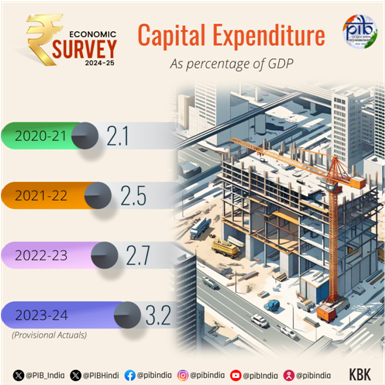
      Capital expenditure (capex), as a per cent of the total expenditure of the union, has continuously improved from FY21 to FY24. After the general elections, union government capex has grown by 8.2 per cent during July – November 2024 YoY, the Survey says.

      Despite the gross tax revenue (GTR) increasing by 10.7 per cent YoY during April-November 2024, the tax revenue retained by the Union, net of devolution to the states, hardly increased, says the Survey. As of November, the deficit indicators of the union were comfortably placed, leaving ample room for developmental and capital expenditure in the rest of the year.
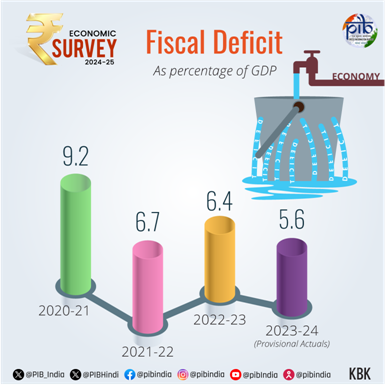
      According to the Survey, the GTR of the union and own tax revenue (OTR) of the states have increased at comparable pace during the period April - November 2024. The revenue expenditure of the states grew at 12 per cent (YoY) during April to November 2024, with subsidies and committed liabilities registering a growth of 25.7 per cent and 10.4 per cent, respectively.

      The Survey observes that stability in the banking sector is underscored by declining asset impairments, robust capital buffers, and strong operational performance. The gross non-performing assets (NPAs) in the banking system have declined to a 12-year low of 2.6 per cent of gross loans and advances. The capital-to-risk-weighted assets ratio (CRAR) for Schedule Commercial Banks stands at 16.7 per cent as of September 2024, well above the norm, says the Survey.

      Emphasizing that the external sector stability is safeguarded by services trade and record remittances, the Economic Survey quotes that India’s merchandise exports grew by 1.6 per cent YoY in April – December 2024. Merchandise imports rose by 5.2 per cent. India's robust services exports have propelled the country to secure the seventh-largest share in global services exports, underscoring its competitiveness.

      In addition to the services trade surplus, remittances from abroad led to a healthy net inflow of private transfers. India was the top recipient of remittances in the world, driven by an uptick in job creation in OECD economies. These two factors combined to ensure that India’s current account deficit (CAD) remains relatively contained at 1.2 per cent of GDP in Q2 FY25, as per the Survey.

      Gross Foreign Direct Investment inflows recorded a revival in FY25, increasing from USD 47.2 billion in the first eight months of FY24 to USD 55.6 billion in the same period of FY25, a YoY growth of 17.9 per cent, says the Survey. Foreign portfolio investment (FPI) flows have been volatile in the second half of 2024, primarily on account of global geopolitical and monetary policy developments.

      The Economic Survey states that as a result of stable capital flows, India’s foreign exchange reserves increased from USD 616.7 billion at the end of January 2024 to USD 704.9 billion in September 2024 before moderating to USD 634.6 billion as on 3 January 2025. India’s forex reserves are sufficient to cover 90 per cent of external debt and provide an import cover of more than ten months, thereby safeguarding against external vulnerabilities.

      The Economic Survey highlights continued good performance on the employment front. It states that India's labour market growth in recent years has been supported by post-pandemic recovery and increased formalisation. The unemployment rate for individuals aged 15 years and above has steadily declined from 6 per cent in 2017-18 to 3.2 per cent in 2023-24. The labour force participation rate (LFPR) and the worker-to-population ratio (WPR) have also increased.

      The Survey also mentions that for India, a services-driven economy with a youthful and adaptable workforce, the adoption of AI offers the potential to support economic growth and improve labour market outcomes. Prioritising education and skill development will be crucial to equipping workers with the competencies needed to thrive in an AI-augmented landscape. The Survey brings out the fact that there are at present barriers to large-scale AI adoption, leading to a window for policymakers to act. The Economic Survey calls upon for collaborative effort between government, private sector, and academia to minimise the adverse societal effects of AI-driven transformation in the labour sector.

      On infrastructure front, the Economic Survey highlights the need for continued step-up of infrastructure investment over next two decades to sustain a high growth. Under railway connectivity, 2031 km of railway network was commissioned between April and November, 2024, and 17 new pairs of Vande Bharat trains were introduced between April and October 2024. Port capacity improved significantly in FY25, leading to improvements in operational efficiency and reduction in average container turnaround time in major ports from 48.1 hours in FY24 to 30.4 hours during FY25 (Apr-Nov).

      The Economic Survey underscores the government of India’s efforts to boost renewable energy in the country and green investments through schemes, policies, financial incentives and regulatory measures such as PM - Surya Ghar: Muft Bijli Yojana, National Bioenergy Programme, National Green Hydrogen Mission and PM-KUSUM. The capacity addition in solar and wind power has lead to a 15.8 per cent year-on-year increase in renewable energy capacity by December 2024.

      The Government social services expenditure has witnessed an increase of compounded annual growth rate of 15% (combined for centre and states) from FY 21 to FY 25. The Gini coefficient, which is a measure of inequality in consumption expenditure, has been declining in recent years (For rural areas it declined to 0.237 in 2023-24 from 0.266 in 2022-23 and for urban areas, it fell to 0.284 in 2023-24 from 0.314 in 2022-23), reflecting positive impact of Government’s initiatives in reshaping income distribution. On the school education front, the government is working toward meeting the objectives of National Education Policy 2020 through a range of programmes and schemes. These interalia include the Samagra Shiksha Abhiyan, DIKSHA, STARS, PARAKH, PM SHRI, ULLAS, PM POSHAN, etc, as per the Survey.

      In the total health expenditure of the country between FY15 and FY22, the Survey quotes the share of government health expenditure has increased from 29.0 per cent to 48.0 per cent. During the same period, the share of out-of-pocket expenditure in total health expenditure declined from 62.6 per cent to 39.4 per cent.

      Micro, Small and Medium Enterprises (MSME) sector has emerged as a highly vibrant sector of the Indian economy, noted the Survey. To provide equity funding to MSMEs with the potential to scale up, the government launched the Self-Reliant India Fund with a corpus of ₹50,000 crore.

      The Survey, says that reducing excessive regulatory burdens, governments can help businesses become more efficient, reduce costs, and unlock new growth opportunities. Regulations increase the cost of all operational decisions in firms, the Economic Survey adds. It has outlined a three-step process for states to systematically review regulations for their cost-effectiveness. The steps include identifying areas for deregulation, thoughtfully comparing the regulations with other states and countries and estimating the cost of each of these regulations on individual enterprises. The Survey highlights that Ease of Doing Business (EoDB) 2.0 should be a state government-led initiative focused on fixing the root causes behind the unease of doing business. It mentions that in the next phase for EoDB, states must break new ground on liberalizing standards and controls, setting legal safeguards for enforcement, reducing tariffs and fees, and applying risk-based regulation. 

      As the Survey underscores, looking ahead, India’s economic prospects for FY26 are balanced. Headwinds to growth include elevated geopolitical and trade uncertainties and possible commodity price shocks. Domestically, the translation of order books of private capital goods sector into sustained investment pick-up, improvements in consumer confidence, and corporate wage pick-up will be key to promoting growth. Rural demand backed by a rebound in agricultural production, an anticipated easing of food inflation and a stable macro-economic environment provides an upside to near-term growth. Overall, India will need to improve its global competitiveness through grassroots-level structural reforms and deregulation to reinforce its medium-term growth potential.

      Topics

      ActsIncome Tax
