
Just a moment...

Top
Help
×

By creating an account you can:

Logo TaxTMI
>
Call Us / Help / Feedback

Contact Us At :

E-mail: [email protected]

Call / WhatsApp at: +91 99117 96707

For more information, Check Contact Us

FAQs :

To know Frequently Asked Questions, Check FAQs

Most Asked Video Tutorials :

For more tutorials, Check Video Tutorials

Submit Feedback/Suggestion :

Email :
Please provide your email address so we can follow up on your feedback.
Category :
Description :
Min 15 characters0/2000
Add to...
You have not created any category. Kindly create one to bookmark this item!
Create New Category
Hide
Title :
Description :
❮❮ Hide
Default View
Expand ❯❯
Close ✕
🔎 News - Adv. Search
TEXT SEARCH:

Press 'Enter' to add multiple search terms. Rules for Better Search

Search In:
Main Text + AI Text
  • Main Text
  • Main Text + AI Text
  • AI Text
Category: ?
Categorized by AI
---- All Categories ----
  • ---- All Categories ----
  • Income Tax
  • GST
  • Customs, DGFT & SEZ
  • FEMA & RBI
  • Corp. Laws, SEBI & IBC
  • PMLA, Black Money & ED
  • Budget
  • News and Press Release
  • PTI News
Month:
---- All Months ----
  • ---- All Months ----
  • January
  • February
  • March
  • April
  • May
  • June
  • July
  • August
  • September
  • October
  • November
  • December
Year:
---- All Years ----
  • ---- All Years ----
  • 2026
  • 2025
  • 2024
  • 2023
  • 2022
  • 2021
  • 2020
  • 2019
  • 2018
  • 2017
  • 2016
  • 2015
  • 2014
  • 2013
  • 2012
  • 2011
Sort By: ?
In Sort By 'Default', exact matches for text search are shown at the top, followed by the remaining results in their regular order.
RelevanceDefaultDate
    Union Minister of Commerce & Industry Shri Piyush Goyal Announces Task Force to Support Toy Sector, Targets 5% Global Market Share by 2032.
    Bihar: Doctor held in connection with paper leak in PSC teachers' recruitment exam 2 years ago
    NYVO Launches India’s First Family Advisory Platform to Close the Investment Advisory Gap
    Tata Power to set up solar equipment manufacturing plant in Odisha
    SC asks Parsvnath Developers to file report on pending cases against it
    HDFC Bank board imposes Rs 1 lakh penalty on its MD, CFO and Group head in MSRDC case
    Gold rebounds Rs 2,440 to Rs 1.49 lakh/10g; silver climbs Rs 5,300 amid strong global cues
    Panasonic Washing Machines in 2026: Five Models with AI Connectivity, Built-In Heaters, and Smart Fabric Care
    Chandigarh University MBA Students Secure 2,605 Job Offers from 300+ Leading MNCs in 2025 & 2026; 196 Students Receive Multiple Offers
    New Handbook In-House Matters Maps the General Counsel's Rise to Business Leadership as India Builds Legal Capability Centres
    InCred Asset Management has Crossed ₹1,000 Crore in investments in listed healthcare companies, becoming one of India''s largest dedicated Healthcar...
    OmniCard Launches India's First Flexi Benefits Basket on UPI — Employee Benefits Beyond Just Meals
    Final US Section 301 Measures on Forced Labour: India Placed in Lower Tariff Tier at 10%
    Department of Commerce Reviews Flue-Cured Virginia (FCV) Tobacco Market Situation in Andhra Pradesh
    Ministry of Corporate Affairs’ ‘Corporate Mitra Scheme’ Awareness Webinar Successfully Organized by IICA Shillong for the youth and enterprises ...
    FM Sitharaman directs Income Tax dept to work for benefit of common people
    Crime Branch chargesheets 10 accused in separate fraud & forgery cases in Jammu
    ED chargesheets 3 founders of Gameskraft under PMLA
    IDFC FIRST Bank Q1FY27 Results: Highest Ever PAT of ₹1,075 Crore, Up 132.4% YoY
    India placed in lower 10 pc US tariff bracket; reaffirms commitment to BTA
❯❯
MaximizeMaximizeMaximize
0 / 200
Expand Note
Add to Folder

No Folders have been created

    +

    Are you sure you want to delete "My most important" ?

    NOTE:

    News
    Showing Results for :
    Reset Filters
    Results Found:
    Show All SummariesHide All Summaries
    July 28, 2026
    Show AI Summary
    Toy-sector competitiveness is advanced through a task force and playbook focused on manufacturing, innovation, quality compliance and exports.
    Toy-sector competitiveness is proposed to be advanced through a dedicated task force and a playbook addressing manufacturing ecosystems, value chains, standards and compliance, skills, innovation, intellectual property and exports. The task force is intended to strengthen manufacturing capability, resolve value-chain bottlenecks, enable design and innovation, develop employment and skills, improve ease of doing business and support global value-chain integration. The roadmap emphasises domestic production, quality standards, localisation, branding, cluster development and support for MSMEs and startups.
    July 28, 2026
    Show AI Summary
    Examination-paper leakage allegations prompt arrest over arranging teacher recruitment candidates' access to leaked questions before the competitive examination.
    Alleged examination-paper leakage in the Public Service Commission teacher recruitment examination is under investigation by the state Economic Offences Unit. A doctor was arrested in connection with allegations that he participated in a conspiracy to leak the examination paper and arrange candidates' selection for payment. Investigators alleged that he arranged candidates who were taken to a hotel shortly before the examination and given access to the leaked question paper.
    July 28, 2026
    Show AI Summary
    Fee-only investment advisory integrates household goals, insurance and mutual fund execution through personalised, incentive-independent financial planning.
    NYVO's fee-only platform integrates investments, goals, insurance and cash flows into a personalised household financial plan. Users may connect existing mutual fund holdings, assess their alignment with financial goals and execute mutual fund transactions on the platform. Recommendations are based on an in-house asset-allocation model and mutual fund rating engine, while the flat-fee structure and absence of product-linked remuneration are intended to preserve independence from sales incentives. The platform uses read-only access under the RBI Account Aggregator framework.
    July 27, 2026
    Show AI Summary
    Solar wafer and ingot manufacturing expansion in Odisha advances subject to environmental, water and other regulatory approvals.
    A solar wafer and ingot plant is proposed on acquired special economic zone land in Odisha, subject to arrangements for environmental clearances, water and other approvals. Work is expected to commence in October, with operations targeted for January 2028. The facility is intended to support solar manufacturing capacity and may address export opportunities arising from European renewable-energy market access for non-Chinese supply chains.
    July 27, 2026
    Show AI Summary
    Homebuyer enforcement measures require developer compliance with deposit, project completion, and disclosure of pending cases.
    Homebuyer enforcement proceedings required the developer and its directors to disclose the status of pending purchaser cases and complete outstanding work in the booked dwelling unit by the specified deadline. Earlier directions required deposit of the recoverable amount with annual interest and warned of coercive consequences for non-compliance. Protective measures included freezing bank accounts, issuing bailable warrants, and preventing creation of third-party rights or transfer of possession. Insolvency proceedings were stated not to impede enforcement of directions concerning the homebuyers' claims.
    July 27, 2026
    Show AI Summary
    RBI direction compliance prompted internal disciplinary action over deposit mobilisation and marketing-expenditure payments, with the matter referred to RBI.
    HDFC Bank's board addressed potential divergence from applicable RBI Directions concerning deposits mobilised from the Maharashtra State Road Development Corporation and related marketing-expenditure payments. Based on recommendations of a Special Disciplinary Committee of Independent Directors, it treated the conduct as business overreach rather than mala fide conduct, personal enrichment, or improper motive. Monetary penalties and warning letters were issued to relevant employees, and the board directed communication of the matter to the Reserve Bank of India.
    July 27, 2026
    Show AI Summary
    Precious-metal market pricing rebounds as easing inflation concerns, global bullion strength and lower yields support gold and silver.
    Precious-metal prices rebounded in the domestic market, supported by stronger global bullion trends, lower crude-oil prices, easing inflation concerns, a weaker US dollar and lower Treasury bond yields. Domestic gold gains were limited by rupee appreciation. Further bullion-price movement was linked to geopolitical developments, inflation and GDP data, US economic indicators, and monetary-policy decisions by major central banks.
    July 27, 2026
    Show AI Summary
    Consumer financing eligibility supports instalment purchases of washing machines through partner stores, requiring in-person application and approval.
    Consumer financing for Panasonic washing-machine purchases is available through Bajaj Finance partner stores under an Easy EMI Loan or Insta EMI Card, subject to eligibility and available credit limits. Repayment is offered through instalments over specified tenures, with zero down payment available on select models. Buyers must be physically present at a partner store to apply. The process includes comparing models, verifying pre-approved eligibility through mobile-number and OTP verification, evaluating the product in store, selecting an EMI plan, and completing the transaction after approval.
    July 27, 2026
    Show AI Summary
    MBA campus placements across industry-linked management programmes report recruitment activity spanning finance, analytics, technology, supply chain, healthcare and marketing roles.
    Chandigarh University reports MBA placement activity during 2025 and 2026 across banking, information technology, financial technology, healthcare, retail, analytics, consumer goods and automobile sectors. It describes placements in flagship, applied finance and analytics, and industry-collaborated MBA programmes, including marketing, human resources, operations, supply chain, business analytics, digital marketing, financial technology, data science and healthcare management. The release identifies industry collaborations and participating recruiters, and is issued under a PRNewswire arrangement with PTI disclaiming editorial responsibility.
    July 27, 2026
    Show AI Summary
    General Counsel leadership now integrates commercial decisions, regulatory risk, legal-team design, and technology adoption within corporate management.
    Corporate legal departments are evolving from compliance-focused functions into strategic business partners. The General Counsel's role encompasses commercial decision-making, regulatory and reputational risk, acquisitions, market entry, contracts, disputes, crisis management and technology adoption. Increased regulatory complexity and the growth of legal capability centres require proactive legal functions with appropriately structured teams, processes, workflow allocation, and use of technology and artificial intelligence.
    July 27, 2026
    Show AI Summary
    Healthcare portfolio management services disclose equity strategy performance, benchmark methodology, fee treatment and the absence of regulatory performance verification.
    InCred Healthcare Portfolio is identified as an investment approach/product under an Equity Strategy pursuant to a SEBI circular. Its disclosed performance is benchmarked against the BSE 500 TRI, calculated using the Time Weighted Rate of Return method prescribed by SEBI, and stated to be net of fees and expenses. Returns for shorter horizons are described as absolute returns. The performance information is expressly stated not to have been verified by SEBI, and SEBI has not certified its accuracy or adequacy.
    July 27, 2026
    Show AI Summary
    UPI-enabled flexi benefits wallets support employee-selected tax-efficient allowances with category controls, compliance monitoring and employer reporting.
    A UPI-enabled flexi benefits wallet is described as allowing employees to allocate employer-provided allowances among eligible categories and make payments through the relevant wallet at UPI-accepting merchants. Tax-efficient treatment is stated to depend on the prescribed conditions applicable to each benefit category. Merchant-category-code controls are intended to restrict expenditure to eligible purposes, while centralised allocation, transaction visibility and reporting support employer compliance. The arrangement is stated to operate through a Reserve Bank of India licensed prepaid payment instrument framework.
    July 27, 2026
    Show AI Summary
    Section 301 forced-labour measures place Indian imports in a lower tariff tier while preserving specified product exclusions.
    Section 301 forced-labour import measures impose an additional ad valorem duty on imports from India, with India placed in a lower additional-tariff tier than initially proposed. Specified exports that attract no additional duties, and goods already subject to Section 232 measures, remain outside the Section 301 additional duty. A substantial portion of Indian exports is therefore excluded, while the remaining exports are subject to the additional duty. The textile-specific mechanism has not yet been operationalised, and engagement continues in relation to that mechanism and bilateral trade agreement negotiations.
    July 27, 2026
    Show AI Summary
    FCV tobacco market stability remains under review through coordinated measures to protect growers and maintain transparent auction operations.
    FCV tobacco market stability was reviewed with emphasis on protecting growers' interests and considering long-term measures for the sector. The delegation inspected Tobacco Board auction operations, interacted with growers on prevailing market conditions, and noted the transparent and orderly conduct of auctions. The Government is monitoring developments and examining appropriate measures with the State Government, Tobacco Board and stakeholders to safeguard FCV tobacco farmers' interests.
    July 27, 2026
    Show AI Summary
    Corporate Mitra Scheme supports MSMEs through accredited professionals delivering affordable compliance, financial, taxation, accounting and governance assistance.
    The Corporate Mitra Scheme seeks to strengthen MSMEs by connecting them with accredited para-professionals providing affordable compliance and business-support services. Corporate Mitras are envisaged to assist with regulatory compliance, finance, taxation, accounting and governance, allowing enterprises to focus on growth. The scheme also trains young graduates in industry-relevant skills and creates employment opportunities. IICA Shillong serves as the nodal agency for coordination, stakeholder liaison, promotion and awareness in the North Eastern Region.
    July 26, 2026
    Show AI Summary
    Tax administration must deliver timely lawful service, protect public assets, and uphold integrity in tax collection.
    Tax administration should assist common citizens by handling matters within departmental authority without unnecessary delay, while remaining within applicable rules. Government departments should protect public land from illegal occupation and expedite lawful land transfers, permissions, construction arrangements and procurement for departmental premises and accommodation. Integrity is the essential principle for officials performing tax-collection functions.
    July 26, 2026
    Show AI Summary
    Investment fraud and forged residence certificates prompted chargesheets over alleged misappropriation, fabricated revenue records, land purchases and employment access.
    Criminal chargesheets concerned alleged investment fraud through false promises of high returns and alleged misappropriation of investor funds, involving a company stated to be unregistered with SEBI, RBI and the relevant Registrar of Companies. A separate chargesheet concerned alleged conspiracy to procure permanent resident certificates using forged revenue records, with the certificates allegedly used for land purchases and government employment. Forensic examination reportedly found that the relevant revenue documents were not genuine according to official records.
    July 25, 2026
    Show AI Summary
    Money-laundering allegations in online rummy gaming prompt prosecution proceedings and asset attachment over suspected cheating of users.
    Money-laundering proceedings concerning online real-money rummy operations include a prosecution complaint against Gameskraft Technologies, RummyTime Technologies, founder-directors and associated persons. The allegations concern proceeds of crime said to arise from cheating users through rummy applications and from an addictive environment encouraging repeated wagering. The proceedings also involve provisional attachment, seizure and freezing of financial holdings, equity interests and immovable properties alleged to be connected with suspected proceeds of crime. The founder-directors' arrests were declared invalid by the Karnataka High Court, while the investigating agency proposes to challenge that order.
    July 25, 2026
    Show AI Summary
    Banking financial performance reflected loan and deposit growth, improved asset quality, stronger margins and prudent contingency provisioning.
    Quarterly financial performance reflected growth in customer business, loans and deposits, expansion in lending portfolios, an improved CASA ratio and lower cost of funds. Asset quality improved through reductions in gross and net non-performing assets, while profitability indicators improved in relation to net interest margin, cost efficiency, provisions, net profit and return on assets. The bank received credit-guarantee claims for its microfinance portfolio and created a contingency provision for macroeconomic and geopolitical uncertainty. Capital adequacy and common equity tier-one ratios were also reported.
    July 25, 2026
    Show AI Summary
    Forced-labour import tariffs place Indian goods under an additional duty while exemptions preserve access for specified exports.
    A 10 per cent Section 301 additional import duty applies to specified Indian goods over and above ordinary most-favoured-nation duty, following a forced-labour-related investigation. Generic pharmaceuticals, smartphones, other specified products, and goods already subject to Section 232 sectoral duties remain outside the additional levy. The textile-specific mechanism has not yet been operationalised for India, while tariff-rate quota concessions using US-origin cotton and fibre were announced for certain other economies. India continues engagement on a bilateral trade agreement and tariff access for garments using American inputs.

    News

    Back

    All News

    Showing Results for :
    Reset Filters
      No Records Found

      News

      Back

      All News

      whatsappJoin Channel
      Showing Results for : Reset Filters

      SUMMARY OF ECONOMIC SURVEY 2024-25

      January 31, 2025

      Contents
      Plus +
      Summary
      Note

      Note

      -

      Bookmark

      Print

      Print

      INDIA’S GDP EXPECTED TO GROW BETWEEN 6.3 & 6.8 PER CENT IN FY26

      REAL GDP ESTIMATED AT 6.4 PER CENT IN FY25, CLOSE TO ITS DECADAL AVERAGE

      REAL GVA ESTIMATED TO GROW BY 6.4 PER CENT IN FY25

      CAPEX GROWS AT 8.2 PER CENT IN JULY – NOVEMBER 2024 AND EXPECTED TO PICK UP FURTHER PACE

      RETAIL HEADLINE INFLATION SOFTENED TO 4.9 PER CENT IN APRIL-DECEMBER 2024

      INDIA’S CONSUMER PRICE INFLATION TO ALIGN WITH THE TARGET OF AROUND 4 PER CENT IN FY26

      OVERALL EXPORTS GROW 6.0 PER CENT (YOY) DURING APRIL-DECEMBER 2024

      INDIA’S SERVICES EXPORT GROWTH SURGED TO 12.8 PER CENT DURING APRIL–NOVEMBER FY25, UP FROM 5.7 PER CENT IN FY24

      GROSS FDI INFLOWS INCREASE FROM USD 47.2 BILLION IN FIRST EIGHT MONTHS OF FY24 TO USD 55.6 BILLION IN THE SAME PERIOD OF FY25, A YOY GROWTH OF 17.9 PER CENT

      FOREX AT USD 640.3 BILLION AS OF END OF DECEMBER 2024, SUFFICIENT TO COVER 10.9 MONTHS OF IMPORTS AND APPROXIMATELY 90 PER CENT OF EXTERNAL DEBT

      CAPACITY ADDITION IN SOLAR AND WIND POWER INCREASES 15.8 PER CENT YEAR-ON-YEAR IN DECEMBER 2024

      BSE STOCK MARKET CAPITALISATION TO GDP RATIO AT 136 PER CENT AT THE END OF DECEMBER 2024, FAR HIGHER THAN CHINA (65 PER CENT) AND BRAZIL (37 PER CENT)

      ECONOMIC SURVEY ADVOCATES DEREGULATION TO ACCELERATE AND SUSTAIN ECONOMIC GROWTH

      CONTINUED STEP-UP OF INFRASTRUCTURE INVESTMENT OVER NEXT TWO DECADES NEEDED TO SUSTAIN A HIGH GROWTH

      ₹50,000 CRORE SELF-RELIANT INDIA FUND LAUNCHED TO PROVIDE EQUITY FUNDING TO MSMES

      AGRICULTURE EXPECTED TO GROW AT 3.8 PER CENT IN FY25

      KHARIF FOODGRAIN PRODUCTION FOR 2024 IS EXPECTED TO REACH 1647.05 LMT, AN INCREASE OF 89.37 LMT OVER PREVIOUS YEAR

      KEY DRIVERS OF AGRICULTURAL GROWTH ARE HORTICULTURE, LIVESTOCK & FISHERIES

      INDUSTRIAL SECTOR ESTIMATED TO GROW BY 6.2 PER CENT IN FY25

      SOCIAL SERVICES EXPENDITURE REGISTERS AN ANNUAL GROWTH RATE OF 15 PER CENT BETWEEN FY 21 AND FY 25

      GOVERNMENT HEALTH EXPENDITURE INCREASES FROM 29.0 PER CENT TO 48.0 PER CENT; SHARE OF OUT OF POCKET EXPENDITURE IN TOTAL HEALTH EXPENDITURE DECLINES FROM 62.6 PER CENT TO 39.4 PER CENT BETWEEN FY15 AND FY22

      UNEMPLOYMENT RATE DECLINES TO 3.2 PER CENT IN 2023-24 (JULY-JUNE) FROM 6.0 PER CENT IN 2017-18 (JULY-JUNE)

      COLLABORATIVE EFFORT BETWEEN GOVERNMENT, PRIVATE SECTOR, AND ACADEMIA ESSENTIAL TO MINIMISE ADVERSE AI SOCIETAL EFFECTS

      “The global economy grew by 3.3 per cent in 2023. The International Monetary Fund (IMF) projects global growth to average around 3.2 per cent over the next five years, which is modest by historical standards”, says the Economic Survey 2024-25 tabled by Union Minister of Finance and Corporate Affairs Smt. Nirmala Sitharaman, in the Parliament today.
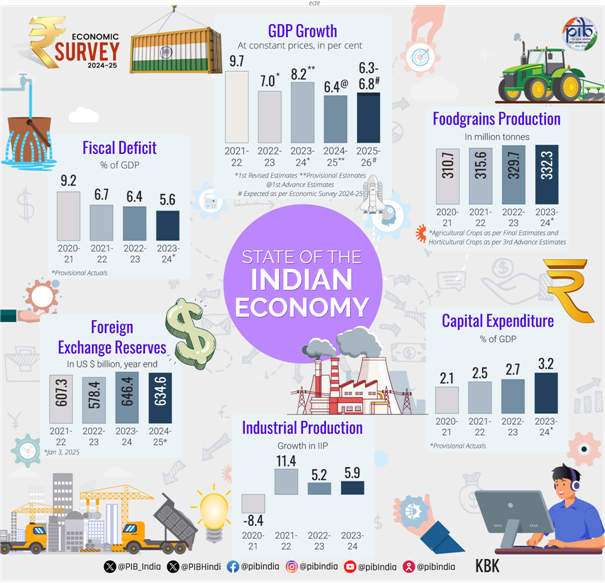
      As per the Survey, the global economy exhibited steady yet uneven growth across regions in 2024. A notable trend was the slowdown in global manufacturing, especially in Europe and parts of Asia, due to supply chain disruptions and weak external demand. In contrast, the services sector performed better, supporting growth in many economies. Inflationary pressures eased in most economies. However, services inflation has remained persistent, notes the Survey.
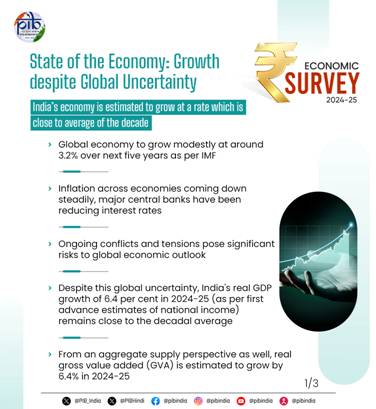
      The Survey highlights that, despite global uncertainty, India has displayed steady economic growth. India's real GDP growth of 6.4 per cent in FY25 remains close to the decadal average.

      From an aggregate demand perspective, private final consumption expenditure at constant prices is estimated to grow by 7.3 per cent, driven by a rebound in rural demand.

      On the supply side, the real gross value added (GVA) is estimated to grow by 6.4 per cent. The agriculture sector is expected to rebound to a growth of 3.8 per cent in FY25. The industrial sector is estimated to grow by 6.2 per cent in FY25. Strong growth rates in construction activities and electricity, gas, water supply and other utility services are expected to support industrial expansion. Growth in the services sector is expected to remain robust at 7.2 per cent, driven by healthy activity in financial, real estate, professional services, public administration, defence, and other services.
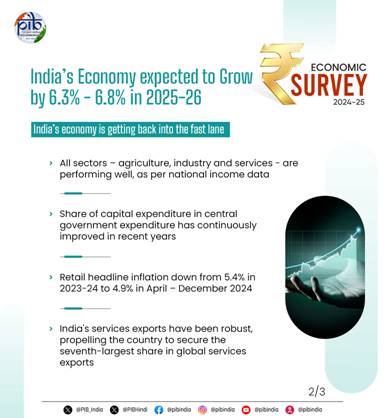
      Keeping in mind the upsides and downsides to growth, the Survey expects the real GDP growth in FY26 to be between 6.3 and 6.8 per cent.

      The Chapter on the Medium-Term Outlook elaborates on the global factors and the importance of strengthening the levers of domestic growth in the context of heightened risks due to global concerns about economic policies and trade policy uncertainties.

      To realize the aspirations of Viksit Bharat by 2047, it is important that the medium-term growth outlook of India be assessed in the context of emerging global realities of Geo-Economic Fragmentation (GEF), Chinese manufacturing prowess, and global dependency on China for energy transition efforts. The Survey puts forth a way forward to reinvigorate the internal engines and domestic levers of growth by focusing on one central element of systemic deregulation, which will enable a paradigm of economic freedom to businesses of individuals and organizations to pursue legitimate economic activity with ease. The Survey stresses that the reforms and economic policy must now be on systematic deregulation under Ease of Doing Business 2.0 so that it encourages creation of a viable Mittelstand, i.e. India’s SME sector.

      The Economic Survey 2024-25 notes that agriculture growth remained steady in first half of FY25, with Q2 recording a growth rate of 3.5 per cent, marking an improvement over the previous four quarters. Healthy Kharif production, above-normal monsoons, and an adequate reservoir level supported agricultural growth. The total Kharif food grain production is estimated at a record 1647.05 lakh metric tonnes (LMT) in 2024-25, higher by 5.7 per cent compared to 2023-24 and 8.2 per cent higher than the average food grain production in the past five years.

      The industrial sector grew by 6 per cent in first half of FY25, and is estimated to grow by 6.2 per cent in FY25. Q1 saw a strong growth of 8.3 per cent, but growth moderated in Q2 due to three key factors. First, manufacturing exports slowed significantly due to weak demand from destination countries, and aggressive trade and industrial policies in major trading nations. Second, the above average monsoon had mixed effects - while it replenished reservoirs and supported agriculture, it also disrupted sectors like mining, construction, and, to some extent, manufacturing. Third, the variation in the timing of festivities between September and October in the previous and current years led to a modest growth slowdown in Q2 FY25.

      Despite various challenges, India continues to register the fastest growth in manufacturing PMI, stated the Survey. The latest Manufacturing PMI for December 2024 remained well within the expansionary zone, driven by new business gains, robust demand, and advertising efforts.

      The services sector continues to perform well in FY25, emphasizes the Survey. A notable growth in Q1 and Q2 resulted in 7.1 per cent growth in first half of FY25. Across sub-categories, all the sub-sectors have performed well. India’s services export growth surged to 12.8 per cent during April–November FY25, up from 5.7 per cent in FY24.

      The Economic Survey states that growth process has been ably supported by stability on fronts such as inflation, fiscal health, and external sector balance. On inflation, the Survey states that retail headline inflation has softened from 5.4 per cent in FY24 to 4.9 per cent in April – December 2024. Food inflation, measured by the Consumer Food Price Index (CFPI), has increased from 7.5 per cent in FY24 to 8.4 per cent in FY25 (April-December), primarily driven by a few food items such as vegetables and pulses. India’s consumer price inflation will gradually align with the target of around 4 per cent in FY26 as per RBI and IMF.
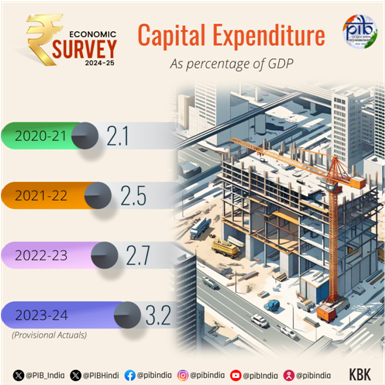
      Capital expenditure (capex), as a per cent of the total expenditure of the union, has continuously improved from FY21 to FY24. After the general elections, union government capex has grown by 8.2 per cent during July – November 2024 YoY, the Survey says.

      Despite the gross tax revenue (GTR) increasing by 10.7 per cent YoY during April-November 2024, the tax revenue retained by the Union, net of devolution to the states, hardly increased, says the Survey. As of November, the deficit indicators of the union were comfortably placed, leaving ample room for developmental and capital expenditure in the rest of the year.
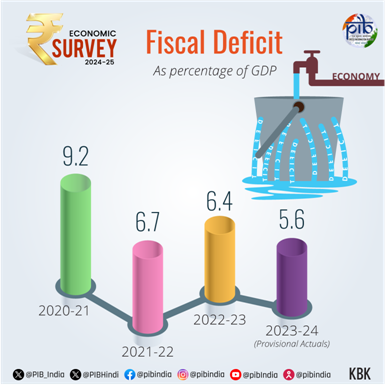
      According to the Survey, the GTR of the union and own tax revenue (OTR) of the states have increased at comparable pace during the period April - November 2024. The revenue expenditure of the states grew at 12 per cent (YoY) during April to November 2024, with subsidies and committed liabilities registering a growth of 25.7 per cent and 10.4 per cent, respectively.

      The Survey observes that stability in the banking sector is underscored by declining asset impairments, robust capital buffers, and strong operational performance. The gross non-performing assets (NPAs) in the banking system have declined to a 12-year low of 2.6 per cent of gross loans and advances. The capital-to-risk-weighted assets ratio (CRAR) for Schedule Commercial Banks stands at 16.7 per cent as of September 2024, well above the norm, says the Survey.

      Emphasizing that the external sector stability is safeguarded by services trade and record remittances, the Economic Survey quotes that India’s merchandise exports grew by 1.6 per cent YoY in April – December 2024. Merchandise imports rose by 5.2 per cent. India's robust services exports have propelled the country to secure the seventh-largest share in global services exports, underscoring its competitiveness.

      In addition to the services trade surplus, remittances from abroad led to a healthy net inflow of private transfers. India was the top recipient of remittances in the world, driven by an uptick in job creation in OECD economies. These two factors combined to ensure that India’s current account deficit (CAD) remains relatively contained at 1.2 per cent of GDP in Q2 FY25, as per the Survey.

      Gross Foreign Direct Investment inflows recorded a revival in FY25, increasing from USD 47.2 billion in the first eight months of FY24 to USD 55.6 billion in the same period of FY25, a YoY growth of 17.9 per cent, says the Survey. Foreign portfolio investment (FPI) flows have been volatile in the second half of 2024, primarily on account of global geopolitical and monetary policy developments.

      The Economic Survey states that as a result of stable capital flows, India’s foreign exchange reserves increased from USD 616.7 billion at the end of January 2024 to USD 704.9 billion in September 2024 before moderating to USD 634.6 billion as on 3 January 2025. India’s forex reserves are sufficient to cover 90 per cent of external debt and provide an import cover of more than ten months, thereby safeguarding against external vulnerabilities.

      The Economic Survey highlights continued good performance on the employment front. It states that India's labour market growth in recent years has been supported by post-pandemic recovery and increased formalisation. The unemployment rate for individuals aged 15 years and above has steadily declined from 6 per cent in 2017-18 to 3.2 per cent in 2023-24. The labour force participation rate (LFPR) and the worker-to-population ratio (WPR) have also increased.

      The Survey also mentions that for India, a services-driven economy with a youthful and adaptable workforce, the adoption of AI offers the potential to support economic growth and improve labour market outcomes. Prioritising education and skill development will be crucial to equipping workers with the competencies needed to thrive in an AI-augmented landscape. The Survey brings out the fact that there are at present barriers to large-scale AI adoption, leading to a window for policymakers to act. The Economic Survey calls upon for collaborative effort between government, private sector, and academia to minimise the adverse societal effects of AI-driven transformation in the labour sector.

      On infrastructure front, the Economic Survey highlights the need for continued step-up of infrastructure investment over next two decades to sustain a high growth. Under railway connectivity, 2031 km of railway network was commissioned between April and November, 2024, and 17 new pairs of Vande Bharat trains were introduced between April and October 2024. Port capacity improved significantly in FY25, leading to improvements in operational efficiency and reduction in average container turnaround time in major ports from 48.1 hours in FY24 to 30.4 hours during FY25 (Apr-Nov).

      The Economic Survey underscores the government of India’s efforts to boost renewable energy in the country and green investments through schemes, policies, financial incentives and regulatory measures such as PM - Surya Ghar: Muft Bijli Yojana, National Bioenergy Programme, National Green Hydrogen Mission and PM-KUSUM. The capacity addition in solar and wind power has lead to a 15.8 per cent year-on-year increase in renewable energy capacity by December 2024.

      The Government social services expenditure has witnessed an increase of compounded annual growth rate of 15% (combined for centre and states) from FY 21 to FY 25. The Gini coefficient, which is a measure of inequality in consumption expenditure, has been declining in recent years (For rural areas it declined to 0.237 in 2023-24 from 0.266 in 2022-23 and for urban areas, it fell to 0.284 in 2023-24 from 0.314 in 2022-23), reflecting positive impact of Government’s initiatives in reshaping income distribution. On the school education front, the government is working toward meeting the objectives of National Education Policy 2020 through a range of programmes and schemes. These interalia include the Samagra Shiksha Abhiyan, DIKSHA, STARS, PARAKH, PM SHRI, ULLAS, PM POSHAN, etc, as per the Survey.

      In the total health expenditure of the country between FY15 and FY22, the Survey quotes the share of government health expenditure has increased from 29.0 per cent to 48.0 per cent. During the same period, the share of out-of-pocket expenditure in total health expenditure declined from 62.6 per cent to 39.4 per cent.

      Micro, Small and Medium Enterprises (MSME) sector has emerged as a highly vibrant sector of the Indian economy, noted the Survey. To provide equity funding to MSMEs with the potential to scale up, the government launched the Self-Reliant India Fund with a corpus of ₹50,000 crore.

      The Survey, says that reducing excessive regulatory burdens, governments can help businesses become more efficient, reduce costs, and unlock new growth opportunities. Regulations increase the cost of all operational decisions in firms, the Economic Survey adds. It has outlined a three-step process for states to systematically review regulations for their cost-effectiveness. The steps include identifying areas for deregulation, thoughtfully comparing the regulations with other states and countries and estimating the cost of each of these regulations on individual enterprises. The Survey highlights that Ease of Doing Business (EoDB) 2.0 should be a state government-led initiative focused on fixing the root causes behind the unease of doing business. It mentions that in the next phase for EoDB, states must break new ground on liberalizing standards and controls, setting legal safeguards for enforcement, reducing tariffs and fees, and applying risk-based regulation. 

      As the Survey underscores, looking ahead, India’s economic prospects for FY26 are balanced. Headwinds to growth include elevated geopolitical and trade uncertainties and possible commodity price shocks. Domestically, the translation of order books of private capital goods sector into sustained investment pick-up, improvements in consumer confidence, and corporate wage pick-up will be key to promoting growth. Rural demand backed by a rebound in agricultural production, an anticipated easing of food inflation and a stable macro-economic environment provides an upside to near-term growth. Overall, India will need to improve its global competitiveness through grassroots-level structural reforms and deregulation to reinforce its medium-term growth potential.

      Topics

      ActsIncome Tax
