 TaxTMI
 Login
 TaxTMI
Login
Loading...
Press 'Enter' to add multiple search terms. Rules for Better Search

Press 'Enter' after typing page number.
Press 'Enter' after typing page number.


No Folders have been created
Are you sure you want to delete "My most important" ?
NOTE:
Press 'Enter' after typing page number.
Press 'Enter' after typing page number.

All News
Press 'Enter' after typing page number.
All News

Note

Bookmark

Share


Sukanya Samriddhi Yojana : A Decade of Transforming Lives
Introduction
The Sukanya Samriddhi Yojana (SSY) stands as a ray of hope and empowerment for millions of young girls across India, encapsulating the Government’s unwavering commitment to nurturing their dreams and aspirations. Launched on 22nd January 2015 by Prime Minister Narendra Modi as part of the Beti Bachao, Beti Padhao Campaign, this visionary scheme weaves together the threads of financial security and social empowerment. This year 22nd January 2025, marks the 10 years of Sukanya Samriddhi Yojana encouraging families to invest in the bright futures of their daughters, fostering a culture of inclusion and progress.
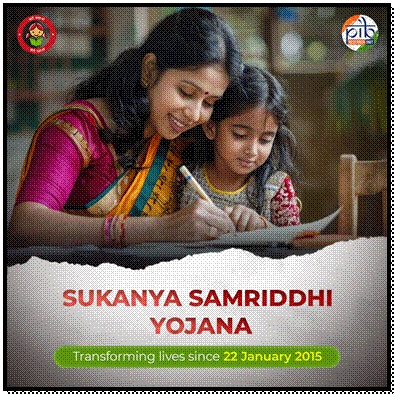
As a testament to its impact, over 4.1 crore Sukanya Samriddhi accounts have been opened as of November 2024, symbolizing not just a number, but a movement towards building an equitable and promising tomorrow for every girl child in India. Through this initiative, the nation celebrates the immense potential of its daughters, reaffirming the belief that empowering one girl strengthens the foundation of society.
How Sukanya Samriddhi Yojana works?
Opening the account
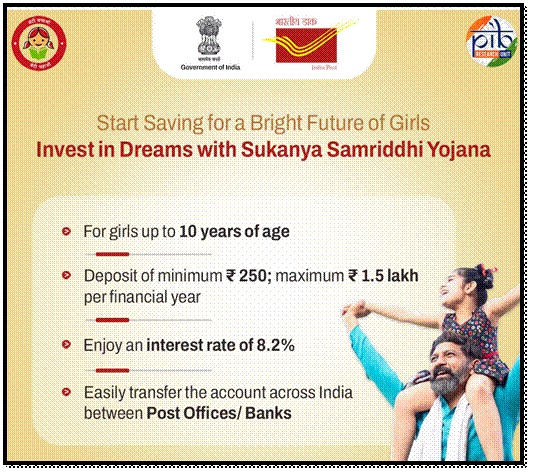
The guardian can open the account immediately after the birth of the girl child till she attains the age of 10 years. Any girl child who is a resident Indian from the time of opening the account till the time of maturity/closure is eligible for the scheme. Only one account is allowed per child. Parents can open a maximum of two accounts for each of their children. However, there is an exception allowed for more accounts in case of twins or triplets. The account can be transferred to anywhere in India. The following documents are required for opening an account:
Deposit required
This scheme allows parents to open a Sukanya Samriddhi account for girls at any post office or designated commercial bank branch, starting with a minimum initial deposit of ₹250, and subsequent deposits can be made in multiples of ₹50, provided that at least ₹250 is deposited in a financial year. The total annual deposit limit is capped at ₹1,50,000; any excess amount will not earn interest and will be returned. Deposits can be made for a period of up to fifteen years from the account opening date.
Managing the account
The account is managed by the guardian until the girl child reaches the age of eighteen. This allows the guardian to oversee the savings and ensure that the funds are utilized effectively for the child’s education and future needs. Upon turning eighteen, the account holder can take control of the account herself by submitting the necessary documents.
Interest Calculation
Interest is calculated monthly based on the lowest balance in the account between the close of the fifth day and the end of the month. At the end of each financial year, this interest is credited to the account, with any fractional amounts rounded to the nearest rupee: amounts of fifty paisa or more are rounded up, while lesser amounts are disregarded. Notably, the interest is credited at the end of the financial year regardless of any changes in the account office due to transfers, ensuring that the financial growth for the girl child remains consistent and secure.
Maturity of the account
The account matures upon the completion of twenty-one years of the account holder from its opening date. However, early closure is permitted under specific circumstances, particularly if the account holder intends to marry before reaching maturity. In such cases, the account holder must submit an application along with a declaration on non-judicial stamp paper, duly attested by a notary, and provide proof of age confirming that they will be at least eighteen years old on the marriage date. Importantly, this early closure can only occur within a one-month window prior to the intended marriage and must be completed within three months post-marriage. Upon approval, the account holder can submit an application form to receive the outstanding balance along with applicable interest, ensuring access to funds when needed.
Withdrawals
An account holder can apply for a withdrawal of up to fifty percent of the balance at the end of the preceding financial year, specifically for educational purposes. This withdrawal is permissible only after the account holder turns eighteen or completes the tenth standard, whichever comes first. To initiate this process, the account holder must submit an application along with supporting documentation, such as a confirmed offer of admission or a fee-slip from the educational institution detailing the financial requirements. Withdrawals can be made either as a lump sum or in installments, with a maximum of one withdrawal per year for up to five years, always ensuring that the amount does not exceed the actual fees and charges as outlined in the admission offer or fee-slip.
Premature Closure
In the unfortunate event of the account holder's death, the account can be closed immediately upon submitting an application along with the death certificate issued by the competent authority. The remaining balance and accrued interest until the date of death will be paid to the guardian. Additionally, interest for the period between the account holder's death and the account's closure will be calculated at the rate applicable to Post Office Savings Accounts. Furthermore, in cases of extreme compassionate grounds: such as the account holder facing life-threatening medical issues or the death of the guardian, the accounts office may allow premature closure after thorough documentation is provided. However, it is important to note that no premature closure can occur within the first five years of opening the account.
Conclusion
The Sukanya Samriddhi Yojana embodies a transformative initiative aimed at securing the future of young girls in India. By fostering financial discipline among families and prioritizing education and empowerment, the scheme has emerged as a powerful catalyst for social progress. The steady growth in account openings reflects the growing awareness and acceptance of this visionary program. As the nation continues its journey towards gender equity and inclusion, the Sukanya Samriddhi Yojana, ensures that every girl has the opportunity to dream, achieve, and thrive in a supportive and empowered environment.
References
https://finance.assam.gov.in/portlets/sukanya-samriddhi-for-your-girl-child
https://transformingindia.mygov.in/scheme/sukanya-samriddhi-yojana/#intro
https://www.indiapost.gov.in/VAS/Pages/PMODashboard/SSA.aspx
RAJYA SABHA UNSTARRED QUESTION NO.2490 session 266 https://sansad.in/rs/questions/questions-and-answers
https://pib.gov.in/PressNoteDetails.aspx?NoteId=153206&ModuleId=3®=3&lang=1

