

Just a moment...

Top
Help
×

By creating an account you can:

Logo TaxTMI
>
Call Us / Help / Feedback

Contact Us At :

E-mail: [email protected]

Call / WhatsApp at: +91 99117 96707

For more information, Check Contact Us

FAQs :

To know Frequently Asked Questions, Check FAQs

Most Asked Video Tutorials :

For more tutorials, Check Video Tutorials

Submit Feedback/Suggestion :

Email :
Please provide your email address so we can follow up on your feedback.
Category :
Description :
Min 15 characters0/2000
Make Most of Text Search
  1. Checkout this video tutorial: How to search effectively on TaxTMI.
  2. Put words in double quotes for exact word search, eg: "income tax"
  3. Avoid noise words such as : 'and, of, the, a'
  4. Sort by Relevance to get the most relevant document.
  5. Press Enter to add multiple terms/multiple phrases, and then click on Search to Search.
  6. Text Search
  7. The system will try to fetch results that contains ALL your words.
  8. Once you add keywords, you'll see a new 'Search In' filter that makes your results even more precise.
  9. Text Search
Add to...
You have not created any category. Kindly create one to bookmark this item!
Create New Category
Hide
Title :
Description :
❮❮ Hide
Default View
Expand ❯❯
Close ✕
🔎 News - Adv. Search
TEXT SEARCH:

Press 'Enter' to add multiple search terms. Rules for Better Search

Search In:
Main Text + AI Text
  • Main Text
  • Main Text + AI Text
  • AI Text
Category: ?
Categorized by AI
---- All Categories ----
  • ---- All Categories ----
  • Income Tax
  • GST
  • Customs, DGFT & SEZ
  • FEMA & RBI
  • Corp. Laws, SEBI & IBC
  • PMLA, Black Money & ED
  • Budget
  • News and Press Release
  • PTI News
Month:
---- All Months ----
  • ---- All Months ----
  • January
  • February
  • March
  • April
  • May
  • June
  • July
  • August
  • September
  • October
  • November
  • December
Year:
---- All Years ----
  • ---- All Years ----
  • 2026
  • 2025
  • 2024
  • 2023
  • 2022
  • 2021
  • 2020
  • 2019
  • 2018
  • 2017
  • 2016
  • 2015
  • 2014
  • 2013
  • 2012
  • 2011
Sort By: ?
In Sort By 'Default', exact matches for text search are shown at the top, followed by the remaining results in their regular order.
RelevanceDefaultDate
    No Records Found
    ❯❯
    MaximizeMaximizeMaximize
    0 / 200
    Expand Note
    Add to Folder

    No Folders have been created

      +

      Are you sure you want to delete "My most important" ?

      NOTE:

      News
      Showing Results for :
      Reset Filters
      Results Found:
      AI TextQuick Glance by AIHeadnote
      Show All SummariesHide All Summaries
      No Records Found

      News

      Back

      All News

      Showing Results for :
      Reset Filters
      Showing
      Records
      ExpandCollapse
        No Records Found

        News

        Back

        All News

        whatsappJoin Channel
        Showing Results for : Reset Filters
        Case ID :

        Public Sector Banks: A Resurgent Force

        December 16, 2024

        📋
        Contents
        Note

        Note

        -

        Bookmark

        print

        Print

        Login to TaxTMI
        Verification Pending

        The Email Id has not been verified. Click on the link we have sent on

        Didn't receive the mail? Resend Mail

        Don't have an account? Register Here

        PSBs Achieve ₹1.41 lakh crore net profit; GNPA drops to 3.12%

        Introduction

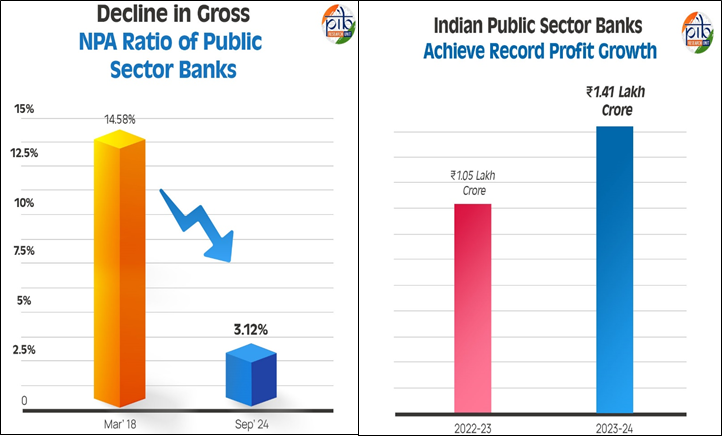
        Public Sector Banks (PSBs) in India have achieved a remarkable milestone by recording their highest-ever aggregate net profit of ₹1.41 lakh crore in the financial year 2023-24. This landmark achievement reflects the sector's robust turnaround, underpinned by a significant improvement in asset quality. The Gross Non-Performing Assets (GNPA) ratio steeply declined, dropping to 3.12% in September 2024. Demonstrating continued momentum, they registered a net profit of ₹ 85,5206,000 crore  in the first half of 2024-25. In addition to their stellar performance, PSBs have contributed significantly to shareholder returns, paying a total dividend of ₹61,964 crore over the past three years. This remarkable financial growth underscores the sector's operational efficiency, improved asset quality, and stronger capital base.
        Beyond their financial achievements, these banks have played a key role in promoting financial inclusion. They have implemented crucial government schemes like the Atal Pension Yojana and Pradhan Mantri Jeevan Jyoti Bima Yojana, to name a few. These efforts have ensured that vital benefits reach underserved sections of society. The government of India has actively supported the sector with reforms, welfare measures, and strong policies. This has strengthened the banking system, fostering greater transparency, stability, and inclusivity.

        Decline in GNPA: Strengthening PSB Resilience

        The Gross NPA ratio of Public Sector Banks (PSBs) has witnessed a remarkable improvement, declining to 3.12% in September 2024 from a peak of 14.58% in March 2018. This significant reduction reflects the success of targeted interventions aimed at addressing stress within the banking system.

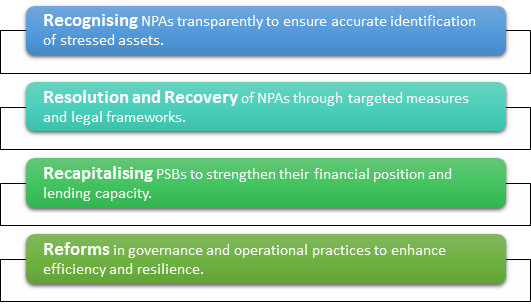
        A turning point came in 2015 when the Reserve Bank of India (RBI) initiated the Asset Quality Review (AQR). This exercise aimed to identify and address hidden stress in banks by mandating the transparent recognition of NPAs. It also reclassified previously restructured loans as NPAs, resulting in a sharp increase in reported NPAs. The heightened provisioning requirements during this period impacted the financial parameters of banks, restricting their ability to lend and support productive sectors of the economy.

        To address these challenges, the Government introduced a comprehensive 4R’s strategy:
        Another indicator of the improved resilience of Public Sector Banks (PSBs) is their Capital to Risk (Weighted) Assets Ratio (CRAR), which rose by 3983 basis points to 15.43% in September 2024, up from 11.45% in March 2015. This substantial improvement not only highlights the renewed stability and robustness of India’s banking sector but also positions PSBs to better support economic growth. Notably, this CRAR far exceeds the Reserve Bank of India’s (RBI) minimum requirement of 11.5%, underscoring the strengthened financial health of these institutions.

        Expanding Financial Inclusion

        PSBs continue to expand their reach across the nation, deepening financial inclusion. Their strengthened capital base and improved asset quality have enabled them to access markets independently, reducing reliance on government recapitalisation.

        Here’s how PSBsSCBs are deepening financial inclusion:
        • 54 crore Jan Dhan accounts and more than 52 crore collateral-free loans have been sanctioned under various flagship financial inclusion schemes (PM Mudra, Stand-Up India, PM-SVANidhi, PM Vishwakarma).
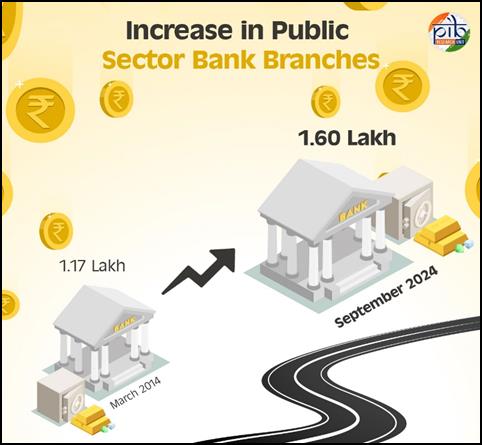
        • The number of bank branches has increased from 1,17,990 in March 2014 to 1,60,501 in September 2024; out of which 1,00,686 branches are in Rural and Semi-Urban (RUSU) areas.

        The Kisan Credit Card (KCC) Scheme aims to provide short-term crop loans to farmers. Total operative KCC accounts as of September 2024 stood at 7.71 crore with a total outstanding of Rs. 9.88 lakh crore.

        • The Government of India (GoI) has consistently supported the MSME sector with a flow of credit at affordable rates through various initiatives. MSME advances registered a CAGR of 15% over the last 3 years, with total advances as on March 31, 2024, standing at Rs. 28.04 lakh crore, posting an annual growth of 17.2%.
        • The gross advances of Scheduled Commercial Banks grew from Rs. 8.5 lakh crore to 61 lakh crore during 2004-2014, which has significantly increased to Rs. 175 lakh crore in March 2024.

        Strengthening PSBs through EASE Framework

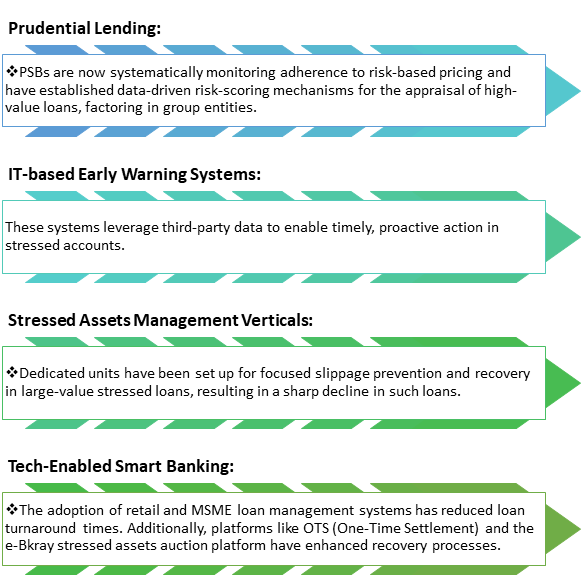
        The Government has implemented a series of measures to enhance the financial condition of Public Sector Banks (PSBs) through the Enhanced Access & Service Excellence (EASE) framework. This framework institutionalises an objective process of incremental reforms aligned with the evolving banking ecosystem, focusing on governance, prudent lending, risk management, technology- and data-driven banking, and outcome-centric human resources.

        Key highlights of the steps taken under EASE to strengthen the financial condition of PSBs include:
        Conclusion

        Public Sector Banks in India have made remarkable strides in recent years, achieving unprecedented financial milestones and contributing significantly to the nation’s economic stability and growth. The decline in Gross Non-Performing Assets (GNPA) and improved Capital to Risk (Weighted) Assets Ratio (CRAR) reflect the sector’s resilience and sound risk management practices. The EASE framework has been crucial in institutionalising reforms, promoting prudent lending, and leveraging technology for better banking services. The focus on financial inclusion has expanded access to banking, empowering millions with affordable credit and insurance. With a stronger financial base and improved asset quality, PSBs are well-positioned to support India's development agenda and drive inclusive economic growth.

        References:

        Decline in gross non-performing assets restores public sector bank resilience and strengthens capital adequacy and financial inclusion. The release reports a recovery of Public Sector Banks driven by reduced GNPA levels following the Asset Quality Review, strengthened capital buffers as reflected in higher CRAR, and institutional reforms under the EASE framework; it links these improvements to expanded branch networks, broader financial inclusion initiatives, and increased targeted credit to farmers and MSMEs, enabling reduced dependence on government recapitalisation.
                          Cases where this provision is explicitly mentioned in the judgment/order text; may not be exhaustive. To view the complete list of cases mentioning this section, Click here.
                            Provisions expressly mentioned in the judgment/order text.

                                Decline in gross non-performing assets restores public sector bank resilience and strengthens capital adequacy and financial inclusion.

                                The release reports a recovery of Public Sector Banks driven by reduced GNPA levels following the Asset Quality Review, strengthened capital buffers as reflected in higher CRAR, and institutional reforms under the EASE framework; it links these improvements to expanded branch networks, broader financial inclusion initiatives, and increased targeted credit to farmers and MSMEs, enabling reduced dependence on government recapitalisation.


                                Note: It is a system-generated summary and is for quick reference only.

                                Topics

                                ActsIncome Tax
                                No Records Found