

Loading...

Top
Help
×

By creating an account you can:

Logo TaxTMI
Call Us / Help / Feedback

Contact Us At :

E-mail: [email protected]

Call / WhatsApp at: +91 99117 96707

For more information, Check Contact Us

FAQs :

To know Frequently Asked Questions, Check FAQs

Most Asked Video Tutorials :

For more tutorials, Check Video Tutorials

Submit Feedback/Suggestion :

Email :
Please provide your email address so we can follow up on your feedback.
Category :
Description :
Min 15 characters 0/2000
Make Most of Text Search
  1. Checkout this video tutorial: How to search effectively on TaxTMI.
  2. Put words in double quotes for exact word search, eg: "income tax"
  3. Avoid noise words such as : 'and, of, the, a'
  4. Sort by Relevance to get the most relevant document.
  5. Press Enter to add multiple terms/multiple phrases, and then click on Search to Search.
  6. Text Search
  7. The system will try to fetch results that contains ALL your words.
  8. Once you add keywords, you'll see a new 'Search In' filter that makes your results even more precise.
  9. Text Search
Add to...
You have not created any category. Kindly create one to bookmark this item!
Create New Category
Hide
Title :
Description :
❮❮ Hide
Default View
Expand ❯❯
Close ✕
🔎 News - Adv. Search
TEXT SEARCH:

Press 'Enter' to add multiple search terms. Rules for Better Search

Search In:
Main Text + AI Text
  • Main Text
  • Main Text + AI Text
  • AI Text
Category: ?
Categorized by AI
---- All Categories ----
  • ---- All Categories ----
  • Income Tax
  • GST
  • Customs, DGFT & SEZ
  • FEMA & RBI
  • Corp. Laws, SEBI & IBC
  • PMLA, Black Money & ED
  • Budget
  • News and Press Release
  • PTI News
Month:
---- All Months ----
  • ---- All Months ----
  • January
  • February
  • March
  • April
  • May
  • June
  • July
  • August
  • September
  • October
  • November
  • December
Year:
---- All Years ----
  • ---- All Years ----
  • 2026
  • 2025
  • 2024
  • 2023
  • 2022
  • 2021
  • 2020
  • 2019
  • 2018
  • 2017
  • 2016
  • 2015
  • 2014
  • 2013
  • 2012
  • 2011
Sort By: ?
In Sort By 'Default', exact matches for text search are shown at the top, followed by the remaining results in their regular order.
Relevance Default Date
❯❯
Maximize Maximize Maximize
0 / 200
Expand Note
Add to Folder

No Folders have been created

+

Are you sure you want to delete "My most important" ?

NOTE:

News
Showing Results for :
Reset Filters
Results Found:
Show All Summaries Hide All Summaries
September 1, 2026
Show AI Summary
Personal guarantor insolvency: repayment plan stayed pending majority determination, with restraint on direct or indirect asset alienation.
Personal-guarantee insolvency proceedings involve a stay on implementation of a repayment plan because the earlier members' views did not produce a clear majority capable of taking effect. The personal guarantor has been restrained from directly or indirectly alienating assets pending further hearing. The dispute follows split views on approval of the plan, claim admission and voting, followed by a third-member opinion that did not resolve the absence of a determinative majority. Creditors dispute the proposed recovery, claim treatment and declared net worth relevant to the guarantees.
September 1, 2026
Show AI Summary
Rupee exchange-rate movement reflects portfolio inflows, growth data and possible central-bank support, while crude oil prices constrain gains.
Foreign-exchange market conditions strengthened the rupee by 28 paise to 94.94 against the US dollar, supported by domestic growth, controlled fiscal slippage and portfolio inflows. Possible Reserve Bank of India intervention was also identified as supportive. Higher crude oil prices, weak domestic equities and hawkish US monetary-policy signals were identified as constraints on further appreciation. Foreign investment flows, stronger-than-expected domestic growth and the fiscal-deficit position remained material factors affecting currency conditions.
September 1, 2026
Show AI Summary
Money-laundering probe into public service recruitment irregularities examines alleged question-paper leaks, selection manipulation, and laundering through purported CSR donations.
Money-laundering investigation under the Prevention of Money Laundering Act concerns alleged irregularities in Public Service Commission recruitment examinations. Allegations include question-paper leaks, manipulation of candidate selection, and illegal gratification for securing appointments of relatives and favoured candidates. Recruitment rules were allegedly amended to facilitate selection of relatives. Alleged proceeds of crime were collected in cash and routed through layered banking transactions, including through a family-controlled samiti presented as receiving corporate social responsibility donations for a non-existent college.
September 1, 2026
Show AI Summary
Personal guarantor settlement scrutiny intensifies as asset alienation is restrained pending review of a disputed creditor repayment proposal.
A five-member special bench found that no clear majority view existed under section 419(5) of the Companies Act and stayed the third member's order that had permitted the proposed recovery. Notices were directed to all parties, and the guarantor was restrained from directly or indirectly alienating property pending further consideration. The dispute concerns approval of a personal guarantor's repayment proposal, treatment of guarantee claims, creditor voting support, assessment of the personal estate, and scrutiny of declared net worth.
September 1, 2026
Show AI Summary
Personal insolvency proceedings restrict property alienation while notices issue to parties in the debtor's case.
A five-member special National Company Law Tribunal bench hearing Subhash Chandra's personal insolvency matter issued notices to all parties and restrained him from alienating property directly or indirectly. The restraint applies during the continuing insolvency proceedings and concerns dealings with the relevant property. The procedural measure requires the interested parties to participate in the matter.
September 1, 2026
Show AI Summary
Aadhaar authentication alternatives enable eligible farmers with failed fingerprint verification to access loan-waiver benefits after identity verification.
Elderly farmers whose fingerprints cannot be captured for Aadhaar authentication may approach an Aaple Sarkar Seva Kendra with their Aadhaar card and bank passbook. Loan-account details are verified on the scheme portal before authentication is initiated. If authentication fails, the concerned tehsildar verifies identity using the Aadhaar card, bank passbook and 7/12 land record extract. Eligible farmers receive loan-waiver benefits directly in their bank accounts after authentication, identity verification and satisfaction of the scheme's eligibility criteria.
September 1, 2026
Show AI Summary
GST collection growth reflected higher domestic and import revenue, while increased refunds moderated net collections during August.
GST collections recorded year-on-year growth in August, with gross receipts reaching about Rs 2 lakh crore. Domestic transaction revenue increased to over Rs 1.37 lakh crore, while import-related revenue rose to Rs 62,604 crore. Refunds increased to Rs 31,795 crore, and net GST collections stood at Rs 1.68 lakh crore after refunds.
September 1, 2026
Show AI Summary
Personal insolvency repayment plan faces fresh hearing after a split bench prevents enforcement and restrains guarantor property transfers.
Personal insolvency proceedings were reopened before a five-member special bench after a split view on a repayment plan. As no majority view existed, including that of the third member, no final order was in force and the repayment-plan determination could not be acted upon. Notices were issued to all parties, including dissenting creditors, and the guarantor was restrained from directly or indirectly alienating property pending further consideration. Dissenting creditors also challenged the repayment-plan determination before the appellate tribunal.
September 1, 2026
Show AI Summary
Equity market sentiment weakens as higher crude prices, geopolitical tensions and tighter monetary policy expectations curb risk appetite.
Equity-market sentiment weakened as higher crude oil prices, renewed US-Iran tensions, and expectations of prolonged tight US monetary policy reduced emerging-market risk appetite. The Sensex and Nifty declined, while domestic GDP growth above projections offered partial support. Weakness in several Asian markets, a lower US market close, and net foreign institutional equity sales reinforced cautious trading conditions.
September 1, 2026
Show AI Summary
Money laundering investigation triggers searches linked to alleged Public Service Commission irregularities, including premises of a former chief minister's assistant.
A money-laundering investigation under the Prevention of Money Laundering Act has led to searches at seven locations in Chhattisgarh in connection with alleged irregularities at the Chhattisgarh Public Service Commission. The search operation includes the premises of K. K. Chandrakar, personal assistant to former Chief Minister Bhupesh Baghel. The investigation remains at the search and inquiry stage.
September 1, 2026
Show AI Summary
Income-tax return filing: non-audit business and professional taxpayers use applicable forms by prescribed due dates.
August 31, 2026 was the due date for taxpayers having business or professional income who were not subject to audit. Such non-audit taxpayers may use ITR-3, ITR-4, ITR-5 or ITR-7, as applicable. ITR-3 applies to individuals and Hindu Undivided Families with proprietary business or professional income, while ITR-4 is intended for small and medium taxpayers. ITR-5 applies to firms, limited liability partnerships and cooperative societies, and ITR-7 applies to trusts and charitable institutions.
September 1, 2026
Show AI Summary
Gold smuggling enforcement targets transit abuse, concealed carriage, and border routes through coordinated seizures and arrests nationwide.
Intelligence-led enforcement against organised gold smuggling resulted in the seizure of over 42 kg of foreign-origin gold and around 10 kg of foreign-origin silver, collectively valued at more than Rs. 65 crore, and the arrest of 25 persons. Operations targeted networks using airport transit routes, airport personnel, land-border corridors, coastal routes, and domestic road transport. Gold was concealed in wax, compound, paste, raw-chain and bar forms, including through body concealment, internally secreted capsules, clothing, and specially created cavities.
September 1, 2026
Show AI Summary
Predictive consumption-expenditure framework will use household survey data to support poverty estimation, consumption analysis, and economic planning.
MoSPI and Thapar Institute of Engineering & Technology have entered into a memorandum of understanding for a research study to develop a predictive and analytical framework for monthly consumption expenditure in India. The study will use Household Consumption Expenditure Survey data to estimate Monthly Per Capita Consumption Expenditure at national and state levels, analyse household consumption patterns, and generate evidence relevant to poverty estimation and broader economic planning.
August 31, 2026
Show AI Summary
Personal insolvency repayment plans: conflicting views on binding dissenting creditors prompted reconsideration through an expanded adjudicatory bench.
National Company Law Tribunal constituted a five-member bench after conflicting views on a personal insolvency repayment plan left no majority position for a formal order. The central issue is whether creditor approval of the plan binds dissenting creditors and extinguishes their claims against the personal guarantor. One view preserved dissenting creditors' independent recovery rights, while another applied the creditor-approved plan uniformly to all creditors. Disagreement also concerns the Adjudicating Authority's power to examine the resolution professional's report of the creditors' meeting.
August 31, 2026
Show AI Summary
Personal insolvency repayment plans raise unresolved questions on dissenting creditors' rights and uniform extinguishment of claims.
Personal insolvency proceedings were referred for fresh adjudication because no majority emerged on the repayment plan. The Technical Member rejected the plan; the Judicial Member confined it to consenting creditors while preserving dissentents' recovery rights; and the Third Member approved it with uniform extinguishment of all creditors' claims. The dispute concerns whether creditor approval under section 115(1) binds dissenting creditors, the effect of section 79(2)(g), and the Adjudicating Authority's power to examine the Resolution Professional's creditors' meeting report.
August 31, 2026
Show AI Summary
Rupee exchange-rate support through suspected intervention and FCNR(B) inflows offset pressure from dollar strength and higher crude prices.
Rupee exchange-rate movement reflected a recovery from early losses to close stronger against the US dollar, amid market expectations of Reserve Bank of India support at lower trading levels. Pressure arose from higher US Treasury yields, possible US rate-hike expectations and a broad dollar rally. Suspected intervention, FCNR(B)-related foreign-currency flows and the special USD-INR forex swap facility supported sentiment, while rising crude prices, geopolitical supply risks and foreign institutional equity outflows remained adverse factors.
August 31, 2026
Show AI Summary
Income-tax return filing for non-audit business and professional taxpayers closes at midnight, requiring use of applicable forms.
Income-tax return filing for Assessment Year 2026-27 reaches its due date on 31 August 2026 for taxpayers having business or professional income who are not subject to audit. Such taxpayers may file the applicable ITR-3, ITR-4, ITR-5 or ITR-7. ITR-3 applies to individuals and Hindu Undivided Families with proprietary business or professional income, ITR-4 to small and medium taxpayers, and ITR-5 to firms, limited liability partnerships and cooperative societies.
August 31, 2026
Show AI Summary
Monthly fiscal accounts track receipt composition, expenditure allocation, tax devolution, interest payments, and major subsidy outgo through July.
Union Government monthly accounts through July 2026 record total receipts comprising net tax revenue, non-tax revenue and non-debt capital receipts, with tax devolution transferred to State Governments. Total expenditure is divided between revenue and capital expenditure. Revenue expenditure includes interest payments and major subsidies.
August 31, 2026
Show AI Summary
Personal guarantor insolvency distinguishes guarantee liability from borrower debt while creditor voting challenges question repayment-plan approval.
Personal insolvency proceedings concerning personal guarantees distinguish a guarantor's liability from the underlying borrowing entities' debts. Claims against the guarantor arise from guarantees furnished for loans obtained by Essel Group-associated entities, while the borrowers' repayment obligations remain enforceable and creditors may pursue corporate assets and securities. Dissenting lenders have challenged the resolution-plan voting process, alleging that family-linked associates or related parties should have been excluded from committee of creditors voting.
August 31, 2026
Show AI Summary
National accounts revisions align GDP and sectoral estimates with updated price, production and banking service indicators.
National Accounts Statistics-2026 incorporates updated Producer Price Index, Index of Industrial Production and Banking Services Price Index series with base year 2022-23 into annual and quarterly GDP estimates. The revised indicators expand coverage, update weights and improve price mapping for national-account activities. GDP and gross value added estimates from 2022-23 onwards are revised at current and constant prices, with sector-specific effects in mining and quarrying, manufacturing, trade services, general government and departmental enterprises. Supply and Use Tables for 2022-23 and 2023-24 are also updated.

News

Back

All News

Showing Results for :
Reset Filters
No Records Found

News

Showing Results for : Reset Filters

PAN 2.0: A Digital Leap in Taxpayer Services

November 27, 2024

Contents
Acts
Summary
Note

Note

-

Bookmark

Print

Print

The Permanent Account Number (PAN) has long been a cornerstone of India’s financial and administrative systems, connecting individuals and businesses to vital economic activities while promoting financial transparency and compliance. As a key enabler of the digital economy, PAN has transformed into a gateway for essential services, making it indispensable in daily life. To enhance user-friendliness and align with technological advancements, the Cabinet has recently approved PAN 2.0, a step forward in redefining how PAN serves India's evolving digital and financial landscape.

PAN 2.0: A Landmark in Financial Innovation
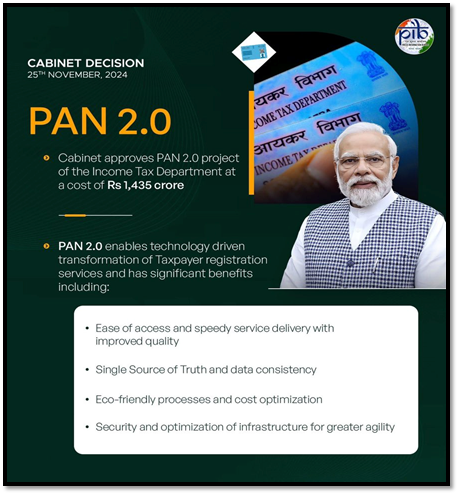
The PAN 2.0 Project is a transformative initiative to modernise taxpayer registration through advanced e-governance. With a financial outlay of ₹1,435 crore, it re-engineers the PAN/TAN services to offer seamless digital experiences. This project aims to streamline and modernise the process of issuing and managing PAN and TAN, making it more user-friendly and efficient. The project addresses the requirements of taxpayers, focusing on consolidation of multiple platforms/portals and efficient services to PAN/ TAN holders.

PAN 2.0 Project enables technology driven transformation of Taxpayer registration services and has significant benefits including:
  • A single portal for all PAN/TAN-related services to simplify access for users.
  • Eco-friendly paperless less processes to reduce paperwork.
  • PAN will be issued free of cost, with quicker processing times.
  • Personal and demographic data will be protected through enhanced security measures, including a PAN Data Vault.
  • A dedicated call centre and helpdesk to address user queries and issues.

PAN 2.0 Revolutionizing Existing System

PAN 2.0 aims to revolutionize the existing system by integrating all PAN/TAN services into a unified portal, ensuring a seamless and paperless process. Free e-PAN services and simplified updates enhance convenience for taxpayers. Have a look at these key features in detail: -

(i) Integration of Platforms: PAN-related services are currently hosted on three different portals (e-Filing PortalUTIITSL Portal and Protean e-Gov Portal). In the PAN 2.0 Project, all PAN/TAN-related services will be hosted on a single unified portal of the Income Tax Department. The said Portal would host all end-to-end services related to PAN and TAN like allotment, updation, correction, Online PAN Validation (OPV), Know your AO, AADHAAR-PAN linking, verify your PAN, request for e-PAN, request for re-print of PAN card etc.

(ii) Comprehensive use of technology for paperless processes: Complete the online paperless process as against the prevailing mode.

(iii) Taxpayer facilitation: Allotment/updation/correction of PAN will be done free of cost, and e-PAN will be sent to the registered mail ID. For a physical PAN card, the applicant has to request along with the prescribed fee of Rs 50 (domestic). For delivery of the card outside India, Rs. 15 + India post charges at actuals will be charged to the applicant.

Changes for Existing PAN Cardholders

Old PAN cardholders need not worry—existing PAN cardholders are not required to apply for a new PAN under the upgraded system. The current valid PAN cards will remain fully operational under PAN 2.0 unless holders request an update or correction. No new PAN card will be issued unless a specific request for updates or corrections is made.

QR Code Feature in PAN 2.0

A look at the QR code feature and what’s changing under PAN 2.0:

(i) The QR code is not new; it has been part of PAN cards since 2017-18. Under PAN 2.0, it will be enhanced with a dynamic QR code displaying the latest data from the PAN database.

(ii) PAN holders with older cards lacking a QR code can apply for a new card with a QR code under both the current PAN 1.0 system and the upgraded PAN 2.0.

(iii) The QR code facilitates validation of PAN details, ensuring authenticity.

(iv) A dedicated QR reader application is available to verify details. When scanned, it displays the holder's photo, signature, name, parents’ names, and date of birth.

Global Standards for Secure and Seamless Services

The PAN 2.0 Project adopts global standards to enhance taxpayer registration with seamless digital processes and strong data security. It ensures compliance with key ISO certifications for quality, security, and service management (e.g., ISO 27001, ISO 9001). The project streamlines PAN/TAN registration with simplified online processes, minimal documentation, and centralized databases, improving user experience while safeguarding data through robust security and international best practices.

PAN Service in India
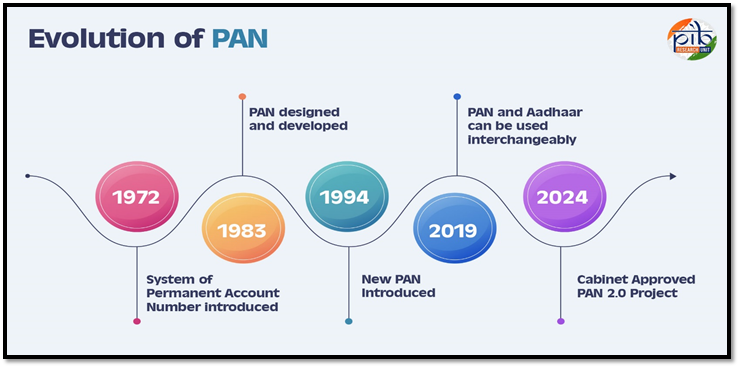
PAN 2.0 builds upon decades of evolution since the introduction of the Permanent Account Number (PAN) in 1972. Designed as a unique 10-digit alphanumeric identifier, PAN links an individual or entity's financial transactions, such as tax payments, TDS/TCS credits, and income returns, to the Income Tax Department. By streamlining and modernizing these processes, PAN 2.0 aims to enhance efficiency, security, and ease of access, ensuring a robust digital framework that simplifies compliance and strengthens financial transparency.

PAN is to be obtained by –

  • Every person if his total income or the total income of any other person in respect of which he is assessable during the year exceeds the maximum amount which is not chargeable to tax.
  • A charitable trust who is required to furnish return under Section 139(4A)
  • Every person who is carrying on any business or profession whose total sales, turnover, or gross receipts are or is likely to exceed five lakh rupees in any year
  • Every person who intends to enter into specified financial transactions in which quoting of PAN is mandatory. • Every non-individual resident person and person associated with them shall apply for PAN if the financial transaction entered into by them during the financial year exceeds Rs. 2,50,000.

Penalty for not having PAN or having more than one PAN:

  • Section 272B of the Income-tax Act imposes a penalty of Rs. 10,000 for taxpayers who fail to comply with PAN-related provisions. This includes not obtaining a PAN when required, knowingly quoting an incorrect PAN on prescribed documents, or providing an incorrect PAN to the person deducting or collecting tax.
  • As per the Income-tax Act, no individual is allowed to hold more than one PAN. If a person does hold multiple PANs, they must inform the Jurisdictional Assessing Officer and request the additional PAN to be deactivated or deleted.
  • Under PAN 2.0, the system has been enhanced with improved logic to identify duplicate PAN requests. This centralized and advanced mechanism will help minimize instances of individuals holding more than one PAN.

TAN Allotment

TAN (Tax Deduction and Collection Account Number) is a 10-digit alphanumeric code issued by the Income Tax Department for entities responsible for TDS/TCS. It is mandatory for filing returns, making payments, and issuing TDS/TCS certificates. TAN cannot be replaced with PAN except under specific provisions like Section 194-IA. Failure to obtain or quote TAN can lead to penalties, emphasizing its critical role in ensuring compliance with tax regulations and accurate deduction tracking.

Conclusion

The PAN 2.0 Project marks a significant leap towards modernizing India's tax system with enhanced digital processes, security, and greater accessibility. By shifting to a Direct Delivery Model and integrating global best practices, it promises a more streamlined and efficient experience for taxpayers, aligning with the government’s vision of a digital India. This initiative not only simplifies services but also ensures data security and transparency, fostering better tax compliance and governance.

References


Topics

Acts Income Tax
