
Just a moment...

Top
Help
×

By creating an account you can:

Logo TaxTMI
>
Call Us / Help / Feedback

Contact Us At :

E-mail: [email protected]

Call / WhatsApp at: +91 99117 96707

For more information, Check Contact Us

FAQs :

To know Frequently Asked Questions, Check FAQs

Most Asked Video Tutorials :

For more tutorials, Check Video Tutorials

Submit Feedback/Suggestion :

Email :
Please provide your email address so we can follow up on your feedback.
Category :
Description :
Min 15 characters0/2000
Add to...
You have not created any category. Kindly create one to bookmark this item!
Create New Category
Hide
Title :
Description :
❮❮ Hide
Default View
Expand ❯❯
Close ✕
🔎 News - Adv. Search
TEXT SEARCH:

Press 'Enter' to add multiple search terms. Rules for Better Search

Search In:
Main Text + AI Text
  • Main Text
  • Main Text + AI Text
  • AI Text
Category: ?
Categorized by AI
---- All Categories ----
  • ---- All Categories ----
  • Income Tax
  • GST
  • Customs, DGFT & SEZ
  • FEMA & RBI
  • Corp. Laws, SEBI & IBC
  • PMLA, Black Money & ED
  • Budget
  • News and Press Release
  • PTI News
Month:
---- All Months ----
  • ---- All Months ----
  • January
  • February
  • March
  • April
  • May
  • June
  • July
  • August
  • September
  • October
  • November
  • December
Year:
---- All Years ----
  • ---- All Years ----
  • 2026
  • 2025
  • 2024
  • 2023
  • 2022
  • 2021
  • 2020
  • 2019
  • 2018
  • 2017
  • 2016
  • 2015
  • 2014
  • 2013
  • 2012
  • 2011
Sort By: ?
In Sort By 'Default', exact matches for text search are shown at the top, followed by the remaining results in their regular order.
RelevanceDefaultDate
    Markets climb in early trade on falling crude oil prices; RBI monetary policy decision awaited
    Rupee jumps 39 paise to 94.89 against US dollar ahead of RBI monetary policy decision
    Punjab govt committed to paying all valid dues; legal options being examined: FM Cheema
    ED searches multiple locations in Punjab, Chandigarh in PMLA case against PSIEC officials
    Rupee gains 9 paise against US dollar
    India, US working towards interim trade agreement: MEA
    Govt to adopt appropriate measures to mitigate fuel price volatility: MoS Finance
    Taxation laws (Amendment) Bill to attract more foreign capital, provide policy certainty introduced in LS
    Champion Mirabai Chanu Unveils MMTC-PAMP's 'Virasat' Recycled Gold Coin to Celebrate India's 80th Year of Independence
    Indian economy to hit USD 5-trillion mark in FY29 as per IMF: FM
    SVC Co-operative Bank Concludes 120th Annual General Meeting, Reaffirms Growth, Governance and Digital Focus
    Rupee falls 3 paise to close at 95.40 against US dollar
    Government Boosts MSME Financing Through SIDBI and ECLGS 5.0
    India's Market Opportunity is Growing, and the Trade is Taking Notice
    50,000 Students to Participate in Season 2 of the Franklin Templeton National Mutual Fund Olympiad 2026
    Currently nine trade disputes pending against India under WTO rules: Govt
    MNLU Mumbai Launches MBA in Entrepreneurship & Digital Business Law
    AU Small Finance Bank Savings Accounts: Competitive Interest Rates, Zero-Balance Digital Account Opening and 24x7 Mobile Banking
    Rupee opens on flat note, rises 3 paise to 95.34 against US dollar in early trade
    Meeting of Heads of National Statistical Offices of BRICS Countries “Quality Statistics as Driver of Change”
❯❯
MaximizeMaximizeMaximize
0 / 200
Expand Note
Add to Folder

No Folders have been created

    +

    Are you sure you want to delete "My most important" ?

    NOTE:

    News
    Showing Results for :
    Reset Filters
    Results Found:
    Show All SummariesHide All Summaries
    August 5, 2026
    Show AI Summary
    Monetary policy expectations shape equity sentiment as softer crude prices and foreign investment support domestic financial assets.
    Equity market sentiment improved in early trading as lower crude oil prices and foreign fund inflows supported benchmark indices, while investors awaited the monetary policy decision. Softer crude prices, rupee recovery, improving global risk sentiment, resilient economic growth, corporate earnings and sustained foreign portfolio investment supported domestic financial assets, despite continuing global and geopolitical uncertainties.
    August 5, 2026
    Show AI Summary
    Foreign exchange market movement strengthens as lower crude prices and monetary policy signals influence the rupee's direction.
    Foreign exchange market movement saw the rupee appreciate against the US dollar in early trading, supported by lower crude oil prices, a softer dollar index, domestic equity gains and net foreign institutional investment. Market attention centred on the Reserve Bank of India's monetary policy decision, with expectations of an unchanged benchmark repo rate. Policy communication on inflation and developments in Hormuz-related talks were identified as factors that could influence the rupee's direction.
    August 4, 2026
    Show AI Summary
    Dearness allowance arrears must be cleared promptly, while the government examines legal remedies and continues its structured liquidation plan.
    Pending dearness allowance arrears of government employees and pensioners are to be cleared within a fortnight, with restraint on unproductive expenditure until admissible dues are paid. The government states that it will pay constitutionally and legally valid dues while examining the judgment, precedents and possible legal remedies. It attributes the arrears to delayed pay commission implementation and frozen dearness allowance, and states that a structured liquidation plan has been prepared and partly implemented.
    August 4, 2026
    Show AI Summary
    Money-laundering investigation examines alleged fraudulent industrial plot allotments, benami holdings and diversion of plots to residential use.
    A money-laundering investigation under the Prevention of Money Laundering Act examines alleged irregularities in industrial-plot allotments involving corporation officials, private persons, property dealers and alleged benamidars. The inquiry concerns alleged use of fictitious firms and false addresses to obtain plots, allotments to relatives and associates, and alleged diversion or change of land use from industrial to residential purposes. These activities are alleged to have generated private gains while causing loss to the public exchequer.
    August 4, 2026
    Show AI Summary
    Rupee exchange-rate movement gains support from capital inflows, while oil prices, dollar strength and monetary policy shape sentiment.
    Rupee exchange-rate movement was supported by foreign capital inflows and improved global risk sentiment, while elevated crude-oil prices and a stronger US dollar constrained gains. Market attention shifted to monetary policy, overseas dollar-deposit incentives and easier foreign access to government bonds, which were reported to support capital inflows and India's external position. A cautious approach to the benchmark repo rate was expected amid assessment of the West Asia conflict.
    August 4, 2026
    Show AI Summary
    Interim bilateral trade agreement negotiations continue as both sides work to finalise unresolved issues in the proposed arrangement.
    Interim bilateral trade agreement negotiations between India and the United States are continuing. Both sides have undertaken substantial work, while certain issues remain to be finalised before completion of the proposed interim trade arrangement. A United States Trade Representative delegation visited India to advance discussions. The text records the status of negotiations and identifies no concluded agreement or operative customs measure.
    August 4, 2026
    Show AI Summary
    Fuel-price volatility mitigation will combine fiscal measures, consumer protection, energy security and fiscal sustainability during external energy shocks.
    Fuel-price volatility is to be mitigated through fiscal and administrative measures that protect consumers while maintaining fiscal sustainability. The approach includes monitoring revenue and expenditure, reprioritising spending, and using fiscal measures when economic conditions require. Reduced central excise duty on petrol and diesel moderated the impact of elevated international crude prices and partly offset under-recoveries of public-sector oil marketing companies. Longer-term measures include revenue mobilisation, import diversification, Strategic Petroleum Reserves, cleaner fuels and energy efficiency.
    August 4, 2026
    Show AI Summary
    Tax policy certainty reforms propose easier fund management, data-centre access, electronics incentives and revised electronic-payment charging rules.
    The proposed Bill seeks to simplify conditions for foreign investment funds using fund managers in India without being treated as carrying on business in India, while retaining safeguards against misuse and round-tripping. It proposes removal of approval requirements for foreign cloud companies using Indian data centres and permits leased operation of Indian data centres. It also extends tax support for foreign companies participating in electronics contract manufacturing and component warehousing, preserves tax-free dividends for REIT and InvIT investors in specified circumstances, and removes the prohibition on Merchant Discount Rate charges for notified electronic payment modes.
    August 4, 2026
    Show AI Summary
    Responsible precious-metals recycling supports recycled-gold products, organised buyback channels and a more self-reliant domestic supply chain.
    Responsible precious-metals recycling is promoted through a commemorative recycled-gold coin intended to support domestic recycling, responsible sourcing and a self-reliant supply chain. The product is described as having certified purity authentication, tamper-proof packaging, a unique identification number and an assayer-certified minted card. The initiative seeks to reduce dependence on imported gold and expand organised, transparent recycling infrastructure. An organised silver buyback programme is also described as supporting secure consumer sales and a circular economy for precious metals.
    August 4, 2026
    Show AI Summary
    Broad-based growth strategy links tax reforms, trade resilience, industrial support and services development to medium-term economic expansion.
    The growth strategy combines agricultural productivity, manufacturing, MSME support, infrastructure, logistics, ease of doing business, streamlined income-tax and GST reforms, innovation, digitalisation, human-capital development, energy security, public capital expenditure, foreign direct investment liberalisation, export promotion, fiscal prudence and price stability. Trade resilience is to be strengthened through expanded trade agreements, while manufacturing, services, agriculture and strategic sectors receive targeted policy support. The material also reports secured-asset enforcement cases and recoveries by banks under the SARFAESI framework during FY25.
    August 4, 2026
    Show AI Summary
    Co-operative bank governance and financial disclosure support digital transformation, risk management, priority-sector lending and sustainable member-focused growth.
    Co-operative bank governance and financial disclosure were addressed at the annual general meeting, where the member-notice agenda was transacted and audited financial statements were presented. The bank reported growth in business, deposits and advances, together with net profit, asset quality, provisioning coverage and capital adequacy indicators. Its operational priorities include digital transformation, risk management, selective network expansion, customer service and operational discipline. Future priorities include retail and priority-sector lending, MSMEs, affordable housing and institutional deposits.
    August 4, 2026
    Show AI Summary
    Foreign-exchange market conditions weakened the rupee as oil prices, domestic equities and dollar strength shaped near-term currency expectations.
    The rupee weakened against the US dollar amid elevated crude oil prices, weaker domestic equities and a stronger dollar index, while foreign fund inflows moderated the decline. Attention shifted to the central bank's monetary policy meeting, with continuation of the existing benchmark policy rate anticipated. Earlier measures encouraging overseas dollar deposits and facilitating foreign participation in government bonds were reported to support capital inflows and India's external position.
    August 4, 2026
    Show AI Summary
    MSME credit expansion combines SIDBI lending initiatives with guaranteed additional working-capital facilities for eligible borrowers.
    MSME credit access is being expanded through SIDBI's branch network, direct lending, refinance support, co-lending arrangements, affordable credit for informal micro-entrepreneurs, and invoice-based digital credit for micro enterprises. Emergency Credit Line Guarantee Scheme 5.0 enables eligible MSMEs to obtain additional credit linked to peak fund-based working-capital outstanding, with full guarantee coverage for member lending institutions against defaults on the additional facility. The scheme also covers scheduled passenger airlines under distinct eligibility and guarantee parameters.
    August 4, 2026
    Show AI Summary
    Furniture and interiors sourcing platform connects Indian manufacturers with domestic and international trade buyers through direct procurement opportunities.
    imm india 2026 is presented as a business-to-business sourcing platform linking Indian furniture, home de cor, rug, carpet, mattress and handicraft manufacturers with domestic and international trade buyers. It is intended to provide direct manufacturer access, design-led sourcing and project-scale procurement opportunities for architects, designers, retailers, hospitality professionals and real estate developers. The programme includes a hosted buyer initiative, industry conferences, knowledge sessions and awards addressing innovation, sustainability, craftsmanship and design.
    August 4, 2026
    Show AI Summary
    Financial literacy Olympiad builds students' practical understanding of mutual funds, financial planning, market concepts and responsible investment participation.
    Financial literacy and investment awareness are promoted through a nationwide, multi-level educational competition for undergraduate and postgraduate students. Participants are assessed on mutual funds, investment fundamentals, financial planning, market concepts and long-term wealth creation, with exposure to market-linked products including ETFs, portfolio management services, alternative investment funds and specialised investment funds. The initiative combines academic institutions and financial-sector participants to improve practical investment knowledge, informed decision-making and responsible participation in investment markets.
    August 4, 2026
    Show AI Summary
    WTO dispute settlement challenges test India's safeguards, agricultural support, technology tariffs and production-linked incentives across pending proceedings.
    Nine pending WTO disputes against India concern safeguard measures, sugar support and export schemes, information and communications technology tariffs, and technology-sector incentives. India contests the claims as consistent with its WTO rights and obligations. Appeals concerning iron and steel safeguards, sugar measures, and certain information and communications technology tariff reports remain pending, including because the WTO Appellate Body is non-functional. Other proceedings concern Chinese challenges to production-linked incentives, tariffs, and solar, automotive, renewable-energy and information-technology measures; one panel proceeding is ongoing and another panel has not been constituted.
    August 4, 2026
    Show AI Summary
    Digital business law and entrepreneurship education combine management, compliance and innovation training for technology-driven enterprise careers and ventures.
    The MBA programme integrates management education, entrepreneurial capability, digital business law, and legal and policy awareness for technology-driven enterprise. It addresses compliance, digital platforms, data-driven decision-making, artificial intelligence, digital transactions, intellectual property, cross-border commerce and evolving regulatory frameworks. The programme is designed for prospective founders, start-up professionals, transforming family businesses and careers in consulting, strategy, business development, policy-oriented enterprises and digital commerce, with industry-relevant entrepreneurship education and digital-first learning.
    August 4, 2026
    Show AI Summary
    Savings account access expands through video KYC, mobile banking, no-minimum-balance options, monthly interest payments and deposit insurance coverage.
    Savings accounts provide monthly interest payments, liquidity and access to funds, subject to eligibility, internal policies and applicable terms. Digital account opening through Video KYC is available for an account with no minimum balance requirement, supported by mobile banking for UPI transfers, bill payments and balance monitoring. Account variants include premium, value-oriented, agricultural, financial-inclusion, children's and basic no-frills accounts. Deposit insurance applies up to the prescribed limit per depositor per bank.
    August 4, 2026
    Show AI Summary
    Foreign-exchange market conditions supported a modest early rupee gain, while importer demand and policy data remained key factors.
    Foreign-exchange market conditions supported a marginal early appreciation of the rupee against the US dollar, led by broad US-dollar weakness, improved risk sentiment, lower oil-price levels and foreign portfolio inflows. Importer demand for dollars moderated the movement. Market direction remained linked to the forthcoming monetary-policy decision and US economic data, while reported central-bank activity was described as helping smooth currency volatility. The US dollar index, crude-oil movements, global supply expectations and domestic equity-market activity were relevant exchange-rate influences.
    August 4, 2026
    Show AI Summary
    Quality statistics drive statistical-system reform through administrative data, interoperable systems, stronger governance, and international cooperation for evidence-based policymaking.
    Quality statistics are advanced through modernised national statistical systems, administrative data, digital public infrastructure, and stronger data-governance and privacy standards. Cooperation among national statistical offices is intended to address data gaps through knowledge sharing, methodological harmonisation and statistical innovation. Discussions also emphasised digital dissemination, transformational statistical reforms, and the use of administrative data for timely, cost-effective and granular official statistics, supported by harmonised metadata, interoperable systems and institutional collaboration.

    News

    Back

    All News

    Showing Results for :
    Reset Filters
      No Records Found

      News

      Back

      All News

      whatsappJoin Channel
      Showing Results for : Reset Filters
      News and Press Release

      India’s Growing Influence in Global Innovation: A Look at WIPO 2024’s Intellectual Property Report.

      November 18, 2024

      Contents
      Summary
      Note

      Note

      -

      Bookmark

      Print

      Print

      The World Intellectual Property Organization (WIPO) annually publishes the World Intellectual Property Indicators (WIPI) report, which provides a comprehensive analysis of global trends in intellectual property filings. The 2024 report highlights the growth and evolution of patents, trademarks, and industrial designs across key global economies, with particular attention to emerging markets and innovation hubs. Among these economies, India stands out as a rapidly growing player in the global IP landscape, making significant strides in all three major IP categories—patents, trademarks and industrial design. India has solidified its position as a global leader in intellectual property filings, securing a spot in the top 10 countries for patents, trademarks, and industrial designs. This achievement underscores India's growing innovation capacity, with the country making remarkable strides in patent applications, brand protection, and design innovations. One of the most remarkable findings in the 2024 report is India’s exceptional performance in the global IP landscape. India recorded a phenomenal +15.7% growth in patent applications in 2023, continuing its streak of double-digit growth for the fifth consecutive year. This surge places India among the top countries contributing to global patent filings, signaling the country's increasing role as a global innovation hub. The resilience of IP filings during the COVID-19 crisis further underscores the enduring importance of intellectual property in driving economic recovery and growth.

      India’s Stellar Growth in Patent Applications Global Ranking:

      India now ranks 6th globally in terms of patent applications, with 64,480 patent filings in 2023. This puts India among the leading nations, including China, the United States, Japan, and South Korea, in terms of intellectual property activity. India’s rise in global patent rankings is particularly notable given its vast and diverse economy, ranging from traditional sectors like agriculture to cutting-edge industries like pharmaceuticals, information technology, and renewable energy.

      Resident Filings Lead:

      For the first time in history, more than half (55.2%) of India’s patent applications in 2023 were filed by residents, a significant milestone. This demonstrates India’s increasing domestic innovation capabilities, with Indian companies, universities, and research institutions now playing a major role in generating new technologies and intellectual property. This trend reflects the effectiveness of the government’s efforts to foster an innovation-friendly environment and to support local inventors through initiatives such as the National Intellectual Property Rights (IPR) Policy and the Atmanirbhar Bharat campaign.

      Growth in Patent Grants:

      India also saw a 149.4% increase in the number of patents granted in 2023 compared to the previous year. This rapid growth in granted patents underscores the efficiency of India’s patent office in processing applications and granting IP rights. It also reflects the rising quality of applications being filed, with many innovations meeting global standards. This progress signifies India’s growing maturity as a hub for technological and scientific development.

      Patent-to-GDP Ratio:

      India's patent-to-GDP ratio—a measure of the economic impact of patent activity—grew significantly, from 144 in 2013 to 381 in 2023. This means that as India’s economy expands, its patent activity is scaling up in tandem, signalling the increasing importance of innovation in driving economic growth. A higher patent-to-GDP ratio is often seen as a sign of a knowledge-driven economy, where innovation and intellectual property play a central role in economic development.

      Surge in Industrial Design Applications

      Record Growth:

      India’s industrial design applications surged by 36.4% in 2023, further emphasizing the country’s expanding focus on creativity, design, and manufacturing innovation. This growth reflects a greater emphasis on aesthetic and functional design across various sectors, such as consumer electronics, automobiles, fashion, and healthcare. The surge in design applications is indicative of India’s evolving capabilities not only in manufacturing but also in product development and value-added industries.

      Sectoral Focus:

      India’s industrial design filings were led by key sectors such as Textiles and Accessories, Tools and Machines, and Health and Cosmetics. These sectors accounted for nearly half of all design filings, underscoring India’s strength in both traditional industries like textiles and emerging sectors like health and cosmetics. The textile and fashion sectors, in particular, benefit from India’s rich cultural heritage and the increasing demand for innovative product designs, both domestically and internationally.

      Impact on India’s Manufacturing:

      The surge in industrial design applications highlights the ongoing transformation of India’s manufacturing sector. As industries focus more on product aesthetics, functionality, and user experience, India’s manufacturing ecosystem is diversifying beyond basic production into more value-added, design-driven industries. The growth in design applications is a clear indication of how the country is positioning itself as a global manufacturing hub that prioritizes innovation, quality, and design excellence.

      Comparison to Global Trends:

      India’s growth in industrial design applications is notable when compared to global IP filing trends. While countries like China and the United States continue to dominate in the patent and trademark space, India’s rising figures in industrial design reflect its increasing competitiveness in product design and creativity. This aligns with broader global trends where countries are investing more in industrial design as a strategic asset to drive economic growth and enhance product differentiation in the market.

      Trademark Filings: A Global Leader

      Global Trademark Ranking:

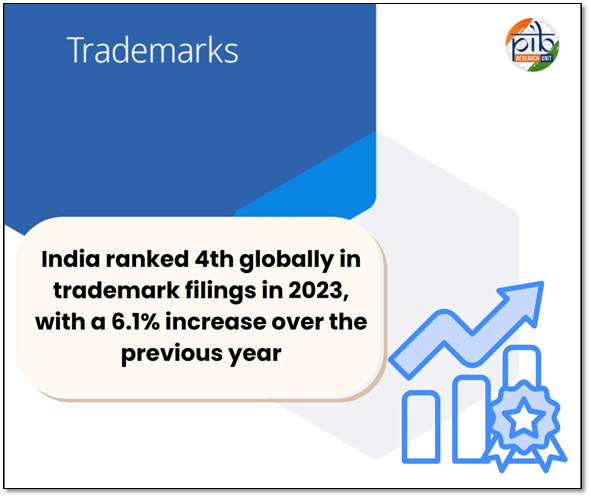
      India ranked 4th globally in trademark filings in 2023, with a 6.1% increase over the previous year. This growth underscores India’s growing emphasis on brand protection and intellectual property as essential drivers of business success. India’s ranking reflects the country’s increasing number of domestic and international businesses, all of which rely on trademarks to protect their brands and ensure consumer trust.
      Resident Filings Dominate:

      Nearly 90% of India’s trademark filings in 2023 were made by Indian residents, reflecting a strong domestic focus on brand protection. This shift suggests that Indian businesses, entrepreneurs, and startups are becoming more IP-savvy and are increasingly leveraging the trademark system to protect their innovations and brands.

      Active Trademark Registrations:

      India now holds the second-largest number of active trademark registrations in the world, with over 3.2 million trademarks in force. This indicates a highly active and competitive domestic marketplace, where businesses are not only creating new products but also working diligently to protect their brand identities. The large volume of active trademarks positions India as a major player in the global brand protection landscape, benefiting from both domestic innovation and the growing demand for Indian brands in international markets.

      Sectoral Trends:

      The largest proportion of trademark filings in India came from sectors such as Health (21.9%), Agriculture (15.3%), and Clothing (12.8%). These figures highlight India’s leadership in areas such as pharmaceuticals, food production, and fashion. As global demand for Indian products continues to rise, the importance of trademark filings as a tool for safeguarding brand equity becomes ever more critical, ensuring that Indian products and services maintain their competitive edge in international markets.

      India’s Position in Global IP Trends

      Contribution to Growth:

      India’s rising IP filings have been a significant part of the global trend of increased intellectual property activity. In 2023, a record 3.55 million patent applications were filed worldwide, with India contributing a meaningful share to this figure. As one of the fastest-growing markets in terms of IP filings, India is helping drive the global increase in innovation and IP protection, particularly in emerging markets.

      Shift Towards Local Innovation:

      The growth of resident filings in India—especially in patents and trademarks—demonstrates a shift towards local innovation. While global IP filings have traditionally been dominated by multinational corporations, India’s rising resident filings reflect a maturing domestic innovation ecosystem backed with the idea of Atmanirbhar Bharat campaign. More Indian companies and individuals are filing patents and trademarks, not just for protection, but as part of a strategy to strengthen their competitive advantage in both local and global markets.

      Government Initiatives Fuelling IP Growth

      National IP Policy:

      A key factor driving India’s growth in IP filings is the National Intellectual Property Rights (IPR) Policy, launched in 2016. This comprehensive framework is designed to guide the development and protection of intellectual property in India. The policy focuses on improving IP awareness, strengthening the IP ecosystem, and encouraging innovation by providing better access to IP services and protection mechanisms. By integrating all forms of intellectual property—such as patents, trademarks, industrial designs, copyrights, geographical indications, and more—the policy aims to foster a more robust and efficient IP environment. Objectives and activities undertaken under the National IPR Policy

      Amendments to IPR Laws: Improvements in procedural requirements to speed up the processing of applications.

      Modernization and Digitization of IP Offices: To enhance the performance and functioning of IP offices, streamlining workflows and reducing processing times.

      Awareness and Education: Programs such as the National Intellectual Property Awareness Mission (NIPAM) to spread IP awareness across educational institutions and businesses.

      IP Commercialization: Establishment of Technology Innovation Support Centres (TISC) in universities to support IP filings and the commercialization of patents and other IP.

      Scheme for Pedagogy & Research in IPRs for Holistic Education and Academia (SPRIHA), which aims to integrate IPR education into higher learning institutions across the country. Under the SPRIHA scheme, IPR Chairs have been established in various universities and academic institutions to facilitate specialized research, teaching, and training in intellectual property. These IPR Chairs provide a platform for faculty members and students to engage in cutting-edge research on intellectual property, its role in innovation, and its impact on industries and society.

      India’s vibrant start-up ecosystem is another key driver of the country’s growing IP activity. Government initiatives like Start-Up India, Digital India, Make in India and the Atal Innovation Mission, the Indian government has continuously fostered entrepreneurship, research, and technological advancement. Startup India was launched on January 16, 2016, with the goal of nurturing entrepreneurship, building a strong startup ecosystem, and transforming India into a nation of job creators rather than job seekers. This initiative includes a variety of programs designed to support emerging entrepreneurs. These efforts are coordinated by the Startup India Team, which reports to the Department for Promotion of Industry and Internal Trade (DPIIT). As of September 30, 2024, DPIIT has officially recognized 1,49,414 entities as startups.

      Atal Innovation Mission (AIM), established in 2016, is a flagship initiative of the Government of India to promote a culture of innovation and entrepreneurship across the country. AIM adopts a comprehensive approach to foster problem-solving and innovative thinking in schools, while also creating an entrepreneurial ecosystem in universities, research institutions, and the private and MSME sectors. Till date, AIM has established 10,000 Atal Tinkering Labs in Schools across the country, more than 3500 startups are incubated at Atal Incubation Centres and have created more than 32000 jobs in the ecosystem

      India as a Global Innovation Powerhouse

      India’s remarkable progress in the 2024 WIPO Report highlights its role as a rising global leader in intellectual property. With significant growth in patents, trademarks, and industrial designs, India is becoming a hub of global innovation. Its increasing number of resident filings demonstrates a shift toward homegrown creativity and invention, supported by an innovation-friendly ecosystem and government policies.
      Looking ahead, India is poised to continue its upward trajectory in global IP rankings. The country’s diverse and rapidly growing economy, coupled with its focus on research and development, makes it well-positioned to maintain its strong position in the global IP landscape. As more Indian companies and creators protect their innovations, India's global role in intellectual property will continue to expand.

      Reference:

      https://pib.gov.in/PressReleasePage.aspx?PRID=2072706

      https://www.meity.gov.in/writereaddata/files/National_IPR_Policy.pdf

      https://copyright.gov.in/Documents/SPRIHA.pdf

      https://www.wipo.int/edocs/pubdocs/en/wipo-pub-941-2024-en-world-intellectual-property-indicators-2024.pdf

      https://pib.gov.in/PressReleasePage.aspx?PRID=1941489

      https://pib.gov.in/PressNoteDetails.aspx?NoteId=153223&ModuleId=3&reg=3&lang=1

      Click here to see PDF. 

      Topics

      ActsIncome Tax

